Remembering Josephine Baker
(Sunday, June 3, 1906 – Saturday, April 12, 1975)
Lineage, Origins, and Formation: A Foundational Black American performer, singer, dancer, actor, Civil Rights advocate, wartime resistance figure, French citizen, and one of the most internationally recognized entertainers of the twentieth century
Born on Sunday, June 3, 1906, in St. Louis, Missouri, Freda Josephine McDonald came up through poverty, early work, street performance, Vaudeville, and the disciplined invention of a young girl who learned how to turn survival into stagecraft. After early work with touring troupes, she entered New York’s Black performance world during the Harlem Renaissance era, appearing in “Shuffle Along,” “The Chocolate Dandies,” and club work before Europe opened the door that Jim Crow America kept trying to close. By the time she arrived in Paris with “La Revue Nègre” in 1925, Josephine Baker had already learned how to command attention and Paris gave that command a much larger stage.
Baker became one of the defining international performers of the Jazz Age, reshaping the image of the modern entertainer through Dance, Comedy, Sensuality, Music, costume, film, and complete command of the stage. Her rise through the Folies-Bergère made her a sensation, while recordings such as “J’ai Deux Amours” helped make her a beloved French music-hall figure. Her film work also carried historical weight: “Siren of the Tropics” is widely recognized as one of the earliest major motion pictures to star a Black American woman, and “Zouzou” and “Princesse Tam Tam” extended her image beyond the stage.
Baker’s legacy cannot be reduced to glamour. During World War II, she used her fame, mobility, and access to aid the French Resistance, including carrying intelligence in ways that could pass unnoticed inside the world of performance. France later honored her with the Croix de Guerre, the Légion d’honneur, and recognition connected to the Résistance, placing her in history not only as a performer but as a decorated wartime figure. After the war, she refused to perform for segregated audiences in the United States, challenged racism publicly, supported Civil Rights organizing, appeared at the 1963 March on Washington, and was honored by the NAACP with Josephine Baker Day.
On Saturday, April 12, 1975, Josephine Baker passed in Paris, France, at age 68 after suffering a cerebral hemorrhage shortly after opening “Joséphine à Bobino 1975,” a retrospective celebrating fifty years in show business. She received French military honors, and although France later honored her in the Panthéon in 2021, her remains stayed in Monaco. Her life holds an unusual archive: St. Louis poverty, New York chorus lines, Parisian fame, military courage, Civil Rights conviction, the children she called her “Rainbow Tribe,” and a permanent challenge to any culture that wanted her image while denying her humanity. Josephine Baker remains one of the rare artists whose legacy cannot fit inside one category: she was a stage revolution, a wartime asset, a Civil Rights activist, and a Black woman who traversed the world to make room for the fullness of her freedom.
Photo: Josephine Baker, Paris, circa 1949, Van Vechten photograph collection (Library of Congress)
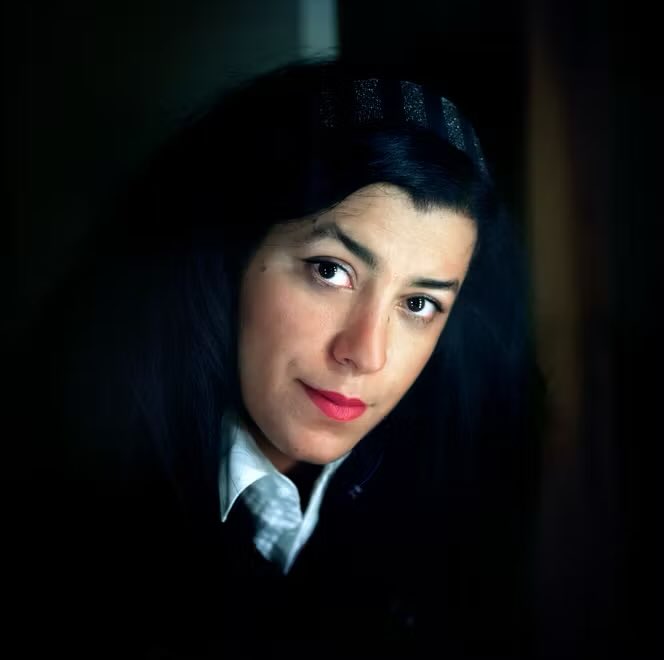
Remembering the brilliant Marjane Satrapi, the extraordinary artist and filmmaker behind Persepolis.
Through this deeply personal and powerful film, she gave audiences a story of identity, freedom, exile and resistance that continues to resonate across the world.
Really really really hurts how Stormé DeLarverie is not mentioned enough in Black Lesbian History…the actual catalyst for the infamous Stonewall riot….
I’ll be doing my Black Lesbian History series on TikTok today :)
Happy Pride
In 1946, the world witnessed the brilliance of Valaida Snow, the woman Louis Armstrong called the "second best swing trumpet player in the world," second only to himself.
Long before mainstream history sidelined her contributions, she was shattering boundaries as an absolute powerhouse of the Swing Era. Known as the "Queen of the Trumpet," Valaida defied the era's strict gender barriers that labeled brass instruments as "masculine," out-blowing her male contemporaries while commanding stages across three continents.
Though her prime years spent headlining in Europe and the profound trauma of wartime imprisonment in Nazi-occupied Denmark nearly caused her legacy to be lost to time, this ultra-archival Soundie stands as undeniable proof of her multi-faceted musicality.
Capturing her performance of "Patience and Fortitude" alongside the Ali Baba Trio, makes this a rare window into the artistry of a woman who refused to be minimized within the Black American music history landscape, in the genre of Swing, that can’t be easily forgotten.
No mês LGBTQIA+ é importante lembrar de quando ele se apresentou usando uma saia e uma blusa com a frase: "Mataram a Alexa, não um homem de saia".
Alexa era uma MULHER transgênero que foi brutalmente assassinada em Porto Rico, mas a mídia local insistia em invalidar sua identidade, noticiando o caso como se ela fosse um "homem de saia". Com esse protesto, a mensagem do Bad Bunny foi bem clara: "homem de saia" é ele próprio, que é apenas um homem cisgênero vestindo uma peça de roupa, totalmente diferente de uma mulher trans.
desde o começo ele foi acolhido por pessoas da comunidade, e exatamente por isso ele as respeita e admira tão bem quanto fazem com ele🥹
Whoopsie: Jared Kushner & Ivanka Trump are taking over protected Albanian land in a $1.4 billion project to build luxury resorts and an Israeli-linked development.
The Albanian prime minister changed the law to make it happen. Now his house is burning.
The Trump's don't know how hated they really are.
Tonight, Shaggy spoke at the Brooklyn Public Library.
The best part was while he was on stage, they played a video of him singing dancehall at a Brooklyn nightclub before he got really big. He was all emotional, looking back. Man the 90s. What a TIME🥹❤️
— stormé delarverie, a black butch lesbian, drag king, civil rights activist & an important figure in lgbtq+ history. her life & style served as a major touchstone for the nonbinary & genderfluid communities. she was the catalyst behind the stonewall riots in 1969. 👩🏾❤️👩🏽🏳️🌈