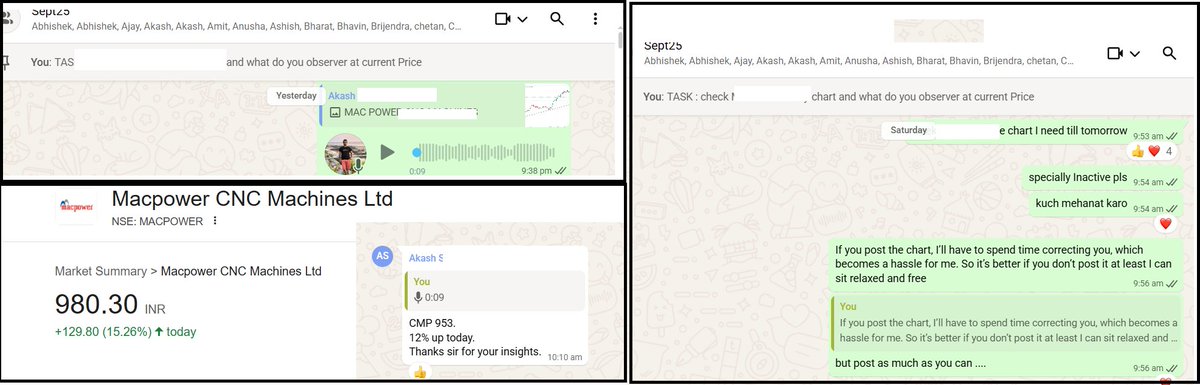
Don’t judge a #MENTORSHIP program by contents or fees many things are freely available what matters is Guidance.
Judge it by the trainer’s Involvement and Commitment.
Task given on weekend
Active learners shared RICOAUTO & MACPOWER—both up 15% today and some other stocks were 3-4% up ,Quality guidance shows in results
Register :https://t.co/Hz1aQIBROa
@kitsharma@SEBI_India@NSEIndia@PMOIndia Everyone should have right to equal opportunity. Its retailers choice weather he wants to take risk or not. Now NSE has taken that choice.
Otherwise rich will become more richer.
NSE has put new rule of caping SME listing to max 90%. Though their intensions must have been right but it puts retailers at disadvantage.
All stock will be taken by parties with direct line and spillover will come to retailers after 10 days.
I strongly oppose this rule.
@adeshjainj I also feel, this rule is bad for investor. It was previously there on BSE but listing on BSE was less so not considered as big problem. But now this new rule will hurt small retailers most.
Open Letter to NSE, BSE, SEBI, and the Finance Minister
Subject: Concerns Over the 90% Cap on SME IPO Pre-Open Sessions Both NSE & BSE
Dear NSE, BSE, SEBI, and Honorable Finance Minister,
I am writing to express my grave concerns regarding the newly implemented 90% cap over the issue price for SME IPOs during the pre-open session. While I understand the intent behind this regulation is to control excessive price volatility, I believe it has several unintended consequences that disproportionately disadvantage retail investors and favor a select group of large operators and bulk buyers. Here are my key points of concern:
1⃣ Inadequate Price Discovery: The 90% cap significantly hinders the natural price discovery process. Price discovery is a fundamental aspect of a fair and transparent market. By limiting the potential price movement, the true market value of a stock based on demand and supply is not realized, which distorts the market and misleads investors about the stock's actual worth.
2⃣Unfair Profits for Operators and Bulk Buyers: Since operators hoard large amounts of shares in the initial days, the day they decide to sell, often at 50-100% higher prices, retail investors are forced to buy at these inflated prices. This scenario means that these operators benefit from the cheapest shares due to their undue advantage, while retail investors are left paying significantly higher prices.
3⃣Challenges in IPO Allotment for Retail Investors: Retail investors already face immense challenges in securing IPO allotments due to the high subscription rates, often exceeding 500 or even 1000 times the offer. This means only a fraction, roughly 1 in 1000 retail investors, receive an allotment. Given that retailers are often the ones who sell their shares on the first and second trading days to realize profits, limiting the price increase caps their potential earnings, further discouraging their participation in the market.
4⃣Unfair Advantage to High-Frequency Traders: The 90% cap benefits bulk buyers and operators with advanced trading technologies and direct NSE lines. These entities can place orders instantly at the opening bell, often within milliseconds, while retail investors, due to latency and slower internet connections, miss out. This was evident in cases like the Nephrocare IPO, where despite a 250% GMP, it listed at a 90% cap and bulk quantities were absorbed by these players, leaving retail investors with 0 opportunity to benefit entire 449600 shares was absorbed by bulk deals which gives them a guarantee to double their money without any risk.
5⃣Locked-In Capital and Opportunity Costs: Retail investors must keep significant amounts of capital in their brokerage accounts to place orders every day, especially when shares hit the upper circuit repeatedly for several days or even weeks. This locked-in capital earns no interest and limits their ability to participate in future IPOs or other investment opportunities, resulting in a loss of potential income and financial flexibility.
6⃣Discouragement of Retail Participation: The perceived favoritism towards large operators and the systemic disadvantages faced by retail investors could lead to reduced retail participation in the market. Retail investors form the backbone of a healthy and diverse market ecosystem. Their reduced involvement could diminish market liquidity and overall investor confidence.
7⃣Potential for Market Manipulation and Retail Traps: When these large operators sell their vast quantities of shares, the market can experience immediate lower circuits. Retail investors who purchase these shares at high prices may find themselves trapped with stocks that are plummeting due to the sudden volume offload by these entities. This not only leads to significant financial losses for retail investors but also erodes trust in the market.
8⃣Distortion of Market Behavior Due to Cap: Due to the 90% cap, regardless of whether the IPO is fundamentally good or bad, all investors will place orders at the 90% cap as soon as trading opens at 9:00 AM. This behavior, driven by the fear of missing out due to the first-come-first-serve execution, artificially inflates prices, negating genuine price discovery and resulting in an artificially high initial trading price.
Suggested Solutions:
1⃣ Minimum Holding Period for Bulk Buyers: Implement a minimum holding period for large operators and bulk buyers who acquire significant quantities of shares. This would prevent them from offloading large volumes immediately and causing market disruption.
2⃣Improved Access to Technology for Retail Investors: Invest in improving the technology infrastructure available to retail investors, including faster access to trading platforms and lower latency connections. This could involve partnerships with brokerage firms to provide better tools and resources for retail traders, ensuring a level playing field.
3⃣Capping the Number of Shares per PAN or Demat Account: During the initial trading days, cap the maximum number of shares that any single investor can buy or sell. This would prevent large players from dominating the market and ensure a more equitable distribution of shares.
4⃣Regulatory Oversight and Penalties: Increase regulatory oversight to monitor and penalize any manipulative practices by large operators. Ensure that any breaches of fair trading practices are met with strict penalties to maintain market integrity.
5⃣Lottery System for Order Execution: Instead of the first-come-first-serve order system on the listing day, introduce a lottery system where orders are randomly executed based on the number of sellers and buyers. This would ensure that both retail investors and operators get an equal opportunity to buy shares, mitigating the advantages of advanced trading technology.
6⃣Staggered Selling Limits for Bulk Buyers: Implement selling limits for bulk buyers, such as allowing only 25% of their holdings to be sold by day 10, another 25% by day 20, and the remaining 50% after day 30. This would reduce market manipulation and prevent inflated prices due to large offloads.
Please note, we are not against the 90% capping, we just want a fair playing field between the biggies and retailer/general investors. While these are just some suggessions that a common man could think of I am sure if this is taken up internally your team can come up with much better solutions for the above concerns.
We urge the NSE, BSE, SEBI, and the Finance Ministry to reconsider this regulation and explore alternative measures to curb volatility that do not disproportionately disadvantage retail investors. A balanced approach considering the interests of all market participants will foster a more equitable and vibrant stock market in India.
Thank you for your attention to this critical matter.
Retweet for maximum reach and tag the Finance Minister and others so that it reaches them.
@NSEIndia@BSEIndia@FinMinIndia@nsitharaman@nsitharamanoffc@ashishchauhan@SameerPatil2019@varungupta2412@cafemutual@JKetan5