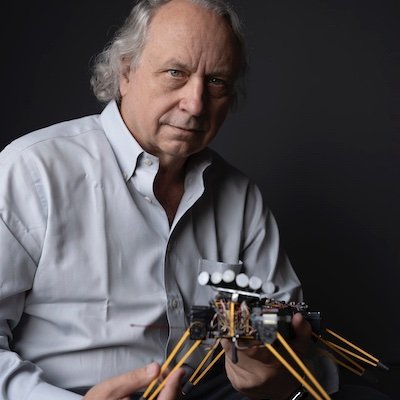
Discussing computer designed organisms (AKA "Xenobots") with CNN anchor @FWhitfield.
Joint work with @drmichaellevin, Douglas Blackiston and @Kriegmerica.
https://t.co/nr6YSDokkS
🚨 Personal news!
2000 years ago, Rome figured out a key idea Silicon Valley still hasn't.
Arenas can train - and monetize - the best embodied intelligences.
We're building embodied agents the same way.
Introducing Colosseums AI.
I find this amusing. It makes it sound like the past 30 years of websites and apps have been completely bug free, stable, fast, efficient, and secure because they were written by humans.
Honestly, the worst code I’ve seen has been human written.
There is a new kind of robotics called "Vibe Robotics"
It's when you ask agents for fully functioning embodied agents (both hardware and software) that must solve a given task in physically grounded environments.
We build an evaluation to test how good agents (frontier models) are at "Vibe Robotics".
Website: https://t.co/tyoD1gdWQ8
AI-doomerism is dangerous like a nuke.
In contrast to intangible doom speculations, the risks of an AI slowdown are very tangible and very certain.
Almost 200,000 people die worldwide EVERY WEEK from cancer. If you accept that in ten years, advanced AI could find cures to just half of those cases, then in 10 years we would be saving 100,000 lives per week.
Asking for a slowdown sounds prudent, but it is exactly akin to postponing half of those potential cures for the duration of the slowdown, essentially letting 50,000 people die per week while we wait.
That’s equivalent to detonating a Hiroshima-scale nuclear bomb every month, while we ponder the ethics of AI.
Unlike p(doom) speculation, the loss from slowing down AI is certain. And that’s just cancer. And that’s not even factoring the rest of the agony that deaths bestow on families and communities.
We already made that mistake before. Driverless cars, which are now confirmed to be 8x safer than human drivers per mile, were delayed for years due to self-proclaimed AI-ethicists who scared us about the ethical dilemmas of autonomous driving (which never happened).
We are paying the price for that unnecessary delay every day, as 23,000 people die every week from human-driven cars, while we struggle to deploy the already-proven solution.
The list goes on. Parkinson. Alzheimer. Drug addiction. Pesticides. Pollution. Every week we delay AI, we postpone those certain benefits at the expense of unsuspecting, voiceless future victims.
If you like philosophy, AI is the ultimate lever in the proverbial Trolley Problem.
So what do I suggest? First, let’s replace abstract doomerism with concrete risks and mitigation strategies. Every tangible risk has a technical solution (probably using AI), and we need to address it asap. We will make some mistakes, but we will learn and prevail.
At the same time, let’s forge full steam ahead. We humans have earned this privilege, as we successfully navigated past technological risks such as nuclear and genomics, to name a few.
This is just the beginning: As AI enters the physical world in the next decade, the stakes will be higher. We must arrive prepared and experienced. We must co-evolve with AI.
Can complex multi-step reasoning emerge purely from cells that only talk to immediate neighbors?
Happy to share our paper “Reasoning with Neural Cellular Automata (NCA)”, from our team at Google, Paradigms of Intelligence 🧵👇
With respect, I disagree.
Intelligence = avoid pleaure; attain pleasure.
More intelligence = I know that if I do this, I'll avoid...
More intelligence yet = I know that you know that if I do this...
Yet more = I know that you know that if I do this...
Consciousness' ratchet.
A new evolutionary theory published September 1, 2026 suggests that intelligence and consciousness are not the same thing, and they did not evolve for the same reason. It explains why AI is now smarter than humans but still isn’t conscious yet.
Jeff Stibel, a cognitive scientist, argues that intelligence and consciousness arose under different evolutionary pressures. Intelligence helped organisms navigate uncertainty. The regulatory processes behind consciousness helped them protect themselves and manage competing needs.
According to Stibel, intelligence is outward-facing: it models the world, predicts, plans, and solves problems. Consciousness evolved for something more internal: holding a fragile organism together when survival is on the line.
Imagine a hungry animal finding food near a possible predator. It must weigh feeding against danger. A decision to retreat involves coordinated changes in attention, bodily readiness, movement, and learning. Stibel identifies consciousness with this coordinated state, a system whose continued existence depends on its own self-regulation.
That is what today’s AI lacks: no biological boundaries, no self to protect, no real survival stakes.
Scaling models may make better predictors and problem-solvers. But under Stibel’s theory, that alone does not produce consciousness.
Simulated zebrafish and a vision-equipped robotic fish reveal how the body shapes brain circuits
by Xiangxiao Liu, Eva Aimable Naumann and Auke Ijspeert
https://t.co/MypDjHs6f0
Can a bacterial collective perceive the physiological state of another life form?
Fascinating new preprint shows motile B. subtilis dynamically tracks and decodes Xenopus embryos vs. Xenobots—reorganizing into spatial patterns via potassium signaling to report the presence, position, and biological identity of nearby biota.
Morphogenesis as a distributed sensor across kingdoms.
Brilliant work by @drmichaellevin@DoctorJosh & team!
🔗 https://t.co/NEhhCir2Be
#CollectiveIntelligence #Bioelectricity #Xenobots #Morphogenesis #SyntheticBiology #EmbodiedCognition #ActiveInference #PatternFormation #Biology
Here it is - the official, revised, peer-reviewed version of my Platonic Space paper. https://t.co/PXNpx5FgFN Of all the many unpopular positions I’ve taken over the decades - bitter controversies around the origin of left-right asymmetry in embryogenesis, bioelectricity and genetics, diverse intelligence, etc., this one has by far generated the most pushback: serious (grateful for those!) and energetic attempts to move me to other views, pleas to just drop it and not talk about it (for several different reasons), nasty emails and accusations, impacts on reviews of papers that have nothing to do with this, etc. Kind of amazing to me how incendiary this is. What can I say... Our job is to call it as we see it, and right now for me, this is it. Apologies to collaborators and colleagues for any shrapnel! Time will tell if this pans out or not; I've placed my bets. And btw, if you think this stuff is weird and uncomfortable, just wait… There’s much more on the way. The knob turns slowly but as long as the data keep coming, I'm going to say what I think it all means and follow it to the next steps it enables. Buckle up!
For those interested in emergent/synergistic interactions, we've got a three-way, synergistic interaction between: individuals, environments, and collective pattern-formation - and that's just one aspect of a really cool, really rich paper!