Pearl is the first money produced by AI and secured by AI.
Every GPU cycle that serves an AI model can mint $PRL at the same time, for little to no extra cost.
This account documents @prlnet and the rise of the 2-for-1 kernel economy. Start here ↓
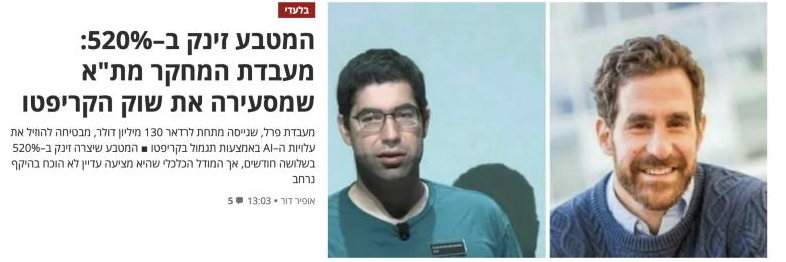
Pearl Research Labs @prlnet made the front page of @TheMarker, the reputed Israeli business daily, on Oct 25.
In an exclusive, Ofir Dor @doritsos reports that the Tel Aviv lab raised $130M without announcing it. Pearl hasn’t announced a funding round on its own channels.
The piece covers Pearl’s pitch: cut the cost of AI by paying for inference compute in pearl-2:native. Its caveat is that the economics haven’t yet been proven at scale.
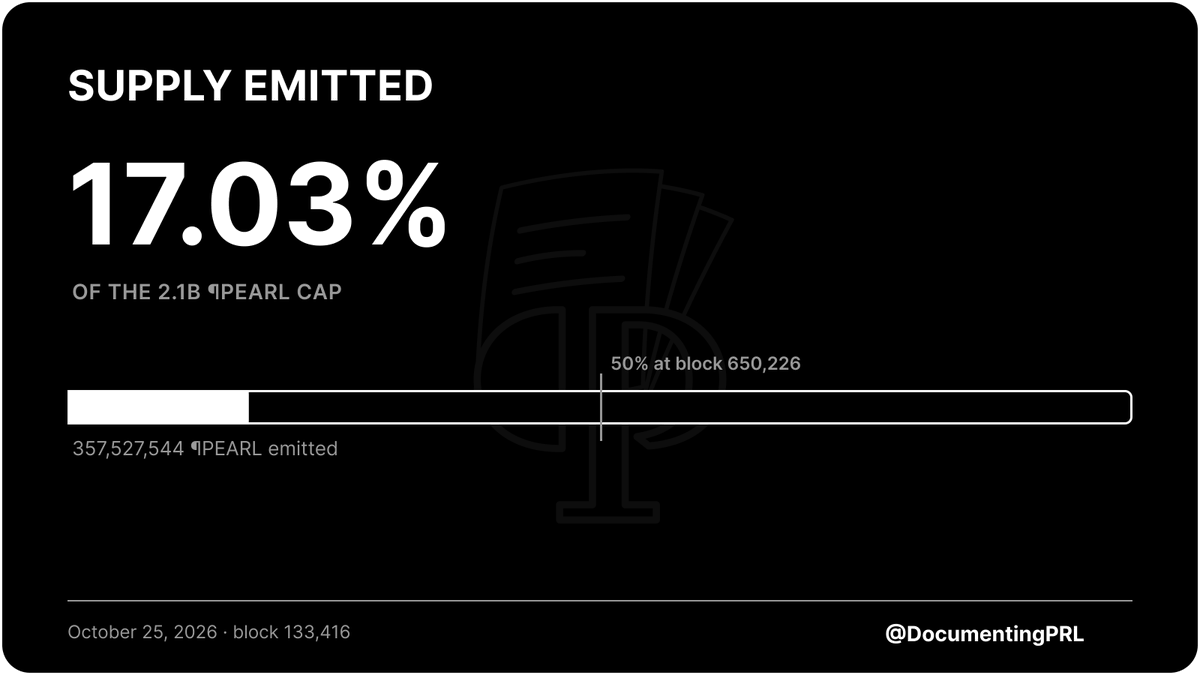
pearl-2:native 's supply passed 17% of its 2.1B cap at block 133,179 on Oct 25, two days before the network turns six months old.
By the emission formula, half the cap is mined at block 650,226, about 517,000 blocks from here, or roughly 3.2 years at the 194-second block target.
Pearl Research Labs @prlnet published PearlQuant: a method for compressing the KV cache that LLM serving keeps in GPU memory.
On GLM-5.3 it stores 3.2 bits per value against 9.1 for the FP8 baseline, about 65% less, with no statistically significant difference on four benchmarks (RULER, LongBench v2, MMLU-Pro, LiveCodeBench).
On one 8×B200 node at 128 concurrent sessions it gave 1.8x FP8’s throughput and cut p90 time to first token from 144 s to 7 s. At light load, FP8 was about 5% faster.
New high for Pearl’s network hashrate: 85.62 EH/s.
The previous high was 79.15 EH/s on Oct 20.
pearl-2:native blocks averaged 138.5 seconds over the last 60, against the protocol’s 194-second target.
Difficulty sits at 42.7M, up 19% in a week (36.0M on Oct 15).
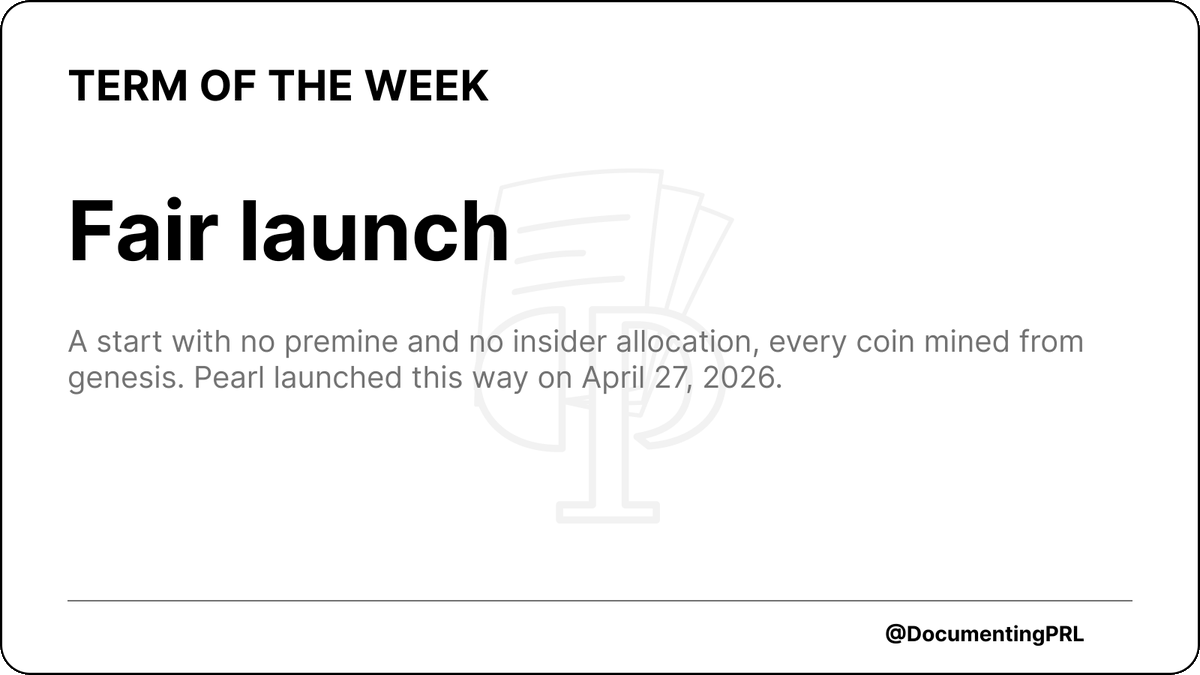
Every pearl-2:native in existence was mined from the genesis block on April 27, 2026. The team kept nothing back for itself and there was no private sale. That’s what a fair launch means.
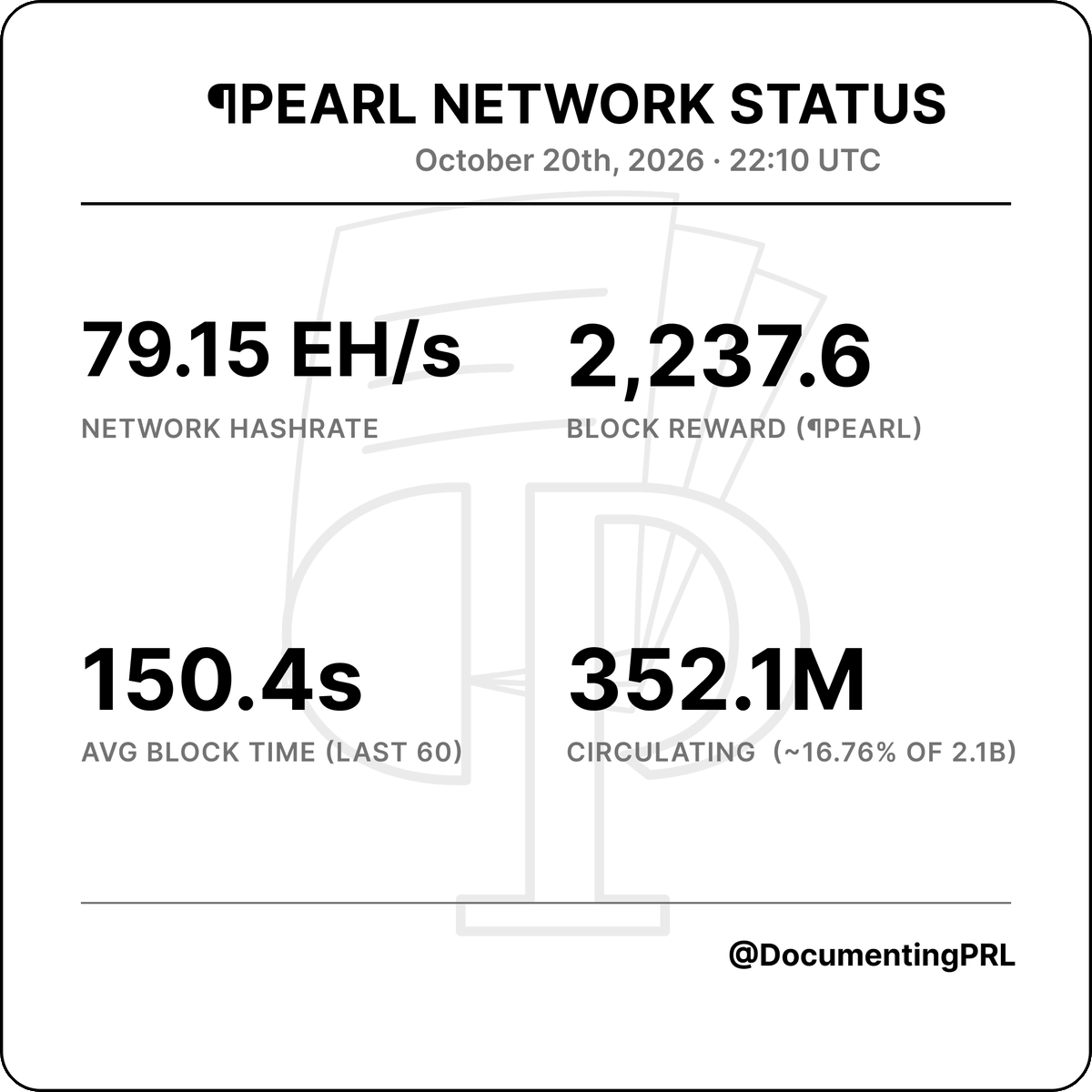
New high for Pearl’s network hashrate: 79.15 EH/s.
The previous high was 70.57 EH/s on Oct 18.
pearl-2:native blocks averaged 150.4 seconds over the last 60, against the protocol’s 194-second target.
Difficulty sits at 40.6M, up 17% in a week (34.7M on Oct 13) and 22% since Oct 3 (33.2M). It adjusts on a weighted average with a one-week half-life, so it trails a fast climb in hashrate.
Pearl node v1.5.2 is out (Oct 17), the third node release in five days.
It fixes how the node reads its UTXO cache: the gettxout RPC could read an entry after releasing the chain lock while a new block was changing it. The fix credits an outside researcher and Kryptex, the pool that found the most blocks this week. No fork height changed.
Pearl node v1.5.0 is out (Oct 13), a security release: hardening across P2P, RPC, SPV, the mempool and the wallet, for issues reported through GitHub security advisories.
Twelve researchers and Zellic are credited.
No fork height changed, and the FP8 pull request is still open.
Pearl node v1.5.1 is out (Oct 15), a consensus fix. A transaction could spend an output created by a later transaction in the same block.
Nodes now require parents before children inside a block, and re-check blocks that older versions had marked valid. No fork height changed. The PR credits the researcher who reported it.
Animation explaining Pearl’s Proof of Useful Work, in which matrix multiplications performed on GPUs for AI inference also generate verifiable work for network security and $PEARL issuance.
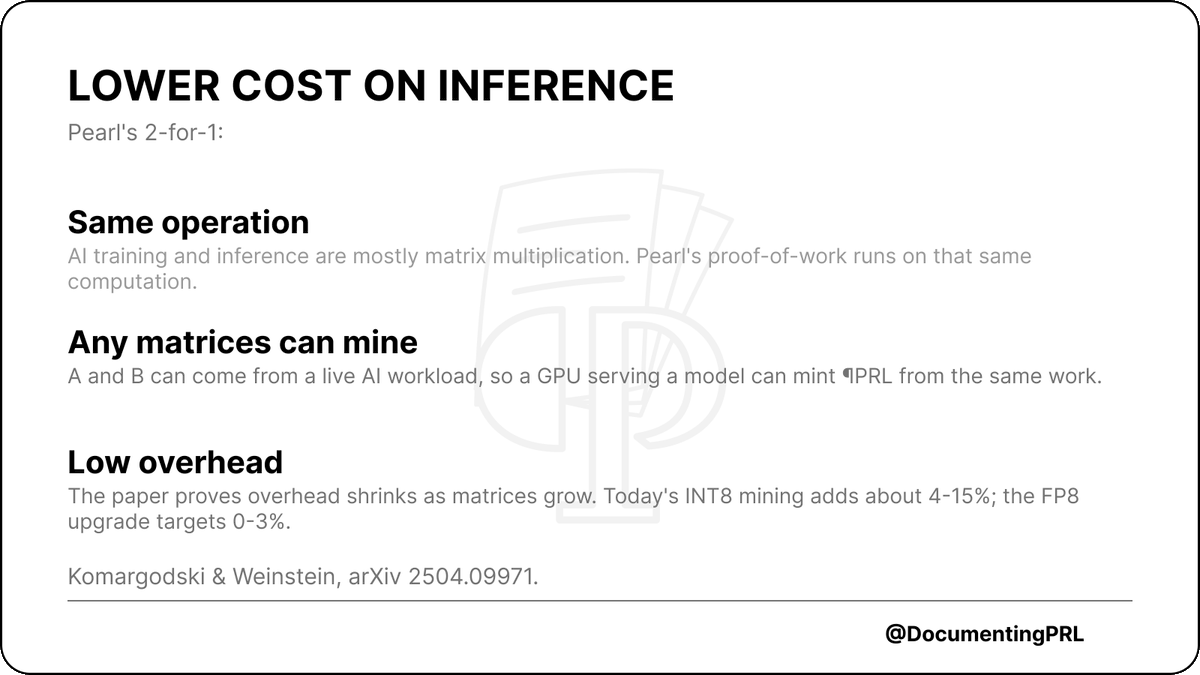
The math under Pearl's 2-for-1 comes from a 2025 paper by Ilan Komargodski and Omri Weinstein: proof of work on arbitrary matrix multiplication.
The miner picks both matrices, so they can come from a model the GPU is already serving. The paper proves the extra cost shrinks as the matrices grow. Today's INT8 mining adds about 4-15% depending on workload, and the FP8 upgrade targets 0-3%.
The operation that runs AI can also mint $PRL.
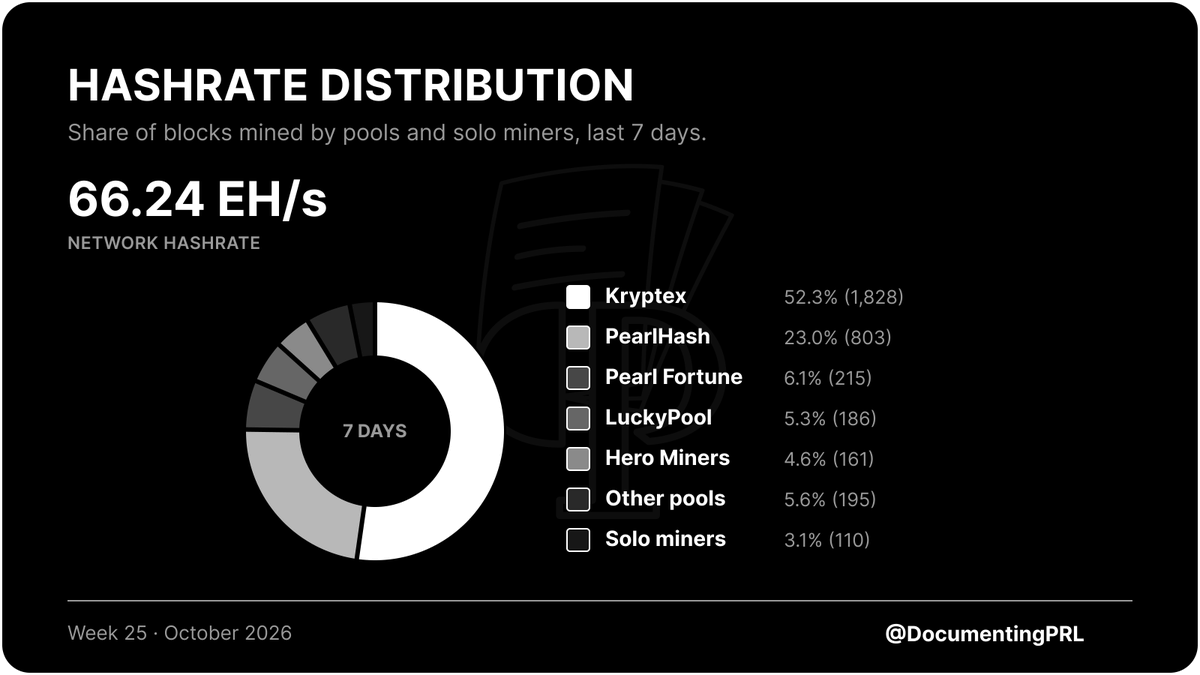
Since Oct 1, one pool, @KryptexMining, has mined more than half of Pearl’s pearl-2:native blocks in every daily 24h snapshot but one (48% on Oct 2). On Oct 16: 258 of 487 blocks, 53%.
A pool groups many independent miners, so the share shows who assembles blocks. It says nothing about who owns the GPUs. Pearl @prlnet has no official pool.
On Oct 14 the second-largest pool, PearlHash, cut its fee to 0% and asked miners to spread their hashrate.
Pearl’s supply should cross 17% of its 2.1B cap around Oct 25-26, a day or two before the network turns six months old.
Emission is set by block height, and blocks have been arriving faster than the 194-second target: hashrate is up 94% in 30 days, and difficulty adjusts on a weighted average with a one-week half-life, so it lags a fast climb.
Half the cap is reached at block 650,226, whenever that comes.
Pearl’s supply should cross 17% of its 2.1B cap around Oct 25-26, a day or two before the network turns six months old.
Emission is set by block height, and blocks have been arriving faster than the 194-second target: hashrate is up 94% in 30 days, and difficulty adjusts on a weighted average with a one-week half-life, so it lags a fast climb.
Half the cap is reached at block 650,226, whenever that comes.
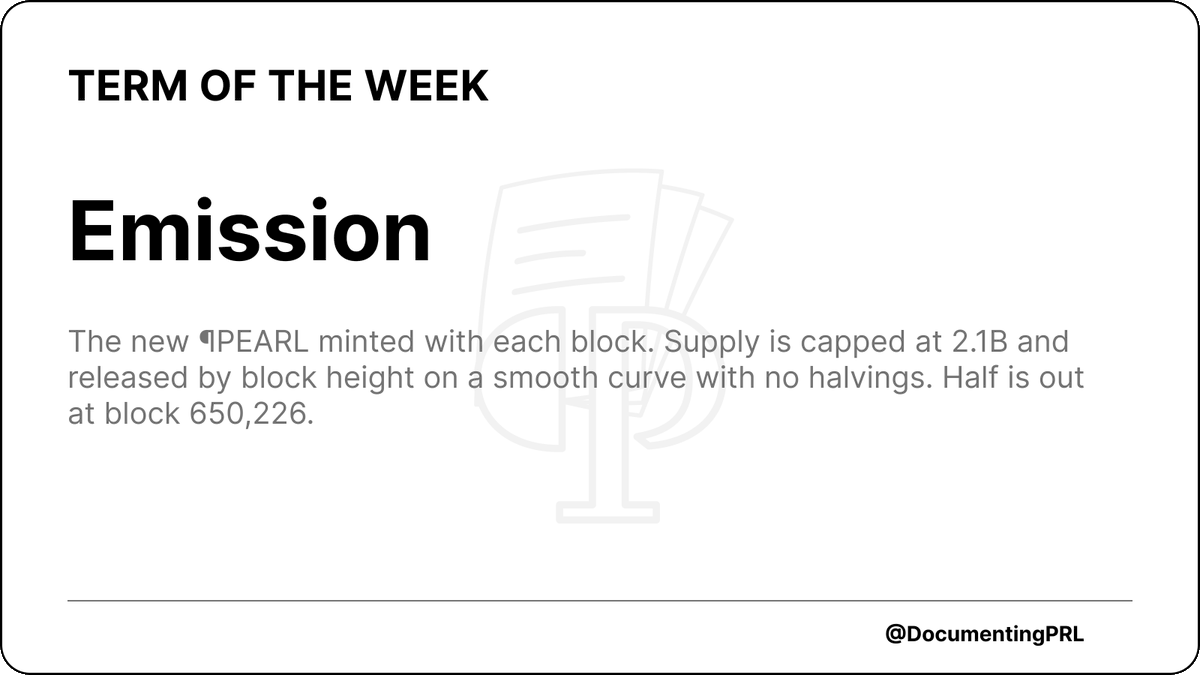
Emission is the fresh $PRL minted with each block.
The total is capped at 2.1 billion and released by block height on a smooth curve with no halvings: half is out at block 650,226, about 4 years of blocks at the 194-second target.