“Vergi Veren Enayi Mi?”
Parasını Türkiye'de nasıl kazandığı belli olmayıp Mann Adasına taşıyanlara da gün doğmuş olabilir mi?
“Türkiye’de üret, Türkiye’de kazan, sonra parayı dışarı taşı…
Ardından ‘yabancı yatırımcı’ gibi geri dön, 20 yıl vergi avantajı al…”
Olur mu bu?
Milletin aklına gelen soru tam da bu.
Bu ülkede yıllardır vergi veren esnaf var.
Maaşından otomatik vergi kesilen çalışan var.
Elektrik faturasında bile çeşitli vergiler ödeyen halk var.
Şimdi ne oluyor?
Bazıları şirketini Dubai’ye, Malta’ya, Man Adası’na taşıyıp sonra “uluslararası yatırımcı” kimliğiyle geri mi dönecek?
Ama Türkiye’de kazanılan para kâğıt üzerinde dışarı kaçırılıp sonra vergisiz şekilde geri dönüyorsa, burada büyük bir adaletsizlik doğar.
Asıl soru şu:
Vergisini düzenli ödeyen vatandaş mı cezalandırılacak, yoksa sistemi dolaşmayı bilen büyük sermaye mi ödüllendirilecek?
Türkiye'deki bazı büyük sermaye grupları;
Paralarını dışarı çıkarır.
Faaliyetlerini dışarıdaki şirketler üzerinden yapılandırır.
Sonra "uluslararası yatırımcı" görünümüyle geri gelir.
Daha düşük vergi yüküyle çalışır.
Düşünsene:
Türkiye'de 20 yıldır vergi veren bir esnaf %25 kurumlar vergisi ödüyor.
Türkiye'de çalışan bir mühendis gelir vergisi ödüyor.
Türkiye'de fabrika kuran bir sanayici vergi ödüyor.
Ama dışarıdan gelen bir sermaye sahibi bazı gelirlerinde çok daha avantajlı hale geliyor.
The crypto market may be entering the final major bull cycle in its history.
And what people still fail to understand is this:
This market cannot sustain 50 million “promising tokens” forever.
At some point, the bubble will burst.
Liquidity will shrink.
Regulations will tighten.
CBDCs, stablecoin laws, digital identity systems, and global financial filters will take over the landscape.
And when that moment arrives, only systems with real purpose, infrastructure, community, utility culture, and verified human networks will survive.
The remaining millions of tokens will disappear because they were built only on:
• charts,
• influencer hype,
• empty promises,
• artificial volume,
• and “price ” culture.
Because the next era is no longer just about “coins.”
It is about:
• trust infrastructure,
• digital identity,
• data sovereignty,
• human verification,
• community economies,
• mobile accessibility,
• and real-world integration.
People are still arguing about which coin will pump next.
The real question should be:
“Which digital economic models can survive inside the new financial order?”
Because the future will not belong to those who shout the loudest.
It will belong to those who build the most trust.
And yes…
Deep down, everyone already knows which projects among those 50 million are destined to disappear.
But there are also a few networks that people still mistake as “just another coin.”
While in reality, some systems are quietly:
• building human infrastructure,
• forming global communities,
• solving digital identity problems,
• creating trust layers,
• and preparing the economic social networks of the future.
That is the detail most people completely miss.
The winners of the new era will not simply build technology.
They will organize humanity itself.
Not financial or advertising advice.
Why Are Accounts Posting About Pi Growing So Fast? And What Does This Contribute to Pi and the Pi Ecosystem?
Because this is not an ordinary community.
This is a network where millions of real people have spent years researching, building, producing, and growing an ecosystem together.
Today, someone who creates quality content about Pi Network instantly enters the attention flow of one of the world’s most active and loyal digital communities.
And people are slowly realizing something:
Projects built only on manipulation, hype, and empty speculation may attract short-term attention.
But systems that build ecosystems, develop applications, and create real user networks generate a much stronger and more long-term community impact.
This is exactly where Pi stands out.
That’s why quality Pi content:
• Gets more engagement
• Gets reposted more often
• Creates more discussion
• Reaches more people
Because people are no longer only asking:
“Which coin will pump quickly?”
They are starting to ask:
“Which system is actually working?”
And as the Pi ecosystem grows:
• More developers join
• More applications emerge
• More real use cases are created
• More commerce happens through the network
• More people become part of the ecosystem
As a result, while content creators gain visibility, the community grows at the same time.
As the community grows, the ecosystem becomes stronger.
And as the ecosystem becomes stronger, everyone contributes to each other’s growth.
In many projects, the community only watches.
Here, the community itself becomes the force building the system.
And people forget one thing:
The biggest transformations in history started with small shares.
One video.
One post.
One idea.
One community.
Today, people talking about Pi may not simply be creating content.
They may actually be writing the early story of the future digital economy.
That’s why some accounts, after posting about Pi, are not just getting engagement…
they are being pulled into a massive global community.
Because strong communities do not only grow projects.
They grow people too. 🟣
#PiNetwork #Web3 #Blockchain #DigitalEconomy #Community #Crypto
This is not an advertisement or investment advice.
BLOKZİNCİRE 400 TRİLYON DOLAR TAŞINMAK ÜZERE!
Larry Fink az önce finans dünyasındaki en kritik açıklamayı yaptı:
"Her bir finansal varlığı ne kadar hızlı tokenlaştıracağımızı (dijital varlığa dönüştüreceğimizi) tartışmaya henüz yeterince zaman ayırmadık."
Sadece bazı varlıklardan bahsetmiyor. TÜM varlıklardan bahsediyor. Bu süreç gelecekte olacak bir şey değil, aksine çok hızlı gerçekleşiyor.
BlackRock'ın yönettiği varlıklar:
11.500.000.000.000 ($11.5 Trilyon)
Küresel ETF (Borsa Yatırım Fonu) piyasası:
15.000.000.000.000 ($15 Trilyon)
Küresel gayrimenkul/varlık piyasası:
400.000.000.000.000 ($400 Trilyon)
Hepsi... Blokzincir altyapısına taşınmak üzere...
Finans tarihindeki en büyük sermaye göçü başlıyor!
🔥🔥👉 IF SUCCESSFUL… PI COULD BECOME ONE OF THE LARGEST WEB3 IDENTITY SYSTEMS IN THE WORLD 😎🚀
PART 2
▸ Do not look at Pi through the eyes of a crypto trader, but look at it through the eyes of a tech investor 🧠.
▸ Anyone who recognizes this identity layer can see how massive the ultimate goal of Pi is, which goes far beyond how many dollars a single coin is worth 📈.
▸ If large corporations and companies are willing to spend money to rent Pi's KYC system to verify users for them, the landscape of the internet and Pi's position will change rapidly
🌍. At that point, the story is no
longer about mining free coins, but a massive explosion in terms of both economy and technology 💥:
1. Pi Network transforms into a tech goose that lays golden eggs 🦢💰
▸ Current KYC services on the market are very expensive. For every successful document verification and facial scan, applications have to pay from a few dozen cents to a few dollars to security companies 💸.
• If corporations rent Pi ▸ They will have to pay a service fee. This fee will highly likely be charged in Pi, or converted to Pi to maintain the system ⚙️.
• Result ▸ The actual demand to buy and own Pi from businesses (B2B) will skyrocket ▸ Creating a real cash flow into the ecosystem instead of just waiting for users to buy and sell among themselves 📊.
2. Pi Coin has a sustainable core value 💎
▸ In the crypto world, people are most afraid of coins without utility, meaning they are born only for speculation and dumping 📉.
• When Pi's KYC system is commercialized for companies outside the ecosystem ▸ Pi coin will have a very solid foundation of value 🛡️.
• The value of Pi at this time is anchored by the very cost that businesses are willing to pay ▸ To buy convenience and security from Pi's network of real people 🤝.
3. The Soft Lock strategy and the boost from the AI era 🤖
▸ Look at how Apple built their ecosystem to see how precise Pi's move is. People initially just bought an iPhone, then gradually got drawn into iCloud, AirPods, Apple Pay, then Apple ID... until they could no longer leave that ecosystem 🍏.
• The Soft Lock mechanism ▸ Pi is the same, starting from identity verification (KYC), they lead users deep into the wallet (Pi Wallet), the browser (Pi Browser), then progress to daily payment utilities that sometimes users themselves do not even realize they are sinking deep into the Pi ecosystem 🕸️.
• The AI boost ▸ In an era where AI technology generates too many fake accounts and Deepfakes are popping up everywhere ▸ An ecosystem that gathers tens of millions of real people, real verification, retained by such a closed loop, is the ultimate weapon that no other network possesses ⚔️.
4. The appearance of Login with Pi super-apps 📲
▸ This vision is exactly like how people use Google or Facebook to log in nowadays ✨.
• You go to open a digital bank account, register for a stock trading platform, or even create a Web3 game account...
▸ Instead of being forced to take photos of your ID, scan your camera back and forth exhaustingly, you just need to click the button Login with Pi 🔘.
• In just three notes, Pi will confirm with that app ▸ This person has been thoroughly checked by us, they are a real person with legal documents, let them through ▸ Users are spared the hassle while companies are also completely stress-free, saving a ton of time and onboarding costs ⚡
5. Pi steps onto the podium of legal compliance ⚖️
▸ When multinational corporations and Fintech companies accept using Pi's KYC ▸ It means they have acknowledged Pi's algorithms, AI systems, and human validation network (Validators) as legal and meeting international safety standards 🌍.
• This helps Pi crush all legal doubts from the governments of various countries 🛡️.
• From a project infamous for calling people to mine endlessly
▸ Pi officially becomes a standard Trust Infrastructure for the internet 🏛️.
6. Huge income for Pi Validators 💸
▸ Pi's KYC system operates thanks to the combination of AI and Pioneers who perform cross-checking tasks (Validators) 👥.
• If external companies flock to rent this system ▸ The number of KYC requests will be countless and run continuously every day 📨.
• Those Pioneers working as Validators will have steady jobs ▸ Receiving an abundant amount of reward fees in Pi. It creates a sharing economy that sustains and retains the community very well 🔄.
▸ In short ▸ If this happens, the Pi Core Team has made a critical move ▸ Turning a crypto project into a leading digital identity and security solutions company in the world 🎯.
▸ At that point, anyone holding Pi is as good as holding shares in a new internet infrastructure 👑.
▸ What do you think about this vision?
Will Pi successfully shift from a simple mining app into the ultimate Trust Infrastructure of the future internet?
Drop your thoughts below, let us discuss 💬👇
🚨 ATTENTION PIONEERS! THE FUTURE IS NOW! 🚨
▸ REPOST this immediately to spread the word and educate the community 🔄🔥
▸ COMMENT your opinion below to boost this post and let the world hear our voice 💬✨
▸ FOLLOW this channel right now for more sharp tech insights 👤➕
▸ TURN ON NOTIFICATIONS so you never miss out on the next big crypto wave 🔔⚡
📢 PI NETWORK MAY HAVE BEEN DESIGNED FOR THIS LEGAL ERA ⚖️📜
🚨 US is entering the most distinct crypto legal phase in history. 🇺🇸
And the interesting thing is…
the Pi Network model seems to have been oriented in this direction from years ago. 👀
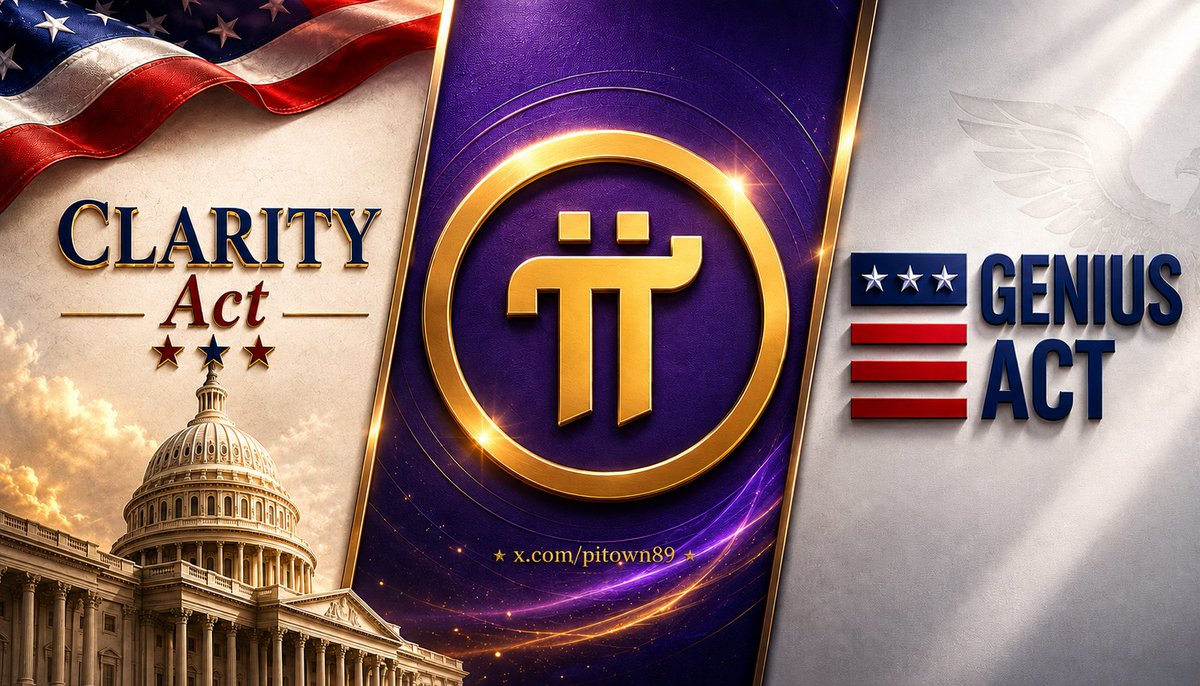
First is the GENIUS Act — the legislation that has officially become law to regulate Stablecoins. ⚖️
In the past:
many stablecoins operated almost like a flea market. 🏪
But now:
anyone wanting to issue stablecoins in the US must:
• have 100% real backing assets 💵
• apply for an operating license 🪪
• comply with a surveillance mechanism just like the financial system. 🏦
But what matters more to the crypto market is:
💥 CLARITY Act.
This act aims to classify crypto more clearly:
• Truly decentralized coins (BTC, ETH,…) → tend to belong to the "Digital Commodity" group managed by the CFTC. 🌐
• Investment/security tokens → managed by the SEC. 📈
• Stablecoins → have their own framework. 🪙
The goals:
✅ reduce litigation
✅ create a clear legal corridor
✅ pave the way for large institutions to participate in crypto in the US. 🏢
So what about Pi Network? 🤔
Pi is NOT a Stablecoin.
Pi does not peg its price to USD or any other asset
→ so basically it does not fall into the group directly affected by the GENIUS
Act. 👀
If looking from the perspective of the CLARITY Act, Pi tends to be closer to the "digital commodity / utility ecosystem asset" model, meaning an asset tied to a blockchain, utility, and a real-operating ecosystem. ⚙️
What is noteworthy is…
Right from the 2019 Whitepaper, Pi Core Team oriented Pi to not be merely a coin for trading. 📑
They talked about:
• digital currency 💸
• utility token 🔑
• distributed blockchain 🔗
• smart contract 📑
• dApp 📱
• real ecosystem 🌍
That means the Pi model from the beginning has leaned more towards a utility ecosystem than a simple speculative token. ⚙️
If the US finalizes the crypto legal framework in 2026… 🗓️
then blockchains with real utility and real ecosystems could benefit the most.
And that is why many people are starting to look at Pi with a very different perspective compared to a few years ago. 👀
Pioneers, do you think Pi will be recognized as a Digital Commodity in
the future? 🤔
❤️ Like if you still believe in the long-term vision of Pi
🔁 Share so more Pioneers can see the bigger picture
💬 Comment your perspective on the future of Pi
➕ Follow @pitown89 to update important signals before the crowd realizes
Pi Network empieza a ganar terreno en comercios reales de EE. UU.: la utilidad ya no es teoría. Florida ya muestra algo claro: Pi Network empieza a entrar en negocios reales, especialmente en bienes raíces y automóviles. @PiCoreTeam
🔍 According to recent community observations and node checks, there is a very interesting movement happening on the Testnet side:
Pi Testnet appears to have skipped Protocols 24 and 25 almost like “intermediate stops” and moved directly to Protocol 26. Meanwhile, Mainnet is still running on Protocol 23.
So why is this important?
Because under normal circumstances, blockchain development versions progress step by step. Skipping multiple protocols at once is usually a sign of either serious confidence, or a major time-sensitive preparation behind the scenes.
⚙️ According to the official roadmap, Mainnet was expected to reach Protocol 26 by the end of June 2026. However, this acceleration on Testnet suggests that the Core Team may have prepared certain modules earlier than expected.
What could this be signaling?
• Earlier activation of Smart Contracts
• The beginning of the real utility era within the Pi ecosystem
• The approach of Pi DEX infrastructure
• RWA (Real World Asset) tokenization tests
• More advanced dApp architectures
• And perhaps new financial integrations moving in sync with regulations
•PostgreSQL 16 + Ubuntu 24 – the node infrastructure just got a massive upgrade
In the United States, the legal foundation required for Mainnet Article 6 to move us out of SEC jurisdiction and classify Pi as a digital currency under CFTC jurisdiction is almost ready through the Clarity Act.
The Bitcoin bill designed to prevent forced BTC selling is close to becoming law. Trump has blocked the globalists from pushing CBDCs until 2030, and even the Fed is now crypto-friendly. My anti-CBDC colleague Kevin came into his position after the oath he took during the Fed’s pizza day. And bonus! We also upgraded Mainnet to V23 on the same day.
And South Korea is preparing to remove crypto taxes.
In Iran, oil payments with crypto were accepted. And there have been some positive developments on the China–US line.
Seventeen major commercial giants from the United States reportedly visited the Chinese president, most likely to redefine money together again.
Remember:
Testnet is not just a testing field. It is also the stage where the future rehearses itself.
And sometimes, what matters in a blockchain is not what it says — but which versions it silently skips. 👀
So what do you think?
Is this just an aggressive testing strategy?
Or the footsteps of a major transition?
Could it really be happening?
@HasanOlgunPi
Legal notice; this is not an advertisement or investment advice.