He was 17. Sent to hospice. They told his family to prepare for the worst.
Diffuse Intrinsic Pontine Glioma (DIPG). A brain tumor that's almost always a death sentence.
November 2025. Doctors referred him to a children's hospice. A place where children go to die.
His family refused to accept that.
December 2025. They started a protocol.
Ivermectin – 1.5mg/kg/day
Mebendazole – 2000mg/day
No clinical trial. No doctor's blessing. Just hope and a prayer.
Three months later? His world changed.
The boy who couldn't stand up straight before Christmas – he's walking without a cane.
The boy who dragged his left foot with every step – he's back at the gym.
His speech? Almost back to normal.
Getting out of bed used to be a very difficult task.
Now he's independent. Strong. Alive.
The same Canadian politicians who push assisted suicide are trying to criminalize his treatment.
Alberta Premier Danielle Smith wants to stop this.
She wants to block a child's "Right to Try."
But this boy's family didn't wait for permission. And now their son is not dying in hospice – he's living.
A child saved from hospice.
The system sent him to die. Ivermectin and Mebendazole brought him back.
This might be a world's first.
It definitely is a family's miracle.
👇 Share this. Someone needs to know hope exists.
⚠️ Not medical advice. Just the story of a boy who refused to give up.
#DIPG #Ivermectin #Mebendazole #RightToTry #Miracle
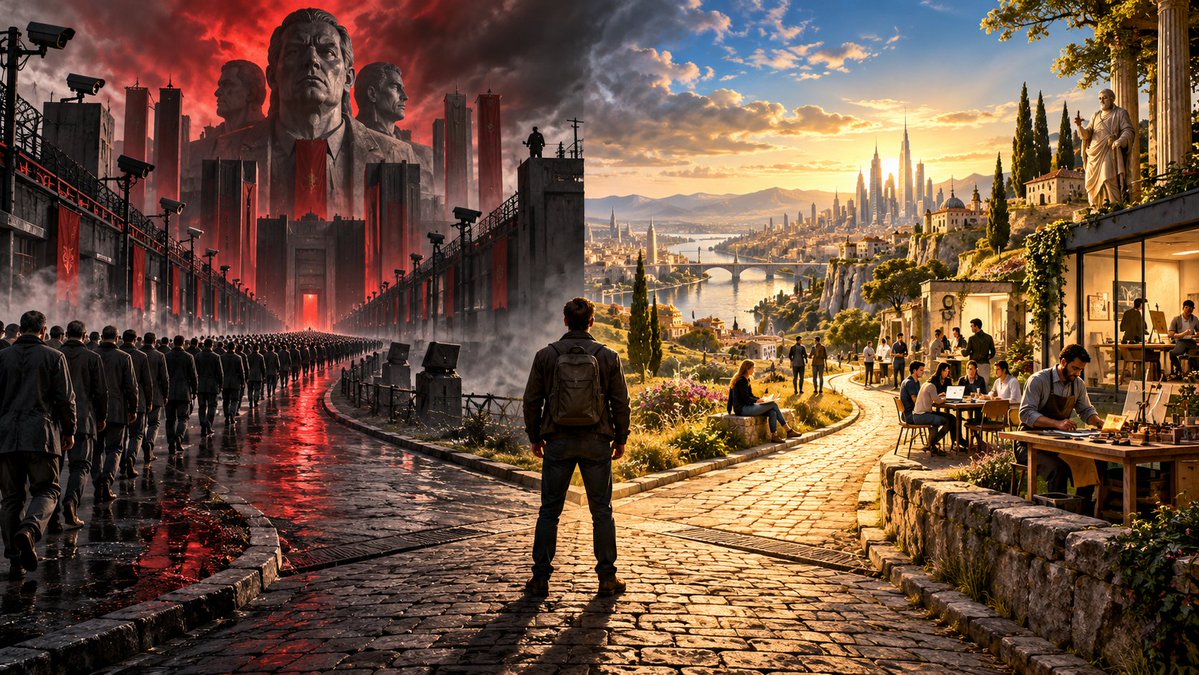
With everything happening right now, one thing is almost certain: globalism and the European Union are going to collapse, and sooner than anyone in Brussels is willing to admit.
So let's stop mourning the old world and start designing the next one.
Here are my proposals.
The Ten Commandments of the Western Renaissance
I. Every people is sovereign in its own home. It alone decides its immigration policy, holds its borders, and sets the rules of assimilation. No supranational body will ever decide in its place who becomes one of its own.
II. Merit becomes the law again. Hierarchy is built on competence, work, and results. Not quotas, not networks, not administrative castes.
III. Every nation's culture is a sacred treasure. Multiculturalism doesn't make cultures coexist. It dissolves them all. The only way to protect the world's diversity is to protect the uniqueness of each people.
IV. Optimism is a duty. No more prophets of degrowth who for fifty years have told us to be ashamed of existing, producing, and dreaming. The future is not a threat. It is a conquest.
V. Speech is free. A First Amendment for the entire West. No state, no platform, no committee has the right to decide what a citizen may think or say.
VI. A free people is a people that can defend itself. A Second Amendment for the West: the right to own a firearm and learn to use it. A freedom you cannot defend is just a permission.
VII. Abundant energy is the foundation of power. Massive nuclear, cheap energy, produced on our own soil. A civilization that rations its energy has already begun to die.
VIII. Family is the first pillar of the nation. A civilization that no longer has children has no future left to defend. Birth rates become a national priority.
IX. No transfer of sovereignty without the people. Never again a treaty imposed after a No vote. Every surrender of power goes through a referendum, and the people can always take back what they gave.
X. We build. Factories, power plants, rockets, AI, semiconductors. The West becomes once again the civilization that builds, invents, and sets out to conquer the stars.
A Letter to America, From a Frenchman Who Loves You
Yesterday, the Prime Minister of Poland posted this: "Restoring the rule of law is our duty. After years of PiS-led lawlessness, this is a difficult process, sometimes painful, and it requires decisive action. There is no other way."
Read it slowly. "There is no other way." In today's Europe, that is the sentence a government says right before doing something it could not do through the normal rules.
I'm French. I'm the grandson of a farmer from Brittany. I taught myself to code at twelve, spent a year in Silicon Valley when I was young, and today I build a tech company between Paris and San Francisco. I'm writing to you because I watch what is happening to my continent, and I'm afraid you are about to take the same road.
Let me tell you what "rule of law" means in Europe now.
When Donald Tusk came to power in December 2023, one of his first moves was to take over Poland's public broadcaster. Rather than pass a media law the president would veto, his government used corporate law to replace its leadership, and the state news channel briefly went dark. When that was blocked, it put public TV into liquidation. When the Constitutional Tribunal ruled against the government, the government stopped recognizing its rulings. Tusk himself said openly that restoring the rule of law would sometimes require decisions that would not fully meet the criteria of legality.
And Brussels? For years, the European Commission froze billions in EU funds to Poland over "rule of law" concerns under the previous conservative government. Once Tusk was in, it unfroze the money and closed its proceedings.
That's the lesson. In Europe, the rule of law is no longer a principle. It is a label. When a conservative government reshapes the courts, it's an assault on democracy. When a pro-Brussels government ignores a court, it's "restoring the rule of law."
It isn't only Poland. In Romania in December 2024, the Constitutional Court annulled the first round of a presidential election after the wrong candidate came first. In France, a TV channel, C8, lost its broadcasting license in 2025, and this week a member of parliament declared that shutting down CNEWS, the most-watched news channel in the country, is "a priority." In Germany, domestic intelligence labeled the main opposition party extremist. In Brussels, the Digital Services Act gives unelected commissioners the power to fine platforms up to 6% of global revenue, and its first fine ever went to X, with more investigations into "disinformation" still open.
There are no gulags here. Let me be precise about that. But there is a reflex: an elite that knows better than the people, that decides what the people are allowed to read, and that corrects their vote when it comes out wrong.
Now let me tell you why you are the first power on earth.
It's not oil. It's not size. It's not luck. Europe has had all of those. You are number one because you built your entire system on a radical idea: the individual comes before the state. Your First Amendment doesn't say "speech shall be protected unless it's disinformation." It says Congress shall make no law. Your Constitution protects private property against the government that wrote it. And your culture lets people fail and try again.
In France, a founder who fails carries it for life. In America, a founder who fails is called experienced. In Europe, we passed a law to regulate artificial intelligence before we had an AI industry. You built the industry. That's not an accident. That's what happens when a society trusts its citizens more than its bureaucrats.
Your system is not perfect. Your politics are loud, ugly and polarized, and I see it. But it is fairer than ours, because it was designed by people who distrusted power, including the power of good intentions. That distrust is the most valuable thing you own.
So here is what worries me as I watch you vote on Tuesday.
From Paris, when I look at the Democratic side, I recognize the European reflex. I saw an administration lean on social media platforms to take down posts; Mark Zuckerberg later wrote to Congress that the government had repeatedly pressured Meta to censor content and that he regretted not pushing back. I saw a proposal to tax unrealized gains, meaning taxing wealth you haven't even sold. I hear calls to end the filibuster, add seats to the Supreme Court, and add new states to the Senate. Each one can be defended on its own. Together, they look like what Europe did: when you can't win under the rules, you change the referee. And a majority that rewrites the rules in its favor doesn't plan on being a minority again.
The twentieth century already ran the collectivist experiment, and it ran it to the end. Every time a state decided that individuals were a means to a collective goal, and that some category of people stood in the way of justice, it ended in camps and mass graves. Tens of millions dead. But it never started with camps. It started with good intentions, a moral elite, and a list of things that were too dangerous to say, too much to own, too misinformed to count.
I'm not telling you Democratic voters are Bolsheviks. Most of them are your neighbors and they want good things. I'm telling you the reflex is real, that I live under it every day, and that you are the last big country on earth built to resist it.
When Europeans want to build something, we look at you. When we leave, we go to you. If you become us, there is nowhere left to go.
Keep your First Amendment. Keep your property. Keep your right to fail. Vote on Tuesday.
From Paris, with love, and with fear.
For those confused as to what’s happening in Poland right now…
Imagine if Democrats won Congress, declared the Supreme Court didn't count anymore, ignored its rulings for 3 years, and then, a year before the next election, picked 8 new justices of their own, including a man their leader called his "right-hand man," and when the Republican president refused to swear them in, they swore themselves in and mailed him the paperwork, and when the Chief Justice said that wasn't legal and wouldn't seat them, they waited for a Friday night when the president was on a plane to Africa and had federal security officers who answer to a Democratic cabinet member walk 7 of them into the court through a back gate connected to the Democratic leader's own offices, where one of them announced she had "suspended" the Chief Justice, a move that even a law professor who openly can't stand him said had no legal basis, and then riot police blocked the Chief Justice from entering his own court, the court's website was taken over, the Attorney General moved that same night to strip his immunity so he could be prosecuted, the president had to turn his plane around mid-flight to come home, and the same people who spent years lecturing everyone about respecting the courts went online to say this was the rule of law, that it was painful, and that there was "no other way," which is roughly where Poland is tonight.
Capitalism has a win condition. Socialism does not.
Here's why, explained so simply a 10-year-old could get it. It starts with a book written in 1944 by an Austrian economist named Friedrich Hayek: The Road to Serfdom.
Imagine a classroom of 30 kids. One day the teacher says: "From now on, I decide what everyone eats for lunch, which games you play at recess, and who sits next to whom. It's fairer that way."
First problem: the teacher doesn't know what you like. You hate carrots. Your friend is allergic to peanuts. Lucas wants to play football, Emma wants to draw. 30 kids, 30 different wishes. Nobody can know all of that, not even the smartest teacher on Earth. Hayek called this the knowledge problem. The information needed to run an economy is scattered across millions of heads, and it can't be gathered in one office.
Second problem: the kids start fighting. "Why does he get the window seat?" "Why football again?" Before, everyone just chose for themselves. Now every choice is a fight, because every choice is made for everyone.
Third problem: the class can't agree on a plan, so someone says "we need one person in charge who just decides." This is Hayek's key insight. Planning doesn't fail because planners are evil. A plan needs everyone to agree on the same goals, and free people never agree on everything. So the plan needs force to work.
Fourth problem, and it's the scariest one: who wants that job? The kind kid doesn't want it, because the kind kid doesn't want to force 29 people to eat carrots. The job attracts the one who likes giving orders and doesn't mind punishing those who disobey. Hayek wrote a whole chapter on this, called "Why the Worst Get on Top." It doesn't happen by accident. It happens by selection.
Here's the trap. When the person who controls your lunch also controls your job, your home, your shop and your newspaper, they control your whole life. You can't say no, because there's nowhere else to go. Controlling the economy doesn't mean controlling one part of life. It means controlling the means to every goal you have.
That's the road to serfdom. Nobody votes for a dictator. People vote for "someone should fix this," then for "give them more power to fix it," and one day they wake up with no one left to say no to.
The USSR, Maoist China, Cambodia, North Korea, Cuba, Venezuela. These are different countries with different cultures and languages, and the story has the same ending every time. When a script produces the same ending every time, it isn't bad luck. It's the script.
Now capitalism. Back to the classroom. Instead of one teacher deciding everything, every kid can trade. You give me your carrots, I give you my apple, and we both walk away happier. Nobody needs to know what everyone wants, because prices do that job. A price is a message telling millions of strangers what's scarce and what's wanted, with no one in charge.
That's the win condition. In capitalism, you get rich by making something other people freely choose to buy, so your success depends on serving others. In a planned system, you get ahead by pleasing whoever holds power. One rewards usefulness. The other rewards obedience.
And this isn't theory. Two centuries ago, almost every human being was extremely poor. In 1990, about 38% of humanity still lived in extreme poverty. Today it's under 10%. More than a billion people escaped it in a single generation. It happened when China, India, Vietnam and South Korea opened up to markets, trade and private enterprise. The largest reduction in poverty in human history came from letting people trade.
So why do so many people hate capitalism?
Because what they hate usually isn't capitalism.
They hate the bank that got bailed out with their taxes while they lost their house. They hate the giant company that writes the regulations so no startup can compete with it. They hate rent they can't afford because building new homes has been made nearly impossible. They hate the lobbyist who gets a subsidy while the small business owner drowns in paperwork.
Look closely at each one, and you'll find a state handing out privileges. A bailout is not the market. The market would have let the bank fail. A regulation written by incumbents is not competition. It's protection from competition. None of this is capitalism. It's cronyism, which is what happens when businesses stop competing for customers and start competing for politicians.
People see the symptom and blame the wrong cause. They say "capitalism failed" and ask for more state. That gives more power to the same people who created the problem, and it puts us right back on Hayek's road.
The answer to bad capitalism isn't less freedom. It's less privilege. That means fewer bailouts, fewer protected incumbents, fewer permits, and more people allowed to build, compete and trade.
Capitalism has a win condition: make things people want. Socialism has an end condition: someone has to be in charge. And history keeps showing us who ends up in that chair.
There was once a fortress whose walls had begun to crack.
For years, the men inside held conferences about the cracks. They wrote reports about the cracks. They promoted people who had become very good at explaining why the cracks were manageable.
Then one day, a few men stopped talking about the wall and started rebuilding it.
They climbed into the broken places themselves. They hauled stone. They changed the design. They angered people whose careers had been built around maintaining the old wall exactly as it was. Slowly, against resistance, the fortress began to change.
Then the governors became nervous.
The work was becoming visible. Important people were watching. So someone suggested that, for credibility, the rebuilding should be handed to the senior masons who had spent their entire careers maintaining the original wall.
After all, they had rank, titles, and the proper credentials. They looked right standing on the battlements.
So the builders were told to step aside.
The old masons arrived, inspected the new work, nodded gravely, and began restoring the fortress to standards everyone already understood.
Soon the walls looked respectable again.
And when they cracked in exactly the same places, everyone was shocked.
That is the danger with reform. Institutions often say they want change right up until change starts looking unfamiliar. Then they reach for the safest face in the room and call it credibility.
But if the people who built the old wall are always considered more credible than the people willing to rebuild it, the wall was never really being reformed.
It was simply being repainted.
Everyone debating beef prices should hear from someone who actually raises cattle.
I’m a small rancher. It can cost me ~$2,500 to raise an animal + ~$600 to process it. If I bring home ~500 lbs of beef, that’s $6.20/lb before I pay myself ONE DOLLAR for land, fencing, equipment, fuel, labor, losses or risk.
So no, American ranchers aren’t getting rich off expensive beef.
And importing cheaper beef isn’t the solution I want.
I’d rather see Americans cut out the mega-packers and buy directly from local ranchers. Buy a quarter, half or whole animal. Know the farm. Know how it was raised. Ask whether it was grass-fed, grass-finished, grain-finished, or something else. Know who processed it.
Quality and production standards vary, and “imported” doesn't automatically mean inferior—but cheaper commodity beef is not the same proposition as knowing exactly where your food came from.
Want to help American families AND American cattlemen?
Buy local. Buy direct. Shorten the supply chain.
Then you don’t have to wonder which multinational handled your dinner—or whether tomorrow’s “beef” came from a cow, a bioreactor or a 3D printer.
Food security starts with knowing your farmer.
#BeefPrices #BuyLocal #AmericanRancher #FarmToTable #FoodSecurity
ZZ TOP's first tv appearance was on Johnny Carson's The Tonight Show in 1986, and it's one of the best because not only did Doc Severensen join in with his trumpet, but both he and Carson wore fake beards and sunglasses to really welcome the Texas band for their network debut 🔥
🔻 In 2011, a neuroscientist at MIT, Dr. Li-Huei Tsai, made a discovery that should have been on the front page of every newspaper on Earth.
She exposed mice with advanced Alzheimer’s disease to a flickering light flashing at exactly 40 Hz—forty times a second. Nothing more. No dope. No operation. Light of a particular frequency.
Within an hour the amyloid-beta plaques in their brains, the protein deposits that define Alzheimer’s, started to dissolve. Not slow at all. Not slowly. In 60 mins.
Plaque levels were reduced by 50% after 7 days of daily exposure to 40 Hz. The mice then regained their memory. Their neurons began firing in sync again. Microglia, the brain’s immune cells, were activated and began cleaning up the toxic buildup like a cleaning crew that had been asleep for years.
The study appeared in Nature. The planet's most prestigious scientific journal. Peer Reviewed . Reproduced. Verified. That was 2016. Year is 2026.
Alzheimer's affects 40 million people worldwide. Pharmaceutical companies earn $13 billion a year on drugs that don’t alter the course of Alzheimer’s disease. Not one of 'em. They slow it down. Possibly. Temporarily. At $26,000 per patient per year.
It costs less than a dollar to make a 40 Hz light.
Dr. Tsai remains at MIT. Her research goes on. It is in phase III human trials. But you'll never see this on the news at evening time. You won’t hear your doctor talk about it. You can’t buy it at any drug store.
Because you can't sustain a $13 billion industry on a free frequency.
The light is 40 Hz. The frequency is a real. The science is settled. And there are still 40 million people waiting for permission to use it.
Share !
♟️
Ok, here’s my corporate greed call-out of the day.
I was dispatched today for a no-cool call. The indoor unit was running, but the outdoor unit wasn’t.
The system was a 10-year-old Bryant Evolution high-end variable-capacity inverter system. After running the factory diagnostics, I found Code 77, indicating the inverter board was detecting excessive compressor startup current.
Following the manufacturer’s diagnostic procedure, I disconnected the compressor leads to determine whether the fault was in the compressor or the inverter board. The results confirmed the inverter board had failed. The system is only 8 months out of warranty.
At that point, I started preparing myself to tell the customer the repair would probably be around $1,500–$1,900. I figured the board would cost somewhere in the $800–$1,000 range. After all, it’s just a printed circuit board.
Before giving the estimate, I called Carrier Enterprise for pricing.
$8,900.
Not for the entire outdoor unit.
Not for a complete system.
Just the inverter board.
That’s not a typo. $8,900.
In my opinion, this is the definition of engineered obsolescence. There is no reasonable justification for a replacement circuit board on a 10-year-old residential HVAC system to cost nearly nine thousand dollars. At that price, you’re essentially forcing the homeowner to replace the entire system instead of repairing it.
This is exactly why I’ll never sell Carrier equipment. They make decent equipment, but pricing replacement parts like this turns a repairable system into a disposable one. Homeowners deserve better than that.
Carrier Carrier Enterprise or anyone that’s sells this shit, care to elaborate why this board is so expensive?
🎩 Patrick Henning
i came to the conclusion that this story is so awful that we have no way to punish it. to commit to an appropriate measure of justice is beyond our willingness to do it.
I’m going to say this as calmly as possible:
Watching Caitlin Clark in the WNBA has become genuinely hard to stomach.
Not because she struggles sometimes. Not because she makes mistakes. Not because she gets criticized. That comes with being great.
It’s hard to stomach because it has become obvious that the league, the officials, the media, the players, and even her own organization have all decided that the most important thing is not letting Caitlin Clark become too big.
And that is insane.
This league was handed the most marketable, electric, revenue-generating player women’s basketball has ever seen, and instead of building around the moment, too many people seem obsessed with humbling her.
She gets fouled. Held. Hit. Cheap-shotted. Mocked. Targeted. Then when she reacts like a normal competitor, suddenly everyone wants to analyze her attitude.
No.
Her attitude is not the story.
The story is that a generational player is being treated like a problem by the very league she helped drag into mainstream relevance.
This reminds me of the worst kind of youth coach... the one who sees a special player, feels threatened by her talent, and slowly drains the joy out of her in the name of “teaching humility.”
That is what this looks like.
The freedom she played with at Iowa is disappearing. The fire is still there, but the joy looks damaged. The confidence looks weighed down. She looks like someone constantly fighting the refs, opponents, narratives, coaching decisions, jealousy, and a league culture that should be protecting its golden opportunity instead of resenting it.
And let’s be honest: Stephanie White has not helped.
Benching Caitlin Clark randomly when she is controlling the game tempo, or having your best shooter off the floor in critical game ending minutes when a victory is within reach is basketball malpractice. Limiting her rhythm, downplaying her greatness, benching momentum, and treating her like just another piece instead of the engine is absurd.
You do not take a player who changed the economics of your sport and manage her like you’re afraid her greatness might offend the room.
Nike deserves criticism too. Other players get signature shoes rolled out with urgency, while the biggest draw in women’s basketball is somehow still waiting on that signature shoe. That is not confusing. That is revealing.
Fans are not stupid.
They see the fouls.
They see the double standards.
They see the jealousy.
They see the media resentment.
They see the league benefiting from her popularity while refusing to fully embrace her.
And here is the part the WNBA better understand quickly:
People are not tuning in to watch Caitlin Clark be humbled.
They are tuning in to watch Caitlin Clark be great.
If she walked away tomorrow, the fans would follow her. The sponsors would follow her. The energy would follow her. The high salaries and the charter jets would follow her. And the league would be forced to confront the uncomfortable truth it keeps trying to avoid:
Caitlin Clark did not need the WNBA nearly as much as the WNBA needed Caitlin Clark.
At some point, her family, her agent, and her team need to ask a hard question:
How much longer do you let a league profit from her while allowing the culture around her to beat the spirit out of her?
Because from the outside looking in, this does not look like normal adversity anymore. It looks like abuse.
It looks like a league trying to break the very player who made millions of people care.
https://t.co/AAxFrO46Z4