JUST IN: WNBA Commissioner announces the league is meeting to review what a woman is, after multiple former NBA stars announced plans to join the league.
❌🎲 ODELL. Maybe this is a reminder that having a microphone doesn’t make someone a Bitcoin authority. Too much energy went into attacking Saylor and MSTR, not enough into challenging assumptions around seed generation and single points of failure.
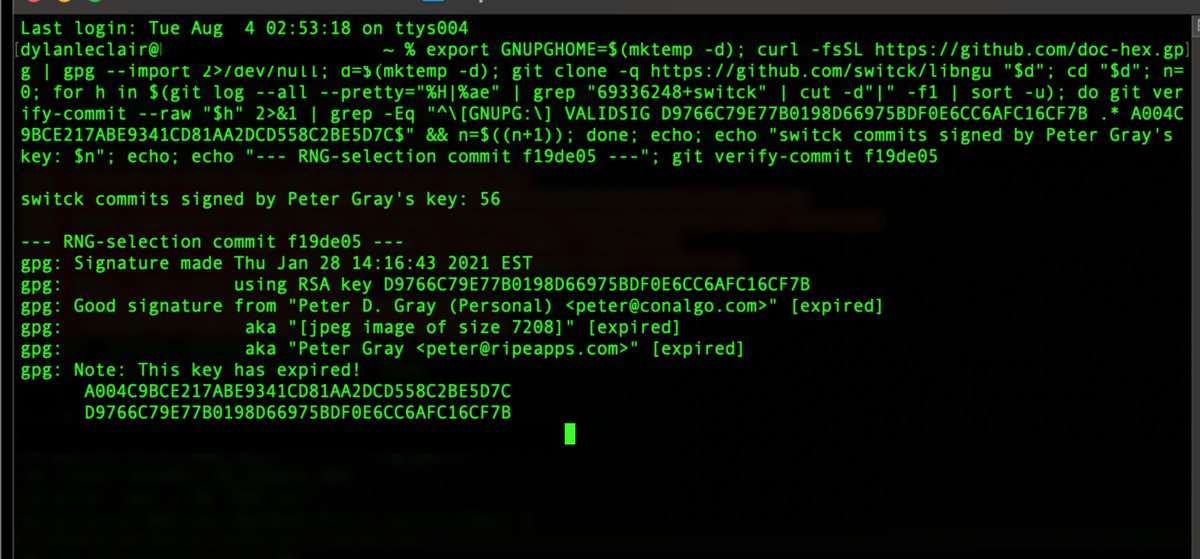
You’d never have a fallback to weak entropy. That’s like having an aircraft engine overheat and instead of shutting down, fall back to a nuclear bomb hiding in the wing. Obviously malicious.
My mind is still blown thinking about how white hat sweeps could've potentially been returned to victims if Bitcoin had a robust DID ecosystem with decentralized social graphs helping arbitrate recovery.
Imagine a white hat sweeping vulnerable wallets and locking the funds into a recovery contract. Anyone could claim ownership by proving control of their DID...but if the DID were derived from the compromised key, so could the attacker.
That's where the social graph comes in. Your pre-registered trusted contacts on a decentralized network like Nostr could attest to your identity and approve releasing the funds to a brand new wallet you provide out of band.
No government, no law enforcement, no lawyers, no middlemen taking a cut. Just a trust-minimized recovery process built on cryptographic identity and the people who actually know you.
And for funds recovered by law enforcement, the same recovery framework could be used if they chose to.
I hope we build this kind of crazy decentralized ecosystem on top of Bitcoin one day.
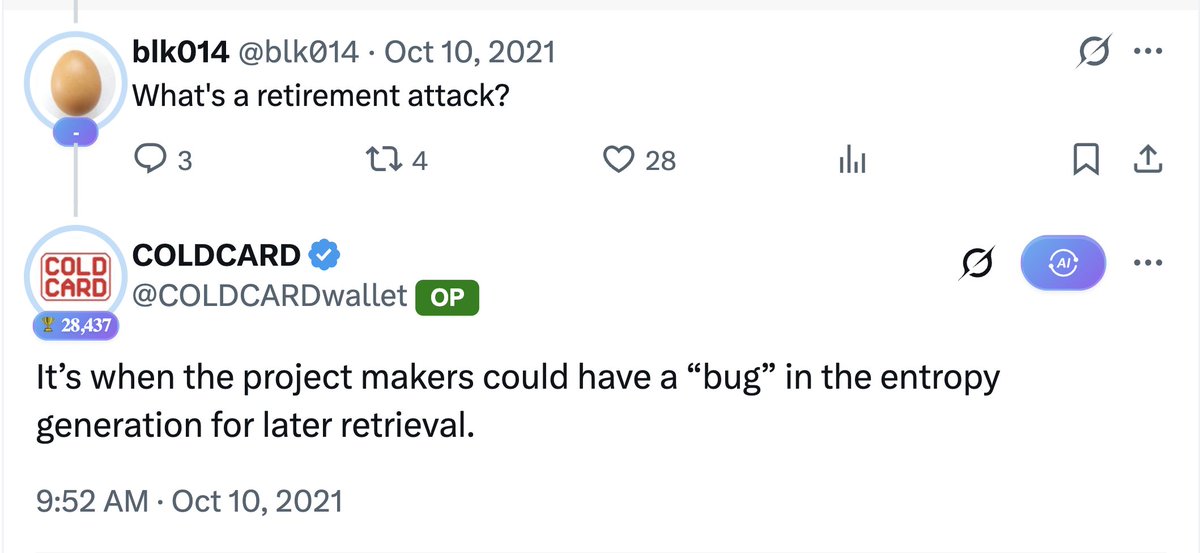
Looks like Coldcard was a state-backed, inside job spanning multiple years of careful planning.
The revelation of earlier tweets like the one below heavily suggests that this was long premediated by Coldcard insiders.
The heist was optimized around max public shock value and minimum discretion.
Given all the facts, we must answer:
- Why did the attacker completely disregard privacy by consolidating stolen coins into a single address?
- How did the attacker, who clearly planed this for a long time, fail to plan to cover their own tracks?
- Why did the attacker use KYC'd service providers?
- Why did Coldcard make these "wink-wink easter egg" posts about this exact bug around the same time the bug first appeared in the code base?
- If it was merely a "retirement attack," why not exercise discretion so you could actually retire?
- Why did the timing line up with major politically relevant developments like CLARITY and a bear market?
The only theory that answers all these questions well is a state-backed operation involving Coldcard insiders. It was never about the money. It was about attacking self custody, one of the core premises of Bitcoin.
I did not want to make this accusation initially even though I did suspect it. Now the evidence is on my side so I am adding the insider point to the theory.
The folks who think there is no conspiracy need to answer some hard questions:
If you think it is a script kiddie using an open source LLM like Kimi, you need to answer why he would do this but not ask Kimi or Google how to cover up his tracks despite planning at least for a few months.
If you think it was a random Bitcoin hater who doesn't care about the money, you need to answer why Coldcard put out these clearly suggestive tweets at the same time.
(Note: you can say coincidence, that's your right).
Skeptics: I would love to hear your answers!
For me the inside job theory squares all the corners and also explains the company's actions over the last few years.
- Antagonizing security researchers -> less visibility into code
- Discredit competitors -> cause confusion
- Heavily fund the marketing engine -> draw in the hardcore Bitcoiners; promote a strong brand association with self custody
- All these easter eggs + NVK hating plebs -> mock the would-be victims and create learned helplessness
All of this comes together really well to the mess we have today.
If you are doing a multi vendor multisig, make sure at least one is a @Trezor. The more I learn, the more I am impressed with that Big Entropy Energy they got
Fair skepticism. We didn't identify the specific code-level bug now being discussed, nor claimed we did here. In 2024, multiple victims approached us with materially similar losses that didn't appear to involve the usual causes, phishing, malware, or known seed exposure. At first, we suspected insider involvement, but it was an early working hypothesis, not a conclusion, and we did not accuse anyone. Our investigation concluded it was a function/failure of the seed generation entropy.
We understood enough to recognize that the weak seed entropy involved warranted escalation, and we reported what we had to the company for review and federal law enforcement. Because these matters involve victims and ongoing investigations, we never responsibly disclose the underlying evidence or comment much further. We can't sensationalize active cases or present speculation as fact.