Imagine making $150/day by being online...
with Tap2Earn people make $500/acc just for tapping
I spent week to scan 50 different Apps...
here's 3 that will generate you $5,000 per month 🧵👇
I usually don’t comment on votes to avoid swinging it, but this is one I’ll bat very heavily for.
The first Jupuary created one of the active communities/strong cultures/valuable protocols in crypto, we get the chance to greatly enhance this over the few jupuaries.
This is not going to go to a small group of insiders, this is going to probably one of the widest committed groups in crypto you can think of.
Remember, the goal of JUP is to accelerate the meta and bring the entire world along into the decentralized world - there is no way in hell we are gonna do that if we worry about short term bumps.
But again, this is not a decision for me to make, we will decide, together. All I can do is make my case.
Metropolis is finally here!
Over the last few months, we have been super hard at work re-engineering our entire backend systems to handle both the massive increase in number of markets/tokens and doing a lot of r&d to solve very tricky issues like slippage/mev.
We call this upgrade Metropolis, because:
1. it really feels like the liquidity ecosystem has became a major, vibrant new city
2. It fits the short hand for MTS (market token service)
3. It reflects our goal for the new backend system, a real time usable reflection of the entire onchain liqudity
4. It brings our backend system to be much more ready to handle the rigors of the new ecosystem requirements
To be honest, it took us much longer than we wanted to, but we are finally ready to comfortable to roll these out. A big part of the reason why things took a while was because we also had a very large number of api/binary users that we had to figure out how to cater to and eventually migrate over.
We were gunning to solve a few key issues with this release - namely instant routing, the very tricky slippage/MEV problem, managing the insane explosion of new tokens and the strict list as a major bottleneck for verification.
For example, many users set very high MEV values when trading volatile memecoins, leading to situations where there is very high incentives for sandwich attacks to happen particularly given the much lower cost of execution on Solana.
One feature that took us months to research, test and figure out was defi’s first dynamic slippage, which uses a combination of backend calculation and frontend simulation to be optimize the chances that it will go through yet protect from the scourge of MEV.
The other feature that we worked on quite a while was intelligent token sorting, which became extremely important as the number of tokens quite simply completely exploded.
To make progress on this, we worked on injecting data from a full range of locations into MTS, including mirroring onchain data, pulling volume data from a range of sources, lists from partners like pump, clone and more, then indexing, filtering out the dubious tokens and putting them through an intelligent real time search.
For instant routing, we had to perform a massive upgrade on our markets discovery backend. While suitable for a world with relatively few tokens which did not needed to be traded instantly, it was unsuitable for a world where 15000 tokens emerged daily and users expected to trade them pronto.
Last but not least, and this one is close to my heart - is token verification. Last year, we created the strict list as a way to let projects apply for strict list status, but it has again become completely unfeasible due to the vast number of tokens applying and the demands placed on the team.
We will be rolling out defi’s first ecosystem token list standard very soon - allowing our community catdets and partners to collaborate to figure out which tokens are which, after which we will be aggregating into a token master list.
All in all, with Metropolis, we aim to push the JUP promise of best price, best token selection and best UX much further, and continue to contribute to the ecosystem by providing the best liquidity infrastructure possible.
❤️,
Meow
the big news is here
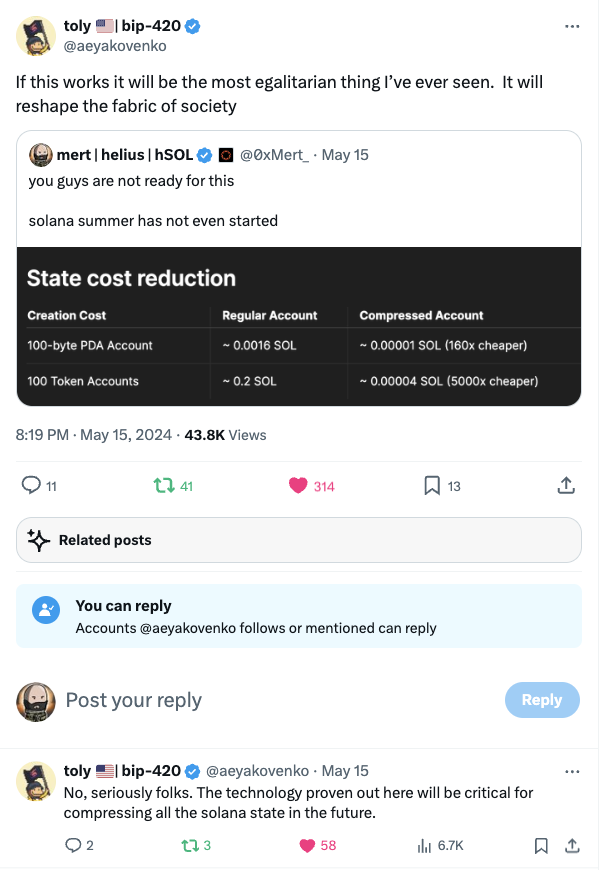
today we're introducing ZK compression to Solana, directly on the L1 — without requiring L2s
this changes everything you thought you knew about Solana and scaling L1s
TL;DR — we compress onchain state to get 10,000x scale improvements and get 1 step closer to building The Financial Computer — an unstoppable, global, atomic state machine syncing at the speed of light
for non-technical folks
developers can now build and scale literally anything they want directly on Solana without needing to leave it
example cost difference
take an airdrop to 1,000,000 users
this today would cost over $260,000 for state alone
now, it's $50 — 5,200x cheaper
but a token account is just one example of this — *everything* on Solana is an account, meaning everything can be scaled
for technical folks
there are two costs on Solana — compute and state
Solana already has cheap compute — but state is expensive
allocating accounts, paying rent, and scaling with users have all been shown to be a massive roadblock for Solana devs
this is now fixed
and if you're a bit more technical, you'll know that state-growth is a major issue for scaling blockchains
well...with this you can compress all Solana state!
and this has further implications for hardware requirements and the overall performance of the entire network
this is just Day 1, there will be challenges of course (and we will overcome them, as we have done before)
you combine this, add in firedancer, multiple concurrent leaders, async execution and an ecosystem of thousands of insanely cracked devs — and we have a real shot at this crypto thing
accelerate
🗳️ Catdets: Time to Vote on the 3 New Trial Working Groups!
After 5+ hours of Town Halls and countless more messages in Discord, the 3 WGs hopefuls are gearing up with their proposals to go live for vote this week
Each of them aims to serve an important role in the Jupiter ecosystem; if approved, they will spend the next few months helping to push things forward along with the rest of the ecosystem.
Critically, all three WGs are proposing a trial budget. The community has made clear they need to see WGs in action before allocating $JUP.
The trial period will ensure alignment with the community, team, and the rest of the WGs before they receive a full-term budget with $JUP allocations.
We will be hearing from each of them at the Planetary Call, before voting begins on Thursday.
What’s Next:
Planetary Call (Wednesday 3:30 PM UTC):
The 3 trial workgroups will present a brief overview of their proposal at the upcoming planetary call, and how they intend to engage the rest of the community during the trial.
Start Voting (Thursday 3 PM UTC):
Voting will begin at Thursday, 3pm UTC with 3 individual votes. Each trial workgroup will be submitting a USDC operational budget for a trial period.
If it passes, the workgroup will be funded to operate for a trial period, after which the WG will present a full budget (USDC + JUP) to align with the DAO over a period of 1 year or more.
Twitter Space (Thursday 4 PM UTC):
One hour after the vote, we will also conduct an open Twitter Space with Meow and other members of the various trial WGs. Expect summaries to be posted afterwards if you can’t make it.
This will make sure that everyone interested has all the information they need to make the best decision possible!
Voting Ends (Sunday 4pm UTC):
The successful workgroups are funded to begin their trial!
Remember, these are not full workgroup budgets. These trial WGs are aiming to be funded for a few months, to see if they can find good synergy w the community, team and the rest of the WGs before proposing a full budget with JUP for long-term alignment.
Remember: the JUP DAO only works if YOU, the Catdet Community, make your voice heard. We are excited to see how you all vote!