Andrej Karpathy spent 8 years at OpenAI and Tesla
Last week, he compressed everything he knows into one free 2-hour lecture
Agents → Loops → Graphs → Self-Improving Systems
People spend $15K on bootcamps that teach less than this
This lecture beats most paid AI engineering courses
You probably don't have 2 hours right now
Don't let this vanish from your feed
Watch it
Then read the guide below
Andrej Karpathy spent 8 years at OpenAI and Tesla
Last week, he put everything he knows into one free 2-hour lecture
People pay $15k for bootcamps that teach half of this
You probably don't have 2 hours right now
Don't let this get lost in your feed
Watch it, then read the guide below and build your first loop
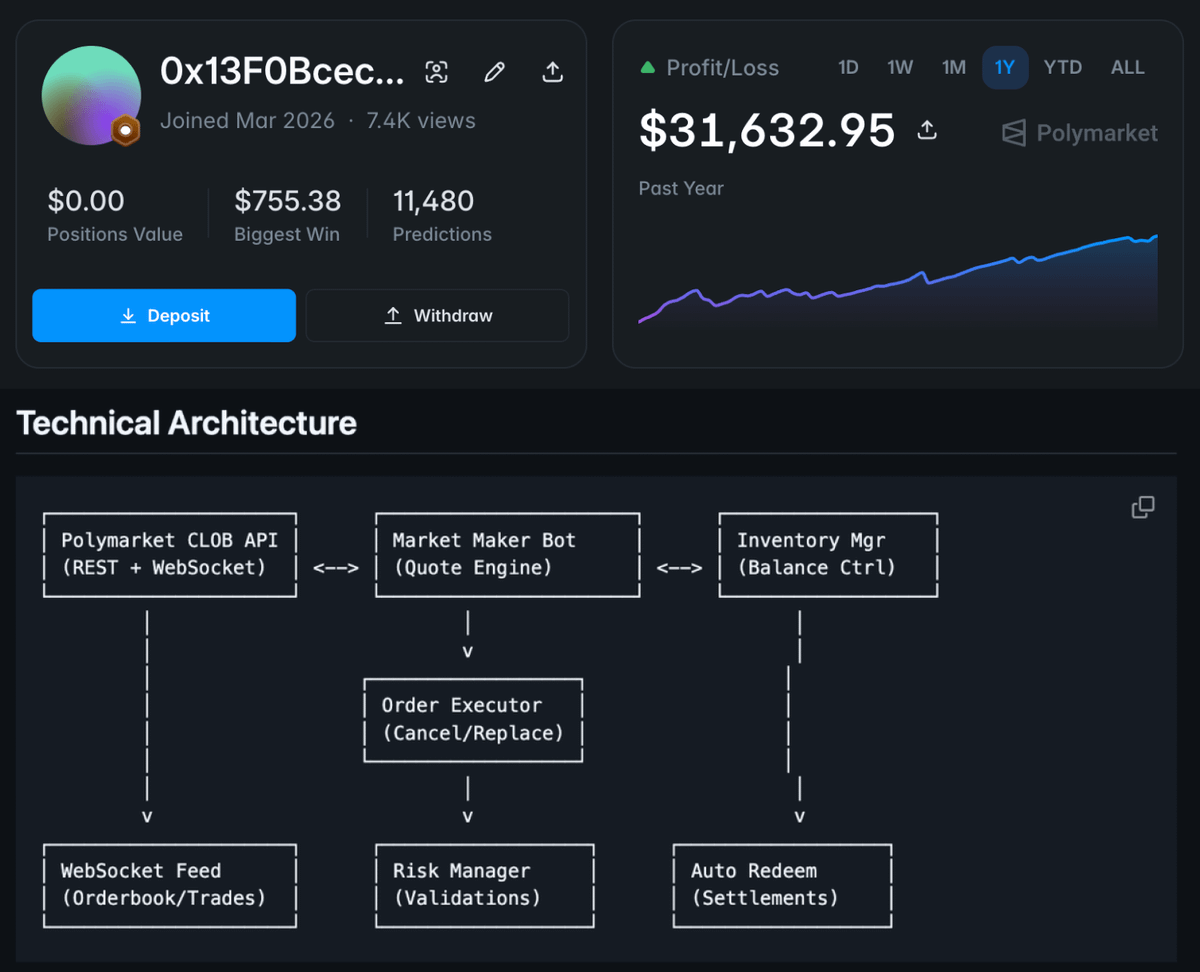
Your bot looks connected and still LOSES HARD.
The ping works, the heartbeat is fine, everything looks green.
But it hasn't seen a real price in 40 seconds and it has NO idea.
This is the silent websocket, and it's trading blind right now:
Here's the trap:
A websocket can stay technically "alive" while the actual data stops flowing.
The connection holds.
The ping and pong still bounce back and forth.
The heartbeat frames keep arriving like nothing's wrong.
But the real price ticks, the thing your bot actually trades on, just quietly stopped.
So your bot thinks it's fully live, and it's making decisions on a book that froze 40 seconds ago.
That's how a working bot bleeds with zero errors in the log.
Mine was stuck because of the same problem
Now it's sitting at $32k PnL: <https://t.co/yCsjRsOAXJ>
Here's how you actually catch it:
Don't trust the ping.
Ping only proves the pipe is open, not that data is moving through it.
Track the timestamp of the last REAL data message, not the last heartbeat.
Use a monotonic clock for this, not wall-clock time, so a system clock adjustment can't lie to you.
If no real tick has landed in a few seconds, treat the connection as dead and reconnect, even though it "looks" fine.
Now the part most people miss after the reconnect.
When you reconnect, your local order book is already stale.
You missed every update during the gap.
So you do NOT just resume.
You pull a fresh REST snapshot first and rebuild the book from scratch, THEN start trusting the stream again.
Skip that step and you're now trading on a book that's wrong in a brand new way.
A green connection light means nothing.
Watch the data, not the heartbeat.
Breaking down latency lag in my next post so son't miss this.
Raphael Townshend, Stanford AI PhD and founder of Atomic AI (Forbes 30 Under 30):
""Wall Street will pay you $500K a year to build these models. I'd rather teach them to you for free."
this free stanford lecture holds the entire "77% win rate, pure math" random forest the 2026 quant threads sell you. and the guy teaching it didn't take the wall street money either, townshend went on to found an ai drug-discovery company and land forbes 30 under 30.
at the board he builds it from scratch: one decision tree overfits, so you grow hundreds on random subsets of the data and features and average them. the errors cancel, the signal survives. that's the whole "100 ai agents auditing the market" idea, minus the marketing.
the √N feature rule, the out-of-bag error, the probability output, all of it is standard ensemble learning, taught free by stanford for years. random forests came out of leo breiman's public paper in 2001. the thread didn't discover it. it renamed it.
and here's the honest part the win rate hides. a model that scored 77% on past data is describing the past, not promising the future. ensembles cut variance, they don't turn a weak edge into a real one, and markets shift under the model in ways the training set never warned about. the lecture is free. knowing whether your 77% survives out of sample and on live capital is exactly the part the post skips."
A retired professor of atmospheric science now bets on the weather on Polymarket instead of teaching it.
He's up $64,742.
Check him -> https://t.co/9znpgbkQax
[HenryTheAtmoPhD] trades the one thing he actually knows -> city temperatures on Polymarket.
> 4,776 predictions.
> $64,742 all-time profit.
> Biggest win: $4,944.95
His trades:
$13.61 -> $1,586.84 NYC temperature (+11,558%).
$193 -> $3,794 NYC temperature (+1,864%).
$117 -> $2,903 London temperature (+2,386%).
He buys at ~1¢ on precise city temp ranges and lets his PhD-level forecast cash him out.
Save it & Check his trades today.
+$370 in LP Rewards in just 3 weeks with my bot on Polymarket
Here’s how it works:
> Finds markets that match my criteria
> Places orders on both sides (YES + NO)
> Continuously monitors the order book/liquidity
> Sell positions in less than <1 second after a fill
The bot runs 24/7 and handles everything automatically
I’m still improving and optimizing the strategy every week…
Previously, I wrote a lot about my LP farm
polymarket trader made over $2,000 just by betting $28 on weather prediction
he has 7,484 forecasts with a total winnings of $17,100
he started with a first deposit of $100
i think he understands meteorology because he bets on weather every day
his probable strategy:
- buy YES low 1-20c
- buy NO high 70-90c
- still risk $13-70 per position
most successful predictions:
- $13 -> $4068
- $28 -> $2318
- $42 -> $1017
small bets + correct purchase prices = 400-5,000% profit
profile: https://t.co/5p6fjEgAOS
A 35-year-old accountant from New Orleans left his job and spent a full month in isolation with Claude.
The result? He made $45,000 in a single day.
300 hours of meticulous work - and the perfect BTC trading algorithm was ready.
If he keeps cooking like this, he’s hitting over $1,000,000 in a single month.
His wallet: https://t.co/ZS6sjM9aoW
He selected username nsh91qaz - an ironic nod to his 1991 birth year, an age when most people believe it’s too late to change their lives.
But he changed anyway.
I ran a backtest of his strategy using Claude + Nautilus via PyPI.
Results genuinely shocked me - mechanics are understandable to pretty much anyone.
The real alpha is in the numbers under the hood. That’s what lets you pull $45k per day with pure math.
I simulated every single one of his trades and broke down every transaction: 75 markets, 72 fills, 85.1% win rate, Sharpe ratio 4.21.
All run on the Nautilus-core broker simulator with 41.8 GB of parquet data in DuckDB.
Every trade is a perfect cycle. Every dollar earned is pure exploitation of market inefficiency.
He doesn’t predict the future - the math already knows it. He just reads the numbers right and takes the money
Brier-loss ensemble: 400 trees · lr 0.03, walk-forward validation with Sharpe 4.21 ± 0.08.
Save this post if you actually want to learn how to build something like this.
Or just skip the homework and start copying his trades right now - that’s the easiest and most profitable route I’m on: https://t.co/vbDZyVcfT3
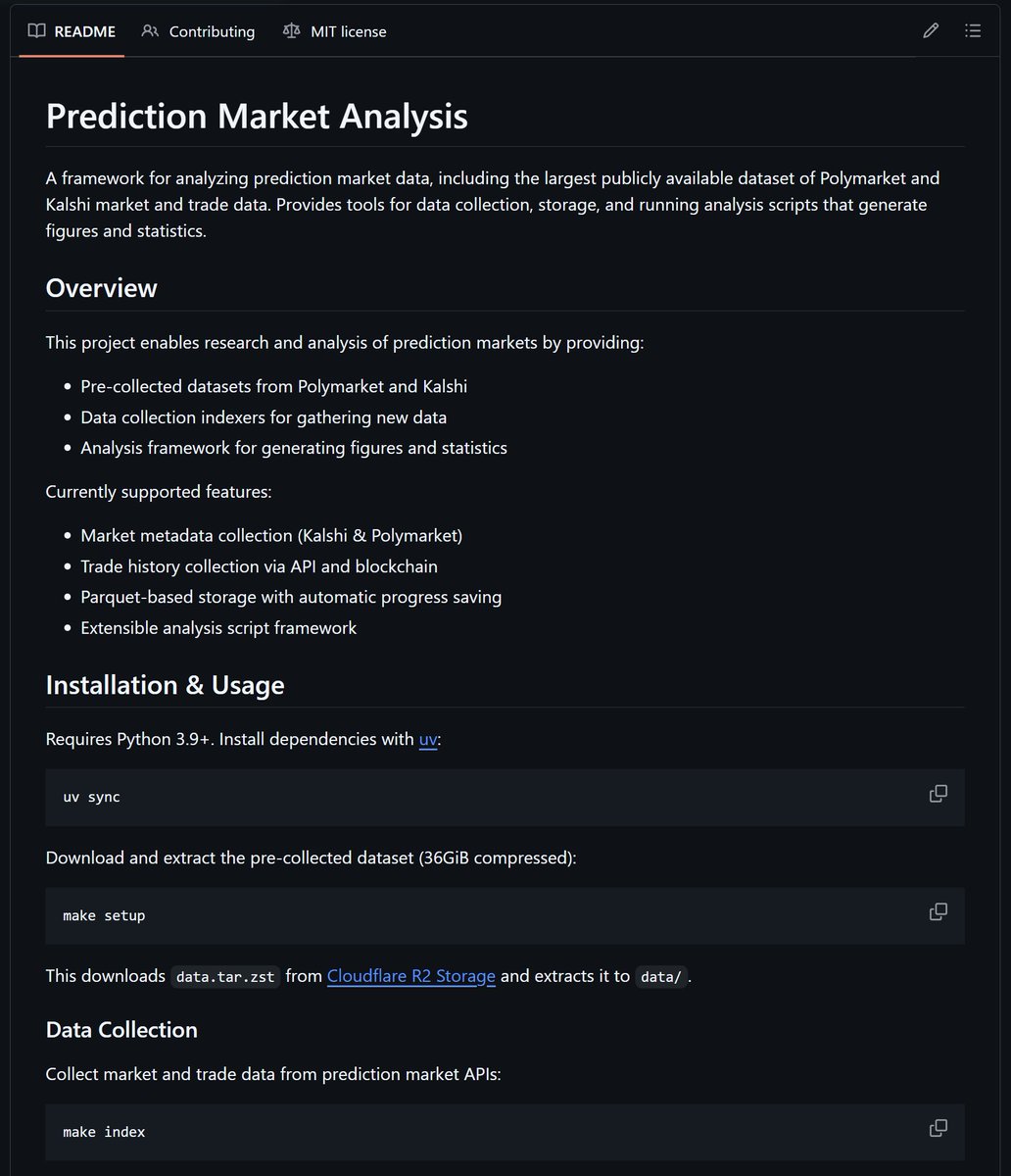
A Coinbase developer analyzed over 72 million Polymarket trades, collected 36GB of real analytical data and released it on GitHub for free…
This is the largest public prediction market dataset that I have ever seen.
Here is how you can use it for trading on Polymarket:
This dataset can help you see how prediction markets actually behave and how prices usually move in different market categories from start to resolution.
For example, you can use it to analyze and compare all historical markets within the same category and find price movement patterns that repeat over time:
Lets imagine, while working with this dataset, you discover that most movie markets are less volatile and often have a clear winner (with the highest % probability) right from the beginning - and BOOM, now this becomes your own created and tested trading strategy.
This way, you can create hundreds of different proven ideas and strategies based on real historical data.
In addition to the dataset, this repository comes with a few tools for fetching Polymarket data directly via API, so u can continuously refresh the dataset, process it, clean it and convert it into an easy excel format. You can even fetch detailed statistics for any trader who has ever traded on Polymarket.
This repo: https://t.co/qkoF6TyjJQ
Article, where the dev explains how this dataset works: https://t.co/D1YRQsvl6b
this bot made $339,000 just buying 99¢ contracts, literally risk-free
the rule is simple:
only buy contracts already trading at 99¢
only "crypto up or down" and sports markets where the outcome is already decided
just farming 0.01–1% per trade, over and over
his profile – https://t.co/YKT48Snb5L
the math is boring
the results aren't
Black hole physics helps make money on Polymarket
trading edges this trader uses:
he trades exclusively on weather markets on Polymarket
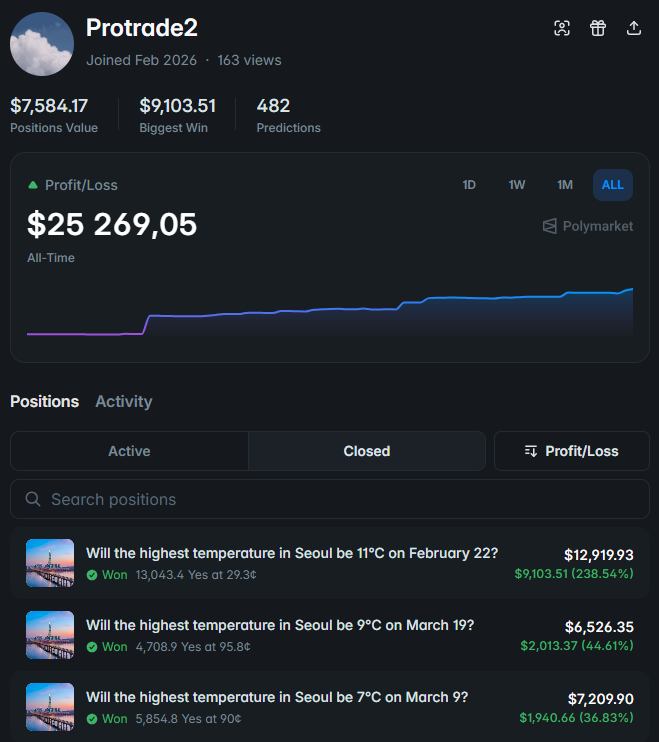
his secret is that he uses the concept of "market temperature":
T = 1/M_eff
> the fewer participants watching the market (low M_eff)
> the higher its "temperature" and the more chaotic the prices
Weather markets on Polymarket are burning hot
almost no one is watching, yet the data (weather forecasts) is public and accurate
High T → find the edge. Low T → size up the position
using this approach he made $25,000 in 482 predictions
best traders don't predict they choose markets where they have an advantage
his profile: https://t.co/i1K62ruk3B
best tool for copytrading: https://t.co/KgQ0WCncXZ
This guy made $15,000 on Polymarket with a 100% win rate
Simply by betting $5 on the weather
Result:
$5 → $15,000
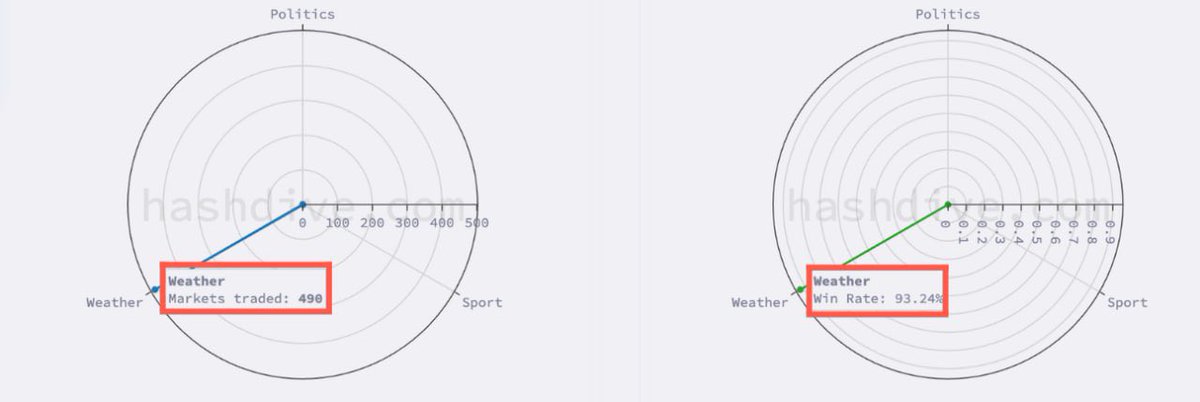
490 trades.
Win rate 100%.
The biggest win: $2,600 on a single bet.
Profile and copytrading:
https://t.co/pnfwYRi8TL
His strategy is simple:
- Buys YES only below 10-15c
- Buys NO only above 40-50c
- Still risks <$5 per position
Small bets + small price = positive profit over time
Bookmark this post so you don’t lose easy money
Polymarket trader turned $21 into $14.5K trading weather markets
He basically swapped a Big Mac meal for decent car in just 3 months
With 94.2% win rate over 490 predictions, he’s one of the best weather traders I’ve ever seen
His wildest trade:
$150 -> $2740
Strategy is simple: buy Yes/No shares at 0.05-0.95 odds and manage your risk
His profile - https://t.co/dAiAyakGYN
Tool for copy trading - https://t.co/nM3lGdUz1a
I just found the 3 best and super underrated ready to use Polymarket tools on GitHub and they are completely free…
Everything u need to automate and make your trading and decision making on Polymarket much easier:
1. This tool analyzes everything happening on the internet over the last 30 days and finds useful patterns and trends. It is literally your own research assistant that helps u to decide what to bet on based on the latest news.
Gh link: https://t.co/yETdyU8jT7
2. AI trading server that lets Claude connect directly to Polymarket. It can analyze markets, track price movements and give u some text suggestions on how to approach yr next bet. You can even connect it to yr own poly account and let Claude trade for u.
Gh link: https://t.co/5kFPrvOY3E
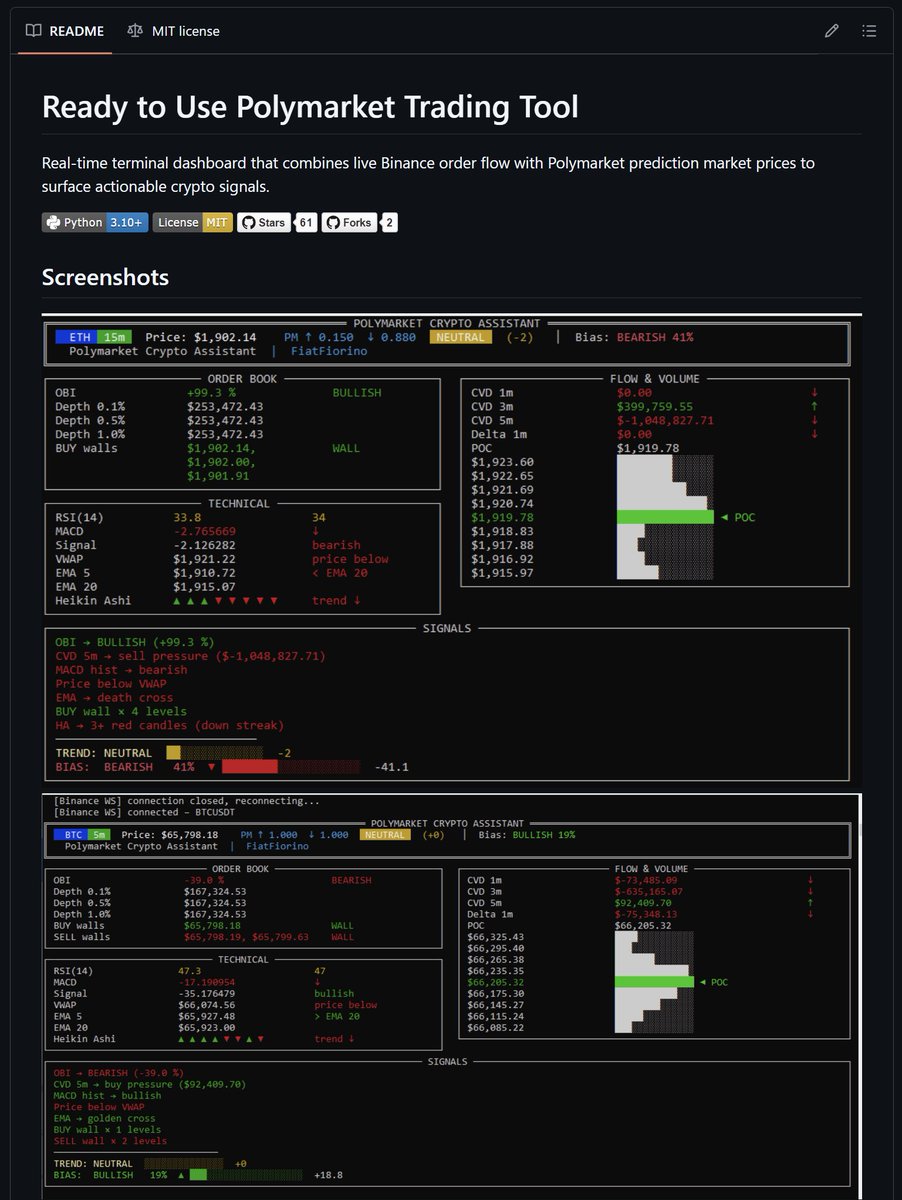
3. Real time market tool that analyzes live data from Binance and Polymarket at the same time. It uses 11 different indicators to show u exactly where the current market is heading and make your trading way more easier and clearer.
Gh link: https://t.co/hZWnnp3GwT
Each of these tools comes with a detailed step by step setup and usage guide, so its actually not so difficult to figure out…
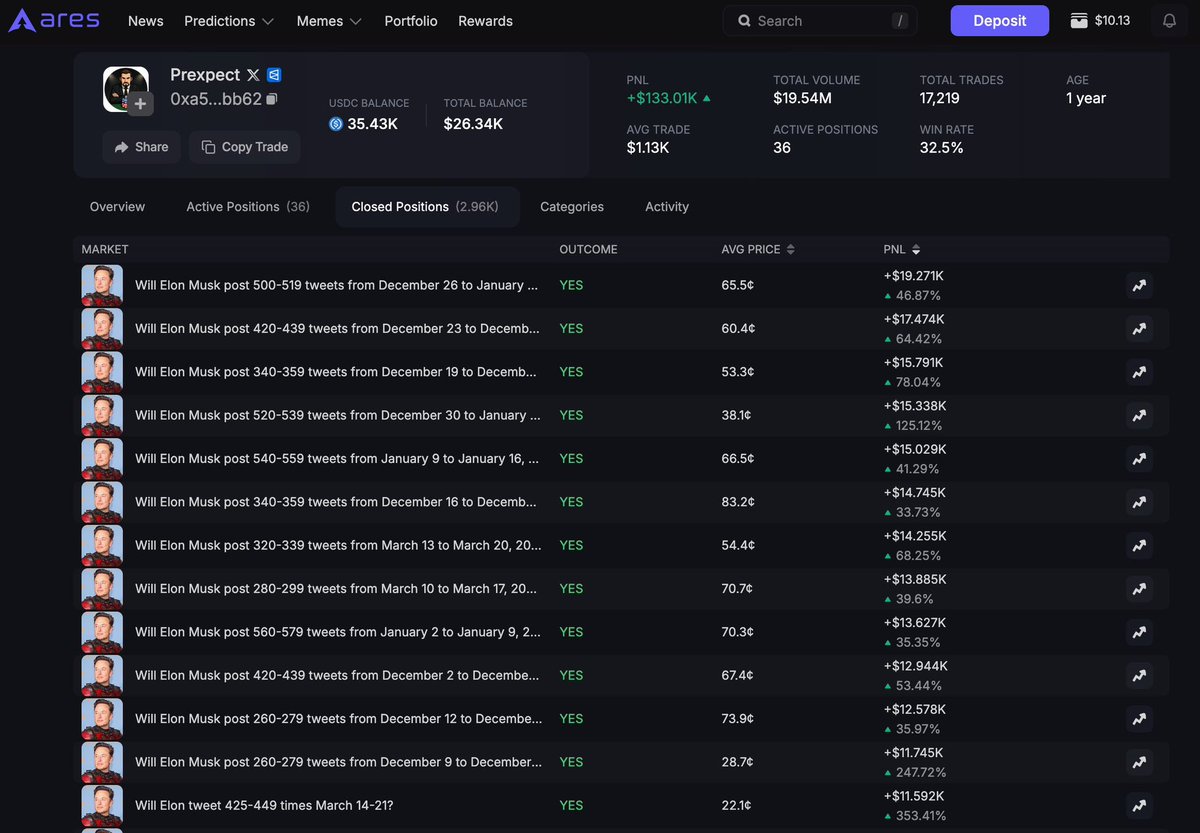
Trader earned $11,400 by betting $667 on Elon Musk’s tweets on Polymarket
He made a total of 2,200 predictions, of which he made a profit of $133,000
He usually buys almost all tweet predictions, 1.7c each for $80-$200
Likely places low-priced limit orders, generating 200%-1200% profit
His profile: https://t.co/3AwlKe3mtn
You can easily copy via Ares: https://t.co/WZWWayc3pr
I ran a simple test.
Asked ChatGPT, Claude, Gemini, and Grok one question:
“Find a wallet making $10K+ daily with the highest consistency.”
The answers told me everything.
ChatGPT → can’t access live data
Gemini → outdated wallets
Claude → “build your own pipeline”
Then Grok replied:
11 seconds.
One wallet.
“No losing weeks since December.”
Stats:
• $1.43M profit
• 37K+ trades
• ~375/day
I expected something complex.
It wasn’t.
Wallet →
https://t.co/CNjYwEc8bR
Copytrade →https://t.co/IPY41UFgnZ
The wallet trades one thing only:
Latency between Binance and Polymarket.
When BTC moves >0.11%
It waits ~10 seconds
Then enters.
That delay is the edge.
Not speed. Timing.
The whole system?
~20 lines of code.
But the real insight:
This isn’t a strategy.
It’s a pattern.
At least 11 wallets are running it right now.
Same logic. Same timing.
Same edge.