I Misunderstood the Best Advice I’ve Ever Heard
If you can live your life without an audience — you should do it.
- Bo Burnham
Easier to read version here: https://t.co/a8BZq89ZAM
I sat many times to write this essay — excited but also a bit frightened. How the hell would I shape this argument to make any sense?
How to use social media to sell the counter-intuitive message that you shouldn’t be focused on building an audience on social media?
Well… fasten your seatbelts. It’s going to be a ride.
The Saddest Comedy Special Ever (and the Best One)
Bo Burnham’s Netflix special Make Happy was probably one of the most transformational pieces of media I’ve ever consumed.
It’s a performance act about performing.
Isn’t that too meta? Well, it isn’t because, in the age of social media, we’re all performers, so we can easily relate to this idea.
He talks about the cult of self-expression, especially prevalent in the USA, where everyone is encouraged to just express themselves — always have something to say, always striving to be interesting, because that’s the thing everyone cares about.
There is one small problem with this approach though.
No one cares.
And funnily enough, that’s even part of the advice given to young creators who may worry that others would be laughing at their new endeavor.
“Don’t worry about other people thinking about you. They’re too busy thinking about themselves.” — this one is so popular, that I struggled to find the original source.
Bo presents social media simply as a market response to a generation that wanted to perform everything, all the time, for no reason.
He describes this as a self-made prison and ends this train of thought with the sentence that stayed in my mind for the last 7 years.
“If you can live your life without an audience — you should do it.”
I lived my life without an audience and I’m glad I did
I’m not a huge fan of social media.
- Facebook makes me stressed — it’s a great way to be aware of potential problems I would never have.
- Instagram is shallow and fake — a perfect place to compare your uneventful Monday afternoon to a well-curated snapshot of someone’s best day in life.
- TikTok is just… wrong. On. So. Many. Levels.
- X honestly looks most promising — it’s amazing at creating bubbles of like-minded people, which is both a powerful tool, especially for creative endeavors, but also a free-for-all hell/heaven for ideologies.
There is one common feature that they all share — you don’t really need them.
I’ve lived my life until this point with barely any contact with social media. At university, I used Facebook groups sparingly to stay in touch with current events and brainstorm some challenges we were facing (that was very useful!)
- I still had a lot of friends.
- I still dated and married the love of my life.
- I still knew about all the interesting stuff happening.
- I still was able to learn, score high on exams, and get my dream job.
I just don’t feel I missed anything significant.
I lived my life without an audience, and without being a part of an audience.
I just learned, played, engaged in hobbies, spent time with my friends, and cared about those I truly cared about.
And all of that was easier because I wasn’t paying the price you need to pay for the use of social media — anxiety, self-doubt, and the constant stream of distractions.
So… what is your point exactly?
Well, that’s a good question!
Recently I’ve encountered some new influential sources that made me change my mind on the matter a bit.
Here are my newly discovered reasons why it’s worth engaging on social media while avoiding its pitfalls.
Audience vs Tribe
What is an Audience exactly?
“The assembled spectators or listeners at a public event such as a play, film, concert, or meeting.”
The audience is the passive spectator that doesn’t truly engage with the content — they just observe.
The audience is a consuming crowd. They’re not meant to be part of a creative process.
Let’s try Tribe
“A division of society built from communities linked by social/economic ties with a common culture and usually a recognized leader.”
This looks way more promising, isn’t it?
What got me interested in social media again was the realization that we can be more than an audience. We can build tribes.
We can cooperate, share ideas, and argue about them.
Journaling is an amazing way to refine your critical thinking. You can’t bullshit yourself as easily on the paper as you can in your mind.
Publishing your writing on social media — sharing it with a tribe — is a natural next step. Now you need to be precise and elaborated enough to not only pass your own “bullshit filter”, but also of all the people that read it.
It’s a true test of your thinking abilities, one you cannot replicate alone.
How to Build a Tribe instead of an Audience
I propose two cornerstones of creating true value on social media Authenticity and Depth
1. Authenticity — Do you want to be an actor?
“Autobiography is only to be trusted when it reveals something disgraceful.”
— George Orwell
What does a great actor do?
He impersonates a fictional, scripted character so well that it seems real.
Social media is an ideal place to create a likable, perfect persona. Follow all of the guidelines for who you should be, what you should talk about, and how you should structure your content to gather the most attention.
You can learn to be a great actor. You can build a functioning tribe based on a persona you created to lead it.
It will work.
It will work because it’s science at this point — the most successful and the most driven people sat down and figured this out — these methods work, there is no point in arguing about that.
Feel free to use all of these methods — they’re not bad, they’re just tools. You’re not a bad person for using them — that’s not my point.
Just make sure that what they will give you is the thing you actually want.
The more this persona and your content are detached from who you really are — your values, skills, and how you act in your real life — the harder it would be to sustain this way of living for a long time. Sooner or later, especially with growing success, acting would become your next day job.
What I propose instead is more of a self-invention rather than a self-promotion journey. Growing, developing skills, and talking genuinely with people.
Making sure that in “Hey, look how good I am!”, the “How good I am” comes before “Hey, look at me” (stolen from J. Peterson).
If you reach for the stars, make sure you know which one you want to pick when you get there.
2. Depth — Show your Work (not life)
“Whatever we say, we’re always talking about ourselves.”
— Alison Bechdel
“Show Your Work” by Austin Kleon was the book that was the final piece that convinced me to publish my writing online. The first article I’ve written was about this very book.
The audience is created by presenting shallow things — cute pictures, random, daily stories, and funny comments.
And once again — those are not bad.
Humor, aesthetics, and silly experiments are very potent — we all like them, and they lighten our lives up. They are small distractions, but as long as they’re genuine and uplifting — there’s nothing bad about a small distraction.
Playfulness is one of the traits that make people like you, but it also has a huge upside of being a natural driver for creativity.
Just make sure they don’t form the main body of your content.
Present your audience a real value:
- Deep, thought out long-forms,
- Detailed processes,
- Real stories with some ambiguous, complex lessons.
And then complement it with playfulness — from time to time let your creativity go crazy — show your silly side.
That’s my current approach to building a tribe and engaging on social media.
I’m aware that this is going to be a long journey.
I’m aware that it may not lead to any form of “measurable” success.
But it’s ok. I think this journey is worthwhile and enjoyable in itself. In the end — that is all that matters to me.
Closing Thoughts
This one was the hardest essay to write to date. I had no idea how to approach it but I felt like there were important lessons here, so I was determined to finish it.
Hopefully, I managed to make a compelling argument here. If not — I’ll try again next week with another essay.
------------------------------------
I’ll be very glad for any feedback on this one — this felt very experimental.
I hope you enjoyed reading this article as much as I enjoyed writing it.
If you want to join me on a journey of embracing Joy in your life join my weekly free newsletter Joyful Mindset and check my X profile for daily ideas and stories.
@ShienaGable You'll get hurt from time to whether you're vulnerable or not.
I think trust and vulnerability is vital for any meaningful relationship or pursuit, so it's worth taking a shot ;).
People get addicted to many things.
Alcohol, social media, pornography, drugs - those are usually easy to spot.
What's harder to notice is the addiction to the certainity of outcomes.
In this addiction your freedom to act as you wish is taken by your perfectionism.
@eliseorenteria I went into sort of monk mode learning for 12h+/day and cutting all distractions, but it's going to end next week ;). I'd sure want to go back to writing later, but I'm not sure about X. I truly enjoy the silence and peace I created in my life lately without social media.
I'm handling my biggest learning project yet, and I had to experiment with some approaches to optimize it.
Nothing worked better for both my efficiency and mood than leaving my phone away for 10-14 hours periods.
@IJ_Neubauer Oh, that's a great question! The realization that any change is going to be rough in one way or another and will require your effort is a crucial condition for a change to happen.
The goal of having a plan isn't to be strict, but rather intentional.
The schedule can be changed at any time, it's the sustained thought you put into it that matters.
@cajunkoi It's not a one-time thing though. I found a lot of value in strictly banning nearly all Internet use during my learning/working periods (usually 8am-5pm).
Constantly switching between the shiny reality of social media and deep focus is tiring AF.
My #1 Weight-Loss “Hack”
Figuring out the answer to a popular question
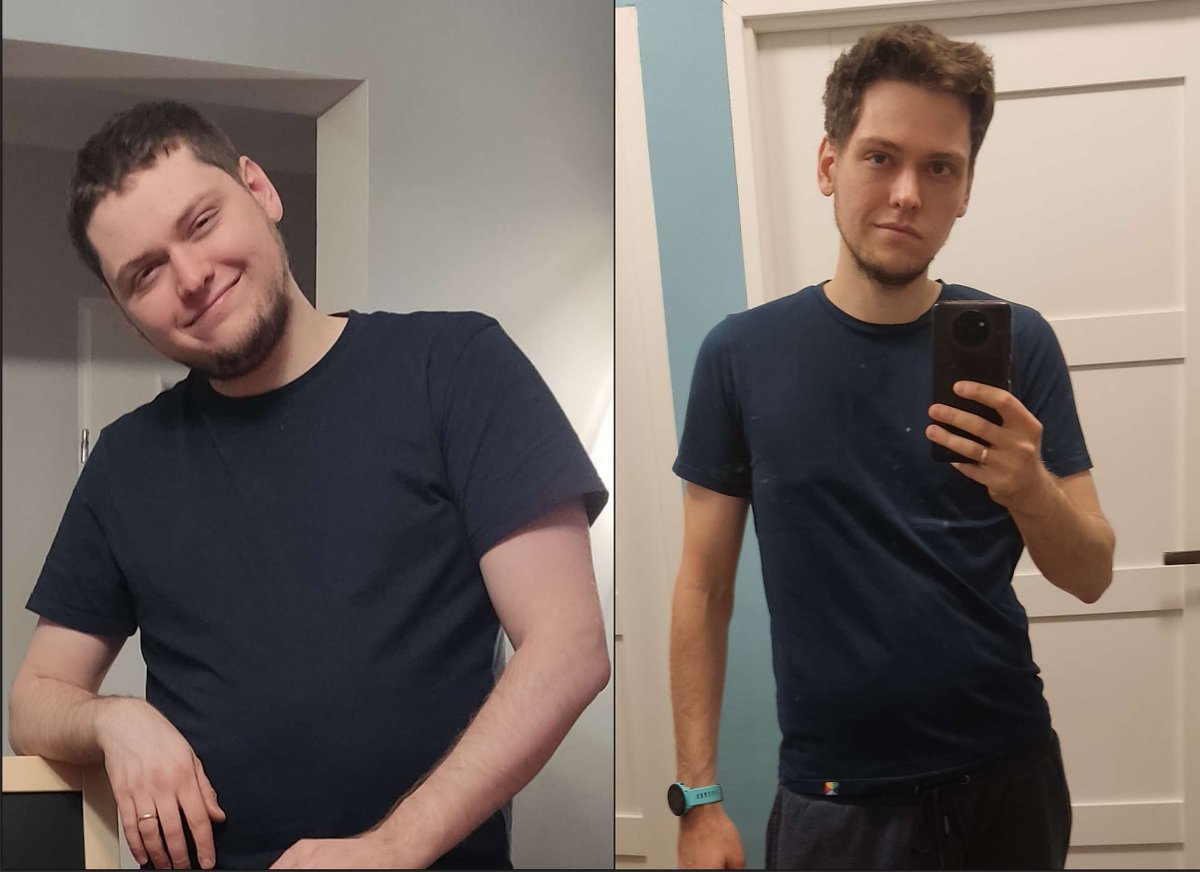
I managed to lose 25 kg in 7 months last year.
It was certainly a great achievement, and it was noticed by many of my friends and family members.
As nearly everybody seems to have “lose weight” on their ongoing to-do list I’ve been asked A LOT how I did it.
I’ve appreciated the compliments and I tried hard to introduce some of my new habits that I considered crucial to my journey.
1. “I eat a lot of protein and unprocessed foods.”
2. “I move every day, and I do my best to make exercise fun.”
3. “I’m not very strict with my diet, I’d let myself have some cheat meals regularly.”
Those were all great tactics I used, but I never felt quite content about those answers. They seemed lacking. I don’t think I’ve helped ANYONE lose ANY weight with those.
I’ve pondered this question a lot for the last year, trying to come up with a more coherent, definite answer that’s actually helpful.
And finally, one day I did manage to find the answer I’m happy with. It seems real.
Ready?
(drum rolls)
I’ve spent a year of my life directing a lot of attention and energy to this issue. I thought about it a lot, read a few books, listened to countless hours of content, thought about it a lot, and experimented with different approaches.
For 12 months it was the #1 priority I’ve put most of my attention to.
Not very sexy, right? Can’t call that “hack” I guess.
The thing is… if you’re up to something hard you need to put in the effort. That’s the only way to solve any problem.
If it was easy you’d have succeeded already.
How I’ve Managed to Free Myself From Distractions And Build a Life of Depth
"You need a VERY strong why, that will carry you through this process long enough to let you experience how joyful your life is on the other side."
Full article here (free): https://t.co/ofaLFjHNtk
The Most Important Reason I Don’t Drink Alcohol Anymore
It was hidden from me in plain sight.
I don’t like drinking alcohol.
A weird conversation starter, I know. I still feel a little bit crazy anytime I say that.
I’m yet to meet anyone else to say those words, but I’m pretty sure I can’t be alone. People would support their drinking or not drinking with various arguments, yet the most important reason for doing any leisure activity — either enjoying it or not — almost never appears in the conversations.
The funny thing is — it hasn’t really stopped me from drinking for the last decade or so. I’ve never been wasted (before you say “Oh, that’s your whole problem!” — no it is not), but I’ve still drank a little bit (or a little bit more) from time to time.
Why?
Honestly… I have no idea.
- Why would I drink despite not liking the taste or the feeling?
- Why would I participate in the drinking culture despite despising it wholeheartedly?
When I noticed this paradox, I managed to finally set myself free. I don’t need to drink. It was like a stupid epiphany that for some reason took me 12 years. It should have always been obvious, yet never was.
So I stopped. And nothing happened.
When people ask if I would want some alcohol I would say “No, thank you.” with a smile.
If they follow up with “Why?” or further encouragement, I’d just answer “Because I genuinely don’t like drinking.”
I got some weird looks and funny conversations. Some people are puzzled.
But it’s fine.
The only reason to drink alcohol is to enjoy doing it. If you don’t, especially if you feel regretful after you do, please take those comforting words from me.
There’s never a need to drink alcohol.
Stressful situations help you figure out a few most supportive people in your life.
Make sure to nurture the relationship with them and pay back the support they’re providing you with.
They are worth more than anything else you have.
Study Quest 4.0 launches TODAY!
This is our biggest effort to make learning how to learn as addictive as a video game.
💭 What is Study Quest?
💡 Why is this special?
❓ How does it work?
Love your questions. Let me pull the curtain and start our mini exploration:
↓