✍️Every individual’s life experience is invaluable, and prioritizing HSE reflects our commitment to safeguarding both people and the planet. Let’s work together to uphold these principles every day.
#SafetyFirst
I just dey listen to Mr Peter Obi's recent interview.. my head just dey ache me 😣
And the way he was being all touchy with Mr Rufai it was so uncomfortable to watch
🚨 GOOD NEWS: Nigerian Army and ONSA Tactical Team kill wanted terror kingpin Kachalla Ibrahim Battijo, neutralise over 15 terrorists, dismantle his network, and foil a planned attack and abduction of WASSCE students in Kogi State
Retweet this if you're not Sadist or terr0rist sympathiser 🔥🔥🔥👇
360 lives rescued in one singular operation no commendation from armchair and social media Generals to Nigerian Troops until there's little setback.
🫡🫡KUDOS, MORE SUCCESSFUL OPERATION AHEAD.🫡🫡
Terrorist sympathiser will not happy with this good news Rt 👇🔥
🚨 BREAKING: Troops Storm Terrorist Stronghold, Rescue 360 Abductees in Daring Midnight Operation!
In a major breakthrough against insurgency, Operation HADIN KAI troops have rescued 360 kidnapped victims from a heavily fortified JAS terrorist enclave hidden deep within the Mandara Mountains of Borno State.
The intelligence-led operation, executed by Special Forces and Sector 1 troops, saw security forces infiltrate the terrorists' stronghold under the cover of darkness, overwhelming insurgents and securing the release of hundreds of men, women, and children abducted from communities around Ngoshe.
Military sources revealed that weeks of covert surveillance, intelligence gathering, and strategic planning paved the way for the successful rescue mission. Several terrorists reportedly fled, while others surrendered as troops took control of the enclave.
Sadly, two infants lost their lives due to exhaustion and the harsh conditions endured during captivity and evacuation.
The operation is being hailed as one of the largest hostage rescue missions carried out by Operation HADIN KAI in recent years.
April 2026, during the "Opposition summit" in Oyo state where Atiku, Peter Obi, Seyi Makinde and other major opposition figure gathered.. an address was directed to the present administration where the term "OPERATION WETIE" was used.
Do what you pls with that info
Nigeria - US coordinated air operation has killed 21 fighters of the Islamic State West Africa Province (ISWAP) in Borno state.
2: media and good Nigerians should commend the Military.
3: RT this aggressively as you dey share bad news
The Nigeria-US AFRICOM security partnership is delivering measurable results. In the latest precision operation in Arege, Borno State, 21 ISWAP fighters were eliminated in a joint strike coordinated by the Nigerian Air Force and US Africa Command. The strike marks another dividend from a defence relationship that has shifted from training-only to direct, intelligence-driven action against terrorist networks.
JUST IN: Nigerian Army troops have rescued 23 passengers who were abducted by suspected kidnappers along the Ayegunle–Bunu Road in Kabba-Bunu Local Government Area of Kogi State.
Learn from Senegal.
At trying times, people naturally dislike reassuring messages.
They prefer a plate of food today to promises of a sustainable future on the horizon.
That is the story of Nigeria right now.
Many citizens are weighing current pain against expected future gains. The challenge for any government is convincing people that today's sacrifice is producing tangible results, not just hopeful rhetoric.
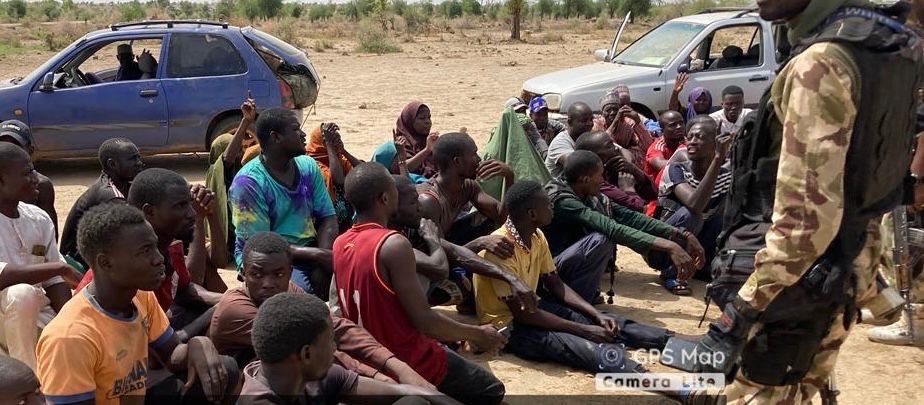
TROOPS RESCUE 92 KIDNAPPED VICTIMS, DETONATE IEDs IN BURATAI
Troops of the Joint Task Force (North East) Operation HADIN KAI have rescued 92 kidnapped victims from Boko haram/ISWAP terrorists along the Buratai–Kamuya road, Biu Local Government Area, Borno State
A statement by the media information officer, Operation Hadin Kai Lieutenant Colonel Sani Uba says, the rescued victims comprising 52 males, 33 females and 7 children, along with 8 vehicles were apprehended. The troops also detonated three IEDs along the Bula Zarma, Mangari general area.
The Nigerian Air Force, under Operation HADIN KAI, intensified its counter-terrorism offensive in Borno State with fresh airstrikes targeting terrorist strongholds and logistics bases around the Sambisa Forest axis.
Acting on credible Intelligence, Surveillance, and Reconnaissance reports, NAF fighter jets on 26 May 2026 launched precision strikes on terrorist hideouts and support structures at Biramiri in the Gezuwa area.
The strikes destroyed key insurgent facilities, eliminated several fighters, and dealt another major blow to the terrorists’ operational network.
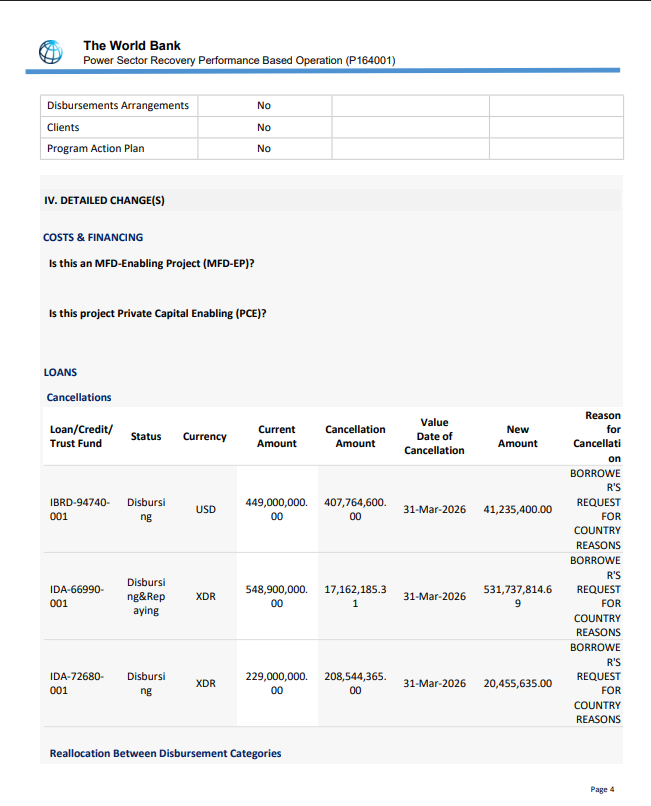
Based on my reading about the cancelled World Bank loan, it appears that:
1. The World Bank (WB) stated there was a "persistent mismatch between power sector revenues and costs," which created "recurrent financing gaps," most notably in the form of "tariff shortfalls." In simple terms, Nigeria was not generating enough revenue to sustain its power sector.
2. In 2021, Nigeria developed a Power Sector Recovery Programme (PSRP), funded by the WB with US$20 million. The implementation was "satisfactory, brought substantial results." The results are listed below:
2.1 Between 2019 and 2022, tariff shortfalls decreased by 71% (from N581b to N166b).
2.2 Regulatory cost recovery increased from 56% to 94% during this period.
2.3 Annual electricity supplied to the distribution grid grew by 13% between 2018 and 2021.
3. Based on this success, a new US$750 million loan was approved on 9th June 2023.
4. However, in June 2023, Nigeria liberalized its foreign exchange market, meaning it needed more Naira to pay for local gas priced in USD. "This effectively increased tariff shortfalls from a low of N140b in 2022 to an estimated N1.9 trillion in 2024 and 2025, exerting serious pressure on the limited fiscal space of the Federal Government of Nigeria (FGN)."
5. According to the World Bank, while "prior results have been achieved and verified," the "broader disbursements under the Additional Financing have not materialized as expected, due to the increase in tariff shortfalls".
In summary, Nigeria devalued its currency thus could not cover the cost of gas priced in $, resulting in soaring power liabilities. Also only Band A tariffs were raised. As a consequence, the World Bank withdrew the loan, citing that progress remains "Moderately Unsatisfactory."
@FinPlanKaluAja1 "The government must use this window of relative calm to aggressively grow non-oil revenues, improve spending efficiency, and gradually reduce reliance on borrowing. Stability has bought Nigeria time." -Kalu Aja
✍️
Pedestrian analyses like this are rife on social media, it’s even funnier when they pose as “finance guy” while running complex macroeconomic analysis using nothing but flat, context-free numbers. Comparing the nominal price per kWh between the US and Nigeria without accounting for supply, infrastructure scale, and investment economics completely misses the mark.
There’s a reason Nigerian/african food is extremely expensive in western countries than in their local countries, a tuber of yam in London can cost £5-10 that’s about N10-20k for a tuber of yam that cost N2-3k in Lagos and the reason is simple supply and demand. The supply of yams in London outpaces the demand hence the higher price.
How does that affect the cost of electricity in say China, the US & Nigeria? Firstly to get a picture of the supply gap the USA & China generates about 500GW an 1200GW of electricity per annum respectively, this economies of scale the Us & China enjoys enables them supply electricity for cheap by contrast Nigeria generates 5GW of electricity annually for a 200m+ population, for a 200m+ population that’s 100x & 240x less than US & China.
Quite frankly the fact we are paying comparative prices with Americans or Chinese while having less supply shows power is already heavily subsidized in Nigeria bcos with the supply gap power could be 10x more expensive in Nigeria w/o the current subsidies, cost reflective pricing w/o scaling up infrastructure means supply would compact for areas that can’t afford it and focus on areas that can, we already have a semblance of this with the Band Pricing, even though that it self is still subsidized.
Solving the maths for the infrastructure gap reveals why the problem is even more complex when you compare FG’s revenue ($20b annually) versus the CapEx required to fix the grid which runs into $100-300b to 10x our generating & distributing capacity to 50GW. No rational private investor or multilateral institution (like the IFC or World Bank) will dump billions of dollars into a sector where regulations force the product to be sold below the cost of production and distribution.
Without cost-reflective pricing:
1. Distribution Companies (DisCos) can't pay Generation Companies (GenCos).
2. GenCos can't pay gas suppliers.
3. The entire value chain collapses into debt, requiring trillions in government bailouts (subsidies) that the national budget simply cannot sustain anymore. The FG & discos are still locked in a battle of subsidies owed to them.
I expected this should be obvious to so called “finance guys” but go figure! Price of a commodity across multiple economies is way more complex than this lazy submission here, it’s not always an apples to apples comparison!