A Chicago philosopher wrote one book in 1940 proving that 95% of the books you have read in your life, you didn't actually read, and Charlie Munger has been telling people to read it for 50 years.
His name was Mortimer Adler.
He spent 40 years at the University of Chicago, ran the editorial board of the Encyclopædia Britannica, and built his entire career on one uncomfortable observation about the people around him.
Most adults who called themselves well-read had not actually read a book in the real sense even once. They had run their eyes over the pages, registered the words, formed a vague impression, and put it back on the shelf.
The book had passed through them without ever entering them.
In 1940 he wrote How to Read a Book. It has stayed in print for 86 years.
Charlie Munger recommends it. Naval Ravikant recommends it. Fareed Zakaria recommends it.
Every serious thinker who builds a career on absorbing information eventually finds their way to this book, and the reason is that Adler had isolated something nobody else was naming clearly.
There are four levels of reading. Almost everyone is stuck on the second one. The fourth level is so different from what most people call reading that you have probably never done it in your entire life.
Level one is elementary.
You learn it as a child. You decode the letters into words and the words into sentences. You finish the sentence and understand roughly what it said. This is reading the way a 7-year-old reads, and almost every adult on earth has stopped developing past this point in some quiet way.
Level two is inspectional.
This is skimming. You move through a book quickly to figure out what it is broadly about. You read the back cover, scan the table of contents, glance at a few paragraphs, and form an opinion. Most adults who claim to have read 50 books a year are actually doing this. They are inspecting books, not reading them. They walk away with a vague sense of the argument and almost none of the evidence that supports it.
Level three is analytical.
This is the level Adler said most people have never properly experienced. You take one book and you wrestle with it for as long as it takes. You identify the question the author is trying to answer. You map their argument from front to back. You write your disagreements in the margins. You force yourself to articulate, in your own words, what the author is claiming and why. The point is not to finish the book. The point is to argue with it as if the author were sitting across the table from you. Most people never do this once in their life, because it is exhausting and slow and feels nothing like the reading they were taught as children.
Level four is the one almost nobody knows exists. Adler called it syntopical reading. The word means "across topics," and the technique is something closer to running a small private research lab in your own head.
You pick a single question that actually matters to you. How does power corrupt people. Why do civilizations collapse. What makes a marriage last. How does a person change their own mind. Then you assemble five or ten or twenty books from different authors, different centuries, different traditions, all of them taking a swing at the same question.
You do not read any of them cover to cover. You move between them. You find the chapter in book three that addresses the same question as the chapter in book seven. You force those two authors to argue with each other inside your own head.
The book stops being the unit of reading. The question becomes the unit. And the authors become voices in a conversation you are now hosting.
This is the level where reading stops being consumption and starts being construction.
You are no longer absorbing what someone else thinks. You are building a position of your own out of the friction between people who disagreed.
Adler argued that this is the only level of reading where you stop being a passive receiver of other people's ideas and start being someone who can produce ideas of their own.
The reason Charlie Munger has been recommending this book for 50 years is that this is exactly how Munger has always thought. He calls it building a latticework of mental models. The technique he is describing is just syntopical reading applied for a lifetime.
You take the strongest insight from psychology, the strongest insight from biology, the strongest insight from economics, and you stack them against the same problem until something new falls out the bottom.
The reason most people never reach level four is not that it is intellectually difficult. It is that it is logistically uncomfortable. It requires you to keep multiple books open at once.
It requires you to take notes that nobody is going to grade. It requires you to abandon the goal of finishing books and replace it with the goal of answering questions.
This is also why AI just changed everything Adler was teaching.
NotebookLM, Claude, and tools like them let you do syntopical reading at a speed that would have looked like magic to a Chicago philosopher in 1940.
You upload 10 books on the same question. You ask the AI to surface every place those authors agree and every place they contradict each other.
The technique Adler said almost nobody on earth had reached can now be run on a Sunday afternoon by anyone with a laptop and one good question.
The technique was always the unlock. The bottleneck used to be time. The bottleneck is now curiosity.
Most people will keep reading the way they always have. A book at a time. Eyes over the pages. No question driving it. No other authors in the room. Adler called that level two for a reason.
You are not behind on your reading list.
You are behind on the level you are reading at.
$NOW can easily triple from $125 by Jan 2027.
Remember, token use is expected to 2800% in 5 years says $GS.
So these 24 stocks can still 10x-20x:
(COMPUTE / GPU)
1. $NVDA — Every token touches a GPU. 24x tokens = 24x chip demand, full stop.
2. $AMD — MI300X gaining enterprise traction. Second GPU source as hyperscalers diversify suppliers.
3. $INTC — Gaudi AI accelerators + x86 CPUs running inference at the edge and enterprise.
(NETWORKING)
4. $ANET — AI clusters need ultra-low latency switching. 24x tokens = 24x network traffic routed.
5.$AVGO — Custom AI ASICs for hyperscalers. Token volume drives ASIC and switching orders higher.
6. $CSCO — Data center fabric and ethernet switching. Every agent call crosses Cisco infrastructure.
7. $CIEN — Optical networking backbone connecting AI data centers. Bandwidth demand scales with tokens.
(MEMORY / STORAGE)
8. $MU — HBM3E stacked on NVDA GPUs. More inference = direct memory bandwidth demand explosion.
9. $WDC — Flash storage holds model weights and KV caches. Agent scale drives NAND demand structurally.
10. $STX — Hard drives store cold AI training data. Data center storage TAM expands with every model.
(POWER / COOLING)
11. $VRT — More tokens = more heat. Liquid cooling demand explodes alongside data center power density.
12. $ETN — Electrical infrastructure for AI data centers. Power management is the #1 buildout bottleneck.
13. $GEV — Gas turbines and grid solutions powering new data center campuses requiring gigawatt-scale energy.
14. $VST — Power generator selling directly to hyperscalers. AI energy contracts already locked in long-term.
(CLOUD PLATFORM)
15. $MSFT — Azure hosts majority of enterprise agents. Token spend flows straight through its cloud margin.
16. $AMZN — AWS Bedrock is the enterprise agent backbone. More agents, more API calls, more revenue.
17. $GOOGL — TPU infrastructure + Gemini API. Every token processed on Google Cloud prints margin.
(ENTERPRISE AGENT LAYER)
18. $NOW — Enterprise agents run on its platform. Every workflow automated burns more tokens daily.
19. $CRM — Agentforce deploys AI agents across sales, service, and marketing. Per-action token billing scales.
20. $PLTR — AIP platform runs AI agents on enterprise and government data. Token volume is its revenue driver.
(AI INFRASTRUCTURE)
21. $NBIS — Pure-play AI infrastructure at ground level. Token supercycle lifts the entire compute ecosystem.
22. $SMCI — Builds GPU server racks for data centers. Every NVDA chip needs a SMCI chassis to run.
23. $DELL — AI server sales to enterprises exploding. Token growth drives hardware refresh cycles faster.
24. $ARM — Chip architecture inside every mobile and edge AI device. Royalties scale with token proliferation.
$NOW is the most undervalued right now. This is why Jensen Huang says the market has made a mistake on it.
♻️ RESHARE this post and write 1 comment, I'll DM you the best $NOW contract to buy and hold.
Harvard Business School charges $200K to teach you how to think like a strategist.
I built the same thinking system in one afternoon
Here are the 10 Claude Opus 4.6 prompts behind it:
🚨 Anthropic just showed a 27-minute workshop on how to actually do prompts for Claude.
Taught by the people who built it.
Free. No registration. No paywall.
I've seen $300 courses that don't cover what they teach in the first 8 minutes.
Watch it and bookmark it now.
🚨شوفت رئيس أكبر شركة ذكاء اصطناعي في العالم صدم الكل وقال إيه!
ديميس هاسابيس (رئيس Google DeepMind + حاصل على نوبل في الكيمياء) صدم الجميع في محاضرته بـ Cambridge وقالها علني:
"في المستقبل القريب، شخص واحد بيفهم الذكاء الاصطناعي هيتفوق على تيم كامل في شركة ناشئة"
احفظ البوست ده عندك دلوقتي عشان ترجع له قبل ما تنسى.
الموضوع بقى حرفياً مسألة وقت، والسر اللي الكبار بيخبوه طلع للعلن!
فيه جزء في المحاضرة دي مش قادر أوقف تفكير فيه:
- الـ AI اللي بتستخدمه النهاردة هو أغبى نسخة هتشوفها في حياتك، اللي جاي مرعب.
- كمان 5 سنين، الفجوة بين اللي بيستخدم الـ AI واللي مبيستخدموش هتبقى مستحيل تستخبى.
- الشركات هتدار بـ 10 أشخاص بس بيعملوا شغل كان بيعمله 200 موظف زمان.
- اللي هيوصلوا الأول مش الأذكياء، بل الناس اللي بدأت من دلوقتي صح.
حاليًا، الشخص الطبيعي بيفتح أي موديل، يكتب أي برومبت، ياخد الإجابة، ويقفل التاب.. هو فاكر إنه كده بيستخدم الذكاء الاصطناعي! بس الحقيقة هو مش مستغل أكتر من 10% من قوته.
بدل ما تضيع وقتك في سكرول ملوش لازمة، اتفرج على المحاضرة دي.. ده أوضح وأقوى شرح شوفته في حياتي من الراجل اللي خلّى الذكاء الاصطناعي يحل أعقد مشاكل البيولوجيا.
المحاضرة دي مفيدة جداً، سواء كنت مبتدئ أو بتستخدم الـ AI كل يوم.
نصيحة: احفظ الفيديو وشوفه حالاً عشان تشوف المستقبل رايح فين وتسبق الكل.
لايك وفولو واحفظ البوست عشان يوصلك كل جديد!
Finance starts with understanding the Balance Sheet
If you don’t understand it, you’ll never truly understand finance
But don’t worry, I’ll teach you everything you need to know about the Balance Sheet right here 👇
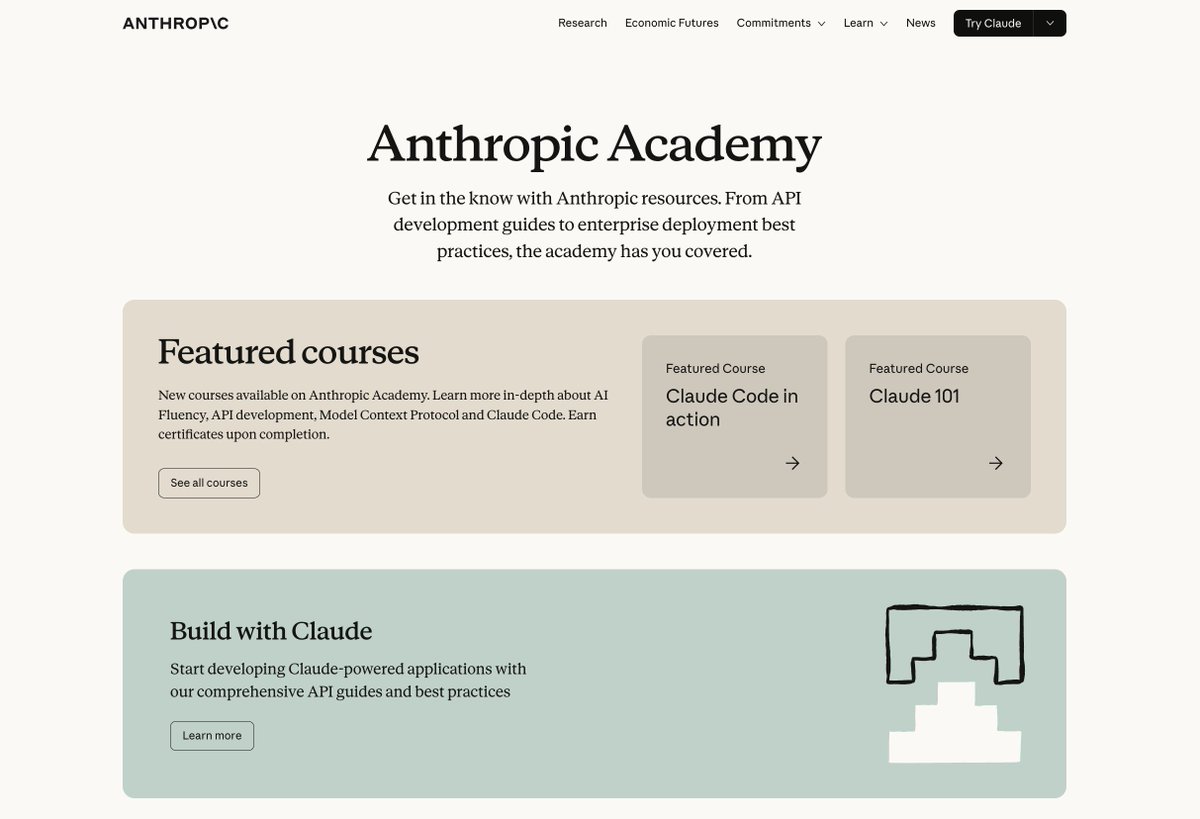
Claude is offering 18 official AI courses with certificates.
And it's 100% free:
1 - Claude 101. Learn Claude for everyday work.
https://t.co/e6zE5ZGigi
2 - Master Claude Cowork. Build powerful agentic workflows right on your desktop.
https://t.co/6YwizS6V5S
3 - Claude Code 101. Master vibe coding with Claude Code.
https://t.co/XsLNY1HMZH
4 - AI Fluency: Core concepts for AI literacy
https://t.co/tl3KSkWMX4
5 - Introduction to Agent Skills.
https://t.co/E3rUCHLhOi
6 - Building with the Claude API.
https://t.co/wOyPE7l61v
7 - Claude Code in Action. Integrate Claude Code into your dev workflow. Hands-on, practical, ship-focused.
https://t.co/KHNiH777M6
8 - Intro to Model Context Protocol. Connect Claude to your local data. The ultimate game changer for context.
https://t.co/FMXmiaN8H8
9 - MCP: Advanced Topics. Build custom integrations and MCP servers. For heavy-duty scaling.
https://t.co/Bi9JJWaagU
10 - AI Fluency for Students. Use AI to study and research smarter. The ultimate cheat code for academics.
https://t.co/ujjMlEqLSj
11 - AI Fluency for Educators.
https://t.co/HHaUIeOfJm
12 - Teaching AI Fluency.
https://t.co/PhQ59xSXRl
13 - AI Fluency for Nonprofits. Maximize your mission's impact. Do way more with way less.
https://t.co/2jHfnOXXN9
14 - Claude with Amazon Bedrock. Deploy Claude on AWS infrastructure. Enterprise-grade scaling made easy.
https://t.co/3KY1K0QBvV
15 - Claude with Google Cloud's Vertex AI. Deploy Claude on Google Cloud infrastructure. Seamless cloud integration for scaling apps.
https://t.co/wKd2aCVfvE
16 - AI Fluency for Small Businesses
https://t.co/B3dSCJLaJI
17 - AI Capabilities and Limitations
https://t.co/imkKxIGSUB
18 - Introduction to subagents
https://t.co/yfV1TfZG3I
Major areas where the financial system still needs an update:
1. Tokenization of real-world assets - Real estate, stocks, bonds, funds, etc. onchain for instant settlement, fractional ownership & massive distribution.
2. 24/7 Global trading - Pooled global liquidity, every asset, every person, with great leverage and capital efficiency.
3. Next-gen payments - Near-instant, low-cost global transfers using stablecoins, including for Agentic payments.
4. AI-powered risk, credit, compliance, and advice - Better decisions, less fraud, and broader access to capital. Everyone gets access to a great financial advisor.
5. Innovation friendly regulation - Move from one-size-fits-all to risk-based rules that encourage innovation and competition instead of stifling it.
6. Expanded access - Open protocols that reduce middlemen and self-custodial wallets to expand access to everyone with a smartphone.
7. Capital formation - Low cost and turnkey for anyone to raise money for a good idea, increasing the number of startups.
8. Sound money - A refuge from inflation, when discipline is lost in fiat money.
Jobs not done until we get these working for all.
Will require lots of tech innovation and policy work to get there.
The next set of Multi Millionaires will have positions in every buildout of the future.
Those who listen to me and follow will be set for Life and RETIRE in the next 5-10 years.
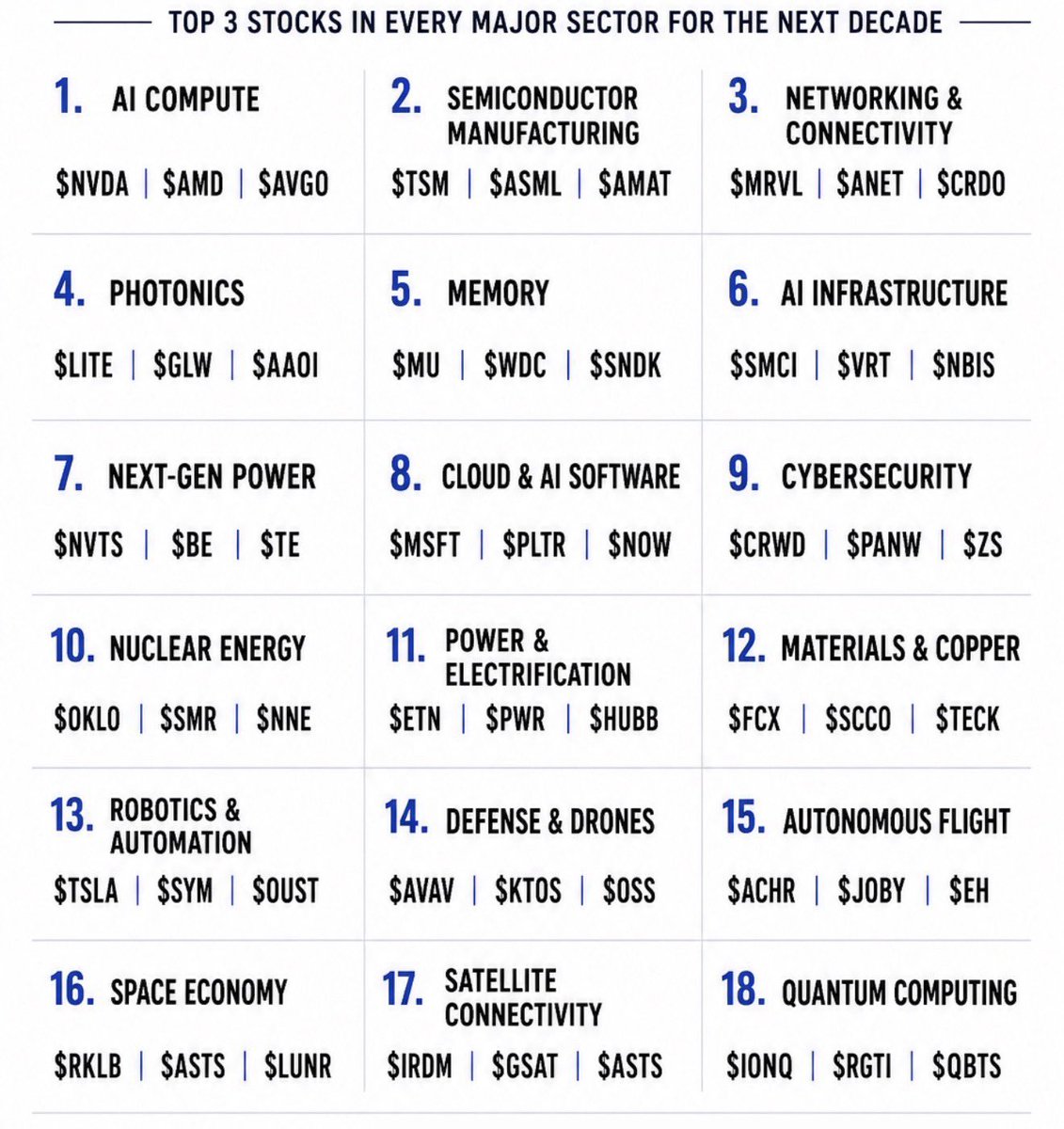
Here are the top 3 stocks in every major sector for the next decade:
AI Compute
$NVDA $AMD $AVGO
Semiconductor Manufacturing
$TSM $ASML $AMAT
Networking & Connectivity
$MRVL $ANET $CRDO
Photonics
$LITE $GLW $AAOI
Memory
$MU $WDC $SNDK
AI Infrastructure
$IREN $VRT $NBIS
Next-Gen Power
$NVTS $BE $TE
Cloud & AI Software
$MSFT $PLTR $NOW
Nuclear Energy
$OKLO $SMR $NNE
Power & Electrification
$ETN $PWR $HUBB
Robotics & Automation
$TSLA $SYM $OUST
Defense & Drones
$AVAV $KTOS $OSS
Autonomous Flight
$ACHR $JOBY $EH
Space Economy
$RKLB $ASTS $LUNR
Satellite Connectivity
$IRDM $GSAT $ASTS
Quantum Computing
$IONQ $RGTI $QBTS
Position early and let time do the work.