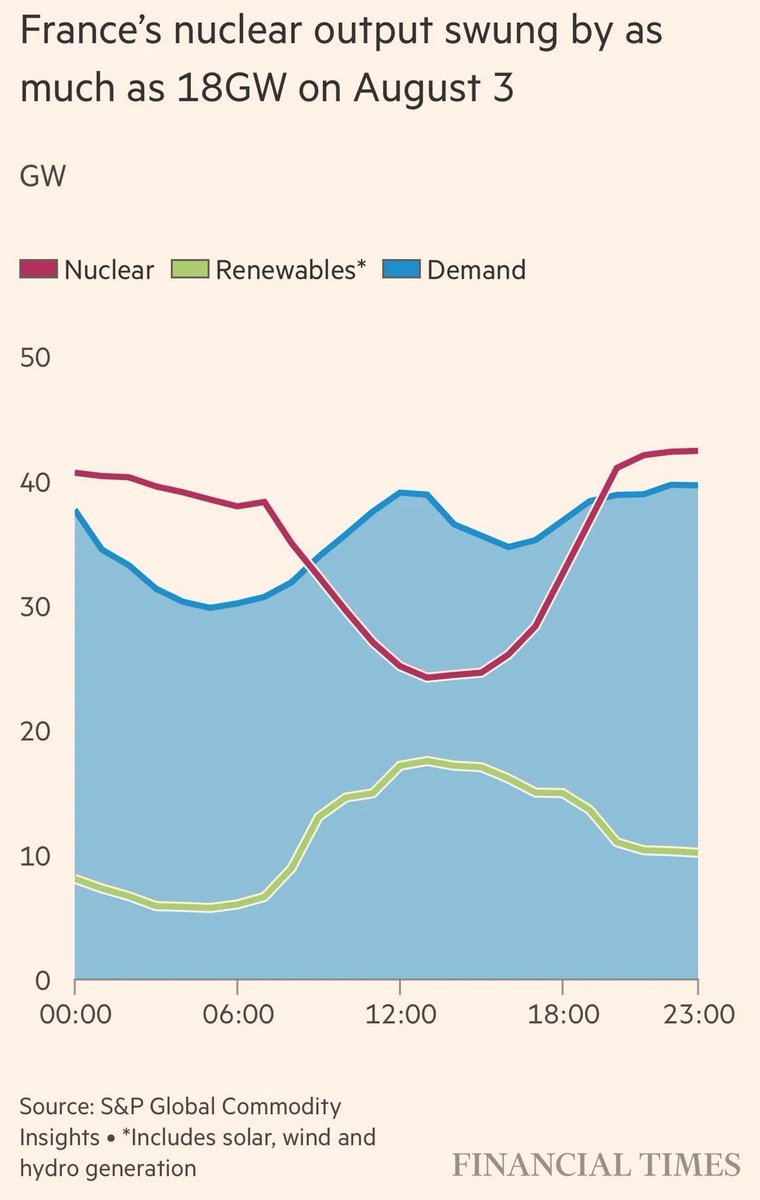
Here’s something I don’t understand. If French solar power requires cleverly running nuclear power plants under capacity (which very slightly increases those plants’ costs), then surely every single centime spent on that solar power is pure added cost with no benefit?
Thanks to Republicans about to gut Obamacare, the average annual health-insurance premium for the 22 million+ Americans covered will increase 114% starting January 1, from $888 to $1,904. And will triple, quadruple, almost quintuple for the neediest people in 10 super-GOP states.
Trump and his Republican Party are reckless un-American anti-constitutional radicals, the very opposite of conservative. His breakup with the Federalist Society makes it official, confirmation that Trump and his GOP are a cult of cruelty, chaos and corruption.
VALAR ATOMICS IN ONE POST
The mission of Valar Atomics is to make the world’s energy.
In order to make the world’s energy, you need to make it cheaper.
The cheapest form of energy humanity has ever experienced came from nuclear fission reactors in the 60s and 70s.
Fission reactors cost 10x more than they did in the 60s and 70s. Nothing changed about physics. Everything changed about policy. Most of this cost increase comes at the nuclear site and project level—also called “indirect cost”—and the other increases comes from higher safety requirements of the reactor itself.
You can get around the “higher indirect cost” problem by making your sites much bigger, thereby spreading indirect costs (which do not scale linearly with site size) across more revenue. Also, by building the same exact unit over and over again on the same site, you get to verticalize and systematize the nuclear components and processes that have a high idiot index.
You can get around the second problem by taking advantage of fundamentally safer designs that were left behind in the nuclear tech tree in favor of standardization around the US Navy nuclear program.
The reactor design which sits at the nexus of safe and scalable is the HTGR. The fastest way to get to scale is to create a small one, as quickly and simply as you can, and turn it on. Then make a slightly bigger one. Then make many of them.
This will leave you with a “Gigasite”— a massive reactor campus where you’ve built 100 of the same simple reactor over and over with diminishing marginal cost each time, yielding energy as cheaply as we got it in the 60s and 70s.
But there’s a problem: as your cheap power climbs into the gigawatts, you exhaust the capacity of the grid to transport it to customers. So instead, you attract data centers and heavy industrial partners to develop alongside your Gigasite and sell power to them on a microgrid.
But you don’t stop there. Soon, you graduate from electricity altogether, because it turns out chemical energy is about 10 times cheaper and easier to transport than electricity.
You can make hydrogen from water using nuclear energy—everyone knows this. But hydrogen is also hard to transport, like electricity.
What few know is that if your hydrogen becomes cheap enough, it actually becomes economical to bond it with point captured CO2, turning it into jet fuel, diesel, gasoline, and other hydrocarbons. If your hydrogen is cheap enough, the end product will be cheaper than refining oil.
This is incredible, because being able to make gas profitably unlocks a nearly unlimited distribution channel to a $4 trillion market. The largest oil refineries in the world approach 100GW of continuous chemical energy distribution.
That means your nuclear Gigasite has the demand to grow to many thousands of units all in one place, further unlocking the economics of scale. Incidentally, you are also selling carbon neutral fuel.
Most importantly, you now have the test bed which allows you to begin tuning and refining your reactor design, pushing costs even lower and margins even higher.
Now you are on the track to making the world’s energy.
This is the Valar Atomics plan.
@KBAndersen Before he realized his dream of becoming an astronaut, Don Pettit was a friend and colleague during my Los Alamos years (1983-90) working as a nuclear rocket scientist.
By burning oil, mankind adds ~459,000 sedan-sized blocks of solid carbon to the atmosphere every day.
Valar would replace this with exactly one sedan-sized block of nuclear waste, encased in concrete.
Climate funds’ reaction to this: “ew fission!”
Climate people aren’t serious
The Role of Fox News in Conditioning the Public
3/10: Fox News did not issue the order, but it made this moment possible.
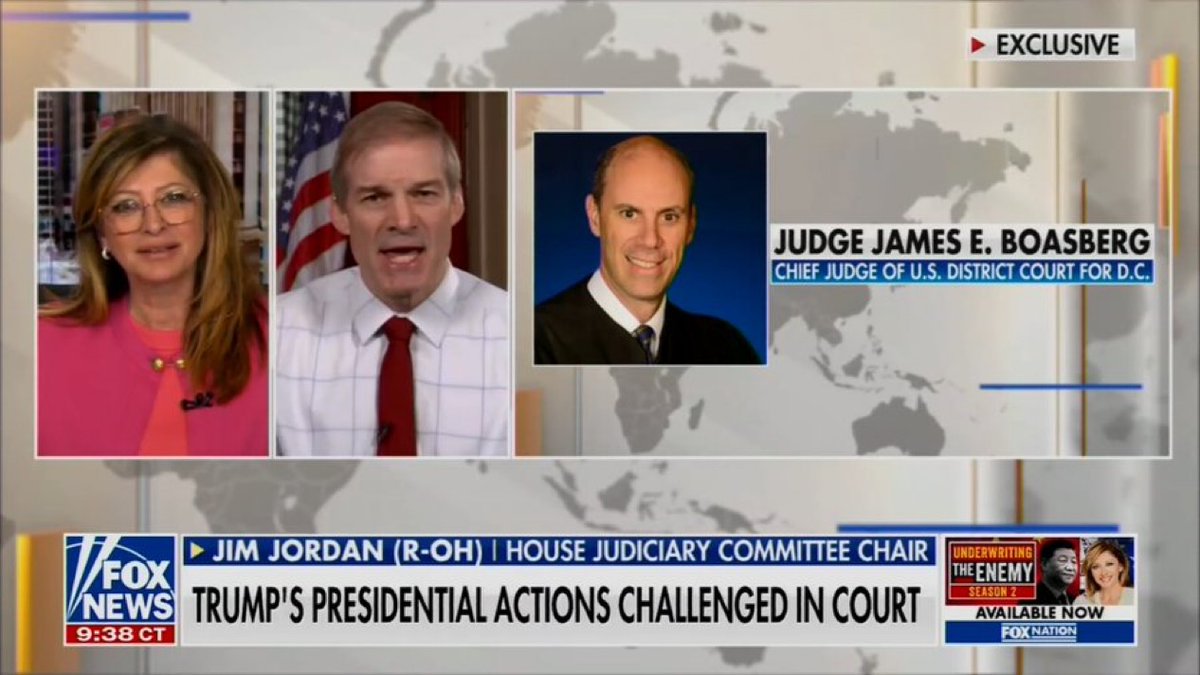
In the aftermath of Trump’s defiance, Fox put the judge’s face on screen, not as part of neutral reporting, but as a deliberate act of intimidation.
They did not need to explicitly declare that judicial rulings no longer mattered—they had already spent years training millions to believe it.
Through relentless framing, they had conditioned their audience to see the courts as corrupt, as partisan, as obstacles to be overcome rather than institutions to be respected.
Trump did not invent this strategy; he simply acted on it, carrying their rhetoric to its logical conclusion.
Why Americans Do Not See the Collapse Happening
This is why the phrase “you cannot see the forest for the trees” is so powerful in this moment.
The trees are the individual events.
Trump ignoring a court ruling.
The Supreme Court making the presidency immune from criminal accountability.
Congress failing to act repeatedly.
The media normalizing the breakdown of democracy.
The forest is the overarching reality.
The U.S. government is no longer constrained by constitutional limits.
The judiciary has been rendered powerless through precedent and selective enforcement.
The executive branch now decides which laws apply to itself.
Most people living through history don’t realize they are inside a moment of collapse because each event, taken alone, does not seem like the end of democracy.
The shock of one ruling being ignored does not feel catastrophic.
The Supreme Court deciding a president is immune from prosecution feels like just another legal controversy. Congressional inaction feels like business as usual.
The media’s treatment of this moment as just another chapter in the ongoing Trump saga makes it easy to assume the system will self-correct.
But when viewed together, it becomes undeniable that the system has already failed.
https://t.co/h8GGvIhtQV
How the System Failed to Stop Him
2/10: This moment did not happen in isolation. It happened because every prior attempt to hold Trump accountable has failed.
The system tried—and at every turn, it proved incapable of stopping him.
Impeachment failed—twice.
Criminal cases stalled.
The Supreme Court refused to rule on his disqualification.
Congress never moved to check his power.
At each step, Trump tested the system—and the system flinched.
He learned that laws are only as strong as the institutions willing to enforce them.
And so, when faced with a court ruling, he did what he had been conditioned to do—he ignored it. And nothing happened.
The Supreme Court’s Role in Making the Presidency Untouchable
The judiciary was already weakened by years of erosion, but in 2024, the Supreme Court itself ensured that when this moment arrived, there would be no legal recourse left.
In a landmark ruling, the Court expanded presidential immunity to such an extent that the office of the presidency is now functionally above the law.
A president can commit crimes while in office and face no immediate accountability.
And now, with Black Saturday, Trump has proven that he can ignore court rulings entirely without consequence.
This is not the separation of powers.
It is the absorption of power into a single branch. The courts were supposed to be the last line of defense. Instead, they have been reduced to issuing rulings the executive can freely ignore.
https://t.co/h8GGvIgW1n
Black Saturday: The Day the United States Ceased to Be a Constitutional Democracy
The Moment Democracy Ceased to Function
🧵1/10: Saturday, March 15, 2025, may have seemed unremarkable to most Americans. But in time, history will remember it as Black Saturday—the moment the United States ceased to function as a constitutional democracy.
For the first time in modern American history, a sitting president openly defied a direct federal court order—and nothing happened. No intervention. No enforcement. No consequences.
A legal ruling was issued, and the White House simply ignored it.
The White House’s Decision: Power Over Law
Inside the White House, the decision was not about law—it was about power.
A federal judge ruled against the administration. The debate inside Trump’s team was not whether the ruling was legal, but whether they could get away with ignoring it. They decided they could. And they were right.
This was not a clash between equal branches of government. It was the moment the judiciary was exposed as powerless. The courts do not have an army. They rely on compliance.
But a court that cannot enforce its rulings is not a court—it is a suggestion box.
And a presidency that can ignore the courts without consequence is no longer constrained by law—it is an untouchable executive.
Trump did not declare the end of judicial authority in a speech.
He demonstrated it in practice.
This is how democratic systems collapse—not with a single act, but with the normalization of defiance, the expectation that a ruling can simply be brushed aside.
https://t.co/h8GGvIhtQV
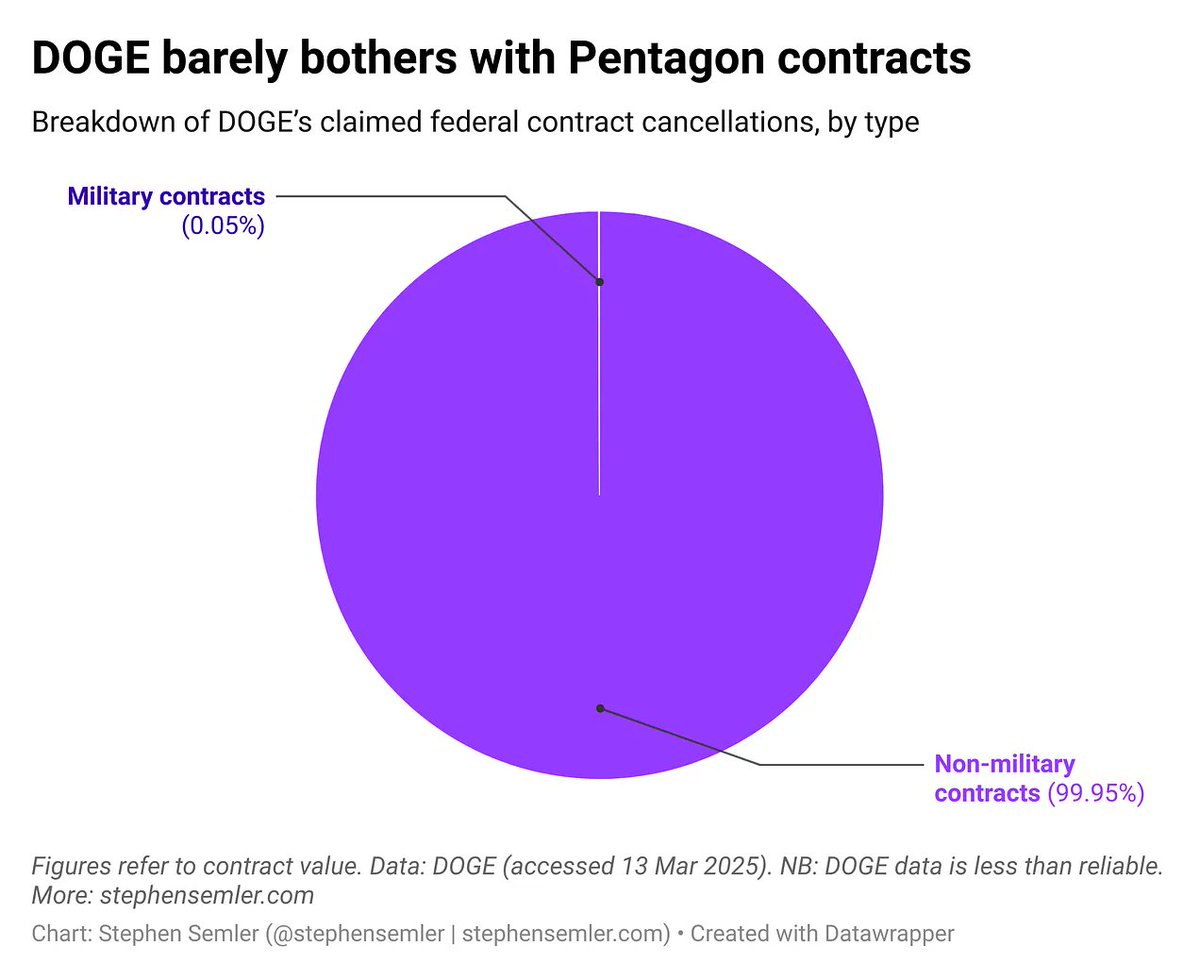
DOGE is basically not touching the US military, where there actually is rampant fraud.
Because DOGE is just a scheme to gut social spending.
What is the biggest Pentagon contractor by market valuation? Elon Musk's SpaceX, with $5.6 billion in contracts.
https://t.co/li0m3CaBnu
@isaiah_p_taylor I worked 24 years for the U.S. NRC, mainly on advanced reactor licensing. The NRC has never even come close to licensing an advanced reactor. I don't think it ever will. We must replace the NRC and its regulations with underwriter certification: https://t.co/p82YvcK66l