@rekdt@vxdb this case will be drawn out and overturned after years and tens of thousands of dollars.
it's not about enforcing it, it's about scaring people into not using this technology or flexing their rights.
people who are afraid to use their rights may as well have no rights.
Only one chance in this lifetime…
Like watching sunset at the beach from the most foreign seat in the cosmos, I couldn’t resist a cell phone video of Earthset. You can hear the shutter on the Nikon as @Astro_Christina is hammering away on 3-shot brackets and capturing those exceptional Earthset photos through the 400mm lens. @AstroVicGlover was in window 3 watching with @Astro_Jeremy next to him.
I could barely see the Moon through the docking hatch window but the iPhone was the perfect size to catch the view…this is uncropped, uncut with 8x zoom which is quite comparable to the view of the human eye. Enjoy.
Testing off-axis projection demo.
Basic scene layout in Blender
glb -> detailed splat via World Labs
Three.js for engine
MediaPipe for face tracking
Next step is to add a character you can move around in the environment
Another big step for World Model.
Tencent just released HY-World 2.0, a 3D world model that turns text, images, photos, and video into editable scenes instead of flat clips.
Most world models predict pixels, which looks fine from one view but often breaks when the camera moves or when you try to reuse the result as a real asset.
HY-World 2.0 tries to build the scene itself, recovering geometry, depth, camera pose, and renderable 3D assets, while WorldMirror 2.0 reconstructs photos or video in 1 feed-forward pass to produce a navigable digital twin.
What is happening here is that @TencentHunyuan is trying to move world models from “generate the next frame” to “build the place itself,” because HY-World 2.0 takes text, a single image, multiview images, or video and aims to output persistent 3D assets such as meshes and Gaussian splats, which are small soft 3D points that can be rendered quickly from new views.
That is a big deal because a video world model can look interactive while still being only a stream of pixels, while a real 3D asset can be re-rendered from new angles, edited later, and imported into tools like Blender, Unity, Unreal, or Isaac Sim.
HY-World does this with a staged pipeline in which HY-Pano 2.0 makes a panorama, WorldNav plans a camera path, WorldStereo 2.0 expands the world, and WorldMirror 2.0 composes the final 3D scene.
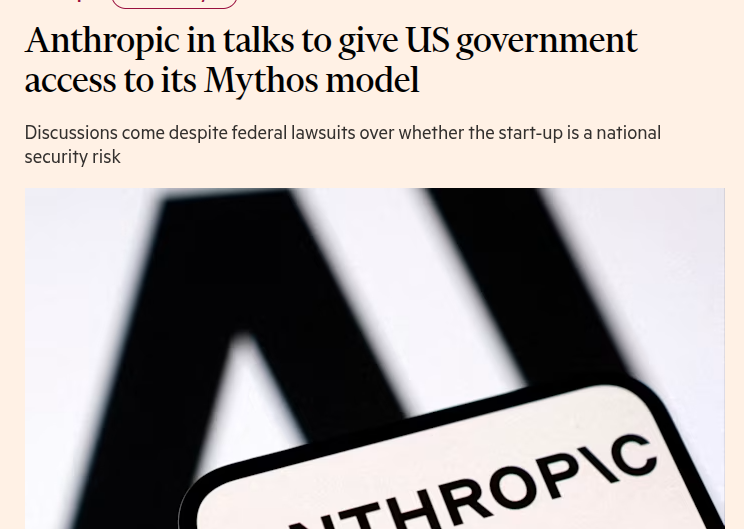
FT: The White House is moving to give major US agencies access to a modified Anthropic Mythos model built to hunt dangerous software flaws before attackers find them.
That makes Mythos useful for defense because a model that can find a weakness in an operating system, browser, or server can help patch it faster.
Looks like Washington is treating AI for cyber defense as too strong to ignore and too dangerous to hand out without tight control.
---
ft .com/content/c9f5b690-a10e-4c66-9245-017f8bfbc7b4