“A growing bipartisan consensus is emerging around one of the biggest drivers of America’s healthcare affordability crisis: hospital consolidation.”
Both sides agree: hospital systems are becoming too big and driving up prices. And the fact that hospitals get paid more than physician offices for the same same procedure is fueling the fire to acquire!
#txlege
@policywishes I actually like the guy. His audience is for fellow physicians, IMO.
As far as trust, we are in the age of “ the death of expertise” where knowledge on a particular subject is dismissed no matter what a person’s credentials. Certainly Covid exacerbated and accelerated this.
This is the misconception that plagues any talk of reform for physicians and salaries. This gentleman claims his spine surgeon made $50k from a single surgery. Utter nonsense, and he is off by a factor of 10x.
While pediatricians and primary care docs are earning less than gas station managers (Buc-ees paying $225k) , and some Walmart store managers earn the same as a specialist ($395k), we can’t begin to talk about fair compensation until we dispel these inaccurate misunderstandings.
Nurse Practitioner training programs are exploding, and many of these private equity backed “schools” extort the student for huge sums in exchange for an extremely poor education. We need a “Flexner Report” for NP training in the US! #medtwitter#medicine#physician#medstudent #txlege
@Hanakookie1@DrBradHolland I’m going to start a school that takes an LVN— and if they’ll give me $150,000, I’ll award them a DNP degree in five months. This is completely legal (and it’s probably a good idea financially.)
There is no standardization of what’s required to be a DNP.
Nurse Practitioners Need Their Flexner Report. The WSJ Just Made That Case for Us.
In July 2024 I wrote that nurse practitioners need their Flexner Report. That argument has not gotten less true since.
Yesterday the Wall Street Journal ran a piece titled "Nurse Practitioner Is Now the Hottest Job in Healthcare." The facts are understandable and the reasons are sound. The NP workforce is projected to grow 45.7 percent by 2032, far outpacing physicians. Demand for care is real while workforce shortages are real. The NPs and PAs on my team are essential to how we care for patients every day.
A headline celebrating the hottest job in healthcare raises a question that is not being asked loudly enough: are we growing this workforce at the expense of the training standards that protect patients? Bloomberg Businessweek investigated the education side of this growth and documented what many of us in medicine already know. Programs motivated by tuition revenue have proliferated. Training standards are uneven at best. Graduates are entering clinical practice without adequate preparation. The field is at an inflection point.
I am not anti-midlevel and I never have been. The problem is not that the profession is growing. The problem is that scope of practice is expanding at the same time that training standards are eroding, and the policy debate has not caught up to that reality.
This week I am going to work through the evidence. On Friday, I will lay out what Texas should do about it legislatively. That solution starts with the same principle Flexner applied over a century ago: access to a profession cannot come at the expense of the standards that protect the people it serves.
I suspect he is not aware of the explosion of “on-line” only training programs, that can be competed in 4 months with absolutely no clinical exposure, and have less than 700 of non-curriculum based “observation.” That is not a good thing, and that is what we have in Texas right now. #txlege
Even barbers and beauticians in Texas are required to have 1000 hours of supervised work!
“Doctor-like” worker is exactly as bad as it sounds. Would you tolerate a “pilot-like” worker flying your plane?
We will all get to witness how this turns out.
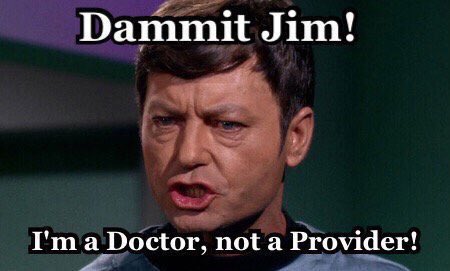
“Healthcare Providers”
He doesn’t mean physicians. He means hospice companies. But since the term “healthcare provider” isn’t defined, his statement is misleading.
Let’s stop using that term for physicians and clinicians. Ok? @JDVance@DrOz
UNBELIEVABLE. Vice President Vance just did a double take after hearing this wild stat dropped by Dr. Oz:
"You're saying that we kicked off 800 fraudulent healthcare providers off of the Medicare system and not a single one of them called the government and said, 'hey, you made a mistake?'"
"It's just completely insane."
If you think all we need to do in healthcare is let people shop for prices and they will fall, is ridiculous
The number of hospitals and insurance comps walking away from each other, particularly for Med Adv, tell us everything
That the entire HC system is designed to make it IMPOSSIBLE to price shop
Hospitals don't know their costs and can't set prices to insurance companies
Insurance companies do their best to manipulate transactions (latelq, underpay, deny, etc)
All of MA is an attempt by the carriers at arbitrage They bet that they can break the law, and never adhere to reporting regs and the worse that can happen is they might get fined
They bet that hospitals don't know their margins or profits on a per plan or carrier basis and they will make stupid decisions That is starting to change
Now they are using AI to manipulate prices and costs in real time, knowing providers use consultants for Rev mgt, making them unable to respond in months, let alone real time
They bet that by gaming MLR with subsidiaries, they can further break the law and not get caught
Bottom line , it's not an efficient market , due to zero transparency at the transaction level ,and the concept that individuals can shop based on price , when neither hospitals or insurance companies know what their actual costs and prices are , is insane
Carriers manipulate and obfuscate every number they can with the goal of making it impossible to know actual prices
Good luck shopping for prices on all bu the simplest, most obvious services
Everything is working so well right now. People hate the economics of healthcare. They are terrified they won’t be able to afford what they need and they already can’t afford their deductibles.
Employers have to pay 30k a year and it impacts their hiring and firing decisions.
The big vertically integrated companies game MLR, game managed Medicaid. Under pay, over charge , year apart independent pharmacies and physicians
It’s the furthest thing from an efficient market. And you think breaking them up would be worse ?
How could it possibly get worse
On the Hill this week, we heard how insurers are standing between patients and care.
New data shows 70% of patients are initially denied coverage for a prescribed medicine, delaying or preventing treatment.
Patients should not face red tape. It is time to put them first.
https://t.co/i09uR0eYby
Most insurers aren’t insurers. They are holding companies that arbitrage capitated systems and self insured employers, looking for weaknesses and lack of contract enforcement in state, federal and commercial organizations
Doctors should be leading healthcare to eliminate that friction.
Too often it has been placed there by committees and bureaucrats who never practiced medicine. Doctors get assigned “just another few clicks” and, a decade later, the discharge process requires an hour on the computer.
There’s another good point here about needing to stay on top of people to get stuff done. Too often, a doctor’s order is interpreted as a suggestion. A CT scan doesn’t get done with just an order, it requires multiple phone calls and, occasionally, the doctor wheeling the patient down themselves. Of course, if the doctor raises their voice in frustration, they are labeled as disruptive. The doctor gets disciplined and the friction remains in place.
This doesn’t happen when the people creating these processes are the same ones delivering care.
Imagine your surgeon preparing for your operation.
They see you in pre-op, answer your questions, calm your fears, examine you, confirm the plan, and go get ready for the case. They review the imaging and think through the critical parts of the operation.
Then a nurse interrupts them:
“Doctor, your pre-op documentation isn’t good enough. You can’t just say you discussed the risks and benefits. You need a full H&P.”
The surgeon points out that the H&P was already done in clinic. The note is right there in the chart.
“No. That note is 31 days old. It has to be within 30 days. But it’s fine if you just copy and paste that old note.”
Think about how insane that is.
There is no new clinical information. There is no patient benefit. There is no improvement in safety or quality. The only thing being demanded is duplication. A pointless bureaucratic ritual to satisfy the machine.
So now you have a frustrated surgeon, a delayed case, a bloated chart, and one more example of modern medicine confusing clerical box-checking with patient care.
This is exactly what is wrong with the system. Endless note bloat. Pointless duplication. Administrative nonsense dressed up as professionalism. If there are no changes, there are no changes. Forcing a doctor to re-paste an unchanged H&P adds absolutely nothing for the patient.
And the most insulting part is the tone. That smug, condescending “of course you have to do it this way” attitude, as if this is self-evidently necessary instead of obviously stupid.
At this point, a lot of doctors would probably take a substantial pay cut to never touch a computer again. Cut the salary and use the savings to hire people to do the computer garbage. Epic. CDI queries. Coding queries. H&P updates. Order entry. Case booking. Inbox nonsense. All of it.
Never touch Epic again. Never answer another coding query. Never update another unchanged H&P. Never place another order that a clerk or protocolized team could enter. Never do another ounce of hospital data-entry cosplay.
Just let us be goddamn doctors instead of highly trained documentation technicians.