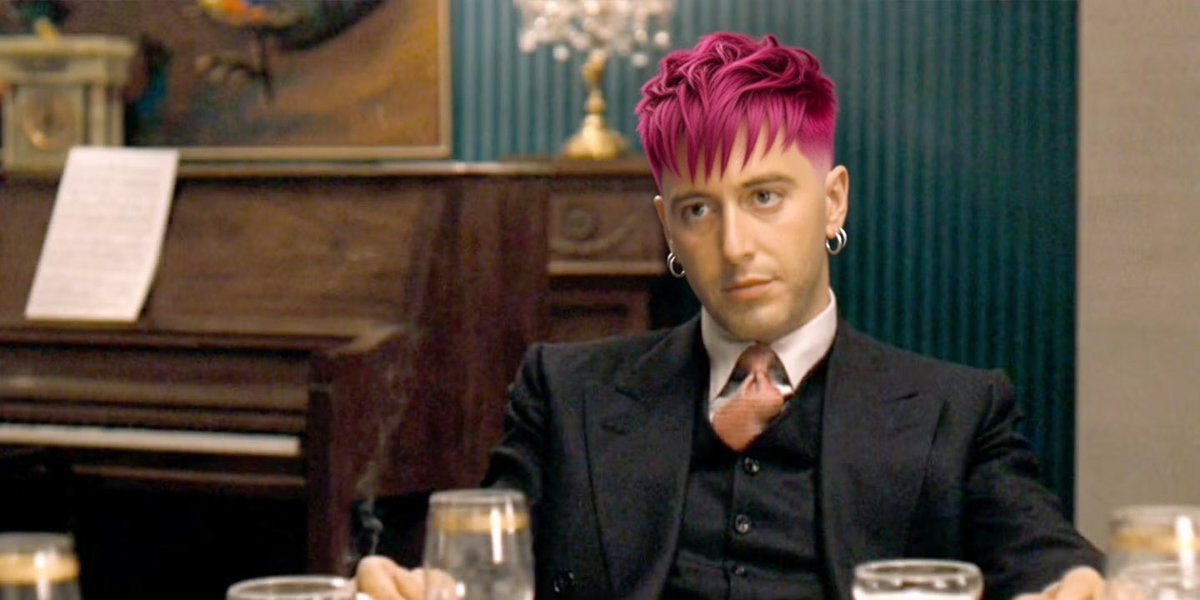
Excalibur's sign-off from the June 3rd 2026 edition of AEW Dynamite, "FIX YOUR HEARTS OR DIE! THIS IS ALL ELITE WRESTLING!" was seemingly a reference to a line from Twin Peaks: The Return. In the series, a character played by David Lynch uses the phrase while defending a transgender colleague. It has since become associated with messages of empathy, acceptance, and LGBTQ inclusion.
Although Tokyo Drifter is a cult classic, if a single reason for watching it has to be chosen it's because of the surreal, avant garde art direction of 木村 威夫, Kimura Takeo.
The film is also sixty years old this year.
A mother octopus lays her eggs, then stops eating. She slowly starves to death while she guards them, and by the time they hatch, she's already gone. Her babies float off into the ocean and will never meet her.
An Oxford scientist named Tim Coulson thinks these animals could be the ones to take over after we're gone. He laid it out in a 2024 book, and the case holds up. An octopus has about 500 million brain cells, roughly the same as a dog. Two-thirds of them aren't even in its head. They're spread through the eight arms, so each arm can taste what it touches and move on its own. Octopuses open jars. They carry coconut shells across the seafloor to hide under later. They've squeezed out of sealed tanks in the dark and gotten away. No animal without a backbone comes close.
But being smart has never been enough to build a city. Everything humans built runs on one trick: each generation starts where the last one left off. A kid today learns in school what took people thousands of years to work out, and inherits all of it for free. An octopus inherits nothing. Its mother died before it hatched, so there's no one to copy and nothing left over from the octopus that came before.
So every octopus has to figure out the whole world by itself, starting from zero. And they're good at it, weirdly good. Then a year or two later they die and take everything they learned with them. Peter Godfrey-Smith, a philosopher who spent years diving with octopuses for his book Other Minds, points out that they pass almost nothing on to their young. The cleverest animal in the sea wipes its memory clean every generation and starts over.
Coulson said it could take hundreds of thousands of years, maybe millions, and he's right that the raw ability is already there. The brain is built, and the body can crack almost any puzzle you hand it. The only thing missing is a second generation that remembers the first.
The mechanical shark in Jaws was supposed to carry the whole movie. On day one they lowered it into the sea and it sank straight to the bottom, because someone had only ever tested it in a freshwater tank. The salt water wrecked it, and for most of the shoot it barely moved.
So Steven Spielberg did the only thing he could. He hid the shark. He showed a fin cutting the water, a barrel getting yanked under, and let the audience build the monster in their own heads. The slow, scary tension that people now call genius was really a young director working around a half-million-dollar machine that refused to cooperate, with the budget climbing the whole time. Almost every monster movie since has copied the trick: keep the creature in the dark for as long as you can.
Bong Joon-ho threw that rulebook out. In The Host, he shows the monster in full daylight in the first few minutes, charging down a crowded riverbank while everyone watches. It's the exact thing other creature movies are scared to do, and he did it on roughly $11 million. The 2014 Hollywood Godzilla cost $160 million.
Showing a monster is the expensive choice. When it's hiding in shadow, you can fake it. The second you put it in broad daylight, every frame has to hold up, and that costs a fortune. So Bong's team got clever. They put the monster into only 125 shots, the individual clips where it actually appears, while a modern Godzilla movie packs in 600 to 1,500. They kept each shot long and made it count, and hand-built a physical puppet for the close-ups so they wouldn't have to pay to draw those on a computer.
It worked. Thirteen million people in Korea bought a ticket. The country was about fifty million back then, so close to one in four Koreans went to see it. The film broke every record at the Korean box office. Off that $11 million, it pulled in around $90 million worldwide. The same director later made Parasite for about the same money, and that one won Best Picture at the Oscars. Hiding the monster was always the cheap way out. Bong paid to drag his into the daylight, and for years it stood as the most-watched Korean film ever made.
Mobland Season 2 was majority filmed by me. Strand-on-the Green, Chiswick House, Chiswick Police Station. Tom Hardy was on set early doors (ask the Mums who were doing school drop-off 🤣) and often late into the evening. I spoke to SCORES of crew, some main actors and a handful of extras (some of whom I'm still in contact with) There was NEVER even a hint of this being an unhappy set. This seems VERY odd.