@_kobim לא יודע על קרסר, אבל עם קלוד אני ממש בונה לא מבנה כדי ליצור לו ״אישיות״ (מסמכים שמאגדים אוסף של מקרים ותגובות / עדיפויות / למידה מטעויות) שלא כזאת
@tom_sadeh אלוף. אני רק יוסיף שיש עוד מקורות הכנסה שחסרים, שעל חקלם אנחנו כן מנסים לדבר במאמר שלנו. מבין אילו, הרווחים הלא מחולקים של חברות, שאפשר לראות בהם הכנסות של בעלי החברות, היו ההכנסות החסרות הכי משמעותיות.
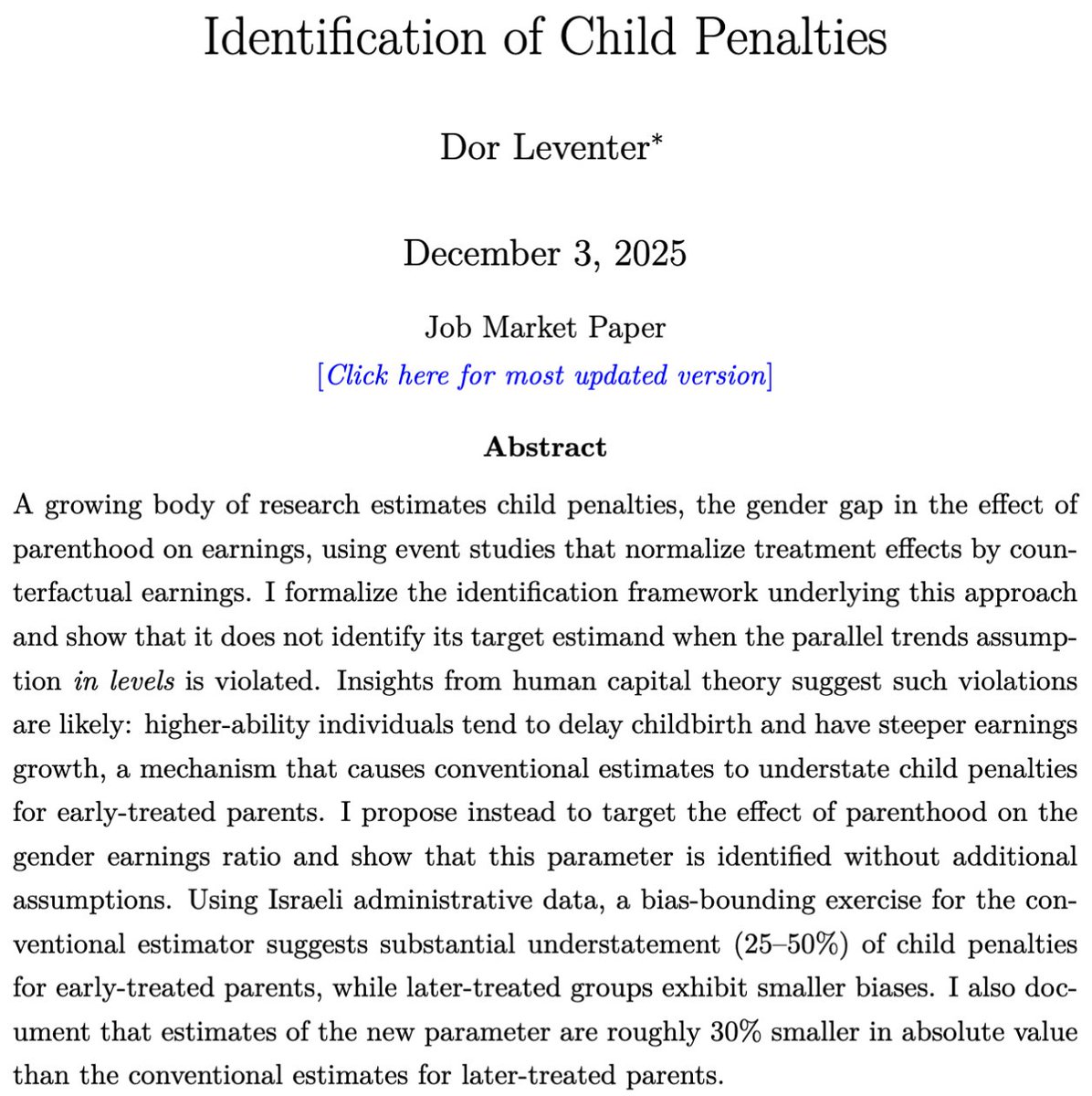
Takeaway: My paper suggests that previous child penalties estimates can be severely biased due to identification issues, and that these issues are easily remedied.
Full paper: https://t.co/68iLEXmNMS
R package: https://t.co/FNMm4CBwUR
JMP thread 👋
A growing body of research estimates child penalties.
I formalize the underlying identification framework, discuss new problems, and present solutions.
#econjobmar#econtwitter
Left out several discussions, for example
- Triple differences and counterfactual gender inequality
- Validation tests when control groups change post treatment
- Aggregation across multiple treatment groups
Hey 👋 #econtwitter new version of the RD-DID paper - https://t.co/vA7SfLJWRb
Some of whats new:
- Iden. and est. of composition effects
- Different SE under cross section / panel w. constant or time-varying running variables
- A package (my first!)
Cheers!
Thats a wrap 👏, thanks for everyone who helped with this along the way. Hopefully this paper will provide guidelines and tools for researchers analyzing an RD design with violations of continuity
https://t.co/vA7SfLJWRb
📢@DanielNevo and I have a new WP out📢
In the paper, we present a general framework for identification in RD designs when continuity is violated using multiple time period data, which we term RD-DID
A thread 1/n
https://t.co/vA7SfLJWRb #EconTwitter#Econometrics
For an application, we revisit Grembi et al. (2016)
We discuss an equivalence testing approach to test RD-DID assumptions (and reject constant discon.)
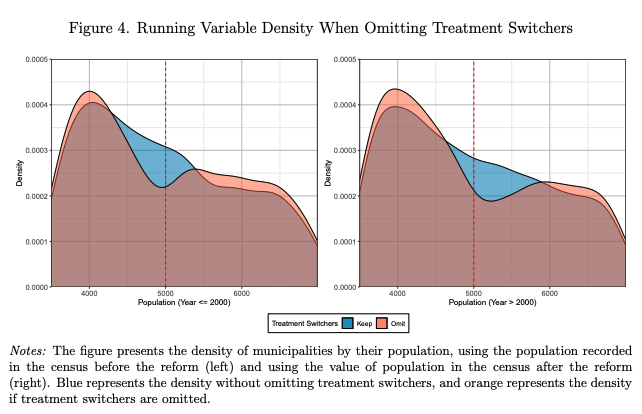
And show that omitting treatment switchers causes a drop in running variable density, resembling a ''donut hole'' RD
8/n