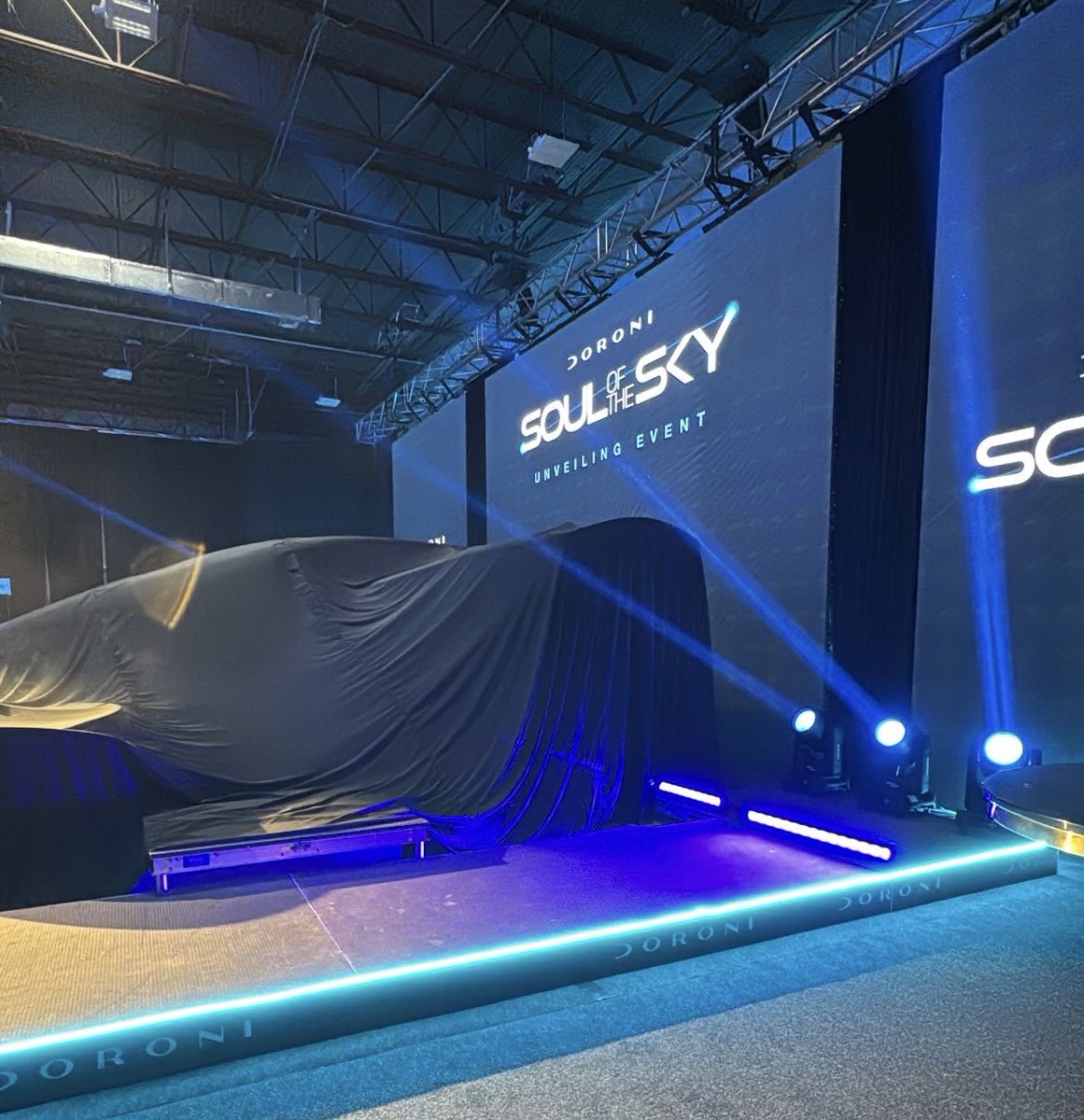
Wow. This new milestone comes just 22 hours after we announced $25M in total capital raised.
The momentum is crazy right now. Make sure to get in at $3.10/share before it’s too late!
New milestone!
We just crossed $30M in total capital raised. This brings us to $17M in raised capital since unveiling the H1-X back in late March.
If you haven’t yet invested, time is running out to invest at $3.10 per share.
Check the link in the replies to do so.
Big milestone!
Doroni has now surpassed $25M in total capital raised, with more than $14M raised since the unveiling of the H1-X.
Momentum is accelerating as we move closer to bringing the H1-X to market.
Check the replies to invest before the share price changes on June 19:
*Welcome to the most practical personal flying vehicle.*
In this video, we take a deep dive into what we believe makes our H1-X model the most practical personal eVTOL design in the world.
From the hardware to the software, everything was designed to enable the average person to eventually fly it.
If you're excited by disruptive innovation, this video is definitely worth the watch.
We just unveiled the future of personal mobility.
At our “Soul of the Sky” event, Doroni Aerospace proudly introduced the H1-X showroom model and SOUL AI™️, our revolutionary Digital Co-Pilot Operating System, giving guests an exclusive first look at the next evolution in personal flight.
This unveiling marked an important milestone in our mission to bring personal aerial mobility to life and create a future with more freedom, less traffic, and a more intuitive way to move through the world.
Watch the full presentation on YouTube here: https://t.co/S1G7BZmIPv
10 years ago I had a vision nobody could see yet.
But on Thursday night, a room full of believers flew from across the world to watch it become more real.
H1-X model unveiled. SOUL AI™ revealed.
I don’t have the words. Just gratitude…and a lot more work to do.
Behold, the day is near. The years of hard work, iteration, and reinvention have lead us to March 26th.
Join us in Dania Beach for our highly anticipated 'Soul Of The Sky' unveiling event. Our team looks forward to meeting you there.
Every morning, I ask myself two questions that shape everything we do that day.
1. Do I believe in this product?
2. Do I believe I can make it happen?
These questions are a way for me to check in with my conviction. As we continue to build the Doroni H1-X, my belief in what we create grows stronger.
Each time we run into a problem and work through it, I find even more proof that we're on the right track and that we have what it takes to see this through.
There's a lot of chaos that comes with the operation of a business that will change the personal aviation industry forever, but those two questions help me cut through the noise. They're simple, but they anchor me, especially when things get messy and the pressure's on.
So far, I’ve never had a moment of doubt when it comes to either answer. That’s what gives me the strength to keep going, even when the path ahead isn’t easy.
This 3D printer basically started our entire company.
In 2016, Doroni Aerospace was just a simple idea. In order to prove the concept as quickly as possible, I used 3 of these Raise3D N2 printers to print individual parts, and then pieced them together to form the shell of our first prototype.
The seat alone took over 1,200 hours to print!
That prototype achieved flight, validating the vision and paving the way for the H1-P1, which I later flew myself in our warehouse. And now, that journey is leading us to the H1-X, the model we aim to deliver to customers.
Crazy how far a 3D printer can take you!
After exiting my first company, I went through a near death experience that taught me one of the most important life lessons.
My childhood friend was assembling a yacht crew for a 30-foot open-deck boat. His team included ex-commandos and former battleship captains… and then there was me, with none of that experience.
But he needed one more person to fill the crew, so when he invited me to join, I said yes.
Little did I know that this decision would put me in the middle of the Mediterranean on an old boat which had no radio, no GPS, and safety gear that belonged in a museum.
Hours into what should have been a routine sail, the sky began to darken and the wind picked up speed. The waves slowly grew stronger until they eventually started overflowing onto the deck. Each one felt like it would flip us over.
I was convinced we were going to die out there, especially after I began noticing the other crew members initiating survival methods that helped them preserve body energy.
But the strangest thing happened as the storm kept getting worse. These ex-military sailors started laughing at the situation, making jokes about the waves and mocking the wind.
Their laughter pulled me out of my panic and suddenly I was laughing too, even though nothing about our situation had actually improved.
The fear loosened its grip once we stopped taking it so seriously.
The sailing trip taught me something I carry into every venture today: if you want to do something extraordinary, it is impossible to entirely eliminate risk.
But you can learn to dance with it - and even laugh in the middle of the storm when everything feels like it’s falling apart.
And that positivity is what will help you move past it.
Every founder’s journey is built on the unseen sacrifices of their spouse and family.
I personally invested $250,000 to build our first two prototypes, and I went five years without taking a paycheck. So if I add the direct spending to the opportunity cost of those unpaid years, the total investment from our family exceeds $1M.
All of it came from our savings, built over years of running our previous business.
Eventually those savings ran dry, and the only way forward was to sell our house.
That moment forced a conversation with my wife that went beyond finances. It was about whether we believed deeply enough in this vision to risk everything we had built as a family.
Her answer was simple: "We’re moving forward with it."
That decision gave me the strength to take the next step.
By the end of 2021, we launched our first crowdfunding campaign and began raising outside capital. Two years later, in January 2023, we achieved the first full-scale flight of our two-seater prototype at our facility.
Looking back, that million-dollar family investment was more than just money. It showed investors that we were willing to risk everything to prove this technology could work. No business plan could have made the case as powerfully.
When you are building something that has never existed before, the cost extends far beyond materials and labor. It touches every part of your life until the vision finally becomes real.
We have raised $10.2M (so far) to build flying cars.
Below is Episode 1 of our build-in-public series, “The Road to Delivering Flying Cars.”
The goal is to document our company's journey as we build what we believe will become the most practical personal air mobility vehicle.
This series will cover the ups and downs, the victories and losses, and the overall love and passion that each employee puts into making the H1-X a success.
Enjoy.
When most people imagine the cockpit of a flying car, they think of what they might see inside of a helicopter or small plane, which is filled with a myriad of intimidating switches, dials, and screens.
From the start at Doroni, I knew that we had to change this.
If we wanted average people to feel confident in the air, the experience needed to be as simple as possible.
That belief shaped every design choice. Extra switches create failure points. Extra screens pull attention away from the world outside. So we asked ourselves, what would it look like if the cockpit only showed what truly mattered?
The answer came from an unlikely place. When I saw how astronauts at SpaceX fly rockets with streamlined touchscreen controls instead of walls of knobs, it was clear the same approach could work for a personal eVTOL.
That insight inspired our biggest breakthrough yet, turning a two-joystick system into a single joystick. And after months of simulator testing, we proved it was possible.
The onboard autopilot handles stability, while the all-electric design removes the risks that come with combustion engines such as fuel leaks, engine fires, and mechanical breakdowns.
The result will be a cockpit that feels natural, reduces workload, and makes flying feel within reach for everyone. For over a century, aviation has been the domain of trained pilots.
I think that we will be the ones that finally open it it up to the world.
When people hear "personal aircraft", they immediately default to the same two objections that have been stopping this industry for decades.
"People don't know how to drive. How can they fly?"
"The sky is going to be full of them. It'll be chaos up there."
Both questions reveal the same fundamental misunderstanding about how personal flight actually works versus how people imagine it works.
The driving comparison makes no sense when you give it some thought.
Driving has stop signs, traffic lights, pedestrians, school zones, construction barriers, other drivers changing lanes without signaling. Flying will have none of that chaos because our users will be operating in three dimensions with geofencing technology and designated corridors.
In addition to that, the overcrowded sky argument falls apart when you look at the numbers today. There are already hundreds of aircraft flying above your city every day, yet we see fewer than 10 mid-air collisions globally each year.
These objections sound reasonable until you realize they're based on imagining the worst possible implementation of technology that already exists and works perfectly fine.
We've been asking the wrong questions about flying cars. We should be asking the right questions about roads.
We raised $10.2M so far with crowdfunding.
But when we decided to crowdfund, I had no idea that it would also turn into one of our *biggest advantages*.
When you crowdfund, you literally bring on thousands of investors. Which also means you will receive thousands of questions.
But, instead of being annoyed, we realized that each question made us rethink the design choices we'd made.
“Will it be easy to charge it?”
“What happens if I need to land somewhere that doesn't have a designated spot?”
“Will it be easier to fly than a helicopter?"
The more real the questions got, the better our prototype became.
Someone would ask about storage, and it made us realize that we never actually measured whether our flying car would fit in a standard garage.
When someone would question the control system, we'd discover our interface was still too complicated for someone who just wanted to fly to work.
Months of this feedback transformed the H1-X from what engineers thought was cool, into what customers needed to make flying part of their daily lives.
The vehicle became the brainchild of thousands of people who helped design it rather than just a handful of us working in isolation.
Crowdfunding became our unfair advantage in a world of secretive startups.
right next to each other.
Your 20-minute drive to the grocery store could be a 3-minute flight if you could just go there directly
Our mission at Doroni, is to refuse to accept traffic and long commutes as normal. Because life is so much more than one big concrete traffic jam.
Roads have limited our perspective on the world without us even realizing it.
Every day we follow the same concrete paths that connect our house to our place of work, driving through highways and neighborhoods in patterns that seem logical until you think about them.
(More)
We have accepted that getting somewhere means following predetermined routes because that's how transportation has always worked.
But if you were to lift off 500 feet in the air, you would start seeing those limitations clearly.
Neighborhoods that seemed far apart are actually
personal electric flight in a fraction of the time.
The new MOSAIC framework came just in time for our upcoming event, and this just gives me more reason to believe that we are perfectly positioned to dominate the market.
On July 22nd, 2025, everything we had been building toward at Doroni became reality.
The FAA had just announced the MOSAIC rule, making personal flight legal in America for the first time in aviation history.
Here’s why this rule will change society:
to build eVTOLs that actually work, instead of compromising performance to hit arbitrary numbers written for a different era of aviation.
On a broader scale, what took traditional aviation decades to achieve through complex certification processes can now be accomplished for