Practice Manager, World Bank Group. Focus areas include Entrepreneurship for job creation, SMEs & AI, SMEs & Productivity, Digital Financial Services/Fintech
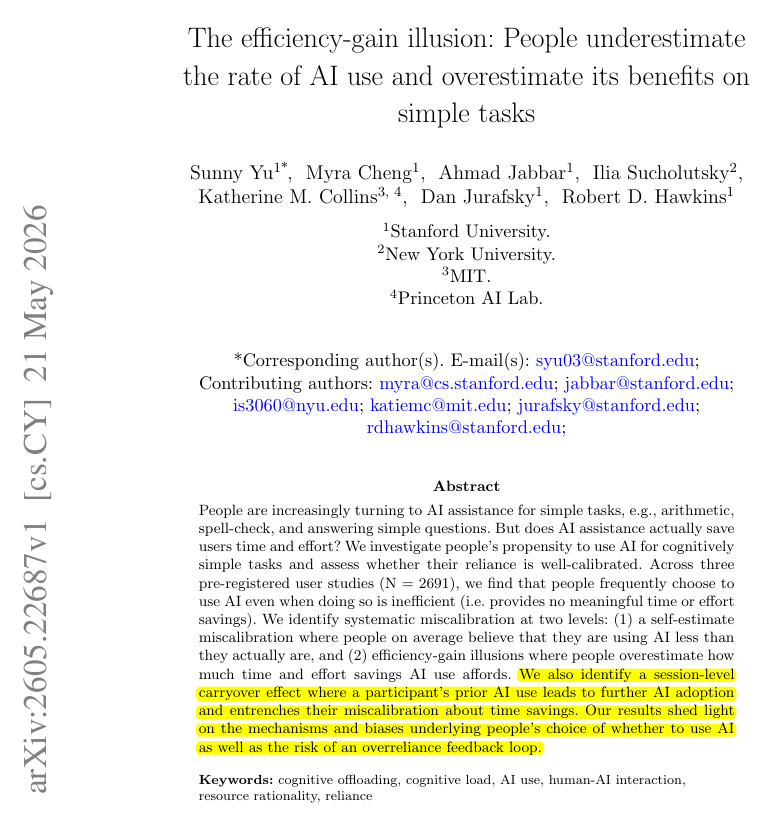
AI can make people feel more efficient even when they are not actually becoming much more efficient.
New paper from MIT, Stanford, New York Univ, Princeton.
That people often use AI for simple tasks because it feels like it saves time and effort, but the measured benefit is often tiny, missing, or even negative.
The biggest point is the feedback loop: once people use AI, they become more likely to use it again, even for easy tasks where doing it themselves would often be just as fast or faster.
i.e. AI dependence can grow from a mistaken feeling of convenience, not just from real productivity gains.
Across three preregistered studies with 2,691 participants, people used AI for basic arithmetic, spelling, recall, and short rewriting at higher rates than they predicted, especially on easy tasks.
They also expected AI to save 55.7 seconds on average, when the measured saving was only 7.5 seconds.
For simple work, the hidden cost is not intelligence but interface friction: writing the prompt, waiting, reading, checking, and deciding whether the answer is acceptable.
Once that loop begins, it can feel like effort has been outsourced, even when effort has only been rearranged.
Here’s the key part: the study suggests that AI use can train its own justification.
After using AI on just two tasks, participants became more likely to use it again, even when independent completion was faster.
The danger is not dramatic dependence, but quiet recalibration.
A person who asks AI for a trivial answer today may not become less capable tomorrow, but they may become less accurate at judging when their own mind is already the faster tool.
----
arxiv. org/abs/2605.22687
"The efficiency-gain illusion: People underestimate the rate of AI use and overestimate its benefits on simple tasks"
💼 Overall, AI is fueling economic growth through investment rather than efficiency.
AI investment is giving the U.S. economy a strong push, but it still hasn’t made American workers much more productive.
Growth is happening mostly because of money pouring into AI and a rising stock market, not because people are working faster or smarter yet.
Economists define productivity as how much output a worker can create in an hour. AI could help by handling boring or repetitive tasks so humans can focus on higher-value work, or by automating some jobs entirely, which raises efficiency.
Right now, the results are mixed. Goldman Sachs sees better productivity in tech and research fields, suggesting AI is helping. JPMorgan Chase, however, finds little link between AI use and productivity gains across industries.
The Yale Budget Lab looked at job data and found that while some early-career workers have been affected by AI since ChatGPT’s release in late 2022, the overall impact is tiny. The share of workers in AI-exposed jobs was 18.2% in late 2022 and only 18.3% by August 2025, showing almost no change.
Younger workers, especially recent graduates, seem to feel more disruption than older ones. Their job mix is shifting faster, which suggests AI might be affecting where they can find stable roles.
A Stanford study adds to this, showing that young workers in fields like software development, where AI can easily automate coding, face shrinking opportunities. Still, that group is small, since only about 25% of U.S. software developers are under 30 out of 163 million total workers.
The clear boost from AI so far is in spending. Two-thirds of U.S. GDP growth in early 2025 came from business investment in software and computing gear. About 10% of U.S. businesses now use AI, up from 5% when ChatGPT launched.
Economist Joshua Gans compares today’s situation to the early days of personal computers. Workers needed time to learn how to use them well, and the same applies to AI. Many people are still experimenting casually, not yet mastering its value.
His view is that the real productivity payoff will take time, once people figure out how to fully use AI tools in their daily work.
----
wsj .com/tech/ai/ai-worker-productivity-economy-77498195
First-ever combination of an IBRD Policy-Based Guarantee (PBG) and a MIGA guarantee, for sustainability-linked financing in Cote d'Ivoire: https://t.co/mHKvUWSkPk
Shein and Temu as competition to Jumia model. Interesting implications for where the Jumia business model fits best. Article: African online retailer Jumia to exit South Africa and Tunisia https://t.co/gNWSglBuNP
Late payments to SMEs from larger firms (or from the public sector) constrain SME viability and growth. UK announces a new 'Fair Payment Code' to try and tackle this https://t.co/BuGKgiszIA via @Finextra
Representatives from 14 countries at the World Bank Climate Finance Risk event here in Dakar discuss how to strengthen climate risk resilience and response through financing mechanisms and index insurance. Great to see such high levels of commitment and engagement @WBG_Finance
The World Bank Index Insurance and Climate Risk Finance Knowledge Week gets underway in Dakar Senegal - joined by representatives from across the region @WBG_Finance
European Commission opens blockchain regulatory sandbox https://t.co/f87XTmRugF via @Finextra The goal is to facilitate the cross-border dialogue with and between regulators and supervisors on the one hand, and companies or public authorities on the other hand.