As a rational animal, a human being is neither angel nor ape but something that combines into a unity a little of both. Our rational powers transcend matter and make it possible for a residue of a human being to survive death, reduced to just a disembodied intellect. But that is not our normal condition, and what makes the human mind distinct from that of an angel is its deep dependence on embodiment for its normal operation and the molding of its character over time.
There are two families of opposite extreme errors concerning human nature, those that exaggerate our dependence on matter and those that exaggerate our independence of matter. The first family of errors include materialist philosophical theories that try to reduce thought to physiological processes, and psychological theories that blur the distinction between human cognition and language on the one hand and that of non-human animals on the other. The second family of errors include the Cartesian dualist thesis that mind and body are two radically independent substances, and transhumanist theories according to which we might radically alter our bodily nature as we wish, or even transcend it altogether by uploading our minds into a virtual reality.
My book Immortal Souls: A Treatise on Human Nature is a sustained, rigorous refutation of both families of errors. It is available from Amazon: https://t.co/lRdfZKiwnT and Barnes and Noble: https://t.co/qOkhXhKU7I
Here are the back cover copy, endorsements, and table of contents:
Immortal Souls provides as ambitious and complete a defense of Aristotelian-Thomistic philosophical anthropology as is currently in print. Among the many topics covered are the reality and unity of the self, the immateriality of the intellect, the freedom of the will, the immortality of the soul, the critique of artificial intelligence, and the refutation of both Cartesian and materialist conceptions of human nature. Along the way, the main rival positions in contemporary philosophy and science are thoroughly engaged with and rebutted.
“Edward Feser's book is a Summa of the nature of the human person: it is, therefore, both a rather long – but brilliant – monograph, and a valuable work for consultation. Each of the human faculties discussed is treated comprehensively, with a broad range of theories considered for and against, and, although Feser's conclusions are firmly Thomistic, one can derive great benefit from his discussions even if one is not a convinced hylomorphist. Every philosopher of mind would benefit from having this book within easy reach.” Howard Robinson, Professor Emeritus of Philosophy, Central European University
“Feser defends the Aristotelian and Thomistic system, effectively bringing it into dialogue with recent debates and drawing on some of the best of both analytic (Kripke, Searle, BonJour, Fodor) and phenomenological (Heidegger, Merleau-Ponty, Dreyfus) philosophy. He deftly rebuts objections to Thomism, both ancient and modern. Anyone working today on personal identity, the unity of the self, the semantics of cognition, free will, or qualia will need to engage with the analysis and arguments presented here.” Robert C. Koons, Professor of Philosophy, University of Texas at Austin
CONTENTS
Preface
Part I: What is Mind?
1. The Short Answer
2. The Self
3. The Intellect
4. The Will
Part II: What is Body?
5. Matter
6. Animality
Part III: What is a Human Being?
7. Against Cartesianism
8. Against Materialism
9. Neither Computers nor Brains
Part IV: What is the Soul?
10. Immortality
11. The Form of the Body
Index
🚨 HOLY CRAP. A DEVASTATING line of questioning from Rep. Brandon Gill totally exposes abortionists for who they are
GILL: What's your favorite type of abortion?
LIB: I don't have one
GILL: Suction abortion. This is when the cervix is dilated, and a strong suction, 29 times the power of a household vacuum cleaner, tears the baby's body apart and sucks it through the hose into a container.
"Do you prefer THAT METHOD?"
LIB: I stand by my former testimony.
GILL: That sounds kind of gross, doesn't it? Sounds pretty gruesome. Do you agree? This one is called dilation and curettage. After dilation of the cervix, a sharp looped knife is inserted into the uterus. You prefer that method?
LIB, PANICS: What I believe we are here to talk about today is the FACE Act! We are not here to talk about the legality of abortion.
GILL: You're a pro-abortion advocate. I'm asking if you prefer the dilation and curettage method. You don't you don't want to talk about abortion itself. Why is that?
"Forceps are inserted into the uterus, grabbing and twisting the baby's body to dismember him or her. If the head is too large, it must be crushed in order to remove it. Do you prefer that method?"
LIB: "I would prefer to talk about the reason the hearing was called and the basis of my expert testimony."
GILL: "The baby's skin is burned off. The baby ingests the solution and dies of salt poisoning, dehydration, and hemorrhaging of the brain. Do you prefer that method?"
"It's uncomfortable to hear this, isn't it? It is."
"How about this one? It's called the saline injection. It's when a 20% salt solution is injected through the mother's abdomen into the baby's amniotic fluid."
LIB: I would prefer to talk about the subject of the hearing.
GILL: This is the subject of the hearing. This is about protests outside of abortion clinics. I'm asking you about abortion.
LIB: I stand by my prior testimony.
GILL: I wouldn't want to talk about this either if I were you because it is barbaric and evil.
🫳🏻🎤
This interview between @patrickbetdavid and @LeeStrobel is fantastic—and a great thing to watch on Easter weekend! (*And thanks for the kind words, Lee : )
A Case For Jesus Christ - Lee Strobel | PBD #770 https://t.co/ekMEqKpRHO via @YouTube
YAHWEH SAVES: THE HOPE FOUND IN JESUS
Have you ever doubted your salvation?
The very name of Jesus is a message of hope. It means “Yahweh saves” or “Yahweh is salvation” (Matthew 1:21).
Before Jesus ever spoke a word or performed a miracle, His name declared His mission. He came to SAVE. And wonderfully, that salvation is personal.
He came into the world to save YOU.
Let this truth lift your heart today.
⸻
1. JESUS CAME WITH A SAVING PURPOSE
From the very beginning, heaven announced why Jesus would come: “You shall call his name Jesus, for he will save his people from their sins” (Matthew 1:21). His mission was intentional and planned.
Jesus Himself said, “The Son of Man came to seek and to save the lost” (Luke 19:10). That means He came for those who feel broken, burdened, and far from God.
Do you ever feel broken, burdened, and far from God?
The good news is that no matter your past, your failures, or your struggles, Jesus came with YOU in mind.
You are not overlooked.
You are not forgotten.
You are the very reason He came.
He came to SAVE you.
⸻
2. JESUS LEADS US OUT OF THE WILDERNESS
Just as Joshua led Israel out of the wilderness into the Promised Land, Jesus leads us out of a far deeper wilderness — the wilderness of sin, guilt, darkness, and spiritual emptiness.
Scripture tells us, “He has delivered us from the domain of darkness and transferred us to the kingdom of his beloved Son” (Colossians 1:13).
What a transformation!
From wandering to belonging.
From bondage to freedom.
From despair to hope.
Jesus literally leads us into a new life: “If anyone is in Christ, he is a new creation. The old has passed away; behold, the new has come” (2 Corinthians 5:17).
You were never meant to stay in the wilderness.
In Christ, you are being led into something far better.
⸻
3. JESUS BRINGS ABUNDANT LIFE
Jesus promised, “I came that they may have life and have it abundantly” (John 10:10). This abundant life is not dependent on perfect circumstances. It is rooted in a living relationship with Him. It is a life filled with…
peace that surpasses understanding (Philippians 4:7),
joy that endures through trials (Romans 15:13),
and hope that anchors the soul (Hebrews 6:19).
⸻
REJOICE—HE CAME TO SAVE YOU
I’ve come to a whole new appreciation for the meaning of Jesus’ name: “Yahweh saves.” Perhaps you feel the same way I do.
Remember:
He came for you.
He saves you.
He restores you.
He gives you life.
Rejoice in Him today.
⸻
A Prayer
Lord Jesus,
Thank You that Your very name declares salvation.
Thank You for coming into the world to save me.
When I feel lost or burdened, remind me that You are the One who saves me and guides me.
Lead me out of every wilderness and into the fullness of life You have promised.
Fill my heart with peace, joy, and unshakable hope.
I rejoice today in who You are — YAHWEH WHO SAVES.
In Your precious name, Amen.
The Story of Everything takes us on a journey into the origins of humanity and the cosmos, illuminating mankind’s most important scientific discoveries and revealing that everything has been created by a designer. "We don’t ask you to believe without evidence — we show you the evidence.” -- Stephen Meyer. Catch this dynamic new documentary in theaters April 30. https://t.co/ukFLpuqT6v
In an article at @Nature, @EddyKemingChen and co-authors claim that “the evidence is clear” that AI has now achieved genuine intelligence. But their arguments are fallacious, as I show in “No, AI does not have human-level intelligence,” over at the blog: https://t.co/8LsQ3cXUYz
Today we were joined on set by award winning author Dr. Frank Turek to discuss the overwhelming evidence for Christianity. The facts and logic are clear. We can't wait to share these programs with you!
Pride, as Aquinas defines it in De Malo, is “the inordinate desire for pre-eminence” (Question 8, Article 2). With Augustine and the Christian tradition in general, he teaches that it is “the greatest sin” and indeed “the root and queen of all sins.” Its immediate effect is “vainglory,” which is the vice of habitually seeking to call attention to one’s own imagined excellence. And the daughters of vainglory, Aquinas tells us (Question 9, Article 3), are disobedience, boasting, hypocrisy (by which Aquinas means a tendency to magnify one’s glory by reference to “imaginary deeds”), contention, obstinacy, discord, and what he calls the “audacity for novelties” or predilection for bold actions that will call attention to oneself by bringing “astonishment” to others.
Hence the marks of a prideful and vainglorious man are an unwillingness to submit himself to any higher authority (which would include prevailing laws and norms); habitual braggadocio and bombastic speech; exaggeration and lying about his achievements; being obnoxiously quarrelsome; stubborn attachment to his own opinions in the face of all evidence and superior counterarguments; and a taste for doing things that are shocking and unexpected.
It stands to reason that a prideful and vainglorious man is bound to be polarizing. On the one hand, his fundamental motivations are to attain pre-eminence, and to do so by drawing attention to his imagined excellence. If he is good at this, then naturally, he is going to gain a following of some kind. On the other hand, pride and vainglory are objectively ugly character traits, as the daughters of vainglory make evident and as one would expect from the fact that pride is the worst of sins. Hence, people who see through a proud and vainglorious man’s charade are naturally going to be repulsed by him, especially if they have decent instincts.
The Christian tradition has, after all, held that pride is the characteristic sin of the devil and of antichrist. It is also the characteristic sin of the tyrant, who on Plato’s analysis is a consummate narcissist, and who in the political philosophy of Aristotle and Aquinas is defined as the ruler who governs a polity for the sake of his own good rather than for the common good. There are no villains more repulsive than the devil, the antichrist, and tyrants. And yet in all three cases we have figures who draw many to them. “Satan disguises himself as an angel of light” (2 Corinthians 11:14). It is no wonder that lesser malign figures – prideful and vainglorious politicians, business leaders, sports stars, entertainers, public intellectuals, and so on – attract many people even as they repulse others.
Aquinas also teaches in De Malo that “pride extinguishes all the virtues and weakens all the powers of the soul.” It is not hard to see how this would be so. If a prideful man is by nature insubordinate, he is not likely to subordinate himself to moral restraints. He may exhibit counterfeits of certain virtues, if that would aid in leading others to perceive him as having excellence. He also may have a certain cleverness or cunning in achieving his ends. But it will not be true wisdom, because that requires seeing things as they really are, and his narcissism prevents that. He will have allies and sycophants, but is unlikely to have true friends, because he will ultimately sacrifice the good of others for the sake of his own good. He may have a certain boldness, but he will not have true courage, because his boldness does not serve the true and the good, but only himself. And so on.
Scripture famously teaches that “pride goes before destruction, and a haughty spirit before a fall” (Proverbs 16:18). But even apart from scripture, everyone knows this from experience. Or almost everyone, because the prideful man himself does not see it. Nor do those in thrall to him, since they labor under the same delusion about his supposed excellence as he does. It goes without saying that the greater the following a prideful man has, or the larger the community over which he has authority, the greater will be his fall, and theirs.
So far, 7,925 planets have been discovered where at least some of their physical features have been measured. Venus still ranks by a wide margin as the most Earth-like known planet. For more on the search for Earth-like planets, see https://t.co/P7J8VnFbBB
God is not a man, that he might lie, or a son of man, that he might change his mind. Does he speak and not act, or promise and not fulfill?
Numbers 23:19
https://t.co/I2q6lbCCZ5
Jude wrote to Christians, "I was very eager to write to you about the salvation we share, I felt I had to write and urge you to contend for the faith that God has once for all entrusted to the saints." The salvation Christians share is of inestimable value. God could have entrusted the mission of bringing people into a relationship with Christ to the angels who would never have messed up. Instead, God entrusts that mission to the saints (human followers of Christ). God knows that mission will transform our character more and more into the image of Christ, fill us with great joy, and speed the return of Christ. I join Jude in saying to all Christians, do not miss out.
A “pro-abortion Christian” is like a “pro-adultery Christian,” a “pro-stealing Christian,” or a “pro-lying Christian.”
It doesn’t make any sense. Christians don’t support murder.
Mike claims, “The Chicago Statement itself acknowledges that inerrancy applies only to the autographs, not to the copies we have today.”
He doesn’t even know what the Chicago Statement on Inerrancy says. Here’s Article X,
“We affirm that inspiration, strictly speaking, applies only to the autographic text of Scripture, which in the providence of God can be ascertained from available manuscripts with great accuracy. We further affirm that copies and translations of Scripture are the Word of God to the extent that they faithfully represent the original.”
Copies and translations are inerrant where they correspond to the original autographs, which our translations do today. Our Bibles are the Word of God. Ask how many times Jesus and the apostles quoted the Septuagint (LXX) as the Word of God, even though it was a Greek translation of the Hebrew Bible.
Today is my 44th rebirthday! On this day in 1981, after 2 years of investigating the evidence, I reached my verdict in the case for Christ: He is the unique Son of God. I repented of my sin, received His free gift of forgiveness & eternal life, & was adopted as a child of God forever (John 1:12). My life has been radically transformed as a result! All glory to God!
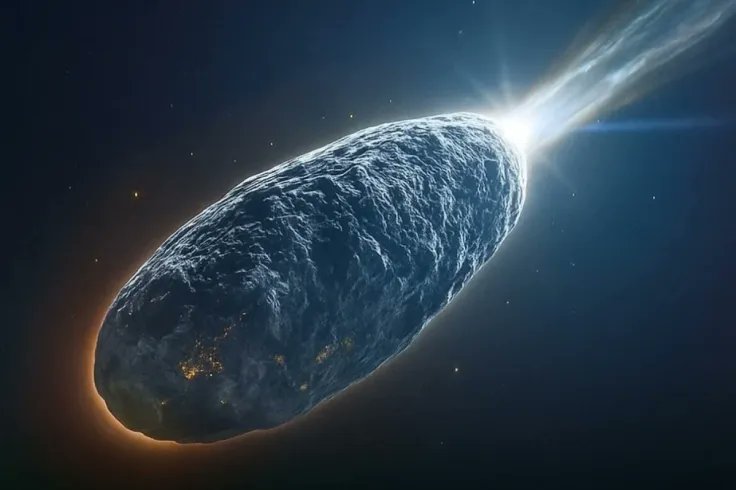
Question of the Week: Is 3iAtlas an interstellar spaceship?
My Answer: Harvard University's Avi Loeb has suggested the object, 3iAtlas, has displayed maneuvers indicating it may be an interstellar spacecraft. Nearly all other astronomers say 3iAtlas is an interstellar comet. Such comets are abundant in our galaxy. About 20% of stars have large Oort clouds in the outer parts of their systems containing several trillion comets. When stars pass close to one another, many Oort cloud comets get ejected into interstellar space. In close stellar encounters, comets belonging to a less massive star may get captured by the more massive star. Because the Sun is more massive than 90% of all stars, it has captured a large number of comets from other stars. It also has captured some interstellar comets. There's a possibility the Sun will capture 3iAtlas, but it's far more likely 3iAtlas will pass through the solar system & re-enter interstellar space. To traverse interstellar space with a spacecraft in less than several tens of thousands of years, the spacecraft must be propelled at a velocity greater than 0.05 light’s velocity. (3iAtlas is travelling at only 0.0002 light’s velocity.) At those velocities, the particles & dust grains in interstellar space will destroy large spaceships. Astronomers are eager to send spacecraft to the nearest planets outside our solar system. They've determined that to have a chance of survival the spacecraft must be no larger than a matchstick. Even then, thousands of such tiny spaceships would need to sent out for there to be any reasonable chance that some will survive. 3iAtlas isfar, far large than a matchst