Queen Mary's Centre for Predictive in vitro Models is looking for an Organ-Chip Research Technician with practical expertise in cell culture and related laboratory techniques to help run our state-of-the-art organ-chip facility. See details and apply here: https://t.co/ESU9Jo889t
Get your organ-on-a-chip abstracts in for #BioMedEng24, happening @QMUL this Sept! Slots for oral and poster presentations across two organ-on-a-chip (broadly defined) conference sessions. It’s going to be great! @OrganOnAChip@QMULCPM
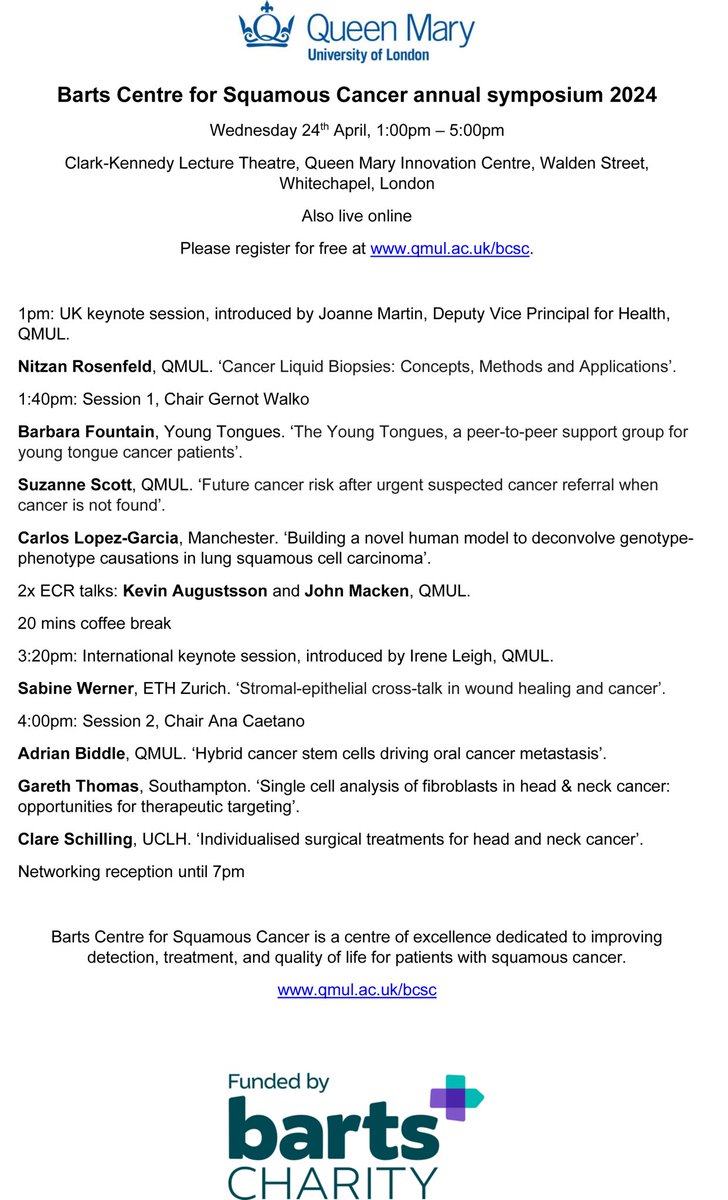
Sabine Werner gives the international keynote at our @BartsSquamous symposium @blizard_inst this afternoon. We brought together a group of squamous cancer researchers, patients and clinicians for the afternoon and it was brilliant! Thank you @Barts_Charity for making it possible!
Join us in welcoming Prof Nitzan Rosenfeld as he steps into the role of BCI Director @QMUL.
In this interview, we explore Prof Rosenfeld's journey through academia and industry, and how a #cancerdiagnosis in his own family changed his career trajectory. https://t.co/1wOxKPV2O7
Not long to go! Our annual @BartsSquamous cancer symposium will be on 24th April @blizard_inst@QMULBartsTheLon and online. Keynote talks from Sabine Werner and Nitzan Rosenfeld. Full program and registration: https://t.co/wT81m1GMto
Not long to go! Our annual @BartsSquamous cancer symposium will be on 24th April @blizard_inst@QMULBartsTheLon and online. Keynote talks from Sabine Werner and Nitzan Rosenfeld. Full program and registration: https://t.co/wT81m1GMto
Our annual @BartsSquamous cancer symposium will be on 24th April @blizard_inst and online. Keynote talks from Sabine Werner (stromal-epithelial cross-talk) and Nitzan Rosenfeld (cancer liquid biopsies). Full program and registration: https://t.co/Lmf9XSbFEF. @QMULBartsTheLon
SLS1: Human lung 3D models to assess antiviral effects of novel and sustainable compounds against SARS-CoV-2 variants with @mccormickadele1 @miriamdwek and Dr Hassan Morad https://t.co/nSIllsq5OG
Super excited to announce that we will be running a major training centre in organ-chip for 60 plus PhD students, after receiving over £7M if funding from @EPSRCCDT.
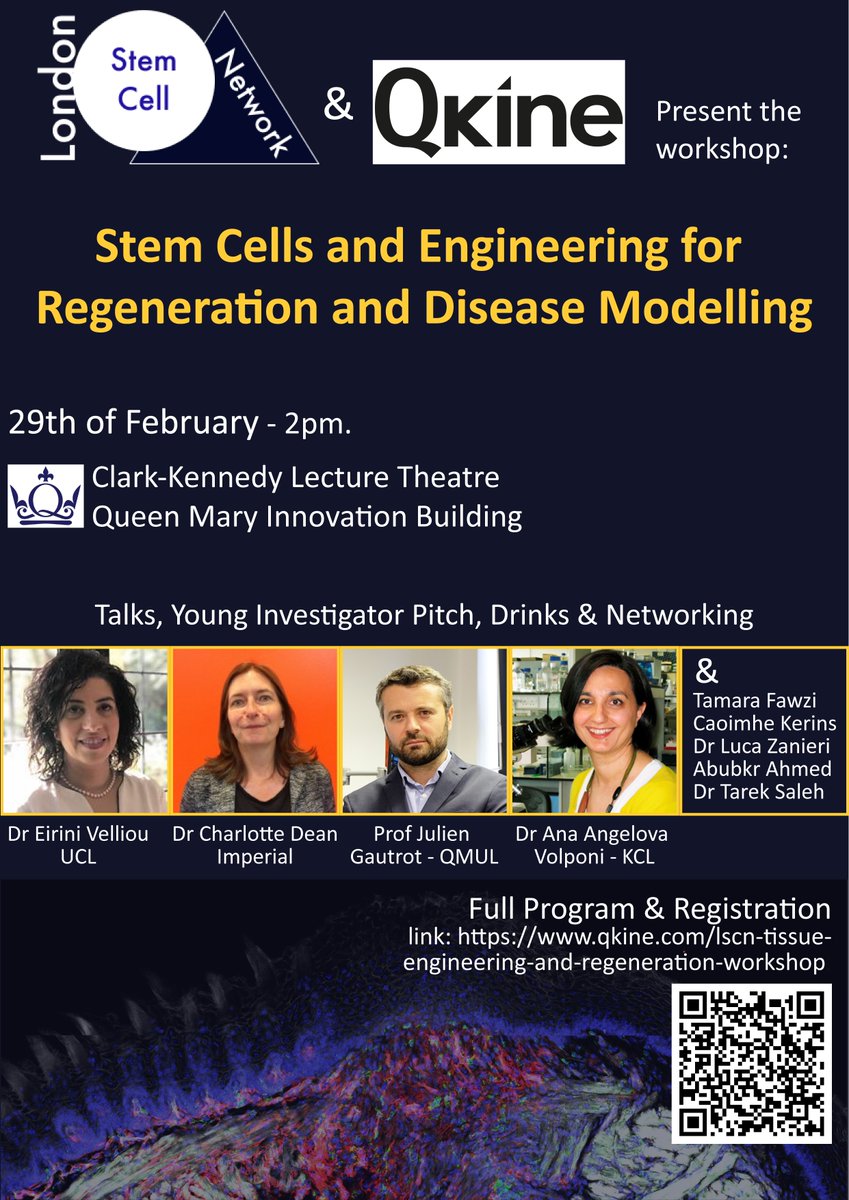
Join us for a workshop on "Stem Cells and Engineering for Regeneration and Disease Modelling” on the 29th of February 2024 organised by the @LSCN_UK and @QkineBio at @QMUL. Registration is free https://t.co/2zjaMHVEW9
#stemcells#diseasemodelling
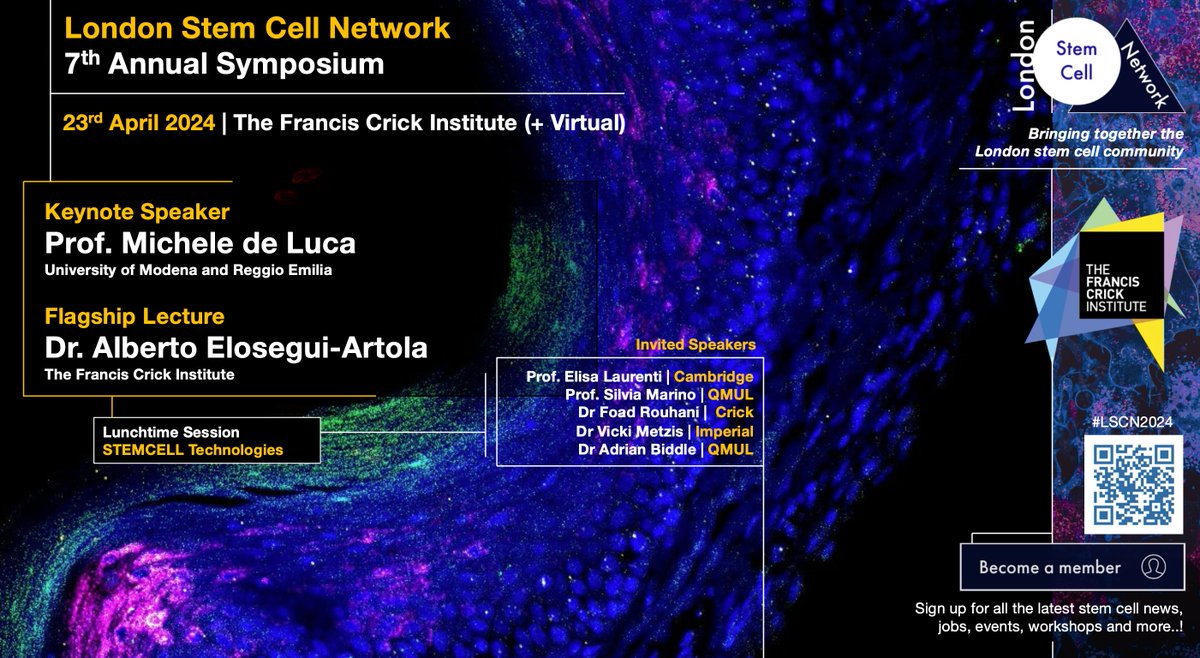
We know you have been waiting, but the wait is finally over! We are very (very!) proud to announce the speakers of the LSCN 7th Annual Symposium (held @TheCrick on Tue 23rd April). Looking forward to hearing the fantastic talk from Michele de Luca on #epithelial#stemcells! 1/3
We hope you are ready for our last workshop before the Annual Symposium as this one is not to be missed! We will talk about #stemcell and #bioengineering and models of #Regeneration and #Diseases! More details and registration: https://t.co/uQ06fCq19h
**Please Share** A fully-funded #PhDposition is available in my group @blizard_inst to examine how chronic inflammation in the human airway affects antibody responses to common respiratory pathogens. Apply by 23rd Feb, more info and link here : https://t.co/dcgDpamH67
In particular, I think we’re at the point now where the legacy concept of a ‘pre-clinical’ mouse model needs serious re-examination. Does this give us any extra useful information on efficacy that we can’t gain more accurately from co-ordinated human tissue and in vitro work? 🤷
When we have access to advanced human pathology and clinical data, and fantastic new in vitro models that are predictive of human disease, then we have to ask the question - who needs mice? 🐁 🧵
Great to see methods first developed by @DrABiddle in his Fellowship continue to be used with new technologies to replace animals in cancer research. This latest paper uses machine learning to analyse human tumour samples and predict risk of metastasis: https://t.co/E1O8QIhmMG
This holds promise for the whole spectrum from basic biology to drug efficacy and toxicology. For example, @emulateinc have assessed their liver-chip for toxicology using human clinical data: https://t.co/u1QvxZZVic