Seven Things This 63 Year Old Surgeon Would Tell My 40-Year-Old Self
I am 63 now, and I spend my days as an orthopedic surgeon watching how people's earlier choices show up in their bodies decades later. I see it in my college friends, high school buddies, and patients that I have known for 20+ years. If I could sit across from myself at 40, here is what I would want that man to understand. None of what follows is complicated, and all of it compounds over the decades… either against you… or in your favor. You are largely in control.
STOP starting your emails with:
“I hope you’re doing well.”
It’s correct. It’s polite. And it’s also one of the most forgettable openings there is.
If you want someone to reply, don’t start like everyone else.
Start with intention.
Here are 10 alternatives: 👇
Between 2011 and 2013, a neurosurgeon named Christopher Duntsch operated on 38 patients in Dallas-area hospitals. Only five came out unharmed. Two were dead. Thirty-three were maimed, paralysed, or left in permanent agony.
Of his 38 surgeries, only three had no complications. Hospitals that discovered what he was doing were reluctant to formally report him, fearing lawsuits and lost credibility. They quietly fired him and let him move on.
Patients woke from his surgeries paralysed from the neck down. One left with paralysed vocal cords. One became paraplegic.
He left a surgical sponge inside a patient's neck wound. He operated on the wrong part of another patient's spine.
In May 2013, University General Hospital threw a celebratory dinner to welcome Duntsch to their medical staff.
The following month he cut into a patient's vertebral artery and left a sponge in his neck.
His licence was suspended on June 26, 2013.
The most chilling detail came out at trial. Prosecutors presented a 2011 email Duntsch had written, sent after his first surgeries went wrong, detailing his plans to "become a cold blooded k*ller."
After 13 days of trial, the jury deliberated just four hours before convicting him.
On February 20, 2017, he was sentenced to life in prison, the first surgeon in US history convicted and imprisoned for actions committed in the operating room.
In 1880, a reclusive, self-taught telegraph operator with no university degree went to war with the greatest scientific minds in the British Empire.
He won, changed the mathematics of physics forever, and quietly built the foundation for the entire modern electrical grid.
Yet today, almost no one outside of electrical engineering and applied mathematics even knows his name.
His name was Oliver Heaviside.
The story of how he solved one of the hardest engineering problems in human history is a masterclass in why book smarts fail where deep, messy intuition succeeds.
In the late 19th century, the world was trying to lay massive underwater telegraph cables across the Atlantic Ocean. But they had a crippling problem: the signals kept distorting. You would type a message in London, and by the time it reached New York, it was a smeared, unreadable mess of electricity.
The top physicists of the day, using traditional university math, said the solution was simple: make the cables purer and reduce resistance. They spent millions of dollars trying to make the lines perfect.
It didn't work. The signals still broke.
Heaviside looked at the exact same problem from his messy, self-taught perspective and realized the elite academic establishment was blind.
They were treating an electrical wire like a water pipe. They thought the electricity was inside the copper.
Heaviside figured out that electricity doesn’t flow inside the wire; it flows in the electromagnetic field around the wire.
Then, he did something that made mainstream mathematicians furious. He invented a bizarre shortcut called operational calculus. Instead of spending weeks solving complex, multi-page differential equations to map these fields, he treated calculus like basic algebra.
To the professors at Cambridge, this was a sin. They called his math clumsy, unrigorous, and nonsense.
Heaviside didn't care. His famous response to them was: "Should I refuse my dinner because I do not fully understand the process of digestion?"
He used his illegal math to propose a mind-bending solution: to fix the distorted signal, engineers didn't need to make the cable cleaner. They needed to deliberately add more corruption to it. He suggested wrapping the cables in iron wire to introduce "inductance", intentionally fighting one distortion with another.
The establishment ignored him for years. But when AT&T finally tried his method, the results were instant. Long-distance communication was solved.
Heaviside wasn't trying to pass a math exam or impress a peer-review board. He wanted to solve a real-world problem.
In the process, he took James Clerk Maxwell’s famously complex 20 equations of electromagnetism and condensed them into the 4 beautiful formulas that every single physics student is forced to memorize today. Heaviside did the heavy lifting, but Maxwell got the name.
The lesson Heaviside left behind is a philosophical blueprint for navigating a complex world:
The people who memorize the proper formulas are excellent at solving textbook problems. But they are entirely dependent on the rules staying the same.
The people who understand the underlying system don't care about the rules. They break them to find what actually works.
Most of us approach our life's problems like the 19th-century British establishment. When something goes wrong in our career or relationships, we try to make our existing wire purer. We try harder at a broken method.
But sometimes, the problem isn't that you aren't trying hard enough. The problem is that you are looking inside the wire instead of looking at the field around it.
What is a distortion in your life right now that you keep trying to fix with the standard advice? What happens if you stop trying to follow the textbook formula and start looking at the hidden forces causing the noise?
An Ebola ‘Conspiracy’?: Why is Uganda Blacklisted While DR Congo Where It Originated Gets a Pass?
It’s very difficult to get agreement on anything in politically polarised Uganda, but there is a rare growing consensus in the country that a "conspiracy" at play against it regarding the latest Ebola outbreak.
As is often the case, the virus originated in the Democratic Republic of Congo (DRC) where 452 confirmed cases, 1,000 suspected cases, and 82 deaths have been recorded - before spilling over into Uganda.
Uganda has registered 15 cases and just ONE (1) death, a 59-year-old Congolese man who had come into the country from the DRC.
This is where it gets strange. Despite this disparity, western governments have issued over a dozen strict travel advisories specifically targeting Uganda, far eclipsing those levied against the DRC, and even suspension of visas!!!. This has prompted Ugandan politicians and social media users to rail against them and sections of international media like Al Jazeera for "bundling Uganda with Congo" and treating the two as a single entity.
The situation in Kenya might throw some light on the Uganda case. Protests erupted in Nanyuki, in the mountainous central region of the country, over a proposed US Ebola quarantine facility at Laikipia Air Base. This backdrop lends some credence to a disclosure from an authoritative Nairobi-based journalist who said: "We hear the US initially approached Uganda, which possesses the continent’s finest technical expertise on Ebola. Kampala refused, stating, 'We are too busy managing the spillover from Congo'."
If Kampala did indeed rebuff Washington, it is confounding given the Ugandan government’s long history of subservience to US interests. Yet, it might explain why conspiracy theories are thriving. Kampala likely suspects it is being internationally penalised for refusing to fall in line and serve as an Ebola "leper colony".
What is clear is how anomalous it is for a nation with minor spillover cases to be treated as the primary medical pariah.
Some first-year medical students were attending their first Anatomy class. They gathered around a table where a real dead body had been placed for study.
The professor began the class by telling them that every good doctor must have two important qualities.
-thread-
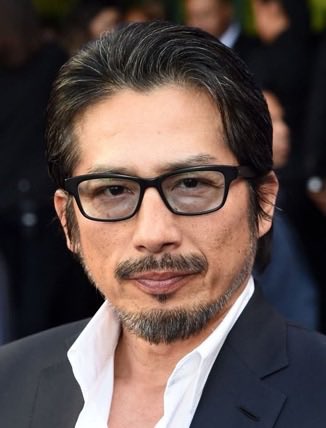
Japanese actor Hiroyuki Sanada spoke about the contradictions of human nature:
“Some people dream of having a swimming pool at home, while those who have one hardly ever use it. Those who have lost a loved one feel a profound sense of loss, while others often complain about their living relatives. Those without a partner long for one, while those who have one often don't appreciate it. The hungry would give anything for a meal, while the satiated complain about the taste of their food. Those without a car dream of owning one, while those who have a car are always looking for a better one.”
The key to happiness is gratitude: truly seeing and appreciating what we already have, and understanding that somewhere, someone would give anything for what we take for granted.
Charlie Munger was a philosopher who's net worth was $2.6 billion.
In 1986, he gave a speech teaching how to guarantee a miserable life.
Most heard the comedy. Few caught the framework.
50 years later, it's the most underrated tool in self-help.
Here's the move: 🧵
7 LAWS TO PREDICT YOUR FUTURE
1) Murphy’s Law: What you fear most tends to happen, so stop feeding your fears.
2) Kidlin’s Law: Writing a problem clearly is already half the solution.
3) Gilbert’s Law: Your success depends on taking full responsibility for your actions.
4) Wilson’s Law: Smart work and knowledge always lead to lasting wealth.
5) Falkland’s Law: If a decision isn’t necessary, don’t make it; patience is power.
6) Hanlon’s Law: Don’t assume malice when simple ignorance could explain it.
7) Newton’s Law of Effort: Every small action creates momentum that builds success.
A must do once in your lifetime as a man,
1. Bet on yourself when failure is very possible.
2. Sit alone in silence for a full day. No phone.
3. Lose something you thought you couldn’t live without.
4. Build something from zero.
5. Be broke enough to respect money forever.
6. Travel where you don’t speak the language.
7. Tell the truth when lying is cheaper.
8. Love without leverage.
9. Watch a sunrise after almost quitting life.
10. Mentor someone with nothing to gain.
11. Get rejected publicly.
12. Pray when you have no words.
13. Kill an old version of yourself.
14. Obsess over one craft for a year.
15. Forgive without an apology.
16. Say “I was wrong” without explaining.
17. Be the poorest in one room, the sharpest in another.
18. Create something that outlives you.
19. Choose discipline over motivation.
20. Finish the Entire Bible at Least Once in Your Lifetime
21. Spend time with a child and actually listen
22. Give something you truly value to someone who needs it more
23. Write a Letter to God
Most people stay average because they can't even try, just do it
15 THINGS MONEY TEACHES YOU THAT NOTHING ELSE CAN:
1. People treat you differently when you have it and when you don't
2. Most relationships have a financial undertone nobody admits
3. Poverty is a mindset long before it becomes a bank balance
4. Earning it is easy keeping it is the real skill
5. The first time you lose it all teaches you more than years of success
6. True freedom isn't luxury,it's having options
7. Most people are one financial crisis away from a completely different life
8. Nobody talks about money openly,but everyone is controlled by it
9. Generosity is only possible when you stop being afraid of losing it
10. Building wealth slowly is the only way that actually lasts
11. The rich think in assets,the poor think in expenses
12. A cheap decision today will cost you ten times more tomorrow
13. Money amplifies who you already are,good or bad
14. Financial stress destroys more relationships than infidelity does
15. The day you stop trading time for money,everything changes
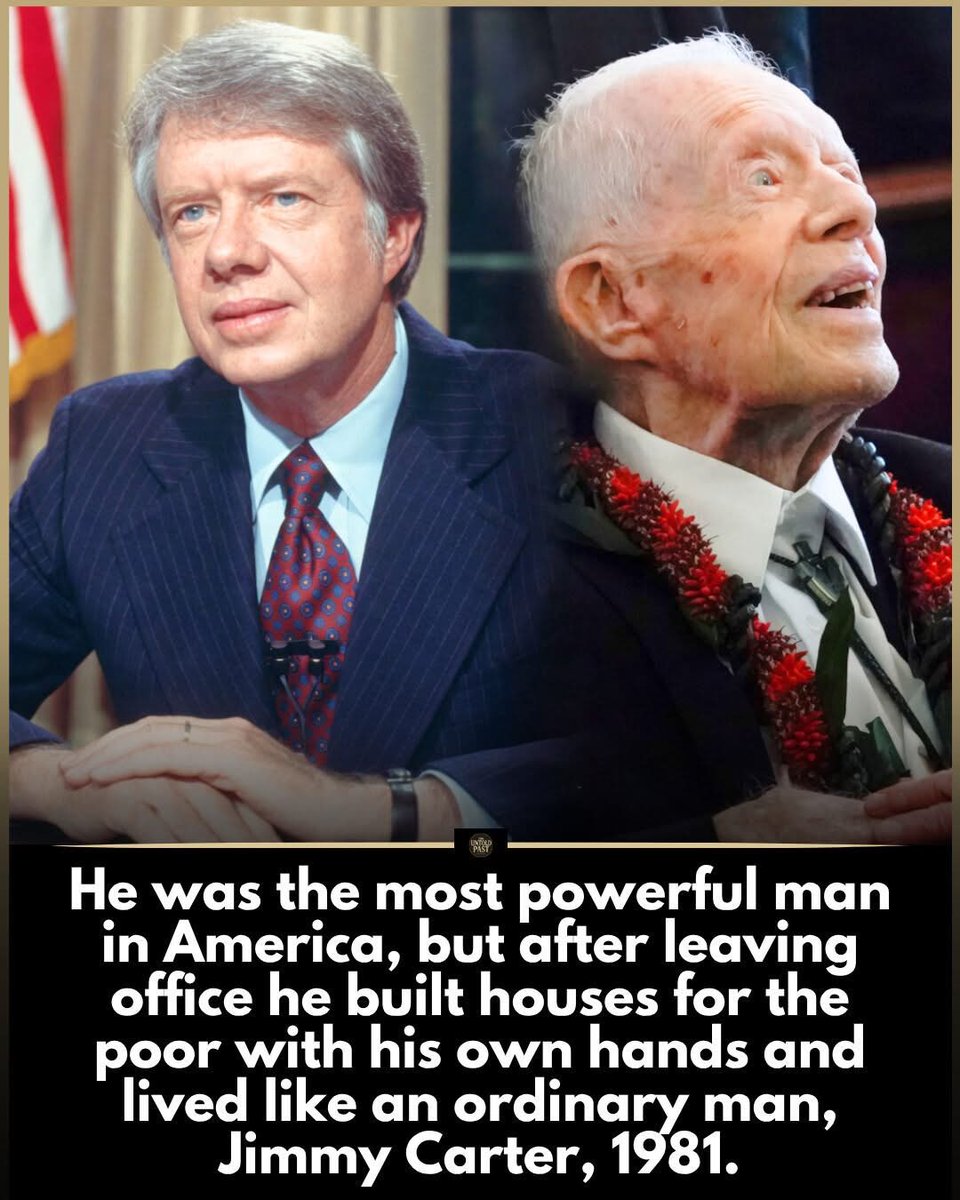
In 1981, Jimmy Carter walked out of the White House.
He had been the most powerful man in the world.
Leader of the United States. Commander-in-Chief. A man with access to anything, anywhere.
Then suddenly, it was over.
Most former presidents take a different path.
Million-dollar speeches. Book deals. Private jets. A life far removed from ordinary people.
Carter didn’t do that.
He went home.
Back to Plains, Georgia. A small town. No spotlight. No luxury lifestyle.
And then he did something almost no one expected.
He picked up a hammer.
With Habitat for Humanity, Carter started building houses for people who couldn’t afford one. Not posing for photos. Not supervising.
Working.
Sweating under the sun. Carrying wood. Hammering nails. Side by side with volunteers.
Year after year.
Into his 70s.
Into his 80s.
Even into his 90s.
This wasn’t a one-time gesture. He helped build and repair thousands of homes across the world.
The same man who once sat behind the most powerful desk on Earth was now on rooftops, fixing homes for strangers.
No cameras needed.
No applause required.
While others chased wealth after power, Carter chose something else.
Service.
He lived longer than any U.S. president in history. Long enough for people to look back and realize something simple.
Power didn’t define him.
What he did after power did.
And in a world where leaders often take, he kept giving.
Story based on historical records. This post is for educational purposes.
I wish someone sat me down and explained housemanship like this before I started.
The impostor syndrome is real, but here is the truth nobody tells you: it's not about how much you know, it's about how you manage the chaos.
Here are 12 things I wish I knew before starting house job:
1. Your pen is more important than your stethoscope.
If it isn’t documented, it never happened. In a lawsuit or a panel, your "good intentions" are irrelevant without a clear, timed note in the folder.
2. Senior Nurses are your greatest allies or your worst nightmare.
They have seen hundreds of HOs before you. Respect their experience. If they like you, they’ll save your skin; if they don’t, your calls will be a living hell.
3. Sleep when you can, eat when you see food.
The "HO Hunger" is real. You never know when a 5-minute break will turn into a 6-hour emergency. Treat every meal like it’s your last for the day.
4. Samples don’t walk to the lab.
Never assume a test was run just because you wrote the request. If you don't physically verify that the sample left the ward, consider it not done.
5. Clinical confidence is a necessary camouflage.
Even when you are panicking inside, stay calm for the patient and the relatives. A panicked doctor creates a chaotic and dangerous ward.
6. There is no trophy for struggling in silence.
If you can’t get a line after 3 - 5 tries or the patient is crashing, call your Senior Registrar. Admitting you need help isn't weakness; it’s professional maturity.
7. Your co-HOs are your oxygen.
The colleague on call with you is the only person who truly understands your stress. Cover for each other. One day, you’ll be the one who needs that 30-minute nap.
8. Treat the patient, not just the lab result.
Results can be wrong; the clinical state rarely lies. Always examine the person in the bed before you blindly adjust a prescription based on a printout.
9. Communication is 90% of the job.
How you talk to grieving or frustrated relatives determines whether you get a "thank you" or an assault. Empathy is just as important as your surgical skills.
10. Don’t carry the system on your back.
You will see death and you will see a broken healthcare system. Do your absolute best, but don’t let the weight of things you can't control break your mental health.
11. Master the "Emergency Tray."
Know exactly where the adrenaline, hydrocortisone, and oxygen keys are kept. Your life becomes 100x easier when you don't have to hunt for basics during a crash.
12. You are the doctor now.
The "Student" shield is gone. Own your decisions, learn from every mistake, and never forget the discipline it took to earn that "Dr." prefix.
Physicians often have worse health than the public: long shifts, night calls, and chronic stress have turned medical practice into a system-driven health hazard for clinicians.
https://t.co/WIloAM2Wxz
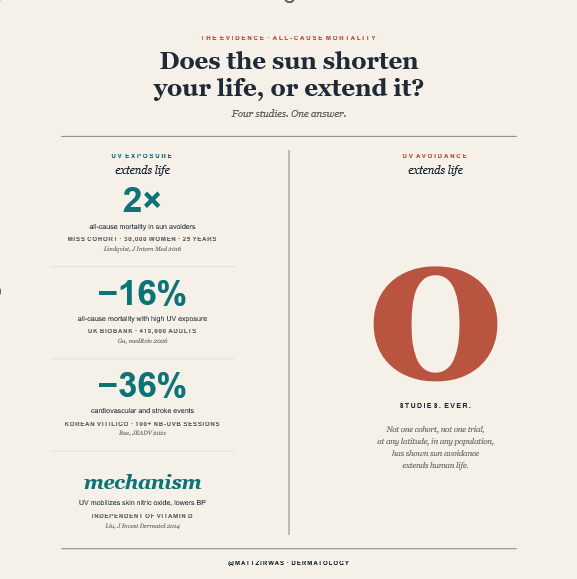
Dermatology is wrong about the sun.
And it's killing people.
I'm a dermatologist. 226 publications. I should know.
Avoiding the sun increases the risk of dying as much as being a smoker.
We can fix it.
For decades, dermatology's message has been simple: avoid the sun. Wear sunscreen. Seek shade. UV causes skin cancer. End of discussion.
That message is incomplete and outdated.
People are dying because of it. Lots of people.
The evidence has gotten strong enough that the field needs to update it.🧵
At a university, a professor asked his students: "If there are four birds on a tree and three of them decided to fly away, how many are left on the tree?"
Everyone answered, "One."
They were surprised when one student disagreed and said, "Four birds remain." This caught everyone's attention.
The professor asked him: "How so?"
He replied: "You said they decided to fly, but you didn't say they actually flew. Making a decision doesn't mean taking action."
And indeed, that was the correct answer.
This story reflects the lives of some people, they have many slogans and catchy words, and they shine in gatherings and among friends, but in reality, their lives don’t reflect those words.
Many people talk, but only a few act..!
Making a (decision) is one thing...
Taking (action) is something else entirely.