When the beautiful game is the ugly game. Great article on youth academy football by @NickRGibbs1 and Daniel Briggs. https://t.co/GALHphYJMA @URealists
There’s a persistent myth that our government is somehow at the mercy of the financial markets and that it has to dance to their tune. This is most definitely doing the rounds this week, mainly as a result of Labour's mismanagement of its own party, and Rachel Reeves' subsequent very public tears.
It’s a myth I have been challenging for years, so let me summarise why.
1. The government creates the money
The UK government is the monopoly issuer of the pound. It spends all of that money into existence. Every pound of government spending creates a matching financial asset for someone else. It is only afterwards that the government issues bonds, not because it needs the money, but to provide a safe place for savers to deposit their funds when banks cannot provide this service.
This point is critical. The government does not need the markets to ‘fund’ its spending. It is simply swapping one form of money (reserves) for another (gilts). Bizarrely, it pays interest to those to whom it provides this service.
2. Gilts are a choice, not a necessity
The sale of government bonds, gilts in the UK, is presented as if the government is dependent on the markets to keep spending. This is nonsense. The government issues gilts largely because:
It wants to drain reserves from the banking system to help the Bank of England hit its (currently too high) interest rate target.
It wants to give pension funds and insurance companies a safe deposit facility to underpin their promises to those who use their services.
It believes it must maintain an outdated and now unnecessary City-based financial architecture.
None of this means it needs the markets to spend. If no one bought gilts, the government could continue to spend. In fact, as quantitative easing and now quantitative tightening prove, there is no relationship between bond issues and Bank of England market interventions and the capacity of the government to spend: the evidence is all there for anyone to see.
3. The central bank is always the buyer of last resort
When financial markets are in turmoil, as happened in the mini-budget fiasco under Liz Truss, the Bank of England steps in. Its role is to stabilise prices and yields. This is not optional. It is a fundamental part of having a sovereign currency and a central bank that acts as the lender of last resort. This means the financial markets are, in fact, dependent on the government and its central bank. Not the other way around.
4. Interest rates are a policy choice
People say, “but the markets set interest rates, and so they can discipline the government.” Again, this misunderstands monetary operations. The Bank of England sets the base rate. It can cap or control longer-term rates by buying or selling bonds as it chooses. The so-called market rates are policy-contingent. When push comes to shove, the central bank can always enforce the interest rate it wants.
5. What markets really influence is ideology
So why the obsession with ‘market confidence’? The reality is, politicians and economists often invoke markets to justify austerity. It is easier to say “the markets demand it” than to admit their own ideological choice, which would otherwise be unpalatable to the electorate. Financial markets do, in that case, play a political role, but they do not hold the government hostage. They operate within the monetary framework that the government and its central bank set. We could just as easily choose to run the economy with other priorities, but it does not suit neoliberal politicians to do so. That is because they view politics as the City does, at cost to us all.
Summary
I keep returning to this issue because it is so fundamental: the UK government is a currency creator, not a currency user. It is not like a household. It does not need to beg or borrow from the markets to spend. Financial markets are accommodated by the government, not the other way around.
Understanding this changes everything. It means that economic policy decisions — on public services, investment, climate action, and inequality — are political choices, not technical constraints imposed by bond traders. That is why misinformation on this issue matters so much, and the fact that it is so widespread shows just how strong are the forces that wish to deny that democratic choices can still be made in the UK.
Excellent blog post from Mayra Barrera on the 'digital coliseum'. Engaging and thoughtful analysis of online culture, social media and our eagerness to share emotion, pain and vulnerability as spectacle. https://t.co/5JJf7h39J5
Out now!
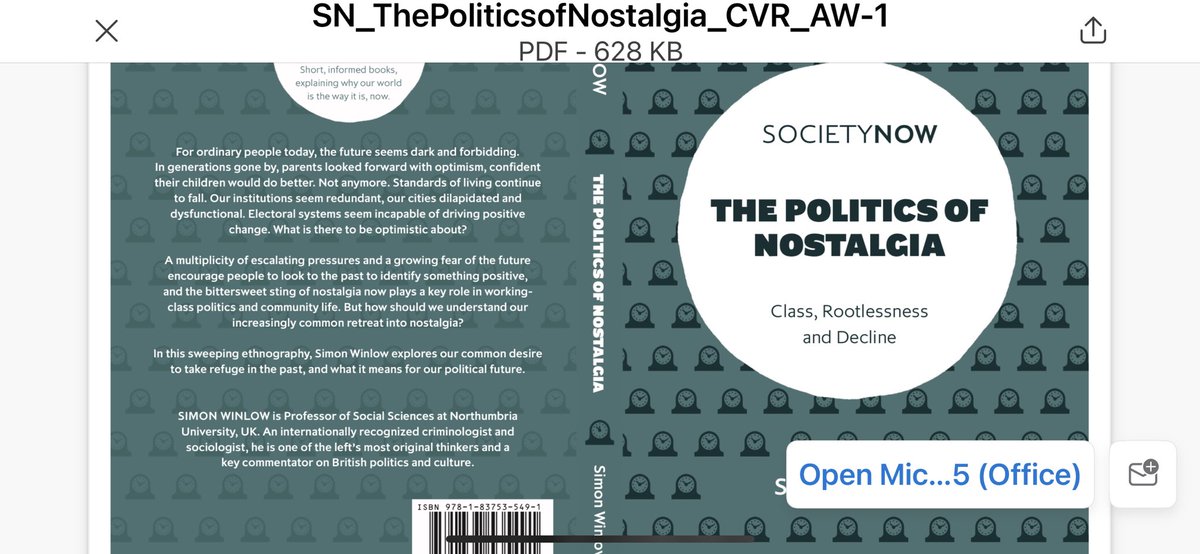
The Politics of Nostalgia: class, rootlessness and decline
£17.99 but you can get 30% with the code EME30 on the Emerald website:
https://t.co/CC8dUOp6eN
"People were clearly worried about him, but either he was never taken seriously, or no one quite knew what to do with him."
Lots of detail here. Was his mental health raised during his trial or sentencing?
https://t.co/JPFlhZLgn9
Watch this because @RichardJMurphy nails it. Only 9 minutes long. The kernel of neoliberalism's ideological strategy is to deny the fact that the government can 'borrow money' from the central bank, the Bank of England, by 'selling bonds' to it any time it wants. There is no logical economic reason for the BoE to sell on these bonds to private buyers in the open market OTHER than to jack up the interest rate above inflation - the 'real net positive interest rate' - so their rich pals can trouser more money. This charade, which started in 1694 when the BoE copied the original Dutch bond-selling scam - thank you William of Orange, it's the only real reason he was invited over - is just a method of giving their pals a safe bet. That way the leveraged investment banks, pension funds, insurance funds and so on don't have to take any risks like investing in the real economy of industry, infrastructure etc. They can just asset-strip and rent out what already exists instead, even if it's falling to bits like Thames Water. The whole thing is a GIANT SCAM. It's like the purloined letter, hiding in the light. The lie is so big and transparent nobody believes it can possibly be a lie. Reeves? She just does what the bankers tell her to do, even though she knows it will bring down her government. So what? https://t.co/W3I0lPjzFK
Young men are entering into an economy that is unequal, a society that is atomised and workplaces that are insecure. Right-wing influencers posing as self-help gurus are appealing directly to them. But an alternative is possible. Me for @guardian.
https://t.co/PAVdnLrhTJ
Student loans to go up again. Anyone who knows even a little about economic history will understand that neoliberalism is an ancient system restored to dominance by the creditor class. Those who live off compound interest supplied by lifetime debt slaves. https://t.co/ubqCnC6iRs
🚨New article by @mikeyhirst02 and me talking about lifestyle medicines, online advertising on social media, and direct-to-consumer services vs illicit markets: https://t.co/tblTu8H3sj
Episode 3 of ‘our lives in the North’ focuses on legacy of conflict-paramilitaries, violence and criminal exploitation of children. Happy to have spoken with @UnaKelly3 about my research @endingtheharm@QUBSSESW@SLSSHub
https://t.co/VQqHoPUWFG
Apparently, ultra-realists are disciples of Steven Pinker (!?), talk about 'brain-shaping' (!?) and claim 'neoliberalism causes crime' (!?). These misunderstandings will be corrected in the second edition. Out next year. Watch this space! https://t.co/HIgKLECuHH @CriticalCrimBSC
Pleased to report my new book will be out soon - the first from my @LeverhulmeTrust funded project, The Politics of Nostalgia…
‘In generations gone by, parents looked to the future with optimism, confident their children would do better. Not anymore…
https://t.co/CC8dUOp6eN