🚨Si solo pudieras ver UNA clase de negocios en toda tu vida… que sea esta.
41 minutos de Peter Thiel en Stanford que valen más que cualquier curso de miles de dólares.
Olvídate de los consejos reciclados que repiten todos los “gurús”.
Aquí Thiel te explica sin filtros:
Cómo construir un monopolio desde cero
Por qué competir es la forma más rápida de matar tu empresa
Qué hicieron realmente Google, PayPal y Facebook para dominar sus mercados
He leído libros enteros de estrategia que no concentran ni la mitad del valor que dan los primeros 15 minutos de esta charla.
Y lo mejor: es completamente gratis.
No importa si estás creando una startup, escalando un negocio o solo quieres pensar como los que realmente ganan…
Después de verla vas a mirar cualquier empresa con otros ojos.
Guárdala.
Vas a volver a ella más de una vez.
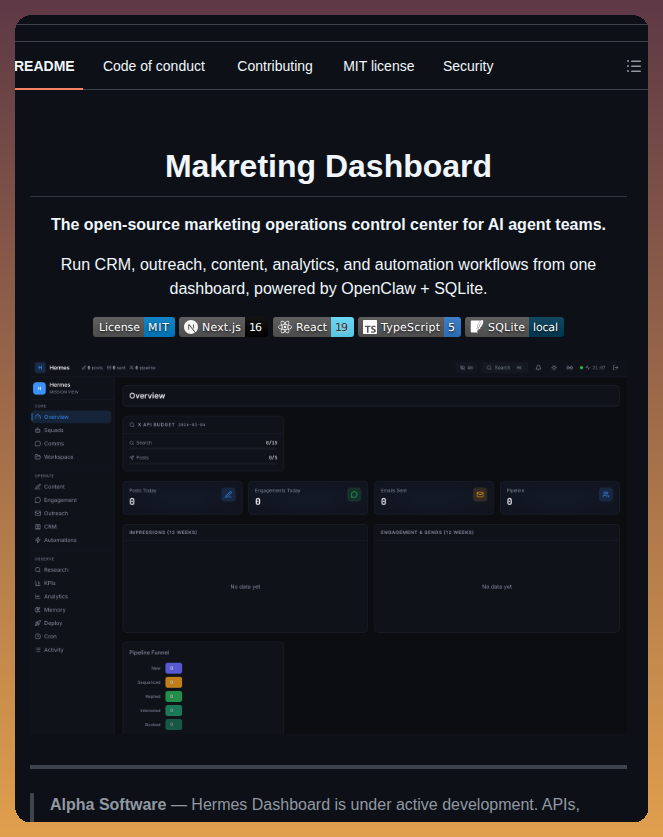
marketing-dashboard is an open-source tool that unifies CRM, outreach, content, and analytics into a single interface for AI agent teams, operating locally via OpenClaw and SQLite.
https://t.co/UAl6mReHOh
New WebGPU Glass Material is almost ready!
It will be available for @threejs and @pmndrs React Three Fiber. Lots of customization; it comes with a very beautiful and handy control panel.
Live link and source code will be available on Monday 😊
#threejsJourney#creativecoding #webgpu
If you want to keep working while you're stuck in traffic in the car, Hermes has the solution for that.
One thing I didn't include in this article is voice control.
Instead of typing and reading the reply, you can literally just have a conversation over Telegram with Hermes, and it can talk back to you with the response.
One of my clients is currently setting this up so that he can build inside of Paperclip using Hermes as the agent builder while he's stuck in traffic. I
don't know anyone doing this right now, but you can easily just ask Hermes, and it will set it all up for you.
An OpenAI engineer, in OpenAI's own Build Hours sessions:
"you don't need IT and engineering support to build out these workflows.
we really want to make sure that these subject matter experts are the ones that can build out these flows."
in 3 hours of their own build sessions, the team says who these setups are actually for
the person who knows the work is the one who builds it
if the people building the tools are saying it out loud, the "I'm not technical" excuse is finished
watch & bookmark, then see all nine setups in the article below ↓
WEB DESIGN AGENCIES ARE COOKED - I BUILT A SITE LIKE THIS IN 5 MINUTES WITH ONE COPIED PROMPT
No Figma, no dev, no week of back and forth. You copy one prompt and Claude builds the whole thing.
The move is GetLayers. It's a library stacked with insane landing pages, full 3D scenes, cinematic camera moves, motion everywhere, and every single one comes with the exact prompt that built it.
You just browse until something stops your scroll, copy the prompt, and paste it straight into Claude running Opus 5. Minutes later you've got a live site with real depth, real motion, source code included.
This is the part that changes everything:
no design skill needed, the prompt already carries the taste full Three.js and Next.js source, not a locked template some prompts are free, the rest unlock with one upgrade copy, paste, ship, same site the demo just built
Studios charge five figures for sites with this much motion. You're getting the exact recipe and building it yourself in one shot.
the people pulling prompts off here tonight are shipping portfolios and launch pages that look impossible, while everyone else stares at a blank Figma file.
Train your own LLM from scratch.
This repo builds a GPT-style transformer from the ground up, without using any high-level libraries.
You see exactly how attention, multi-head attention, the feed-forward block, embeddings, residuals, and layer norm fit together.
And it doesn't stop at the model. It walks the whole path from raw data to generated text.
↳ Data download, preprocessing, training, and generation
↳ Training data from The Pile (825GB across 22 sources)
↳ Tokenized with tiktoken (r50k_base) and stored in HDF5
↳ Training loop with eval, LR decay, and crash-safe checkpoints
↳ An SFT and RLHF guide for what comes after pretraining
The same code scales by changing a few config values. Around 13M parameters is where the output starts producing correct grammar and spelling, and you can train that in about a day on a free Colab or Kaggle T4.
If you've ever wanted to actually see how a transformer works instead of importing one, this is a clean place to start.
Link to the repo in the comments.
holy sh*t this is f**king gold
a GitHub free repo with 42,600 stars just gave out the entire framework to run your entire business using ai agents
9 steps to build a fully ai-native business
intent → issue → agent → runtime → execute → observe → verify → compound into a skill → rerun on cron.
save and bookmark no matter what
Microsoft open-sourced a 4B model that turns any image into a production-ready 3D asset in 3 seconds.
It’s called TRELLIS.2, a fully textured, physically accurate 3D models with PBR textures out of the box.
→ Full PBR (base color, roughness, metallic, opacity)
→ Handles hair, cloth, glass, non-manifold geometry
→ Exports .glb ready for Unity/Unreal/Blender
→ Runs locally, ships in 3 seconds
It's not a demo or a research preview. The full training codebase is public.
You can fine-tune it on your own asset library and get a model that generates in your studio's exact style.
100% Open Source
FLUX 3 Preview is now publicly available, only on Hermes Agent and free on all Nous Portal paid subs for the next 48 hours.
Create a short film with it tagging @NousResearch and @bfl_ai - the 3 best entrants by 7PM PT on August 1st will receive:
1st place: 1 year of free FLUX 3 generation (20/day) + $2,000 Portal credits + Nous hoodie
2nd place: $1,000 credits + hoodie
3rd place: $500 credits + hoodie
First 100 new signups using code L1YSMYDB get a free month of Nous Portal Plus with full video gen access.
First 25 upgrades using code KEQHYO3X get $20 off.
https://t.co/3Uj27KjSik
> hermes update
i keep refreshing this because i can't believe how few people have seen it
an Anthropic engineer gave away a multi-agent system enterprises would have paid a fortune to have built for them, and the internet just kept scrolling
it's called a Loop Engineering System, and the way it works is almost embarrassingly clean:
a task comes in, a planner splits it up, and a resident agent does the actual work. then a set of ephemeral reviewers spin up in parallel and check the output. their results get synthesised into one pass-or-fail decision. if it fails, it doesn't ship, it loops back as feedback and tries again. if it passes, it gets delivered
the whole trick is one idea: agents that stay alive and hold memory, working next to disposable workers that cost almost nothing. long-running context and throwaway price at the same time
he could have charged six figures for this design. he posted it for free, and somehow that's the part nobody's talking about
BLENDER MCP + KIMI K3 JUST DID THIS
Top is a basic gray-shaded scene inside Blender. Bottom is the final cinematic result.
> same car
> same driver
> same camera path
> completely different level of realism and motion
Kimi K3 controlled the scene through Blender MCP.
The gap between simple 3D and final shot keeps getting shorter.
I cut Fable 5 token usage 2.5x with just one change!
(100% open-source solution)
- Before: 5.5 M tokens · 7 errors · $8.94
- After: 2.3 M tokens · 0 errors · $4.17
The final build was the same for both, but the path the agent took wildly differed.
In both runs, the agent started with the same thing, i.e., it understood the backend before building anything, like:
- Permission policies
- Available storage buckets
- Auth providers configured
- How edge functions are deployed
The first run used Firebase, which was built for a human dev using a dashboard.
While the dev can read the above state by clicking through tabs, an agent has no dashboard. So it gathered the same info through API calls.
And there's no single Firebase call that returned this info. The agent required to query multiple times, and each query over-returned.
For instance, when the agent asked how sign-in is configured, Firebase also returned the entire auth surface and every method it supported.
This was far more context than what it needed. And it repeated across every part of the backend it inspected.
Some states (like which auth providers are active) weren't queryable at all. I provided it myself. Otherwise, the agent would have guessed.
Errors further compounded the token usage.
When a dev sees "permission denied," they can look at the console and figure out whether it's a rule, a path, or an unauthenticated request.
Firebase returned the same string to the agent as well, and it had none of that surrounding context to debug.
So it guessed again, picked the most likely cause, and rewrote code, utilizing more tokens.
This Firebase setup cost me 5.5M tokens and 7 manual interventions during errors on a full-stack RAG app.
But I brought that down to 2.3M tokens and 0 manual interventions by using InsForge as the backend context engineering layer (open-source and self-hostable via Docker).
It provides the same primitives as Supabase/Firebase, but structures the entire information layer for agents, instead of dashboards.
In one CLI call that consumed ~500 tokens, the agent saw the full backend topology before writing a single line of code.
This included auth, database, storage, edge functions, model gateway, micro VMs, and deployment.
Also, instead of loading the entire product surface into context on every task, four narrowly scoped skills activated only when relevant to keep cognitive load minimal.
And to ensure efficient retries if needed, every CLI operation returned structured JSON with meaningful exit codes, so the agent never guessed what to do next.
Here's the InsForge GitHub Repo: https://t.co/o36D5sFAJe
(don't forget to star 🌟)
The video below depicts the final build, comparing Firebase and InsForge.
If you want to dive deeper, my co-founder recently published a full walkthrough building the same RAG app on both backends and inspected them end-to-end.
The article is quoted below!
China open-sourced a fully local memory system that gives any AI agent human-like long-term recall.
No cloud. No API bills. No flat vector piles.
- 61.38% fewer tokens per session
- 76% persona accuracy (up from 48%)
- 51.52% higher task success rate
- works with any agent
100% Open Source.
Don't waste 2 years learning to build AI agents.
An Anthropic engineer who built Claude Code tells you what to learn from scratch instead.
60 minutes course. Free:
00:00 - AI agent architecture
24:47 - LangGraph AI agent
29:15 - building AI agents live
Prompting is the old job. Building AI agent loops is the new one.
Bookmark now & watch it. Then build your own AI agent with the guide below.
Stateful vs. Stateless MCP core.
(Anthropic's biggest MCP update)
Let me explain what that means:
Until this release, talking to an MCP server worked like a phone call. Both sides ran an initialize handshake, and the server returned a session id carried on every later request.
That session was a live object inside one specific server process, holding the negotiated state.
Picture a restaurant where the waiter who took the order is the only one who knows what was ordered. Everything works until that waiter goes home.
Because that state lives in one process, a balancer could not spread requests across three MCP server instances. Teams pinned clients with sticky sessions or pushed session state into shared storage, which blocked autoscaling and made a single restart drop every open session.
The latest update deletes all of it. The handshake and the Mcp-Session-Id header are gone, and each request now carries its own protocol version, client identity, and capabilities in a _meta field.
Clients that want the capability list up front can call server/discover, but nothing requires it.
The restaurant works the other way around now. That flips the restaurant around. Every request is a written order slip now, and any waiter can fill it.
So any request can land on any instance behind a plain round-robin balancer, with no shared session store. MCP servers become ordinary HTTP services that run on serverless and edge, and survive restarts.
Removing sessions broke three features, so each got rebuilt.
→ Tools that need to ask the user something mid-call used to push that request down a held-open stream. Now the server returns input_required and the client retries with the answers attached.
→ Method and tool names moved into the Mcp-Method and Mcp-Name headers, so a gateway or rate limiter can route and meter without parsing the JSON-RPC body.
→ List responses carry ttlMs and cacheScope, so clients cache tool catalogs instead of refetching them on every reconnect.
State did not disappear here, it moved somewhere the model can see it.
Applications that need continuity get an explicit handle from a tool and have the model pass it back as an argument on the next call.
A session id in a header is invisible to the model, while a handle in the arguments is something it can read, thread between tools, and recover from after a failed call.
Official Spec: https://t.co/jC4Lu7eGi5
Since we are on MCP, I also wrote about why the MCP versus CLI debate was the wrong one, and how agents can call tools by writing code instead of loading every schema into context.
The article is quoted below.
While everyone is building Obsidian second brains, this German developer built something that actually runs his business.
Seven workflows. A waiting list. Clients paying him to set up their own.
That's not a chatbot on his screen. It's his operations team. The one that doesn't sleep, doesn't forget, and doesn't need to be told the same thing twice.
He watched an AI build a full game on a single voice command in five seconds. Then it said: "One of us has to keep working."
A year ago he was doing all of it himself. Leads unanswered. Invoices unfollowed. Reports unfinished. Competitor moves nobody caught.
He talked to seven workflows instead. Described what he needed. They listened once and haven't stopped since. No prompt engineering. No re-explaining context. No starting from scratch every Monday morning.
The leads qualify themselves now. The invoices chase themselves. The reports arrive before anyone wakes up. The competitor intel lands every Friday whether anyone asked or not.
He checked in once this week.
The business hadn't noticed he was gone.