On December 1, 1984, NASA/FAA remotely controlled an entire Boeing 720 straight into the dirt at Edwards AFB to test a new fire retardant fuel additive. Unfortunately, the aircraft clipped its wing on landing and exploded into a gigantic fireball. The additive failed spectacularly! But, as per the test team, the crash gave them valuable data that helped make commercial aviation safer.
But you know what I think? I've a sneaking suspicion that the boys just crashed the Boeing for the heck of it. 😄
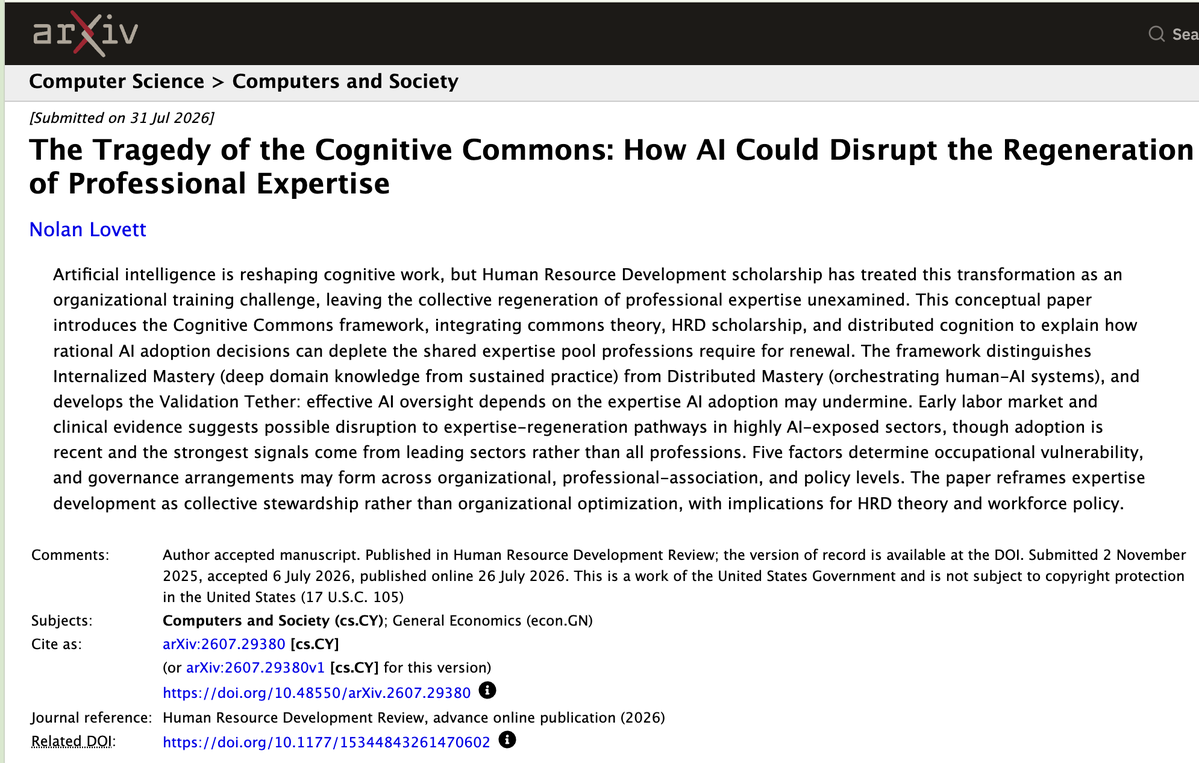
This paper gives a fancy name to a problem you can already feel in your bones
"The Tragedy of the Cognitive Commons." Checking AI output requires deep expertise. Deep expertise comes from doing grunt work for years. And grunt work is the first thing AI eats
So we're building systems that need expert supervision while dismantling the only known process for making experts
The paper calls the shared pool of human expertise the "cognitive commons." Every profession drinks from it. Nobody's refilling it.
By eliminating junior roles, each company is acting totally rationally, and the collective result: a profession that can't catch AI's mistakes anymore because it never learned to do the work in the first place
Who checks AI's homework in 15 years?
💬 « Le #CSIRT Ecologie participe à la sécurité numérique d'infrastructures cruciales pour notre pays, comme par exemple certains tunnels routiers. »
➡️ Découvrez le rôle et les missions du CSIRT #Ecologie :
https://t.co/zr7Hhslhxe
Apollo HD - To The Moon And Back In 6 Minutes
This short film is a compilation of stunning Apollo moon landing film footage upscaled and interpolated to 60 FPS using modern techniques set to a beautiful music score The film was made by Mike Constantine of @Moonpans
by upscaling footage from the NASA Johnson Space Center and The Apollo Flight Journal.
[1/5] 🔵 Depuis les années 2010, les membres du C4 - Centre de Coordination des Crises Cyber (ANSSI, @ComcyberFR, @DGA, DGSE, DGSI, @francediplo) ont observé le ciblage et la compromission d’entités françaises au moyen du mode opératoire d’attaque (MOA) Turla.
🚨Save a life, not a bag!
In the event of an emergency aircraft evacuation, the safety of you and your fellow passengers is top priority. Every second counts.
Visit the Passenger Evacuation resource page at https://t.co/aXbrD5wz67.
@IATA@EASA
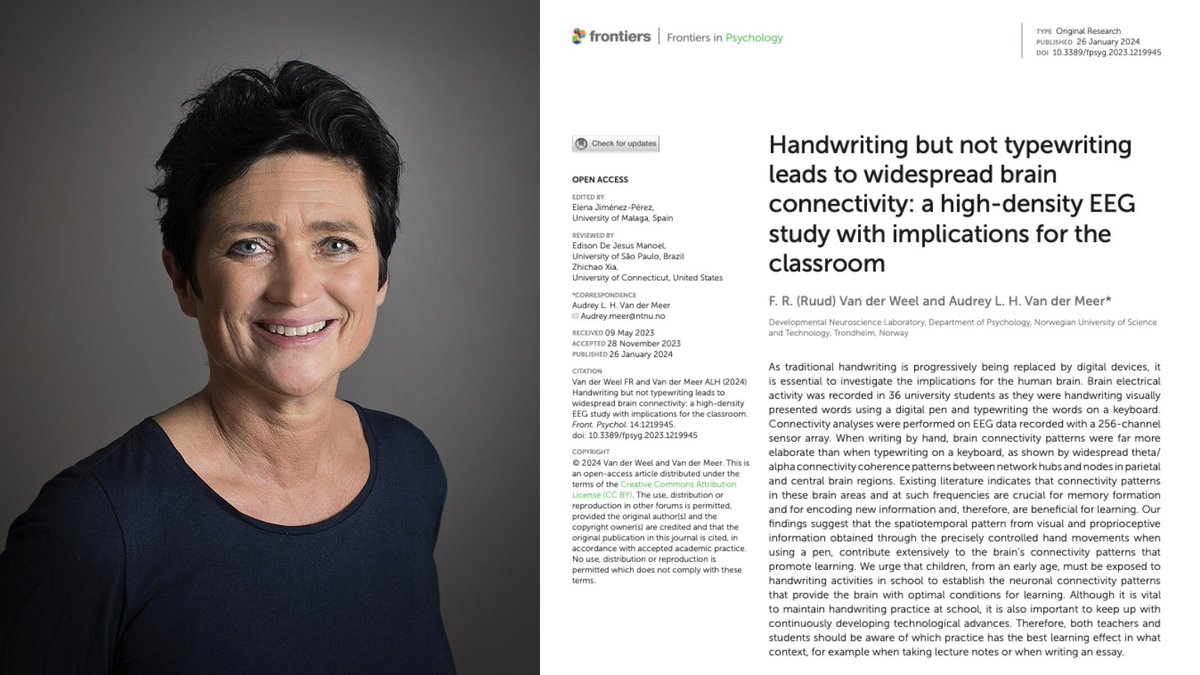
A Norwegian neuroscientist spent 20 years proving that the act of writing by hand changes the human brain in ways typing physically cannot, and almost nobody outside her field has read the paper.
Her name is Audrey van der Meer.
She runs a brain research lab in Trondheim, and the paper that closed the argument was published in 2024 in a journal called Frontiers in Psychology. The finding is brutal enough that it should have changed every classroom on Earth.
The experiment was simple. She recruited 36 university students and put each one in a cap with 256 sensors pressed against their scalp to record brain activity. Words flashed on a screen one at a time.
Sometimes the students wrote the word by hand on a touchscreen using a digital pen, and sometimes they typed the same word on a keyboard. Every neural response was recorded for the full five seconds the word stayed on screen.
Then her team looked at the part of the data most researchers had ignored for years, which is how different parts of the brain were communicating with each other during the task.
When the students wrote by hand, the brain lit up everywhere at once.
The regions responsible for memory, sensory integration, and the encoding of new information were all firing together in a coordinated pattern that spread across the entire cortex. The whole network was awake and connected.
When the same students typed the same word, that pattern collapsed almost completely.
Most of the brain went quiet, and the connections between regions that had been alive seconds earlier were nowhere to be found on the EEG.
Same word, same brain, same person, and two completely different neurological events.
The reason turned out to be something nobody had really paid attention to before her work. Writing by hand is not one motion but a sequence of thousands of tiny micro-movements coordinated with your eyes in real time, where each letter is a different shape that requires the brain to solve a slightly different spatial problem.
Your fingers, wrist, vision, and the parts of your brain that track position in space are all working together to produce one letter, then the next, then the next.
Typing throws all of that away. Every key on a keyboard requires the exact same finger motion regardless of which letter you are pressing, which means the brain has almost nothing to integrate and almost no problem to solve.
Van der Meer said it plainly in her interviews.
Pressing the same key with the same finger over and over does not stimulate the brain in any meaningful way, and she pointed out something that should scare every parent who handed their kid an iPad.
Children who learn to read and write on tablets often cannot tell letters like b and d apart, because they have never physically felt with their bodies what it takes to actually produce those letters on a page.
A decade before her, two researchers at Princeton ran the same fight using a completely different method and ended up at the same answer. Pam Mueller and Daniel Oppenheimer tested 327 students across three experiments, where half took notes on laptops with the internet disabled and half took notes by hand, before testing everyone on what they actually understood from the lectures they had watched.
The handwriting group won by a wide margin on every question that required real understanding rather than surface recall.
The reason was hiding in the transcripts of what the two groups had actually written down.
The laptop students typed almost word for word, capturing more total content but processing almost none of it as they went, while the handwriting students physically could not write fast enough to transcribe a lecture in real time, which forced them to listen carefully, decide what actually mattered, and put it in their own words on the page.
That single act of choosing what to keep was the learning itself, and the keyboard had quietly skipped the choosing and skipped the learning along with it.
Two studies. Two countries. Same answer.
Handwriting makes the brain work. Typing lets it coast.
Every note you have ever typed instead of written went into your brain through a thinner pipe. Every meeting, every book highlight, every idea you captured on your phone instead of on paper was processed at half depth.
You did not forget those things because your memory is bad. You forgot them because typing never woke the part of the brain that would have made them stick.
The fix is the thing your grandmother already knew.
Pick up a pen. Write the thing down. The slower road is the faster one.
🔴 Un Airbus A330-300 de Swiss, opérant un vol entre Delhi & Zurich, a subi une panne du moteur numéro 1 pendant son décollage. L’avion a effectué un arrêt décollage.
Les toboggans d'évacuation ont été déployés, et l'avion a été évacué sur la piste par mesure de précaution.
📢 L’ANSSI met à disposition un kit d’exercice de crise d’origine #cyber dédié au secteur de l’#audiovisuel.
🎯 Ce kit « clé en main » propose de s’entraîner à la gestion de crise cyber et d'accompagner sa montée en maturité.
👉 Plus d’infos sur :
https://t.co/K6qBJtnWTT
The B-52 Stratofortress was built differently.
While most aircraft must straighten before touchdown, the B-52 can land while still crabbing—thanks to landing gear that swivels up to 20°.
📹: theflyingduck77(YouTube)
Rejoindre l'ANSSI ?
🇫🇷 C'est contribuer à l'accomplissement de ses missions pour protéger la Nation.
💙 C'est être au cœur d'un collectif, pour une Nation cyber-résiliente.
📥 Rejoignez-nous :
https://t.co/JcwatGjghO
Quand... la jeune contrôleuse aérienne... de la région de Barcelone...
Se retrouve à parler avec son père... pilote de ligne... CDB A330 Iberia...
Le jour où ce dernier effectue une ultime rotation avant de prendre sa retraite...
Madrid > Doha > Madrid
giving #AI to #students without clear instructions or parameters teaches students how to rely on the device, not their own critical thinking #cognition
https://t.co/e8CLk3bym0
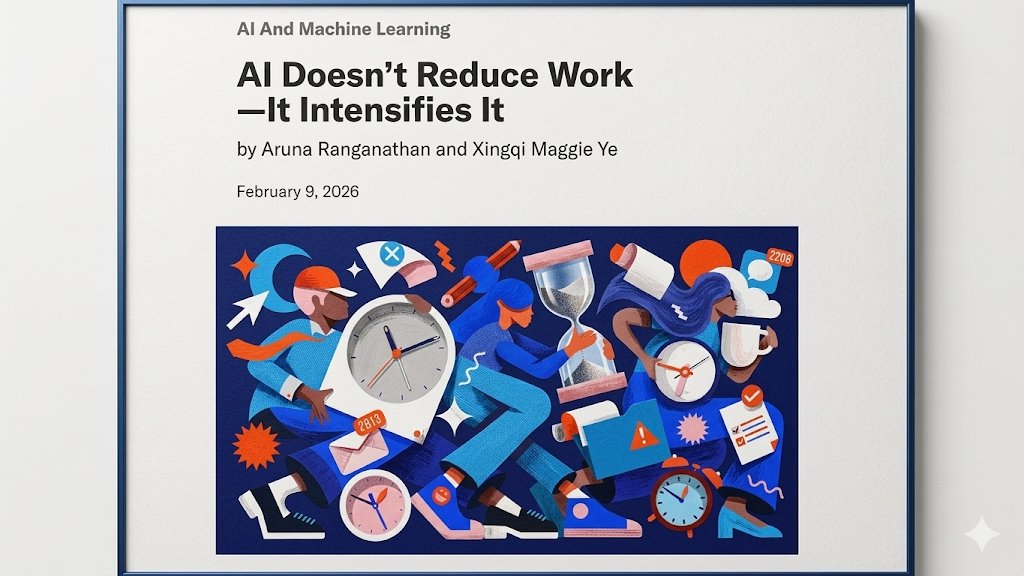
🚨BREAKING: Berkeley researchers spent 8 months inside a tech company watching how employees actually use AI.
The promise was simple: AI will save you time. Do less. Work smarter.
The opposite happened.
Workers didn't use AI to finish early and go home. They used it to take on more. More tasks. More projects. More hours. Nobody asked them to. They did it to themselves.
The researchers sat inside the company two days a week for 8 months. They watched 200 employees in real time. They tracked work channels. They conducted 40+ interviews across engineering, product, design, and operations.
Here's what they found. AI made everything feel faster, so people filled every gap. They sent prompts during lunch. Before meetings. Late at night. The natural stopping points in the workday disappeared. People ran multiple AI agents in the background while writing code, drafting documents, and sitting in meetings simultaneously.
It felt like momentum. It felt productive. But when they stepped back, they described feeling stretched, busier, and completely unable to disconnect.
83% said AI increased their workload. Not decreased. Increased.
62% of associates and 61% of entry-level workers reported burnout. Only 38% of executives felt the same strain. The people doing the actual work absorbed the damage while leadership celebrated the productivity numbers.
Then came the trap nobody saw coming. When one person uses AI to take on extra work, everyone else feels like they're falling behind. So the whole team speeds up. Nobody formally raises expectations. But the new pace quietly becomes the default. What AI made possible became what was expected.
The researchers gave it a name: workload creep. It looks like productivity at first. Then it becomes the new baseline. Then it becomes burnout.
AI was supposed to give you your time back. Instead it's eating more of it. And the worst part? You're doing it to yourself. Voluntarily.
Scientists have identified a reversal of the long-standing Flynn effect—the roughly 200-year trend of rising average intelligence (measured via IQ and cognitive tests) across generations.
For the first time in modern recorded history, Generation Z (born roughly 1997–2012) shows lower performance than previous generations in key cognitive domains, including attention, memory, literacy, numeracy, executive function, problem-solving, and general IQ—despite spending more years in formal education than ever before.
Neuroscientist and educator Dr. Jared Cooney Horvath, PhD, MEd, testified before the U.S. Senate Committee on Commerce, Science, and Transportation on January 15, 2026, highlighting this shift. In his written testimony, he stated that cognitive development in children across much of the developed world has stalled or reversed over the past two decades, with declines evident in international assessments (e.g., PISA, TIMSS) and other large-scale data starting around the mid-2000s and accelerating post-2010.
Horvath attributes the primary driver not to reduced schooling, but to the widespread integration of digital screens and educational technology (EdTech) in classrooms. He argues that human brains evolved for deep, focused learning through face-to-face interaction and sustained attention, not fragmented skimming or constant task-switching encouraged by devices.
Key points from his testimony include:
- Teens now spend over half their waking hours on screens, with significant portions in school involving computers or tablets—often leading to off-task behavior and shallower processing.
- Evidence from meta-analyses and national/international studies shows a consistent pattern: higher classroom screen exposure correlates with weaker outcomes in reading, math, science, and higher-order reasoning.
- Digital tools may aid narrow, repetitive skill practice in controlled settings, but in core academic contexts, they tend to reduce depth of understanding, retention, and critical thinking.
Horvath describes this as a "structural mismatch" between human cognition and how digital platforms are designed (to capture and fragment attention), warning that unchecked EdTech adoption risks long-term harm to workforce skills, innovation, and societal reasoning.
[Horvath, J. C. (2026). Written testimony before the U.S. Senate Committee on Commerce, Science, and Transportation. U.S. Senate]
💬 « Chaque jour, des millions de passagers, des milliers d'appareils et d'infrastructures dépendent de systèmes d'information. »
✈ Découvrez le rôle crucial du CERT Aviation France.
+ d'infos sur :
🔗 https://t.co/zr7Hhslhxe


![ANSSI_FR's tweet photo. [1/5] 🔵 Depuis les années 2010, les membres du C4 - Centre de Coordination des Crises Cyber (ANSSI, @ComcyberFR, @DGA, DGSE, DGSI, @francediplo) ont observé le ciblage et la compromission d’entités françaises au moyen du mode opératoire d’attaque (MOA) Turla. https://t.co/lyaEQq8XqU](https://pbs.twimg.com/media/HNGEWmsX0AERruL.png)
![ANSSI_FR's tweet photo. [1/5] 🔵 Depuis les années 2010, les membres du C4 - Centre de Coordination des Crises Cyber (ANSSI, @ComcyberFR, @DGA, DGSE, DGSI, @francediplo) ont observé le ciblage et la compromission d’entités françaises au moyen du mode opératoire d’attaque (MOA) Turla. https://t.co/lyaEQq8XqU](https://pbs.twimg.com/media/HNGEPheWgAEUmHt.png)
![ANSSI_FR's tweet photo. [1/5] 🔵 Depuis les années 2010, les membres du C4 - Centre de Coordination des Crises Cyber (ANSSI, @ComcyberFR, @DGA, DGSE, DGSI, @francediplo) ont observé le ciblage et la compromission d’entités françaises au moyen du mode opératoire d’attaque (MOA) Turla. https://t.co/lyaEQq8XqU](https://pbs.twimg.com/media/HNGEIQiWYAAd1ue.png)







![ANSSI_FR's tweet photo. [1/5] 🔵 Depuis les années 2010, les membres du C4 - Centre de Coordination des Crises Cyber (ANSSI, @ComcyberFR, @DGA, DGSE, DGSI, @francediplo) ont observé le ciblage et la compromission d’entités françaises au moyen du mode opératoire d’attaque (MOA) Turla. https://t.co/lyaEQq8XqU](https://pbs.twimg.com/media/HNGEbBfXIAAWu8C.png)

![Rainmaker1973's tweet photo. Scientists have identified a reversal of the long-standing Flynn effect—the roughly 200-year trend of rising average intelligence (measured via IQ and cognitive tests) across generations.
For the first time in modern recorded history, Generation Z (born roughly 1997–2012) shows lower performance than previous generations in key cognitive domains, including attention, memory, literacy, numeracy, executive function, problem-solving, and general IQ—despite spending more years in formal education than ever before.
Neuroscientist and educator Dr. Jared Cooney Horvath, PhD, MEd, testified before the U.S. Senate Committee on Commerce, Science, and Transportation on January 15, 2026, highlighting this shift. In his written testimony, he stated that cognitive development in children across much of the developed world has stalled or reversed over the past two decades, with declines evident in international assessments (e.g., PISA, TIMSS) and other large-scale data starting around the mid-2000s and accelerating post-2010.
Horvath attributes the primary driver not to reduced schooling, but to the widespread integration of digital screens and educational technology (EdTech) in classrooms. He argues that human brains evolved for deep, focused learning through face-to-face interaction and sustained attention, not fragmented skimming or constant task-switching encouraged by devices.
Key points from his testimony include:
- Teens now spend over half their waking hours on screens, with significant portions in school involving computers or tablets—often leading to off-task behavior and shallower processing.
- Evidence from meta-analyses and national/international studies shows a consistent pattern: higher classroom screen exposure correlates with weaker outcomes in reading, math, science, and higher-order reasoning.
- Digital tools may aid narrow, repetitive skill practice in controlled settings, but in core academic contexts, they tend to reduce depth of understanding, retention, and critical thinking.
Horvath describes this as a "structural mismatch" between human cognition and how digital platforms are designed (to capture and fragment attention), warning that unchecked EdTech adoption risks long-term harm to workforce skills, innovation, and societal reasoning.
[Horvath, J. C. (2026). Written testimony before the U.S. Senate Committee on Commerce, Science, and Transportation. U.S. Senate]](https://pbs.twimg.com/media/HBDIc7NagAAWGAb.jpg)


