Thursday · Paper → Clinical Meaning | Technical Success ≠ Clinical Benefit
Removing more blood does not necessarily mean restoring more function. In the 2025 MIND randomized trial (n=236), minimally invasive surgery achieved a median 80.7% hematoma reduction but showed no significant improvement in disability at 180 days. The contrast with ENRICH, where benefit appeared concentrated in lobar hemorrhages, suggests that hematoma location, timing, and patient selection may matter as much as evacuation efficiency. The unresolved surgical question is not simply how much clot we can remove, but which patients actually recover because we removed it.
4/ GTR still matters for oncologic control: 20-year recurrence 4.2% after GTR vs 18.5% after partial resection.
Counseling point: warn families about the early dip. Judge the result at months, not POD1.
PMID 26235023
Day 1 after GTR of a cervical intramedullary ependymoma: the patient is weaker than before surgery.
Instinct says "we resected too much."
Large series say early decline is common—and often temporary. 🧵 #Neurosurgery
3/ Long-term McCormick grade vs preop:
unchanged 74.5% · improved 5.9% · worse 19.6%.
Permanent morbidity rose with thoracic level, older age, long symptom history, tumor hemorrhage, and surgery on a recurrence.
An artery touching the trigeminal nerve is not necessarily the cause of trigeminal neuralgia. Neurovascular contact is also common in asymptomatic nerves, while focal indentation, displacement, or atrophy makes compression more clinically significant. For microvascular decompression, the crucial distinction is contact versus deformation—not simply whether a vessel is present. Yet even convincing imaging must be interpreted alongside the clinical pain phenotype, rather than treated as an operative indication by itself.
My read: useful for volume tracking and research cohorts. Not a resection map.
Before trusting it on my cases I'd want an external multicenter test, per-class metrics and failure examples.
Open-source in Spinal Cord Toolbox:
https://t.co/Ca4mAUoQgG
#Neurosurgery
An AI model segments intramedullary spinal cord tumors on MRI at 76.7% Dice.
Sounds usable. Until you split the classes:
- tumor 61.8%
- cavity/cyst 55.4%
- edema 31.0%
Surgeons care about the boundaries between those three. That's exactly where the score drops.
Clinical implication: re-running the primary regimen on a recurrence often underperforms — because the target cell populations have changed. That's exactly why my virtual cell modeling treats primary and recurrent separately. (Building GlioState: Virtual Cell Modeling for Glioma.)
Monday · Surgical Insight | The Invisible Perforator
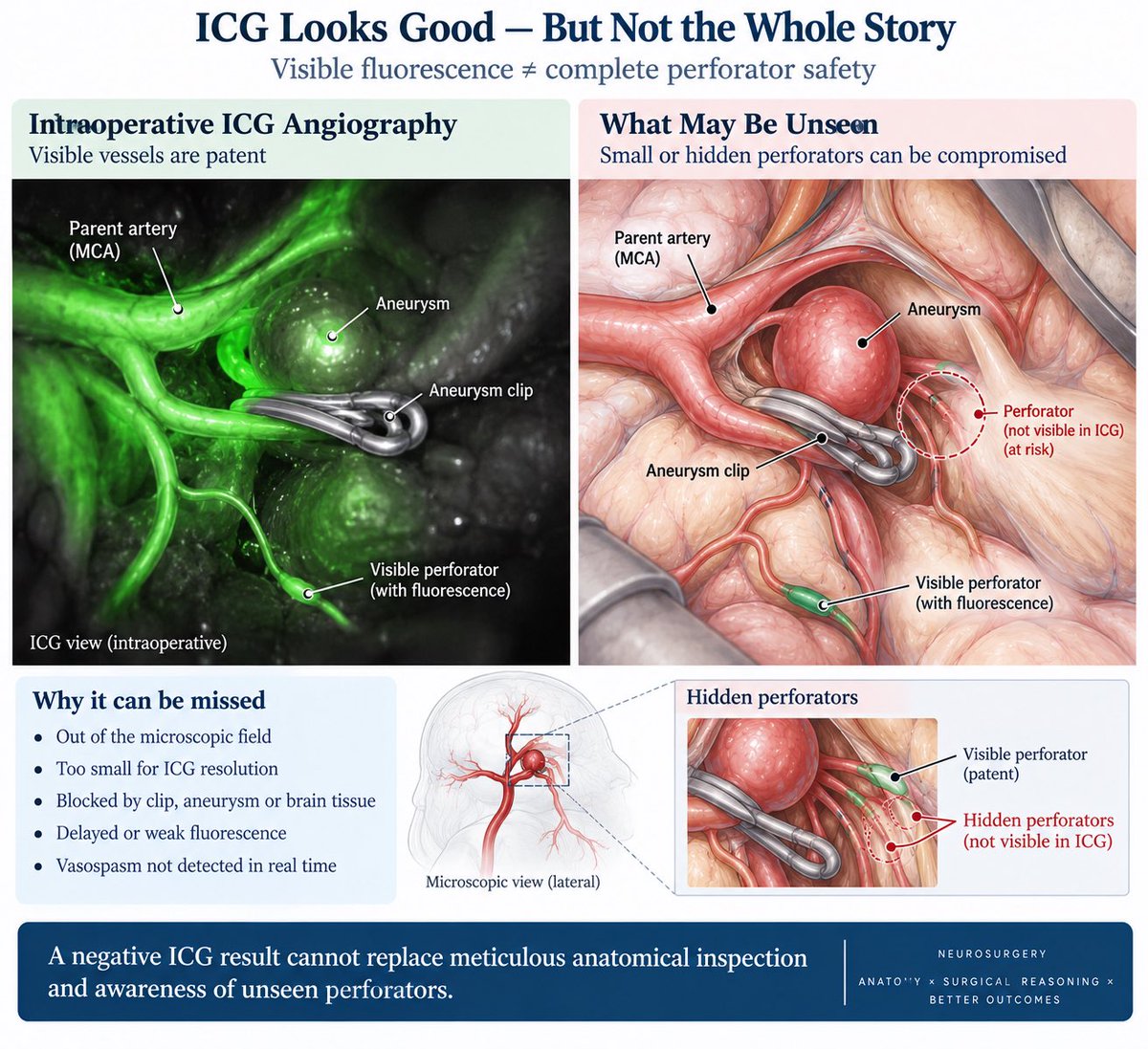
An ICG run can look reassuring while a perforator remains compromised. In a 60-patient aneurysm clipping series, 4 developed perforator infarcts; 3 involved vessels not visible or distant from the aneurysm. After clipping, the question is not only what fills—but what remains unseen?
You can now trade on whether a Phase 3 trial will hit its primary endpoint.
A new NEJM Perspective asks the right question: information, at what cost?
What's real, what's at stake for patients, and why trial integrity is the issue. 🧵
What Kalshi lists (AppliedXL pilot, July 2026):
- e.g. "Will AR1001's POLARIS-AD Phase 3 trial meet its primary endpoint in early Alzheimer's disease?"
- Resolved on the registered https://t.co/9ZRh2Ie6SG endpoint
- Listed only after enrollment closes
- Trader employment checks
Physician's view:
- Patients enroll on equipoise and trust, not odds
- Site staff, CROs, monitors see partial data; employment checks can't catch every leak
- A public price can sway referral and retention
Guardrails before expansion.
https://t.co/Q2U1ypkFdh #ClinicalTrials
NEJM: "Kalshi is entering the drug-development space with contracts on end points in large, late-stage trials but is considering broadening its scope to include earlier-phase trials and additional outcomes."
Kalshi itself says earlier phases carry greater insider-trading risk.