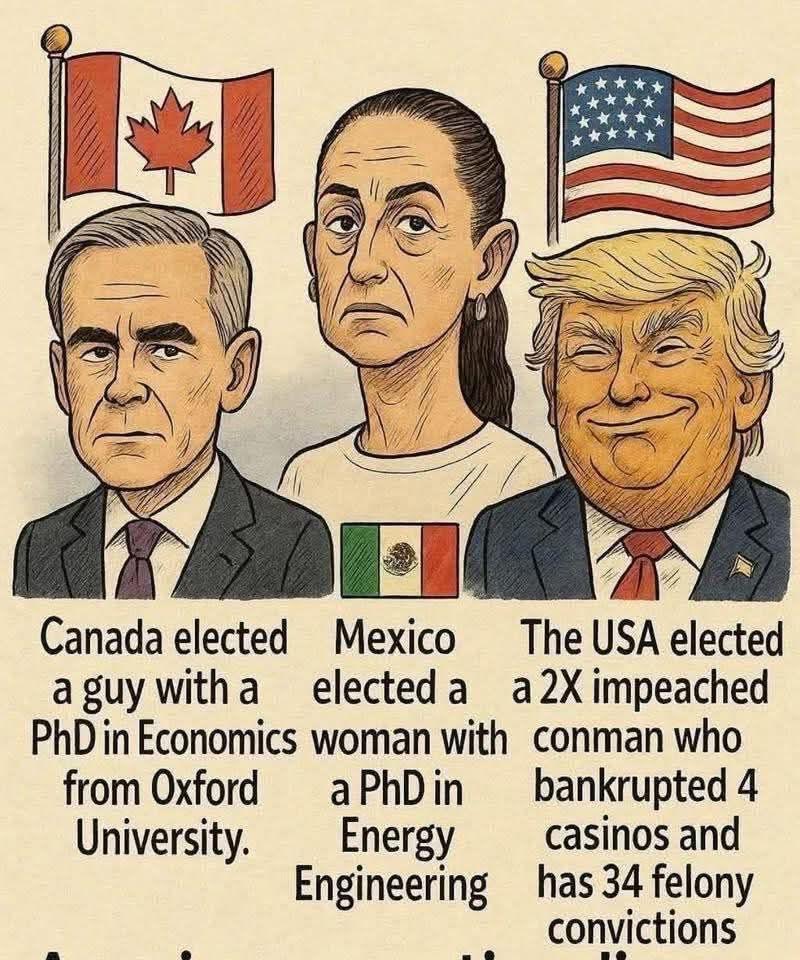
Carney: "The U.S. introduced in the last hours, efforts to restrict our ability to have other trade deals. We're the partner of choice in many respects for countries around the world, and the Americans wanted to restrict that. Unacceptable."
Fox News is forced to tell there viewers that Trump has just started a trade war with Canada.
This is going to make prices in America soar even higher just in time for the midterms.
Democrats need to win the House and Senate so they can stop this insanity.
Carney: "This was not our choice. We were ready and close to having a comprehensive agreement that would be fair to both countries. But they made changes, including threats on the French language and Quebec culture and Canadian culture. That is not acceptable. That would never be acceptable."
David Cochrane: "We're about 20 days away from the 25th anniversary of 9/11, and Donald Trump has imposed a 50% tariff on the country that gave refuge to thousands of its citizens on the day of the worst terrorist attack in American history."
Trump broke his own trade agreement to tariff Canada. He called the best ever, and doubled down to get Canadians to bend the knee! I stand with @MarkJCarney for saying NO to a bad deal. Yes it will hurt Canadians but it will hurt Americans too - especially politically. #elbowsup
I'm a cardiologist. Hayden Panettiere died at 36. Toxicology is pending, and I won't speculate about what killed her. But I want to say something about what her death should force us to confront, because I think we're going to get this wrong the way we always do.
She had already done everything we tell people to do. She spoke publicly about addiction. She named the postpartum depression. She wrote the memoir. She was told her liver damage could kill her within five years and she said it out loud, in interviews, to an audience of millions. She did the disclosure. She did the reckoning. She got the applause for being brave.
And she died at 36 anyway.
Here's the uncomfortable thing I need you to understand: that is not a contradiction. That is the disease. Addiction is a chronic, relapsing brain disorder with high fatality rates even among people who have insight, support, resources, and genuine periods of sobriety. Relapse is not a moral failure or evidence that someone wasn't really trying. For a substantial percentage of patients, it is the expected clinical course. The body does not care how eloquently you articulated your trauma, or how many people celebrated your journey.
We have built an entire cultural performance around public recovery, and we have quietly confused disclosure with protection. Someone tells their story. We call it progress. We share the interview. We buy the book. And we feel, collectively, that something has been solved. Nothing has been solved. The underlying drivers remain exactly where they were — untreated or incompletely treated psychiatric illness, unaddressed trauma, easy access to potent opioids, the neurobiology of tolerance and craving that does not respond to insight, and the systems and people who enabled it in the first place.
A memoir is not a treatment plan. And I want to say something specific about naloxone, because it's the piece most misunderstood. Naloxone reverses opioid-induced respiratory depression. It is extraordinary. It saves lives when it reaches someone in time, and everyone reading this should have it and know how to use it. In most states you can get it at a pharmacy without a prescription. But naloxone is harm reduction, not treatment. It buys minutes. It does not rewire the circuitry that drives someone back to the next dose after years of trying to stop.
And in my own field, I'll add the part rarely said: opioid overdose kills through respiratory arrest that becomes cardiac arrest. By the time the heart stops, hypoxic injury to the brain and heart may already be irreversible. The window is measured in minutes. Which is precisely why the drug has to already be in the room, and why someone has to be there to give it.
Here is what actually reduces mortality, and it is unglamorous:
Medication for opioid use disorder — buprenorphine, methadone, naltrexone. These substantially reduce overdose death, and they remain badly underused, badly stigmatized, and hard to access. If you take one clinical fact from this post, take that one. Treating the psychiatric illness underneath, properly and continuously — not as an afterthought to the addiction. Naloxone in the home, in the bag, at the workplace, everywhere. And sustained care long after the public has moved on — which is the thing our attention span is structurally incapable of providing.
Hundreds of thousands of people have died of this same physiology, under the same mechanism, without a single headline. We notice when the face is familiar. We extend more grace when there's a redemption arc attached. That selective attention is itself part of the problem — because it means our response is shaped by narrative rather than by mortality data.
Toxicology will eventually clarify the mechanism. It will not answer the harder question: why a woman who had already named the danger, with every resource available to her, still ended here at 36. That question belongs to all of us — to medicine, to an industry that consumed her from childhood, and to a culture that prefers the drama of a fall and a partial recovery over the tedious, expensive, imperfect work of keeping people alive for decades.
Addiction is not a story. It is a high-mortality disease. We should treat it like one — with medication, with sustained care, with naloxone in every home, and with a great deal less applause for disclosure and a great deal more funding for treatment.
Rest in peace, Hayden. Thirty-six.
The Canadian women's flag football team has officially qualified for the 2028 LA Olympics!
Canada defeated No. 1 Mexico at the flag football world championships to clinch their Olympic berth and will play against the United States on Sunday for gold.
Vaccines do not cause autism
Vaccine doses are nowhere close to “the size of a bottle of soda,” they’re a fraction of a teaspoon
The combo MMR vaccine is not “quite lethal,” it’s been very safe for more than five decades
There are no separate M/M/R shots available in the US and won’t be anytime soon
Autism prevalence wasn’t “1 in 10,000” in 2006, it was 1 in 110
No state has been requiring little kids to get “72 jabs,” nor even by age 18
Fact check on the rapid-fire vaccine misinformation President Trump delivered yesterday while pushing to change US vaccine policy: https://t.co/qSF53N8XJW
If folks in La Crete want fancy things like hospitals and bridges, maybe they should work harder and pay for them themselves instead of expecting taxpayers in Edmonton and Calgary to subsidize their lifestyle.
Am I doing this anti-equalization thing right?
Danielle Smith is right. She and I are nothing alike. I’m not corrupt, and I work for Albertans, not for wealthy insiders.
I believe in democracy for everyone, not only for separatists. I won’t mess with the electoral maps to cheat to win.
I have a strong track record of growing the economy and helping get pipelines built. I don’t pick fights. I win them.
I passed 11 straight balanced budgets with the lowest residential taxes in the country. Calgary was named one of the best cities in the world when I was mayor.
I’ll fix the health care and education systems that this premier has broken so badly.
I will never take away your human rights and use the notwithstanding clause when the Charter of Rights is inconvenient.
And I will never gamble the future of our nation to save my own political skin.
That’s because I’m focused on the real priorities of Albertans, not on separatists and foreign billionaires.
Good News today,
Statistics Canada shows a sharp rise in tourism spending :
- 1st quarter 2026 tourism spending in Canada rose 5.6% to $29.5 billion.
- Domestic spending by Canadians reached $23.5 billion.
This gain shows ongoing recovery.
Canada Strong 🇨🇦
Most Canadians take CPP at 65. 🇨🇦
Almost none know what waiting 5 more years actually does.
Average CPP at 65: ~$925/month
Average CPP at 70: ~$1,312/month
That's a 42% higher monthly payment.
For the rest of your life.
The break-even point is roughly age 82.
But if you make it to 65, your average life expectancy jumps closer to 85+.
If you're healthy and have other income sources in your late 60s, deferring CPP to 70 could be worth $100,000+ over your lifetime.
Most Canadians never run this calculation.
Have you?