@IngridGuimaraes Essa cia é um lixo e tratam nós, latinos, como inferiores. Já vi retirarem um casal de brasileiros que estavam com o cinto afivelado, e colocar pra fora do vôo, pra dar lugar a dois estado-unidenses. Se puder, evite!
Dear colleagues and friends. Considering this toxic social media, that stimulates fake news, violence against minorities, hate and crime, I am leaving X. I invite those of you that work with human rights to do the same. Let's keep in touch in LinkedIn or any other safer platform.
Dr. @MMKavanagh, @Georgetown, shares insights on the @g20org in Rio.
As President of the G20, Brazil has steered a transformative health agenda that places inequality at the center.
Watch his video⤵️
🤯🤯CINQUENTA MIL DOWNLOADS!!!🤯🤯
Nosso manual gratuito sobre análise de conteúdo (AC) publicado pela @EnapGovBr alcançou a marca em menos de 3 anos!
Um fio sobre o estado da arte do uso da AC no Brasil, suas lacunas e como o manual busca oferecer opções.
"Everything that is here, I have lived". @DabneyEvans @CaseyXavierHall and our Brazilian team demonstrated that a translated instrument (Composite Abuse Scale) was accurate to help Brazilian women identifying abusive acts that may be naturalized.
In Brazil, an estimated 1 in 3 women experience violence within their intimate relationships. @DrSignorelli & co-authors piloted an instrument for Brazilian women experiencing IPV, allowing for the identification of abusive acts in their language. Read it:
https://t.co/WKnmSUoFpr
I am happy to share that we published an e-book collection "Collective health: dialogues and pathways", vols. 1 and 2, by Dr Marcos Signorelli, Dr Doroteia Höfelmann, Dr Karin Luhm, Dr @TalitaZotz and Dr Yanna Rattmann. You can download for free at https://t.co/fMYm6V1a2K
We just published this study, finding that 70% of transgender (TGD) people in Brazil experienced food insecurity during the COVID-19 pandemic, of these, 20.2% experienced severe food insecurity.
#PLOSONE: Food insecurity in Brazilian transgender https://t.co/nSMY7VaNDa
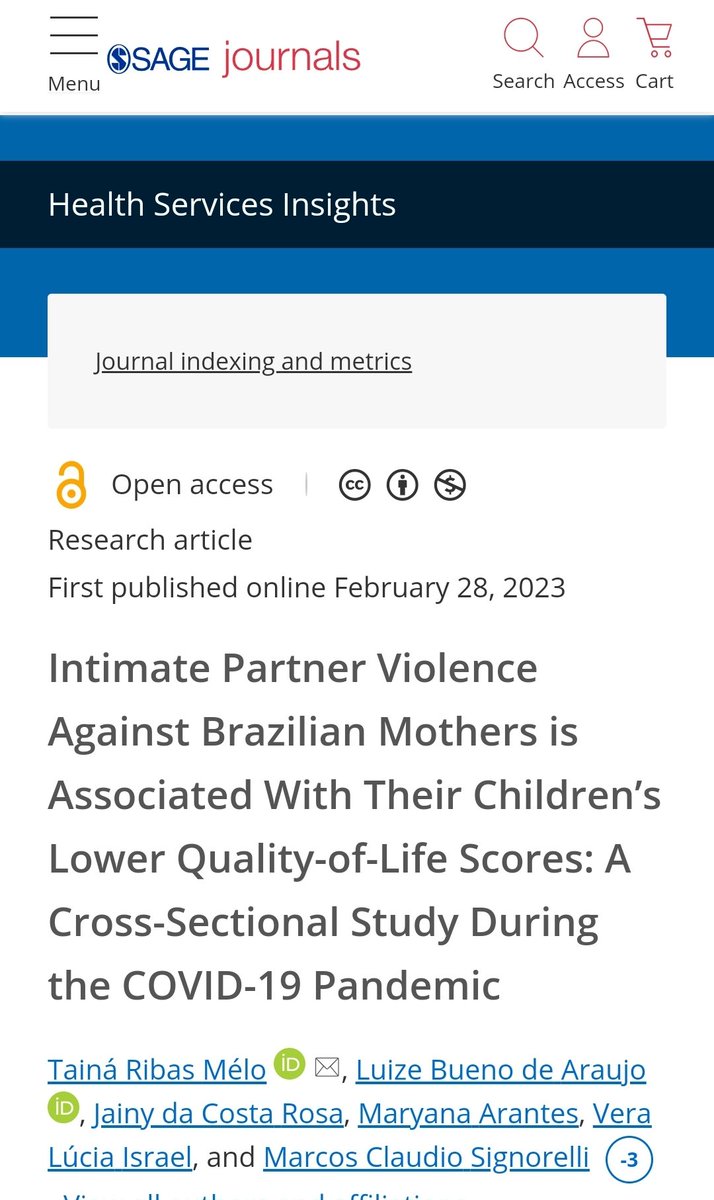
We just published this study with 701 women, conducted during the peak of the pandemic social isolation. The main finding was that children whose mothers were exposed to intimate partner violence were 2.68 times more likely to have a low Quality of Life score.
1/2
We have just published an article on the Brazilian National Health Survey (PNS 2019), with data from 34,000 Brazilian women, on the prevalence of intimate partner violence (IPV) and its subtypes; impacts of IPV on women's health; use of health services due to IPV; and ... 1/2
self-perception of health. The study obviously has limitations, but it indicates that the prevalence of IPV in the last 12 months (7.6%) has been decreasing since the WHO multicenter study (2006), which may be a reflection of advances in legislation, such as Maria da Penha Law.