Anyone who has curated GEMs knows how tedious mass and charge balancing can be — MCC was built to drastically reduce the manual effort in this step.
Thanks to @reihaneh_mo for leading this project!
Our new paper in Microbiology Spectrum 🎉
We present the Python tool MCC, which automates the cumbersome mass and charge curation of genome-scale metabolic models (GEMs), and demonstrate its capabilities using a model of Corynebacterium tuberculostearicum.
https://t.co/Xptz00Kdr6
We presented recent work at COBRA 2026:
✓ Tools for systematic reconstruction & curation of GEMs, enabling AI-supported analysis across biological systems.
✓ With refineGEMs and SPECIMEN, we focus on standardization, reproducibility, and scalable multi-omics data integration.
At COBRA 2026, I presented our work on model reconstruction & curation tools enabling AI-supported analysis of biological systems, followed by applications in respiratory health and infections and in renewable energy via microbial biocatalysts.
Great discussions and organization!
Carolin Brune from our research group gave a talk about her automated reconstruction software SPECIMEN at the Central German Conference on Bioinformatics in Halle.
Carolin Brune from @UniHalle introduces “SPECIMEN and refineGEMs: Open-Source Python Tools for Streamlined Metabolic Modelling” at the Central German Conference on Bioinformatics.
The first session of today at the Central German Conference on Bioinformatics featured a keynote by @EddaKlipp and was chaired by Andreas Dräger, also introducing two presentations from our research group.
@EddaKlipp from @HumboldtUni gives the first keynote speech of the second day of the Central German Conference on Bioinformatics about “Thermodynamically Explicit (TDE) Kinetics”.
International teamwork for sustainable biotech 🌍
Integrating bioprocessing & metabolic modeling for PHB production.
Thanks to @ascenciomarthaL, @HowardR_Malule (University of Valle 🇨🇴), and partners at the Catholic University of the Maule 🇨🇱 & Kiel University 🇩🇪!
How can we make bioplastics more efficient?
In our new paper, we show: it’s not just what you feed; it’s when you feed.
Combining fed-batch pulse feeding with flux balance analysis reveals how timing and N-limitation drive PHB accumulation in C. necator.
https://t.co/3J6d2KGiBk
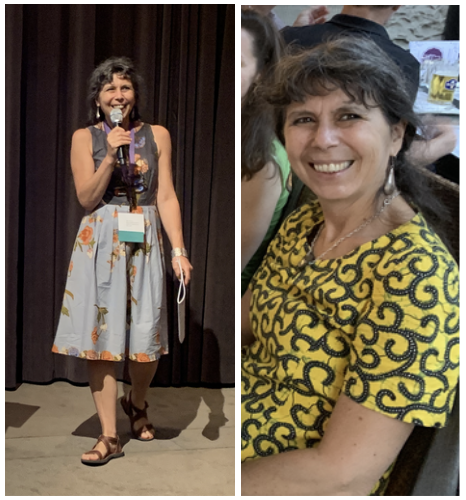
We are deeply saddened by the passing of @ChaouiyaC (1969–2025) – a cherished member of our community and coordinator (2018-2022), contributing with expertise & kindness. Her work on logical modeling of regulatory networks & dedication to SysMod left a lasting mark. We miss her.
Our research group for Bioinformatics & Data Analytics at MLU Halle-Wittenberg @UniHalle has a new logo!
DNA for life sciences, networks for systems biology and data analytics, colors for natural sciences and medicine — all connected by the outer rings.
The @Google Summer of Code 2025 Mentor Summit took place in Munich 🇩🇪 over two days with over 180 international participants. Thanks to Google for the opportunity to present the outcomes of the #NRNB projects and to lead a session on #Bioinformatics.
Pictures by Ronit Banerjee.
As the representative of the National Resource for Network Biology (#NRNB) at the Google Mentor Summit in Munich 🇩🇪, I am excited to present the outcomes of our Google Summer of Code (#GSoC) projects today and to lead the session on Computational Biology/Bioinformatics.
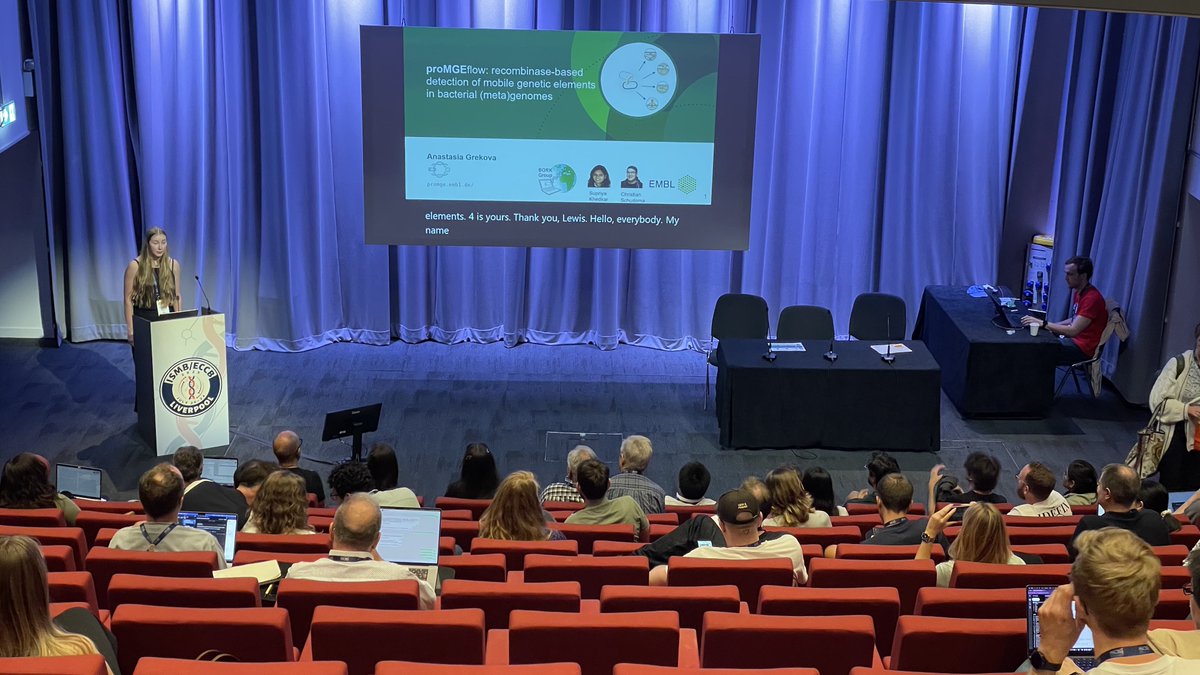
Einige Eindrücke von der #ISMBECCB2025 in Liverpool, zu der über 2½-tausend Teilnehmer angereist waren – darunter auch ehemalige Gruppenmitglieder & namhafte Forscher wie der Nobelpreisträger John Jumper. Unsere Arbeitsgruppe war an der Organisation der SysMod-Sektion beteiligt.
Well done, Anastasiia Grekova 👏🏻👏🏻👏🏻
She previously wrote her bachelor thesis in our lab and then published the results with us as a journal paper.
Today she presented her work as a PhD student at @embl about a large-scale meta genetics data collection at #ISMBECCB2025.
Wir freuen uns, folgendes mitzuteilen:
Unsere Forschergruppe konnte letzten Sonntag, am 13. Juli 2025, ihren siebten Gründungstag begehen. 🤩🎉🎊
#MeinXJubiläum
This week, it was Prof. Stephan-Scherb from Geology and I's turn to give our inauguration lecture to finally establish ourselves at Faculty of Natural Sciences III. About 80 guests attended. Afterward, there was a cozy celebration where we could exchange ideas across disciplines.
We’re attending #ISMBECCB2025 in Liverpool, United Kingdom from July 20-24. Who else is going? Register here and don’t miss it! https://t.co/KeBDNkHKeO
We discovered two antiviral compounds and proved their activity against four viruses: influenzae, respiratory syndrome, SARS-CoV-2, and Dengue – demonstrating how scientists from diverse areas can collaborate using computer models & laboratory experiments.
https://t.co/SMkZzVxRh2
🚨 Study:
Computer model predicts two antiviral compounds from single-cell data—now patented
✅ Active vs. SARS-CoV-2, RSV, Dengue & Flu A in cell culture
✅ In vivo COVID-19 efficacy shown in hamsters
✅ Broad-spectrum antivirals for pandemic preparedness
https://t.co/Ir9dwIcUDS
🎬 Behind the paper — in just 72 seconds!
Dr. Nantia Leonidou (postdoc @DKFZ Heidelberg) and PI Prof. Andreas Dräger (@UniHalle) explain what makes the model iSep23 special and why it matters for infection prevention and precision medicine.
▶️ https://t.co/Rs8YmKnFSd
Read in @ASMicrobiology’s #mSystems:
Genome-scale metabolic model of Staphylococcus epidermidis ATCC 12228 matches in vitro conditions.
Our model, iSep23, helps explore probiotic potential & infection risk — shedding light on this skin-born hospital bug.
https://t.co/1AFgNGhLvc