🇺🇸 The AI gold rush just hit a wall. Investors are DUMPING the debt that bankrolled it.
Bonds financing massive U.S. data centers for the likes of Meta, Nvidia, Oracle and Microsoft are trading well below face value, just months after investors were happy to pay full price.
Meta's "Hyperion" bonds dropped to 92 cents on the dollar, Microsoft's "Project Excalibur" fell below 88, and CoreWeave's plunged under 80.
CoreWeave is in distressed territory, with investors now demanding yields near 15%.
Meanwhile, Nvidia lost roughly $270B in market value in a single week.
But the AI math gets more uncomfortable.
Gartner estimates data center owners need $8.5 TRILLION in revenue by 2030 to cover costs and earn a decent return. Expected AI services spending? Just $3.6 trillion.
That's a $4.9 TRILLION GAP, and Gartner reckons 80% of neoclouds like CoreWeave will be gone or absorbed by 2030.
Nvidia CEO Jensen Huang insists he's "optimistic" and says CoreWeave's borrowing costs are actually falling.
Someone should tell the bond market. It's charging nearly 15% for the privilege.
Source: Financial Times / Writer: Julie
Stunning data: "Chinese AI models have taken the top five spots in weekly token usage, according to OpenRouter...From October 5 to 11, AI models worldwide processed 172 trillion tokens, up 3.61% week-on-week. Chinese models accounted for 86.74 trillion tokens, compared with 18.97 trillion for US AI models. Token usage by Chinese AI models grew by 50.96% week-on-week, while usage by US models increased by 17.1%...It was the 24th consecutive week that Chinese models led their US counterparts in token usage."
I dove deep on the rise of Chinese models in my report on "The AI Trade" (https://t.co/wQQNniS2kj). Here's a snippet:
"The analogy that has stuck in our head to understand the rise of Chinese models: “You don’t need a Lamborghini to drive to the grocery store.” As enterprises experiment with AI capabilities across workflows, they’re realizing the most advanced (and expensive) models are overkill for many tasks. When the LLM Token Expenditure Index spiked through the first half of the year and enterprise bills soared along with it, enterprises woke up to that reality and began switching to Chinese models. Chinese models are able to keep per-token prices far lower than American competitors by leveraging structural architectural efficiencies like “Mixture-of-Experts” designs that reduce the compute and memory required per token. They also enjoy cheaper domestic energy and infrastructure costs and subsidies via local governments and state-owned enterprises. The cheapest Chinese models are cheaper than the cheapest US models. The most advanced Chinese models are cheaper than the most-advanced US models. And those most-advanced US models may be better than Chinese equivalents, but again, enterprises are discovering that the cost/benefit of that extra capability doesn’t pencil."
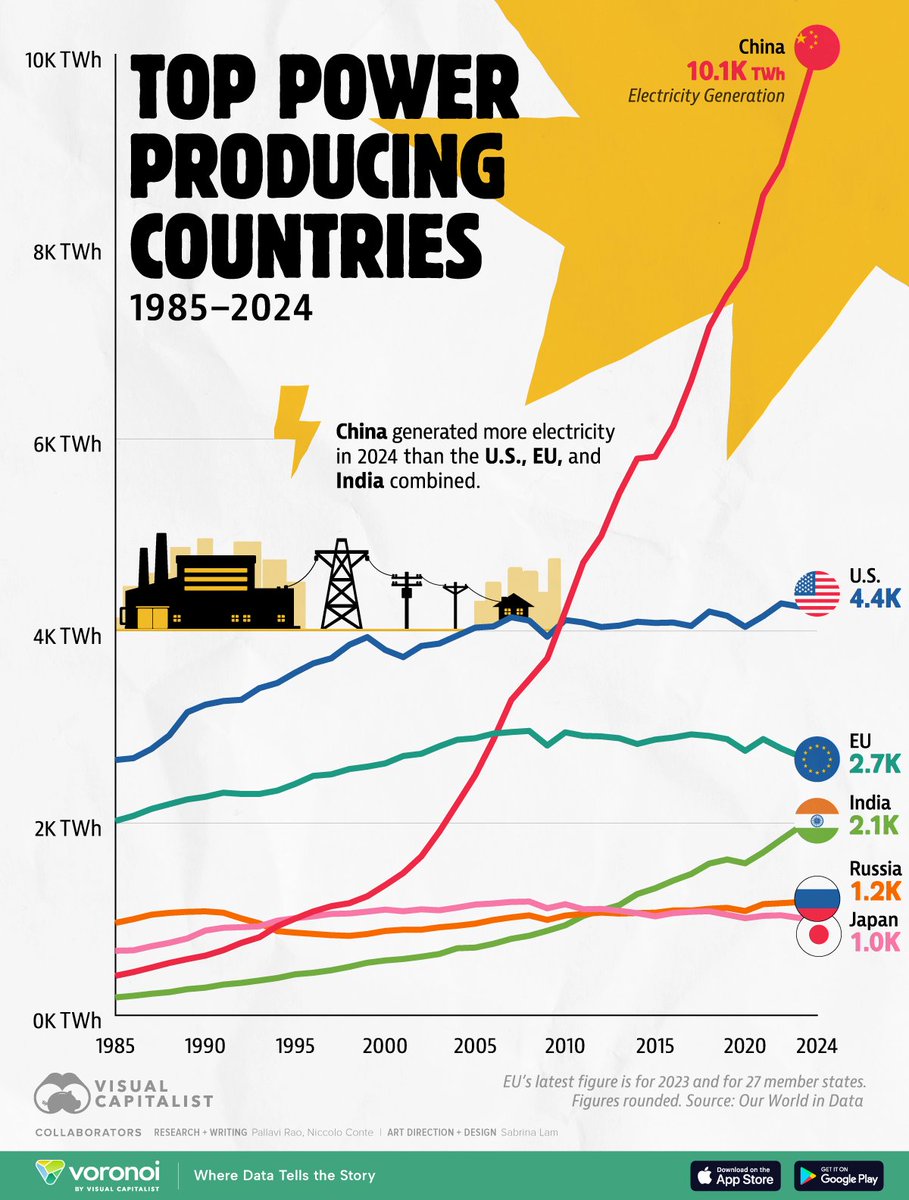
For my next report, I'm diving deep on "Global Electricity Undersupply". At the moment, most investors are fixated on the electricity supply challenge as it relates to data centers in the US. This is for good reason: electricity supply remains a potentially insurmountable obstacle for hyperscalers to scale their models enough to attract the enterprise spending needed to offset CAPEX. However, far too infrequently discussed in relationship to that is that data centers are just one driver of electricity demand increases and across transportation, heating, cooling, and industrial demand, there's reason to believe we're nearing or have passed an electrification inflection point. Far more to come in the report! However, as it relates to the China/US AI arms race, this stat should never be neglected: China generated over 10,000 TWh of electricity in 2024, more than the combined output of the U.S., EU, and India—the next three biggest producers.
Data source: https://t.co/Xns8rB3xEn
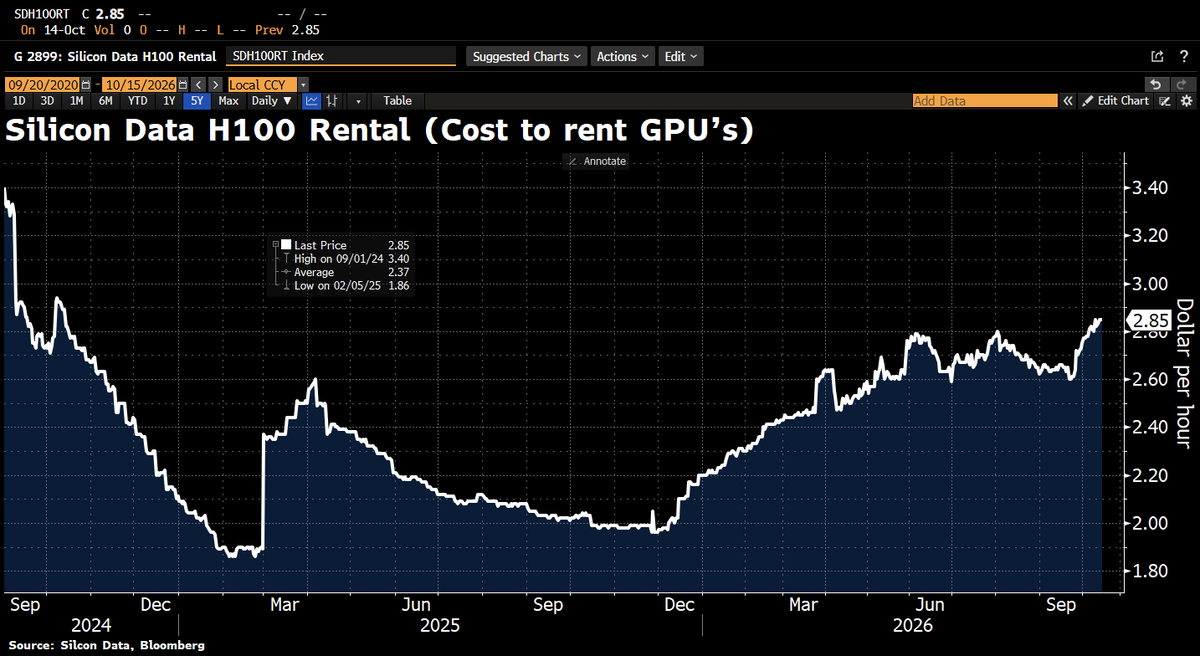
AI bubble fears meet rising GPU rental prices: Nvidia H100s now cost $2.85 per hour to rent, up 53% from the Feb 2025 low and the highest since 2024. Older chips were supposed to get cheaper as new ones arrived. This chart tells a different story.
Two ships sink near Hormuz after being hit by projectiles amid surge in attacks
A container ship and a dry bulk carrier have both sunk near the Strait of Hormuz in the past 24 hours after being hit by projectiles in separate incidents, maritime officials said.
Attacks around the waterway have surged over the past 10 days, with Iran saying it is stepping up strikes in response to the US blockade of its ports and tougher sanctions introduced last month. (Reuters)
Inflation is RED hot in the US.
For anyone not keeping track, US CPI inflation is now nearly double the Fed's 2% target and US PPI Inflation is more than triple that target.
PPI inflation was expected to fall in August, but instead it surged to 6.3%, its second highest level in 4 years.
And, month-over-month Headline PPI inflation surged +1.3%, more than doubling the +0.6% expected and the second largest jump since March 2021.
Meanwhile, month-over-month Core PPI inflation came in +133% above expectations.
The prices Americans are seeing now will look cheap in 12 to 24 months.
All you can do is own assets.
Last but not least, credit stress has extended to key hardware integrators and server suppliers facing auditing or margin pressure. A good example is SMCI borrowing costs blowing-up, forcing lenders to renegotiate revolving credit lines and demand stricter liquidity covenants
5/5
The stress is not confined to the cloud players. 2nd tier hyperscalers like Oracle spent massive upfront cash constructing unpowered / under-equipped data centers before revenue generation kicks in, if it does…CDS now > 260 bp.
2/5
I am surprised this is not getting more airtime. CoreWeave CDS at 1000 bp. AI credit stress is getting acute and spreading. Neocloud players like CoreWeave and APLD have very high debt, very concentrated clients and a duration mismatch (long debt, short contracts).
1/5
@aakashgupta So, of that $12.7 billion, x% of that is 14% of Koch Industries, does that mean we can say Koch Industries is worth about ((x/100)*12.7)/0.16 ?
META CEO MARK ZUCKERBERG ACKNOWLEDGED THE COMPANY COMMITTED $100 BILLION–$200 BILLION TO AI INFRASTRUCTURE BEFORE KNOWING WHETHER THE INVESTMENTS WOULD SUCCEED. META HAS SINCE LAUNCHED ITS MUSE WONDER AI MODEL AND MUSE PERSONAL ASSISTANT, BUT CONSUMER ADOPTION AND THEIR REVENUE POTENTIAL REMAIN UNCERTAIN.
🚨BREAKING: Reports That Yemeni Missiles Have Destroyed ARMACO HQ In Dhahran
An enormous explosion took place & smoke is rising over the area.
Yemen’s armed forces previously warned civilians to evacuate and stay away from the area, following Saudi evacuation orders issued for an oil site in Sana’a.
Data Center debt getting smoked today.
Coreweave unsecureds tag 1000 g-sprd bps for the first time ever. Oracle unsecureds trading like deep junk. Even Meta's Project Beignet about to hit record wide
BP announced this morning write downs of as much as $4.5 billion linked to its failed investments in green energy (to be fully disclosed during 3Q earnings)
This finally exposed the AI industry's dirtiest trick.
Google paid $2.7 billion for everything valuable at https://t.co/loY0TNpIwc, and the 163 million users and the lawsuits stayed behind in the shell that just went bankrupt.
Now Disney is buying what's left for $20 million, and Google is listed as one of the creditors.
This is the first collapse of a deal structure Big Tech has used all over the AI industry, and I'd be shocked if it's the last.
The trick works in four moves:
In August 2024, Google paid $2.7 billion for a non-exclusive license to https://t.co/loY0TNpIwc's models and hired back its co-founders, Noam Shazeer and Daniel De Freitas, along with more than two dozen researchers. On paper, Google NEVER bought the company.
Part of that money bought out the venture investors at around a $2.5 billion valuation, up from $1 billion a year earlier. So the investors got paid, the founders went to Google, and Google walked away with the technology.
What stayed behind was about 100 employees, a platform with millions of users, and a growing pile of lawsuits. The company no longer had the money to train its own models, so it ran on open-source ones instead.
And because the deal was built as a license and a hiring spree instead of an acquisition, it never went through a merger review. The New York Times reported that people involved in these deals cited a desire to sidestep regulatory scrutiny.
Then the bill came due:
In January, Google and https://t.co/loY0TNpIwc agreed to settle lawsuits in four states accusing the chatbots of harming minors, including a case tied to a teenager's suicide. In May, Pennsylvania sued over a bot that presented itself as a licensed psychiatrist. Kentucky now shows up in the bankruptcy as a litigation claimant, and the company itself cites potential litigation liabilities as a reason it couldn't keep funding the business.
Monday's filing in Delaware puts both its assets and its liabilities somewhere between $50 million and $100 million. Google sits on the list of top unsecured creditors, owed $4,148,944.
The filing also counts about 163 million current and past users. The company says they aren't creditors and plans to notify them with a blog post, citing the cost of anything more. The filings don't say what happens to their chats in the sale.
Disney's $20 million gets the intellectual property. Last month Disney also hired https://t.co/loY0TNpIwc's former CEO, Karandeep Anand, as its first CTO.
And this setup is spreading across the industry:
Microsoft paid $650 million to license Inflection's models and take its founders. Amazon did it with Adept, and four people were left working there. Google did it again with Windsurf for $2.4 billion. Meta paid $14 billion for 49% of Scale AI and took its CEO.
So I see ONE business model running through all of it.
Big Tech pays the investors, takes the brains, and licenses the technology. The users, the lawsuits, and the bills stay inside a shell with no founders and no money.
When that shell fails, a bankruptcy court decides who gets paid, and everyone suing waits in line behind the lawyers and the vendors.
The structure is the problem, and it's fixable with one rule:
When a tech giant pays to license a startup's technology and hires its founders, regulators should review it as the acquisition it is, and the buyer should inherit the startup's legal liabilities.
Until that rule exists, every startup Big Tech licenses this way is a company designed to leave its problems behind.