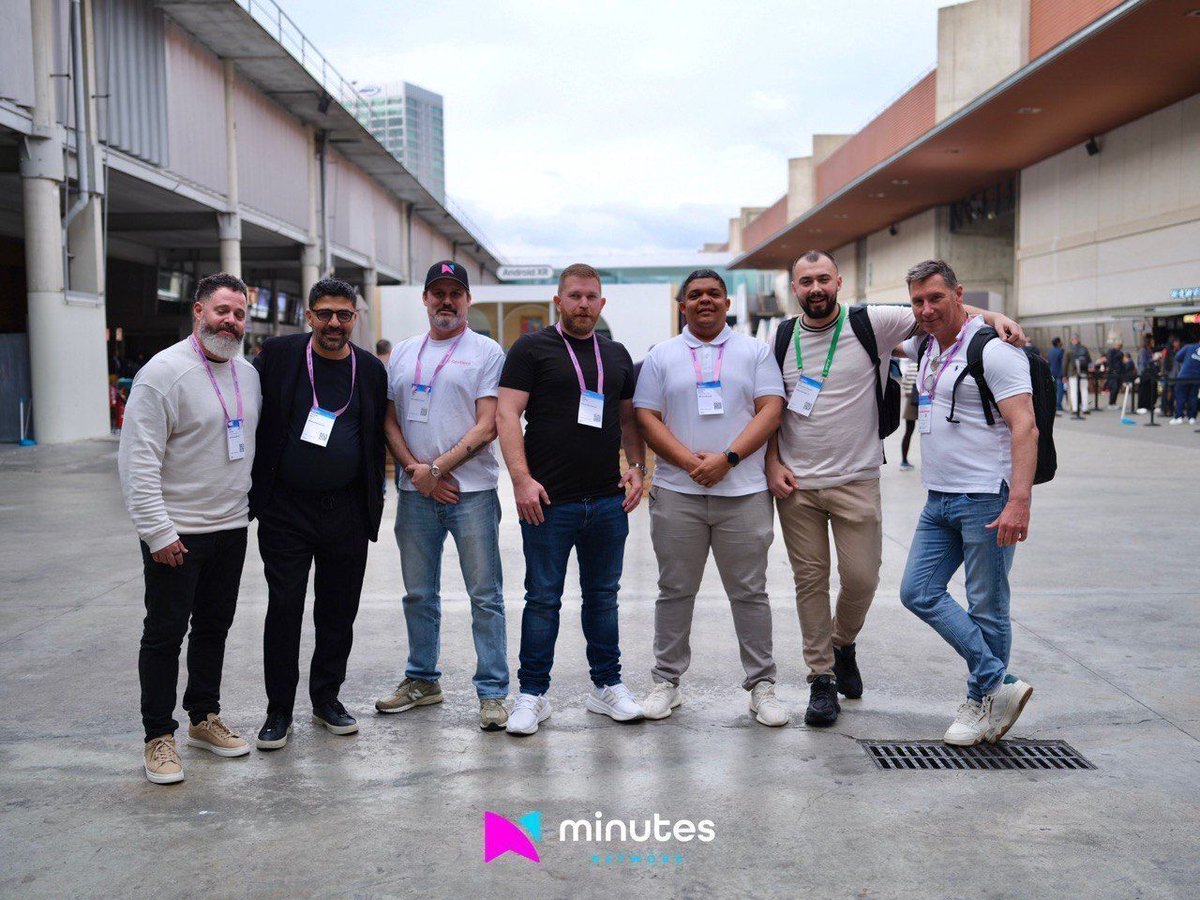
The Minutes Network team has been on the ground this week at #MWC26 in Barcelona, connecting with carriers, operators, and technology partners from across the global telecom ecosystem.
This year’s theme, “The IQ Era”, reflects a major shift in telecom: the move from experimentation with AI to the deployment of intelligent, programmable network infrastructure.
Walking through the halls of MWC, one thing is clear. The industry is moving toward automated, programmable networks capable of supporting new services on a global scale.
That is exactly the direction Minutes Network has already been building.
At the centre of this architecture is Jingle Plug-In, our integration framework that enables applications and endpoints to become directly reachable within the Minutes Network infrastructure. By embedding the Jingle Plug-In into applications, calls can be handled through integrated signaling and routing paths rather than traditional multi-layer wholesale chains.
This programmable foundation is designed to support the next generation of telecom services, from AI-driven anti-fraud protection to agentic AI voice agents operating across global networks.
Meanwhile, the Minutes Network platform continues to scale, recently reaching new all-time highs in users, calls, and minutes. We also saw new call records in key markets, including Turkey and the UK.
MWC remains an important forum for connecting with the operators, carriers, and partners, helping scale the next generation of telecom infrastructure.
We are also working closely with our partners in Pakistan on the rollout of Jingle, with further updates to be shared soon.
The future of telecom isn’t coming. It’s already running on Minutes Network.
🚀 Scout & Runner Alpha is live.
Cohort 1 has received access, and testing is now underway.
From planning to action, Scout & Runner moves into its first live Alpha cycle.
The next phase begins.
Just finished a meeting with the Unity team and a third party company that has confirmed they’re deploying on Unity. Massive for @WorldMobileTeam@wmchain@Minutes_Network and of course @UnityNodesIO and every ULO. 🤑🤯
Scout & Runner: Final preparation underway. Alpha registration to be released in the next 48 hours, and further details to be announced this week.
January Tasks: Additional task types are in development alongside S&R. Updates will follow as each reaches deployment readiness.
iOS Proof of Work: In active development. Timeline to be confirmed shortly.
Rewards: Dynamic based on network demand and task availability. As new tasks deploy, opportunity expands.
Round 1 Privilege: Details will be communicated before the 4 February close.
Further information will be shared in the upcoming roadmap release. Secure your Unity Node at https://t.co/QCkoqJ7ulb to participate in the people-powered edge network.
Minutes Network invites the community to join the next live AMA on X Spaces, where senior members of the team will share key updates on the network’s continued buildout and commercial progress.
🗓 Date: Friday, Jan 30th
⏰ Time: 4pm CET
🔗 https://t.co/4wSsdI4x2r
Live audience questions are welcome. Alternatively, you can send your question on social media using the hashtag #AMAquestion - and we will include it during the session.
Voice traffic patterns are changing.
Traditional volumes are declining. High-frequency, call-centre, and AI-driven traffic is rising fast.
For many carriers, the challenge isn’t volume, it’s trust. High-volume traffic without clear attribution increases risk, even when much of that traffic is legitimate.
That’s why AI-driven anti-fraud has become foundational. Real-time validation protects consumers and allows legitimate traffic to operate at scale.
This is exactly the environment Jingle is designed for - enabling direct reachability, clearer attribution, and more deterministic call handling as traffic concentrates around repeat and high-value endpoints.
This is where wholesale voice is heading - and it’s what Minutes Network is architected for.
🎄 Merry Christmas from all of us at Minutes Network
Thank you to our global community for another year of building, connecting, and scaling together. The lines are ringing, the network is running seamlessly - and with 2026 ahead, some can already hear the jingle coming.
Wishing you a joyful holiday season and a bright, connected year ahead.
Minutes Network (MN) and WorldCall Telecom Limited (WTL) have entered into a collaboration agreement covering the aggregation and termination of international wholesale voice traffic, alongside the use of Minutes Network’s technology stack for revenue assurance operations.
While the agreement immediately supports conventional international wholesale activity, its strategic significance lies in the expansion of an operating environment capable of scaling Jingle - Minutes Network’s core architecture for application- and endpoint-integrated call handling.
Expanding into a High-Value International Voice Corridor
WorldCall operates in markets where international wholesale voice traffic remains commercially significant and operationally complex. Through this collaboration, Minutes Network expands its presence within a live, high-volume traffic environment while strengthening interconnect relationships across the Middle East and adjacent origination regions.
In parallel, Minutes Network will provide services supporting the Hello application within WorldCall’s environment. Hello is designed to operate with Jingle embedded at its core, enabling participating endpoints to become directly reachable through Minutes Network’s infrastructure rather than accessed solely via conventional wholesale routing chains.
Jingle at the Core of Minutes Network’s Architecture
At the center of Minutes Network’s operating architecture is Jingle, its proprietary integration technology designed to enable applications and endpoints to become directly reachable within the network.
Jingle allows calls to be managed over controlled signaling and data paths, reducing reliance on multi-layer intermediary termination routes. Where deployed, this approach enables routing, attribution, and settlement logic to be handled within a single, coherent operational framework.
The result is greater determinism in how calls are delivered, identified, and accounted for - an increasingly important capability as international voice traffic continues to concentrate around repeat and high-frequency call patterns.
Structural Economics: Improving Revenue Retention Through Integration
Traditional wholesale voice routing typically distributes per-minute economics across multiple intermediaries. Jingle is designed to change this structure by enabling Minutes Network to manage call handling and attribution directly within its own infrastructure for integrated traffic paths.
Where Jingle-based integrations are implemented and supported by participating networks, Minutes Network’s architecture is designed to enable full attribution of completed calls along those integrated paths. In such configurations, and subject to network conditions, deployment scope, and operator participation, this structure is intended to allow Minutes Network to retain substantially all applicable call revenues by minimizing dependency on traditional intermediary termination mechanisms.
As adoption expands across applications, enterprise environments, and carrier-aligned use cases - particularly those involving frequent callees - the proportion of traffic operating within these integrated paths can increase over time.
Hello: A Jingle-Enabled Participation Layer
The Hello application plays a practical role in operationalizing Jingle within partner environments. By embedding Jingle at the application layer, Hello enables coordinated participation from integrated endpoints, supporting direct reachability, call attribution, and alignment between routing and settlement processes.
Rather than acting as an overlay, Hello is designed as an access point into Minutes Network’s integrated call handling environment, reinforcing an infrastructure-led participation model built around transparency and accountability.
Six Weeks In.
Polkadot. Shib. Zebec.
Already partnered, with more on the way.
APK released.
Official community channels live.
Early calibration scaling fast.
Onboarding process refined.
Calibration period initialised.
Unity creates work for smartphones.
Unity creates demand for cryptocurrencies.
Unity powers Switch, Validation, and EarthNode activity on the World Mobile Chain.
Unity creates. Unity is composable.
Mine the telecom grid.
https://t.co/rZ3UWOK6T4
The $2 trillion telecom industry depends on constant maintenance. A major part of that is network verification and fault detection, and right now the process is broken.
Today these systems are centralized, fragmented, and inefficient. They miss problems, waste money, and slow everything down.
Centralized Model | Current Problems
Limited device coverage means large blind spots.
Geographic restrictions limit visibility to a few countries.
Centralized infrastructure drives high operational costs.
Single points of failure cause widespread outages.
Data bottlenecks create slow response times.
Decentralized Model | Unity Advantages
Extensive device coverage enables near complete fault detection.
Global operation across multiple countries and regions.
Lower costs through distributed infrastructure and automation.
No single point of failure, ensuring constant uptime and resilience.
Real time responsiveness through instant API data validation.
Sharing economy that rewards every participant.
Be part of the network that powers itself. Start building with Unity at https://t.co/rZ3UWOK6T4
Edge networks are the next layer of the internet.
When people share connectivity and compute through their phones or local nodes, scale happens naturally. The network grows stronger, faster, and cheaper with every participant.
Unity will make a safer space for everyone including carriers, operators, and institutions and by default those benefits flow to the people. A sharing economy of edge networks turns users into infrastructure and builds a more resilient internet for all.
Visit https://t.co/QCT3hpnL4X to read more and participate.
Minutes Network is on the ground this week at Capacity Europe 2025 in London, where the atmosphere has been charged with innovation, collaboration, and opportunities across the global telecom sector.
Now into the second day of the conference, it’s already proving to be an outstanding success. We are engaged in a full schedule of productive meetings with long standing partners and new carriers and enterprises eager to explore integration, traffic exchange, and infrastructure collaboration.
There is significant interest in our Revenue Optimization and AI driven telecom solutions, as more carriers and service providers look for intelligent, automated systems to improve efficiency and profitability across their international routing.
We are also seeing strong momentum around Pakistan, where voice traffic continues to grow rapidly, with new volumes being secured and additional partnerships being lined up to support upcoming licenses set to go live in other key markets.
Minutes Network continues to build out its hyperscaling model preparing for revenue optimization through our proprietary Jingle platform and Revenue Turbine engine, ensuring maximum efficiency, transparency, and profitability for carriers and enterprises worldwide.
The event is an ideal opportunity not only to build new relationships but also to strengthen existing interconnections, reaffirming our position as a trusted and innovative partner within the global telecom ecosystem.
As the conference continues, our focus remains clear - expanding capacity, optimizing global routes, and preparing for the next phase of scale.
Stay tuned for post event highlights following Capacity Europe 2025.
Crypto finally meets reality.
Unity doesn’t reward speculation, it rewards work.
Every active license performs telecom verification that carriers, operators, and institutions rely on.
That’s real world demand, powering real crypto rewards - in BTC, ETH, ADA & more.
This isn’t another token.
It’s the proof that connection itself has value.
Yesterday’s AWS outage took down major parts of the web, including crypto infrastructure like Infura - showing how vulnerable today’s centralized networks remain.
Unity’s community powered, global decentralized edge network provides flexible routing to solve such problems.
The Unity Virtual Route Builder (VRB) is a smart, intel-driven VPN feature that lets enterprises and carriers choose alternate network paths across the edge network in real time.
Example:
Route traffic from 🇪🇸 Spain → 🇰🇪 Kenya → 🇿🇦 South Africa → 🇺🇸 USA
instead of 🇪🇸 Spain → 🇳🇱 Amsterdam → 🇺🇸 USA when Amsterdam is congested.
Beyond resilience, the Unity VRB also optimizes performance by dynamically selecting the fastest Unity edge hops. This lowers latency and increases throughput - improving download speeds, reducing lag, and ensures smoother connectivity even under heavy network load.
What it does:
* Detects regional outages in real time through Unity’s live global network map
* Continuously maps and verifies the world’s internet routes through its verification layer
* Lets carriers and enterprises build custom traffic routes around affected regions
* Offers preset routes like “Bypass Outage-1” or “Low Latency US-East”
* Keeps data encrypted end-to-end through Unity’s decentralized edge
Unity maps the live internet itself. When one area degrades, Unity can instantly reroute data through healthy paths, keeping carriers, enterprises, and services online even when major cloud regions go down.
Outages happen. Downtime shouldn’t. The Unity VRB, in coordination with EarthNodes, creates a resilient, people powered internet that keeps traffic flowing - no matter where the problem starts.
🔗 https://t.co/rZ3UWOK6T4