"🚀🌕 Humanity's Path to the Stars: Elon Musk's SpaceX could avert global collapse by mining the Moon, Mars & asteroids for lithium and all depliting materials before they run out in ~40 years left of battery materials! Prevent resource wars, power EVs & grids forever. Bold 40-year plan inside—will we make it? #SpaceMining #SaveHumanity #ElonMusk RT if you're in!"
### Humanity's Path to the Stars: A Strategic Plan to Avert Global Resource Depletion and Economic Collapse
The core threat is the accelerating depletion of critical battery materials — lithium, cobalt, nickel, graphite, and rare-earth elements — that power electric vehicles, grid-scale energy storage, consumer electronics, and the entire renewable-energy transition. Solid-state batteries, the safest and highest-performing next-generation technology, are even more lithium-intensive than today’s cells. Demand is projected to rise 10–40× by 2040, while economically recoverable terrestrial reserves are insufficient beyond the 2040–2060 window, with severe shortages possible as early as the late 2020s.
Without a new, essentially unlimited source, the post-fossil-fuel economy collapses, energy prices skyrocket, and nations fight over the last accessible deposits. The result: global economic collapse and potential permanent technological regression.
This plan establishes a hard 40-year deadline: by ~2065 we must operate an industrial-scale mining and return pipeline from the Moon (and later Mars and asteroids) delivering hundreds of thousands of tons of battery-grade materials annually.
#### First Stage: Lunar Mining Operations
1. **Exploration & Site Selection**
Robotic precursor missions and crewed sorties conduct high-resolution mapping and core sampling, prioritizing lunar highlands and permanently shadowed craters rich in lithium, rare earths, and water ice.
2. **Base Establishment**
Permanent lunar outpost with integrated launch/landing pads and docking ports at the highest-priority deposit.
3. **Mining & Processing**
Modular mining and beneficiation equipment — designed on Earth to be disassembled, shipped via Starship, and reassembled on-site — begins operations. The Moon’s one-sixth gravity allows lighter, smaller equipment to process far greater volumes than on Earth.
4. **Human–Robotic Operations**
Early mining relies on rotating human crews for oversight and maintenance, transitioning over time to higher levels of robotic autonomy while retaining human supervisors.
5. **Resource Return System**
Processed or high-grade materials are loaded into proven, flight-heritage re-entry capsules (direct derivatives of SpaceX Dragon cargo/trunk return capsules or NASA/ESA-style cargo return vehicles). These capsules are filled on the lunar surface, loaded into Starship’s payload bay or an unpressurized trunk section, and released in batches during Earth orbital fly-by. The mothership never performs a heavy-cargo re-entry; only the capsules — with decades of successful operational history — endure atmospheric descent and are recovered by parachute in designated zones. This maximizes return mass fraction while preserving full Starship reusability.
Initially, most refining occurs on Earth using existing metallurgical plants; later phases shift beneficiation and refining to lunar or orbital facilities.
See in comments for next stages 👇👇👇
"🚀🌕 Humanity's Path to the Stars: Elon Musk's SpaceX could avert global collapse by mining the Moon, Mars & asteroids for lithium and all depliting materials before they run out in ~40 years left of battery materials! Prevent resource wars, power EVs & grids forever. Bold 40-year plan inside—will we make it? #SpaceMining #SaveHumanity #ElonMusk RT if you're in!"
### Humanity's Path to the Stars: A Strategic Plan to Avert Global Resource Depletion and Economic Collapse
The core threat is the accelerating depletion of critical battery materials — lithium, cobalt, nickel, graphite, and rare-earth elements — that power electric vehicles, grid-scale energy storage, consumer electronics, and the entire renewable-energy transition. Solid-state batteries, the safest and highest-performing next-generation technology, are even more lithium-intensive than today’s cells. Demand is projected to rise 10–40× by 2040, while economically recoverable terrestrial reserves are insufficient beyond the 2040–2060 window, with severe shortages possible as early as the late 2020s.
Without a new, essentially unlimited source, the post-fossil-fuel economy collapses, energy prices skyrocket, and nations fight over the last accessible deposits. The result: global economic collapse and potential permanent technological regression.
This plan establishes a hard 40-year deadline: by ~2065 we must operate an industrial-scale mining and return pipeline from the Moon (and later Mars and asteroids) delivering hundreds of thousands of tons of battery-grade materials annually.
#### First Stage: Lunar Mining Operations
1. **Exploration & Site Selection**
Robotic precursor missions and crewed sorties conduct high-resolution mapping and core sampling, prioritizing lunar highlands and permanently shadowed craters rich in lithium, rare earths, and water ice.
2. **Base Establishment**
Permanent lunar outpost with integrated launch/landing pads and docking ports at the highest-priority deposit.
3. **Mining & Processing**
Modular mining and beneficiation equipment — designed on Earth to be disassembled, shipped via Starship, and reassembled on-site — begins operations. The Moon’s one-sixth gravity allows lighter, smaller equipment to process far greater volumes than on Earth.
4. **Human–Robotic Operations**
Early mining relies on rotating human crews for oversight and maintenance, transitioning over time to higher levels of robotic autonomy while retaining human supervisors.
5. **Resource Return System**
Processed or high-grade materials are loaded into proven, flight-heritage re-entry capsules (direct derivatives of SpaceX Dragon cargo/trunk return capsules or NASA/ESA-style cargo return vehicles). These capsules are filled on the lunar surface, loaded into Starship’s payload bay or an unpressurized trunk section, and released in batches during Earth orbital fly-by. The mothership never performs a heavy-cargo re-entry; only the capsules — with decades of successful operational history — endure atmospheric descent and are recovered by parachute in designated zones. This maximizes return mass fraction while preserving full Starship reusability.
Initially, most refining occurs on Earth using existing metallurgical plants; later phases shift beneficiation and refining to lunar or orbital facilities.
See in comments for next stages 👇👇👇
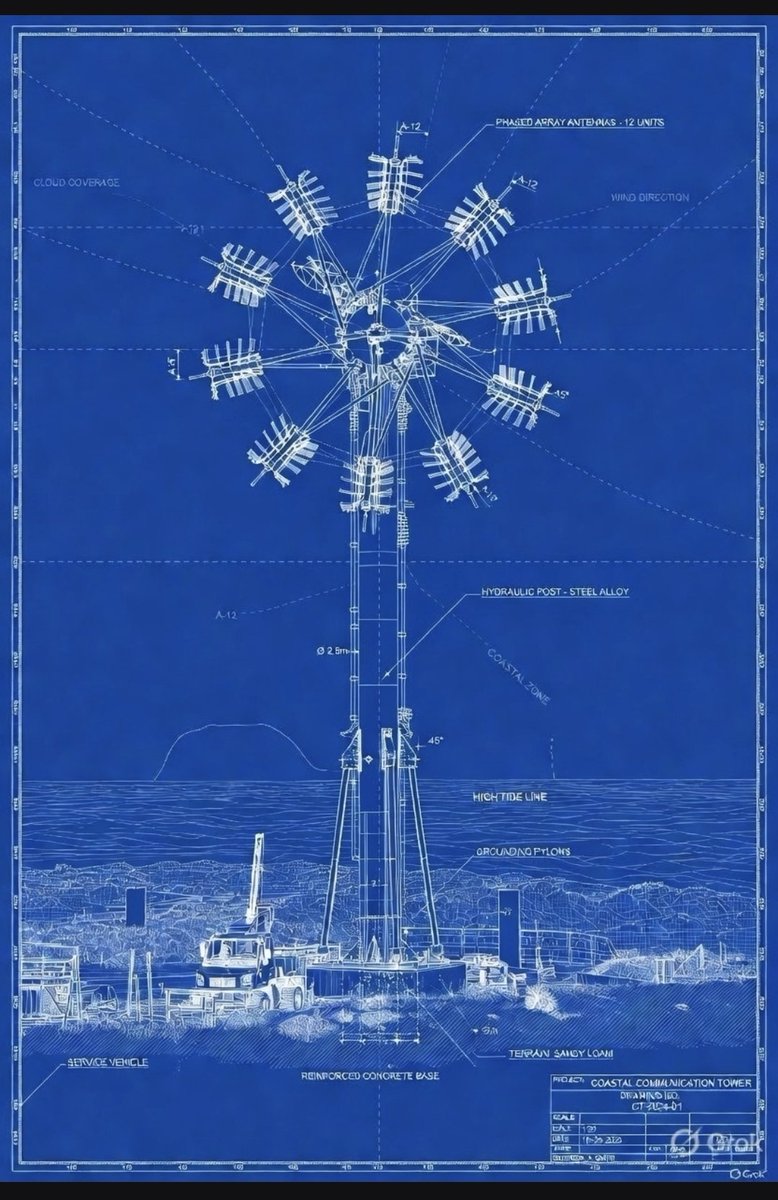
### Modular Wind Turbine System Plan (idea only Beta, blue print education purposes only)
- **Core Idea**: A permanent, hydraulic-extending post (like a telescoping mast) supporting multiple small, modular generators with pivoting blades in a gyroscope-like setup. Each generator is independent, allowing individual replacement without dismantling the whole system. The design emphasizes longevity (80–100+ years for the post), low maintenance costs (no cranes needed), and adaptability to variable winds via 360-degree pivoting and passive wing adjustments.
- **Goals**:
- Compete with large-scale turbines (e.g., 10 MW output) by stacking/scaling modules.
- Reduce waste: Reuse the concrete foundation and post indefinitely.
- Improve efficiency: Smaller blades capture wind from any direction; mechanical (non-electronic) adjustments for reliability.
- Target Output: Aim for 5–10 kW per module; stack 3,000–4,000 for megawatt-scale (as we discussed).
- **Assumptions**: Post height adjustable from 10–50 meters; modules are 2–3 meters in diameter; wind speeds of 5–15 m/s for optimal operation.
#### 2. **Key Components**
- **Permanent Post/Base**:
- Material: High-strength steel or composite alloy for durability (corrosion-resistant coating).
- Foundation: Reinforced concrete pad (e.g., 5x5 meters, 2 meters deep) poured once and reused.
- Height: Fixed base section (10–20 meters) with hydraulic telescoping extensions.
- Features: Integrated cable conduits for power routing; grounding for lightning protection.
- **Hydraulic Extension System**:
- Mechanism: Hydraulic pistons (similar to those in cranes or adjustable masts) to raise/lower the upper sections.
- Power Source: Electric pump (grid or solar-powered) with manual backup.
- Safety: Locking pins at full extension; sensors for wind speed to auto-retract in storms (>25 m/s).
- **Modular Generators/Blades**:
- Size: 2–3 meter diameter blades, each linked to a 5–10 kW generator.
- Number: 10–50 per post, stacked vertically with 1–2 meter spacing to avoid turbulence.
- Design: Three-blade rotors (for stability) mounted on a gimbal/gyroscope frame for 360-degree rotation.
- Pivoting Mechanism: Passive wings/fins on the housing act like weather vanes, using wind lift to auto-align blades perpendicular to flow. Mechanical gears for fine-tuning (e.g., ratchet system to lock angles).
- Modularity: Quick-release mounts (bolts or clamps) for easy swap; each unit weather-sealed and burnout-resistant.
- **Power Management**:
- Inverters: One per module or centralized at the base.
- Grid Tie: Connect to local grid or battery storage; smart controller to balance output from modules.
- **Additional Features**:
- Sensors: Basic anemometers and vibration monitors (mechanical if avoiding electronics).
- Access: Built-in ladder rungs on the post for maintenance when lowered.
"🚀🌕 Humanity's Path to the Stars: Elon Musk's SpaceX could avert global collapse by mining the Moon, Mars & asteroids for lithium and all depliting materials before they run out in ~40 years left of battery materials! Prevent resource wars, power EVs & grids forever. Bold 40-year plan inside—will we make it? #SpaceMining #SaveHumanity #ElonMusk RT if you're in!"
### Humanity's Path to the Stars: A Strategic Plan to Avert Global Resource Depletion and Economic Collapse
The core threat is the accelerating depletion of critical battery materials — lithium, cobalt, nickel, graphite, and rare-earth elements — that power electric vehicles, grid-scale energy storage, consumer electronics, and the entire renewable-energy transition. Solid-state batteries, the safest and highest-performing next-generation technology, are even more lithium-intensive than today’s cells. Demand is projected to rise 10–40× by 2040, while economically recoverable terrestrial reserves are insufficient beyond the 2040–2060 window, with severe shortages possible as early as the late 2020s.
Without a new, essentially unlimited source, the post-fossil-fuel economy collapses, energy prices skyrocket, and nations fight over the last accessible deposits. The result: global economic collapse and potential permanent technological regression.
This plan establishes a hard 40-year deadline: by ~2065 we must operate an industrial-scale mining and return pipeline from the Moon (and later Mars and asteroids) delivering hundreds of thousands of tons of battery-grade materials annually.
#### First Stage: Lunar Mining Operations
1. **Exploration & Site Selection**
Robotic precursor missions and crewed sorties conduct high-resolution mapping and core sampling, prioritizing lunar highlands and permanently shadowed craters rich in lithium, rare earths, and water ice.
2. **Base Establishment**
Permanent lunar outpost with integrated launch/landing pads and docking ports at the highest-priority deposit.
3. **Mining & Processing**
Modular mining and beneficiation equipment — designed on Earth to be disassembled, shipped via Starship, and reassembled on-site — begins operations. The Moon’s one-sixth gravity allows lighter, smaller equipment to process far greater volumes than on Earth.
4. **Human–Robotic Operations**
Early mining relies on rotating human crews for oversight and maintenance, transitioning over time to higher levels of robotic autonomy while retaining human supervisors.
5. **Resource Return System**
Processed or high-grade materials are loaded into proven, flight-heritage re-entry capsules (direct derivatives of SpaceX Dragon cargo/trunk return capsules or NASA/ESA-style cargo return vehicles). These capsules are filled on the lunar surface, loaded into Starship’s payload bay or an unpressurized trunk section, and released in batches during Earth orbital fly-by. The mothership never performs a heavy-cargo re-entry; only the capsules — with decades of successful operational history — endure atmospheric descent and are recovered by parachute in designated zones. This maximizes return mass fraction while preserving full Starship reusability.
Initially, most refining occurs on Earth using existing metallurgical plants; later phases shift beneficiation and refining to lunar or orbital facilities.
See in comments for next stages 👇👇👇
"🚀🌕 Humanity's Path to the Stars: Elon Musk's SpaceX could avert global collapse by mining the Moon, Mars & asteroids for lithium and all depliting materials before they run out in ~40 years left of battery materials! Prevent resource wars, power EVs & grids forever. Bold 40-year plan inside—will we make it? #SpaceMining #SaveHumanity #ElonMusk RT if you're in!"
### Humanity's Path to the Stars: A Strategic Plan to Avert Global Resource Depletion and Economic Collapse
The core threat is the accelerating depletion of critical battery materials — lithium, cobalt, nickel, graphite, and rare-earth elements — that power electric vehicles, grid-scale energy storage, consumer electronics, and the entire renewable-energy transition. Solid-state batteries, the safest and highest-performing next-generation technology, are even more lithium-intensive than today’s cells. Demand is projected to rise 10–40× by 2040, while economically recoverable terrestrial reserves are insufficient beyond the 2040–2060 window, with severe shortages possible as early as the late 2020s.
Without a new, essentially unlimited source, the post-fossil-fuel economy collapses, energy prices skyrocket, and nations fight over the last accessible deposits. The result: global economic collapse and potential permanent technological regression.
This plan establishes a hard 40-year deadline: by ~2065 we must operate an industrial-scale mining and return pipeline from the Moon (and later Mars and asteroids) delivering hundreds of thousands of tons of battery-grade materials annually.
#### First Stage: Lunar Mining Operations
1. **Exploration & Site Selection**
Robotic precursor missions and crewed sorties conduct high-resolution mapping and core sampling, prioritizing lunar highlands and permanently shadowed craters rich in lithium, rare earths, and water ice.
2. **Base Establishment**
Permanent lunar outpost with integrated launch/landing pads and docking ports at the highest-priority deposit.
3. **Mining & Processing**
Modular mining and beneficiation equipment — designed on Earth to be disassembled, shipped via Starship, and reassembled on-site — begins operations. The Moon’s one-sixth gravity allows lighter, smaller equipment to process far greater volumes than on Earth.
4. **Human–Robotic Operations**
Early mining relies on rotating human crews for oversight and maintenance, transitioning over time to higher levels of robotic autonomy while retaining human supervisors.
5. **Resource Return System**
Processed or high-grade materials are loaded into proven, flight-heritage re-entry capsules (direct derivatives of SpaceX Dragon cargo/trunk return capsules or NASA/ESA-style cargo return vehicles). These capsules are filled on the lunar surface, loaded into Starship’s payload bay or an unpressurized trunk section, and released in batches during Earth orbital fly-by. The mothership never performs a heavy-cargo re-entry; only the capsules — with decades of successful operational history — endure atmospheric descent and are recovered by parachute in designated zones. This maximizes return mass fraction while preserving full Starship reusability.
Initially, most refining occurs on Earth using existing metallurgical plants; later phases shift beneficiation and refining to lunar or orbital facilities.
See in comments for next stages 👇👇👇
"🚀🌕 Humanity's Path to the Stars: Elon Musk's SpaceX could avert global collapse by mining the Moon, Mars & asteroids for lithium and all depliting materials before they run out in ~40 years left of battery materials! Prevent resource wars, power EVs & grids forever. Bold 40-year plan inside—will we make it? #SpaceMining #SaveHumanity #ElonMusk RT if you're in!"
### Humanity's Path to the Stars: A Strategic Plan to Avert Global Resource Depletion and Economic Collapse
The core threat is the accelerating depletion of critical battery materials — lithium, cobalt, nickel, graphite, and rare-earth elements — that power electric vehicles, grid-scale energy storage, consumer electronics, and the entire renewable-energy transition. Solid-state batteries, the safest and highest-performing next-generation technology, are even more lithium-intensive than today’s cells. Demand is projected to rise 10–40× by 2040, while economically recoverable terrestrial reserves are insufficient beyond the 2040–2060 window, with severe shortages possible as early as the late 2020s.
Without a new, essentially unlimited source, the post-fossil-fuel economy collapses, energy prices skyrocket, and nations fight over the last accessible deposits. The result: global economic collapse and potential permanent technological regression.
This plan establishes a hard 40-year deadline: by ~2065 we must operate an industrial-scale mining and return pipeline from the Moon (and later Mars and asteroids) delivering hundreds of thousands of tons of battery-grade materials annually.
#### First Stage: Lunar Mining Operations
1. **Exploration & Site Selection**
Robotic precursor missions and crewed sorties conduct high-resolution mapping and core sampling, prioritizing lunar highlands and permanently shadowed craters rich in lithium, rare earths, and water ice.
2. **Base Establishment**
Permanent lunar outpost with integrated launch/landing pads and docking ports at the highest-priority deposit.
3. **Mining & Processing**
Modular mining and beneficiation equipment — designed on Earth to be disassembled, shipped via Starship, and reassembled on-site — begins operations. The Moon’s one-sixth gravity allows lighter, smaller equipment to process far greater volumes than on Earth.
4. **Human–Robotic Operations**
Early mining relies on rotating human crews for oversight and maintenance, transitioning over time to higher levels of robotic autonomy while retaining human supervisors.
5. **Resource Return System**
Processed or high-grade materials are loaded into proven, flight-heritage re-entry capsules (direct derivatives of SpaceX Dragon cargo/trunk return capsules or NASA/ESA-style cargo return vehicles). These capsules are filled on the lunar surface, loaded into Starship’s payload bay or an unpressurized trunk section, and released in batches during Earth orbital fly-by. The mothership never performs a heavy-cargo re-entry; only the capsules — with decades of successful operational history — endure atmospheric descent and are recovered by parachute in designated zones. This maximizes return mass fraction while preserving full Starship reusability.
Initially, most refining occurs on Earth using existing metallurgical plants; later phases shift beneficiation and refining to lunar or orbital facilities.
See in comments for next stages 👇👇👇
#### Funding Mechanism (Self-Reinforcing Loop)
Lunar helium-3 and early lithium/REE sales pay for Mars base
Mars propellant + Phobos hub slashes Δv costs by 40–60 %
Lower transport costs make asteroid metals profitable within 3–5 years
Asteroid profits + lunar mass-driver exports fund full industrial scaling
By the end of Year 20, the combined lunar–Mars–asteroid system is no longer a government program or a billionaire’s hobby — it is the largest and fastest-growing materials industry on (and off) Earth, delivering more battery metals and energy than all terrestrial mines combined.
Third Stage (Years 21–40) simply scales these proven systems by another order of magnitude and begins construction of O’Neill-class habitats, ensuring humanity is truly multi-planetary and resource-independent forever.
The clock is ticking. Second Stage starts the moment the first lunar lithium refinery goes online.
"🚀🌕 Humanity's Path to the Stars: Elon Musk's SpaceX could avert global collapse by mining the Moon, Mars & asteroids for lithium and all depliting materials before they run out in ~40 years left of battery materials! Prevent resource wars, power EVs & grids forever. Bold 40-year plan inside—will we make it? #SpaceMining #SaveHumanity #ElonMusk RT if you're in!"
### Humanity's Path to the Stars: A Strategic Plan to Avert Global Resource Depletion and Economic Collapse
The core threat is the accelerating depletion of critical battery materials — lithium, cobalt, nickel, graphite, and rare-earth elements — that power electric vehicles, grid-scale energy storage, consumer electronics, and the entire renewable-energy transition. Solid-state batteries, the safest and highest-performing next-generation technology, are even more lithium-intensive than today’s cells. Demand is projected to rise 10–40× by 2040, while economically recoverable terrestrial reserves are insufficient beyond the 2040–2060 window, with severe shortages possible as early as the late 2020s.
Without a new, essentially unlimited source, the post-fossil-fuel economy collapses, energy prices skyrocket, and nations fight over the last accessible deposits. The result: global economic collapse and potential permanent technological regression.
This plan establishes a hard 40-year deadline: by ~2065 we must operate an industrial-scale mining and return pipeline from the Moon (and later Mars and asteroids) delivering hundreds of thousands of tons of battery-grade materials annually.
#### First Stage: Lunar Mining Operations
1. **Exploration & Site Selection**
Robotic precursor missions and crewed sorties conduct high-resolution mapping and core sampling, prioritizing lunar highlands and permanently shadowed craters rich in lithium, rare earths, and water ice.
2. **Base Establishment**
Permanent lunar outpost with integrated launch/landing pads and docking ports at the highest-priority deposit.
3. **Mining & Processing**
Modular mining and beneficiation equipment — designed on Earth to be disassembled, shipped via Starship, and reassembled on-site — begins operations. The Moon’s one-sixth gravity allows lighter, smaller equipment to process far greater volumes than on Earth.
4. **Human–Robotic Operations**
Early mining relies on rotating human crews for oversight and maintenance, transitioning over time to higher levels of robotic autonomy while retaining human supervisors.
5. **Resource Return System**
Processed or high-grade materials are loaded into proven, flight-heritage re-entry capsules (direct derivatives of SpaceX Dragon cargo/trunk return capsules or NASA/ESA-style cargo return vehicles). These capsules are filled on the lunar surface, loaded into Starship’s payload bay or an unpressurized trunk section, and released in batches during Earth orbital fly-by. The mothership never performs a heavy-cargo re-entry; only the capsules — with decades of successful operational history — endure atmospheric descent and are recovered by parachute in designated zones. This maximizes return mass fraction while preserving full Starship reusability.
Initially, most refining occurs on Earth using existing metallurgical plants; later phases shift beneficiation and refining to lunar or orbital facilities.
See in comments for next stages 👇👇👇
#### Second Stage
(To be developed: Mars forward bases, Phobos low-gravity refueling and storage hubs, asteroid-belt resource capture, and a complete solar-system supply chain — all funded and enabled by the lunar foundation established in Phase 1.)
This plan uses only technology that either exists today or is in late-stage development. The only question is whether we begin soon enough to meet the deadline.
**From Lunar Bootstrap to Solar-System Industrial Backbone**
Goal: Turn the Moon into a net exporter of energy and materials, use the cashflow and infrastructure to colonize Mars, and begin systematic asteroid mining. By the end of this stage, space-sourced battery materials must exceed 1 million tons per year — enough to fully replace declining Earth production.
#### Core Objectives (by Year 20)
- Lunar production: ≥ 500,000 t/yr of lithium equivalents + helium-3, rare earths, and propellant
- Mars: Permanent city of 10,000+ people, self-sufficient in food, oxygen, and fuel
- Asteroid belt: Regular round-trip missions returning 500,000+ t/yr of metals, water, and volatiles
- Full supply-chain closure: Refining, manufacturing, and return of finished battery-grade materials to Earth
#### Key Milestones & Systems
1. **Lunar Industrial Scaling (Years 6–12)**
- Expand to 5–7 major mining districts (KREEP terrane, Gruithuisen domes, Compton–Belkovich, SPA basin, and polar ice fields)
- Fleet of 50–100 heavy autonomous miners (10–50 tonne excavators designed for 1/6 g)
- In-situ oxygen extraction from ilmenite and anorthosite → produces 200,000 t/yr of LOX for propellant
- Lunar flash-distillation and electro-refining plants for lithium, cobalt, nickel, and REEs
- Lunar space elevator concept replaced by mass-driver or rail-gun launchers at the equator to hurl cargo containers directly into trans-Earth trajectories (cheaper than rockets for bulk commodities)
2. **Mars Forward Base & Transportation Backbone (Years 8–18)**
- Permanent Mars South-Pole or Arcadia Planitia base (10,000 inhabitants by Year 20)
- ISRU propellant plants using Sabatier + electrolysis → 5,000 t/yr of methane/oxygen
- Phobos Refueling & Storage Hub
- Low-gravity (0.001 g) fuel depot with robotic thruster-guided hoses (proven on lunar orbit first)
- Rigid storage ring (10–15 km diameter) anchored 1–2 km above Phobos surface, holding 50,000–100,000 t of pods and refined materials
- Continuous micro-thrust station-keeping to prevent orbital decay or mass-imbalance issues
- Starship “Block 3” deep-space variant: 300–500 t payload to Mars surface when launched from lunar surface or Phobos
3. **Asteroid Campaign (Years 12–20)**
- Target selection: Near-Earth asteroids first (for early payback), then main-belt metallic (Psyche-class) and C-type water-rich bodies
- Fleet of 20–30 dedicated asteroid catcher ships (Starship-derived, equipped with robotic arms, net capture systems, and optical mining lasers)
- Return strategy:
- Fill proven Dragon-derived or new heavy re-entry capsules (10–25 t each)
- Capsules are docked to the asteroid ship, then released in batches during Earth fly-by
- Recovery in ocean splash-down zones (same logistics as Dragon cargo returns today)
- Annual return cadence: 50–100 missions → 500,000–1,000,000 t/yr of nickel, cobalt, platinum-group metals, water, and lithium-rich clays
4. **Orbital & Terrestrial Receiving Infrastructure**
- Earth-orbit “Gateway Refinery” – large shielded station that receives capsules, performs final purification, and drops finished lithium metal, cobalt sulfate, etc., in small shielded re-entry vehicles
- Dedicated recovery fleets (ships + aircraft) for Pacific/Indian Ocean splashdown zones
- Direct pipeline contracts with battery mega-factories (Tesla, CATL, LG, Panasonic)