A house of consulting financial economists that assists #familyoffice, #foundation, and #fiduciary clients in the areas of investment consulting and counsel.
This was the case before AI > Source verification, traceability, and clear decision rules matter more than polished outputs in "What Broke When We Put AI Into Our Research Process" via @CFAinstitute https://t.co/8qeh5DKgRE
“The economist Hyman Minsky applied the term “Ponzi finance” to businesses that do not generate sufficient cash flows to meet their outgoings” in US corporate profit boom faces its ‘Minsky moment’ via @Breakingviews https://t.co/kp9kRYljbp
“The opportunity for AI in finance is not simply to understand individual companies better, but to understand what connects them” in Do Language Models Need a Markowitz Moment? via @CFAinstitute https://t.co/wWbhfxDqh7
“Tech and AI stocks now comprise over 40% of the S&P 500’s market cap. That’s higher than the peak of the dotcom bubble in early 2000. Add in AI-related companies, and tech’s footprint tops 50%, also a record.” @Reuters https://t.co/cP3WHT8sel
“With IR’s rising … policymakers will be forced to choose between inflation other unattractive alternatives, such as deflation, declining GDP, or default. Based on their past actions during crises, we’re confident they’ll choose inflation.” Eric Cinnamond https://t.co/OisWK1XNFn
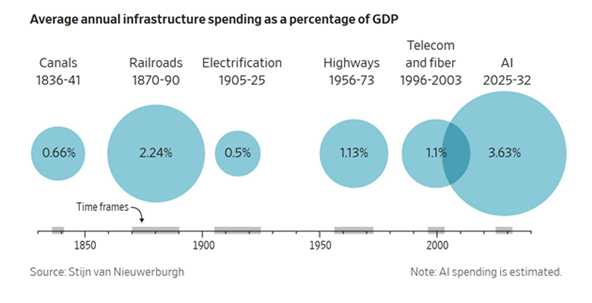
The AI build-out is making history, dwarfing the spending for U.S. canals, railways, and grid combined. It’s creating jobs and wealth while boosting inflation and crowding out housing via @WSJ https://t.co/VbbuE8Bc69
"Markets can remain irrational longer than you can remain solvent." John Maynard Keynes (maybe) > "When Retail Capital Flow Overwhelms Institutional Fundamentals" via @CFAinstitute
https://t.co/aDaFlAwkBi
The Hugging Face Hack and AI going 'rogue' > “People built the test, removed restraints, defined the objective, left a route open and decided not to stop what was happening" by @briandgross via @WSJopinion https://t.co/rNNXUhCBgS
Economist Charles Goodhart turns 90. “He is best known for his dictum, “when a measure becomes a target, it ceases to be a good measure”. Goodhart has an uncanny habit of asking the questions mainstream economists have quietly abstracted away.” via @ft
https://t.co/aVPb2IzSyA
“The way BigTech companies control crucial global choke points echoes the political and economic power of the East India Company and its European siblings at the apex of their power” @DalrympleWill via @nytimes https://t.co/Xik5IZERVL
“The (U.S.) Treasury is shifting issuance towards the short end because the long end has become expensive. The Fed is buying at the short end. The distinction between reserve management and monetary financing of the deficit becomes a question of intent.” https://t.co/qD62f9TWnG
“Debt and deficits haven’t always been a problem in the U.S. Publicly held debt—now approaching WWII levels at about 100% of the country’s annual GDP—was just 31.5% of GDP in 2001 after four years in which the government ran budget surpluses” via @wsj https://t.co/6HdmdQTD3V
Consistent with our experience > "...Family offices may become more professional as a second generation onboards, but family dynamics add a layer of complexity..." > Family Offices Face a Turning Point https://t.co/h3vr51ZijW
“When the Fed is widely thought to be moving toward raising rates, this is exactly the opposite of what it should be doing. Expanding the balance sheet is also the opposite of what Chairman Kevin Warsh has repeatedly said he wants to do.” @jmackin2 https://t.co/BR2XDpPMyA
GDP = C + I + G + NX
This chart shows these four buckets as a % of US GDP, averaged by decade, from the 1950s through today.
@EPBResearch
https://t.co/9pb86BmmaO
Very consistent with what we see > "...A hybrid setup is often the preferred option for new family offices or those that are smaller in size..." > Family Offices Growing in Number, Size https://t.co/53u7vIKyGG