Signed offline, came back late, and the window had closed. DriveKey now has a clean way out.
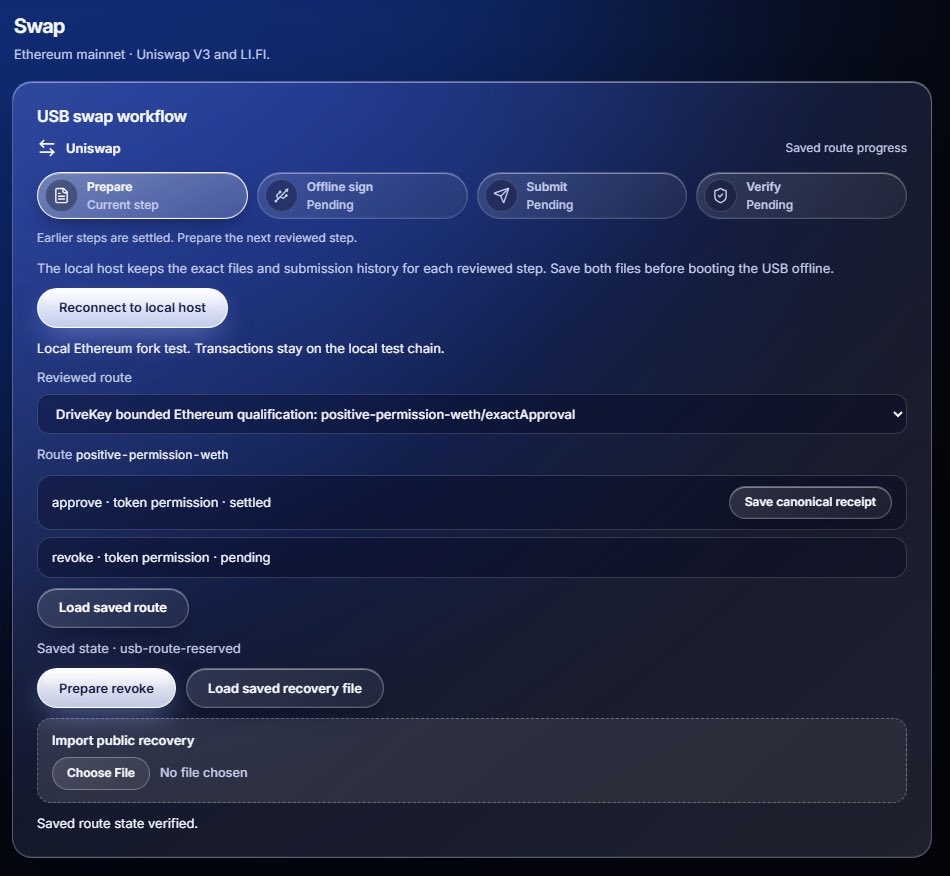
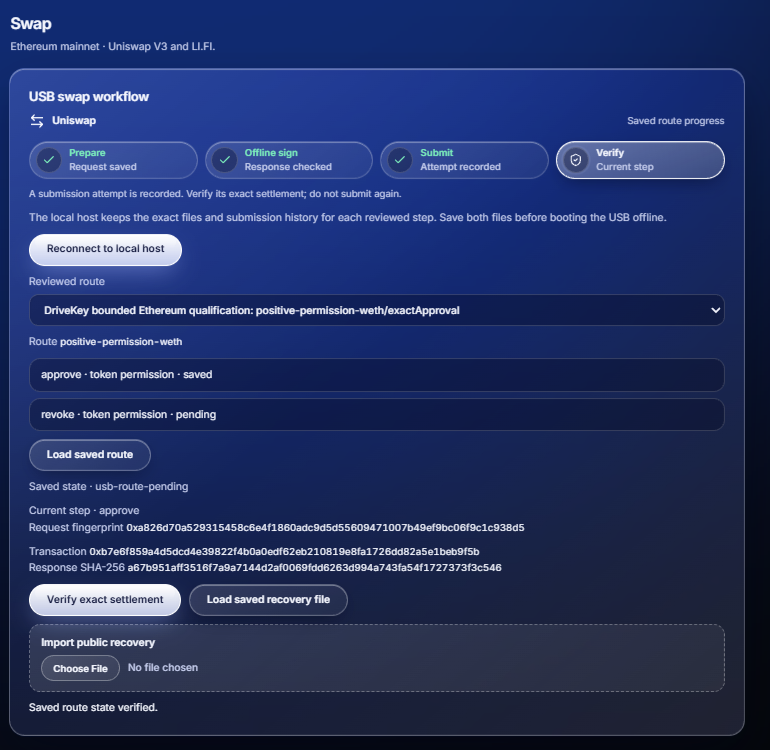
We hit this ourselves yesterday: a transaction signed on the offline stick, imported into the app, and not sent before its deadline. The old rule kept that request locked, and no other route could start.
Today's build fixes it. Once the deadline and a 5-minute grace have passed, and the wallet's nonce is still unused, the app releases the old request and prepares it again at the same nonce. Two signatures, one nonce: only one of them can ever land.
Run end to end today on a local mainnet fork, on the final build, with the offline OS in a VM:
- release refused before the deadline
- release accepted after it
- the old signed file refused by the app
- revoke signed again offline and settled
- the old signature rejected by the chain: nonce too low
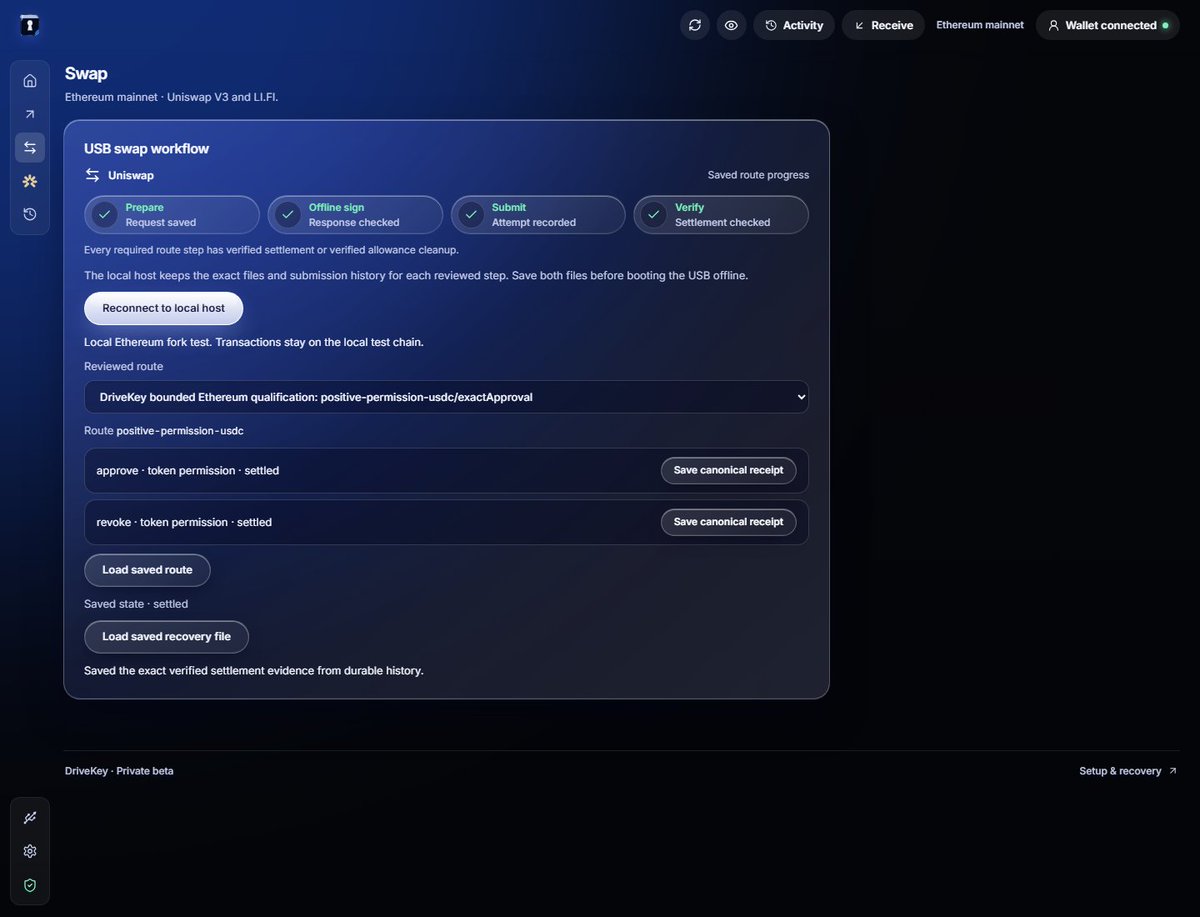
- the next route ran straight after
It went through two internal review gates. The second one sent the release record back once, for four sentences. Installed and verified on our dev PC today.
Online control. Offline approval.
https://t.co/dFu3AgCBhP
The new DriveKey OS just settled its first transaction on Ethereum mainnet. Signed offline, on a USB stick, on real hardware.
Today it left the VM:
- Booted from a USB stick on a real PC.
- Restored a real wallet backup on it, offline. Byte for byte.
- The app prepared a mainnet transaction. The stick showed the exact terms. Approved and signed there.
- Submitted, final on Ethereum, verified by the app, receipt saved.
https://t.co/GGaK2jhNWk
Signed on the offline stick. Only the signed transaction went online.
Small on purpose: a 0.00001 WETH approval. Test build, not released for real funds. Next: the other 21 mainnet test cases.
Online control. Offline approval.
https://t.co/dFu3AgCBhP
DriveKey OS just left the VM. It runs on real hardware, and it is on mainnet's doorstep.
Today, with the new release:
- Booted from a USB stick on a real PC.
- Restored a real wallet backup on it, offline. The restored files match the originals byte for byte.
- Prepared its first Ethereum mainnet request: a 0.00001 WETH approval, saved to the stick and waiting for an offline signature.
The app prepares. The stick shows the exact terms. You approve offline. Only then is anything signed.
Test build, not released for real funds. Nothing has been broadcast yet.
Online control. Offline approval.
https://t.co/dFu3AgCBhP
DriveKey. Built from the board up. Splashed. Still signing.
25 seconds: a bare PCB becomes a sealed aluminium stick, takes a wave, lights up, and approves a real swap offline.
Water resistant. Offline by design. Spending keys stay on the stick.
Prepare the swap in the app.
Review the exact terms on DriveKey: 0.00001 WETH, minimum 0.016797 USDC.
Approve offline. Submit once.
Online control. Offline approval.
https://t.co/dFu3AgD97n
Make the offline step short enough that people still read it on the tenth transaction.
One card: amount, recipient, network, fee cap, deadline. One approve button, never pre-selected. Everything else under Details.
Glad to be doing these setups with you, Blake.
Working with multiple @Bevor_io customers today on their @DriveKeyyy setups. Thanksgiving is busy this year 🦃
Security Researchers how do you usually help clients set up air-gapped signing? (Without them getting security fatigue)
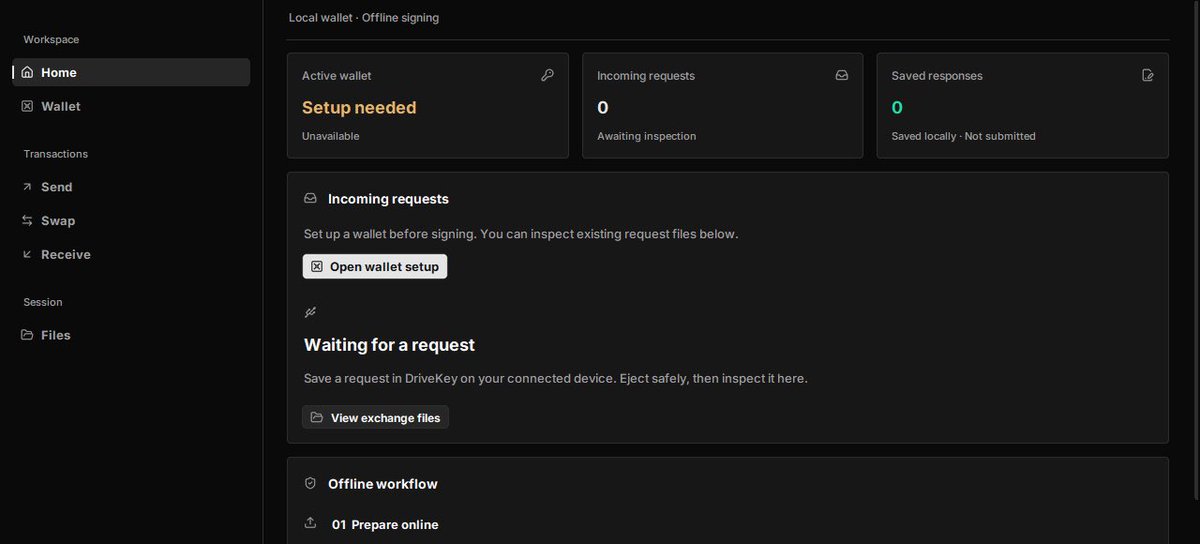
The new DriveKey is running. These are real screens from the offline signer, booted in a VM with Secure Boot.
One card shows what you sign: amount, recipient, network, minimum received, fee cap, deadline. One button approves it. Your password comes after, on a screen that shows the fingerprint of exactly what you approved.
What changed under the glass:
- New wallet: the password is typed twice, and nothing starts until you tick the approval.
- The approve button is never pre-selected. A stray Enter approves nothing.
- Every other field is one click away under Details.
How we checked it before calling it a build:
- Four internal review rounds of the redesign. The first three found problems. We fixed them and ran a fourth: zero blocking findings.
- Ten VM test modes on the final image, from setup to restore, driven by reading the screen and clicking like a person would.
- On a local mainnet fork: a full Uniswap route and three private Hinkal flows, signed on this UI in a test image.
Online control. Offline approval.
https://t.co/dFu3AgD97n
DriveKey has a new face, and it is already signing.
The redesigned offline OS booted with Secure Boot in our test VM today, created a wallet from one password, and signed a payment, a WETH wrap and a token approval on a local mainnet fork.
What changed:
- Setup is one field. Create a password; the wallet and its encrypted backup land on the USB.
- Signing is one screen. Token, amount, recipient, fee cap, one Approve button. Every exact field sits one tap away under Details.
- No wall of boot text. In the VM the logo opens straight into Home.
- The dapp gets the same dark glass.
Online control. Offline approval.
As we speak, we're finalizing the last tests on mainnet to get the OS ready for release. The only thing stopping us from launching on the Microsoft Store is that our company isn't registered yet. Tomorrow we'll announce the company publicly, as required by law in our country.
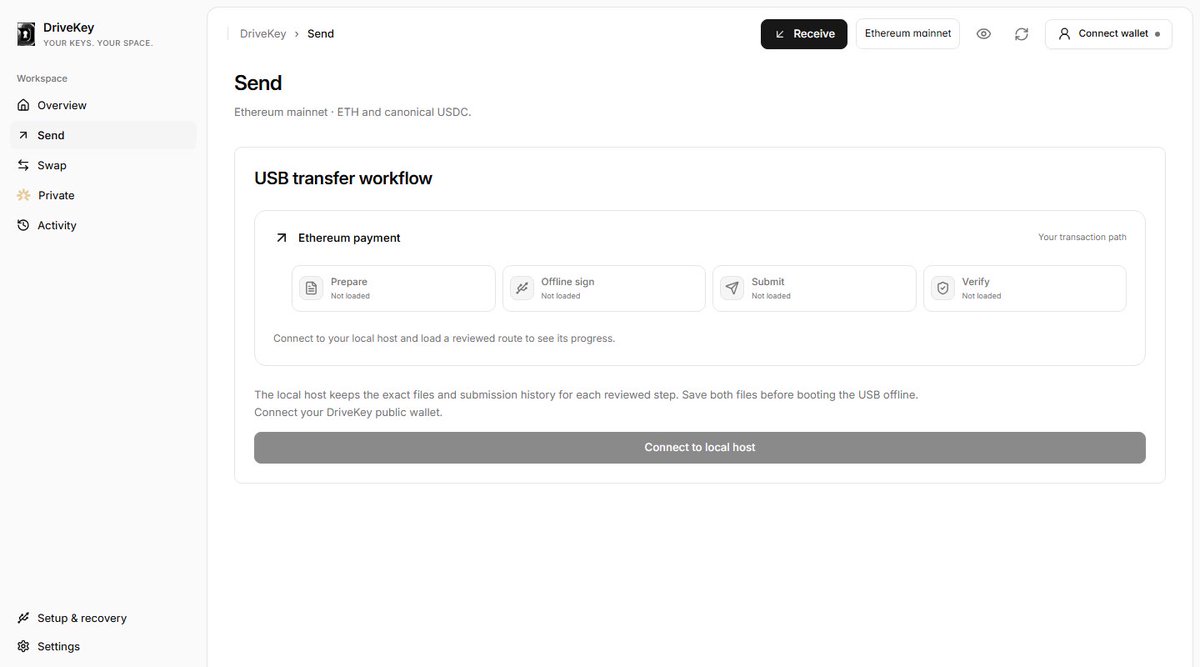
Airgapped signing shouldn't need a dedicated ops team. That's the whole idea behind DriveKey: prepare online, boot the DriveKey USB, see exactly what you're signing, sign, submit.
Excited to bring that to Bevor's clients. More soon.
We've seen many clients who take code security seriously still get hacked due to OpSec issues.
In order to expand our security offering to our clients we're partnering with @DriveKeyyy to solve this problem without making the operational overhead difficult.
Let's get to work.
Airgapped signing has traditionally been difficult for teams, the tooling is advancing fast and we're excited to partner with teams like @DriveKeyyy pushing the frontier forward.
Check them out at https://t.co/Y3EDHyuxG6, we'll have more info on access and deals for our clients shortly!
We've seen many clients who take code security seriously still get hacked due to OpSec issues.
In order to expand our security offering to our clients we're partnering with @DriveKeyyy to solve this problem without making the operational overhead difficult.
Let's get to work.
22 out of 22.
We ran every DriveKey route end to end on an Ethereum mainnet fork: Uniswap swaps and approvals, ETH and USDC payments, wrap and unwrap, https://t.co/rt3U9PEsrd swaps, and Hinkal private deposits, transfers, payments, swaps and withdrawals.
Each one was prepared online, carried over to the offline DriveKey system, reviewed and signed there, then brought back, submitted once and verified.
Plenty of teams spend months getting their contracts reviewed, then lose funds through OpSec.
A leaked key. A compromised laptop. Someone clicking approve on a transaction they never actually read. None of that shows up in a code review.
That’s why we’re excited to join @Bevor_io as an OpSec partner.
DriveKey moves signing off the computer that’s online. A request is prepared on your machine, carried over to a separate offline USB system, and reviewed there in plain view: recipient, amount, fee and deadline. Only then is it signed. The signed response goes back, you submit it once, and the result is verified on-chain.
Keys are only ever unlocked on the offline system, never on the laptop that reads your email.
Bevor helps teams ship secure code. We’ll help their clients keep the keys behind it secure too.
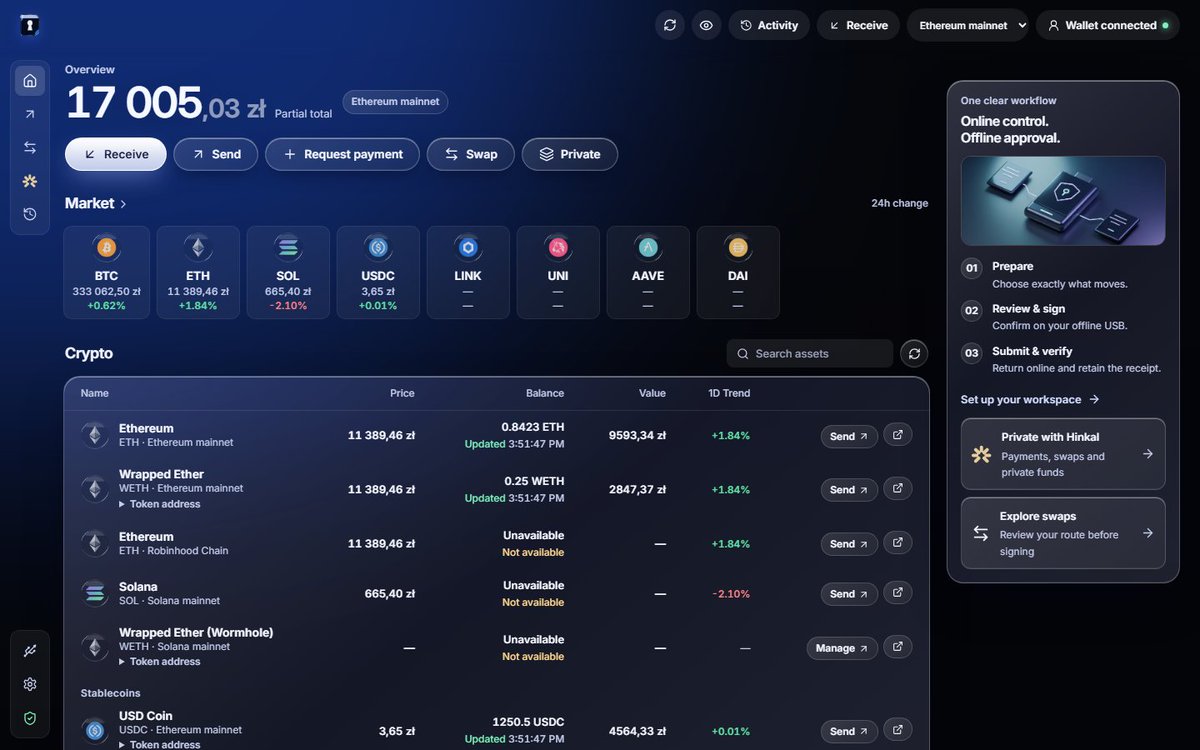
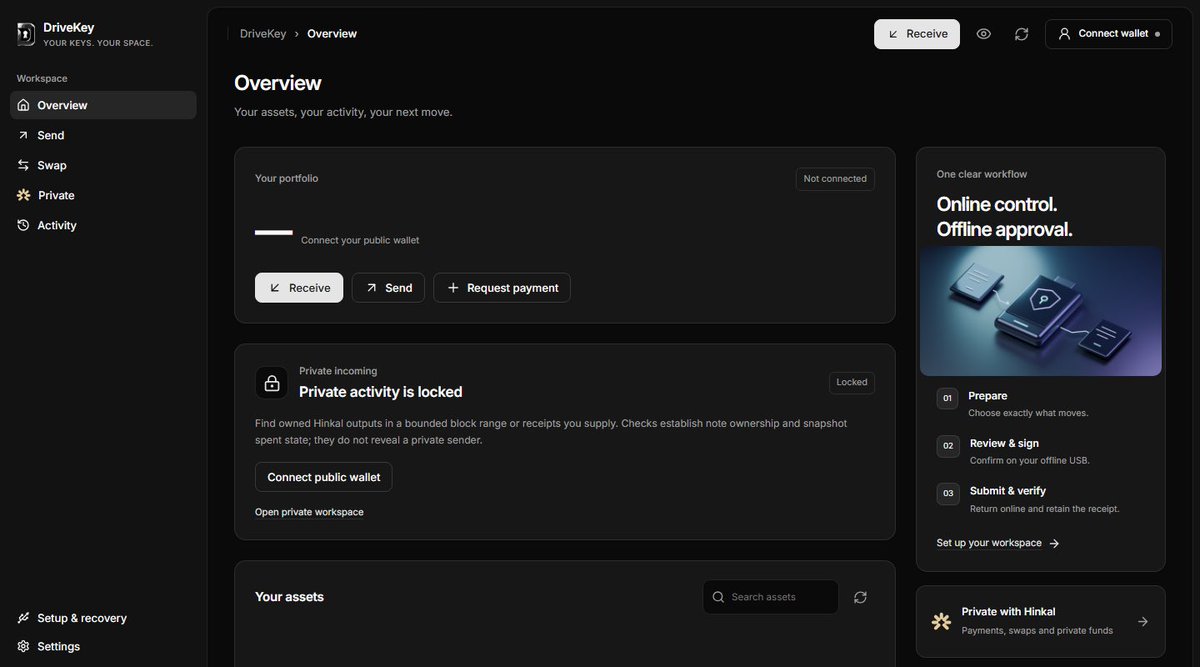
Sneak peek: DriveKey's new look.
Clean black and white across the web app and the offline USB signer. Light and dark, desktop and mobile.
Same flow underneath: prepare online, review and sign offline on the USB, submit and verify.
Ships once it clears our full test run.
Sneak peek: DriveKey's new look.
Clean black and white across the web app and the offline USB signer. Light and dark, desktop and mobile.
Same flow underneath: prepare online, review and sign offline on the USB, submit and verify.
Ships once it clears our full test run.
DriveKey build log, 19 Nov.
All 8 Hinkal private flows pass end to end on a local Ethereum mainnet fork: ETH and USDC payment, transfer, withdrawal, swap.
Hinkal changed a mainnet contract. DriveKey refused every private flow until it was re-pinned. Fails closed by design.