Our 2nd publication in the Q1 journal Briefings in Bioinformatics is now live.
"InversePep: Diffusion-Driven Structure-Based Inverse Folding for Functional Peptides" explores structure-based peptide design using diffusion models.
Read at:
https://t.co/LRPRQB0tpl
#DrugDiscovery
Another one!
Happy to share that our paper “InversePep: Diffusion-Driven Structure-Based Inverse Folding for Functional Peptides” has been accepted for publication in the Q1 journal "Briefings in Bioinformatics".
#AI#DrugDiscovery#peptides#Bioinformatics#BioPharma
@gonucleo We’re still figuring that out ourselves. Closing the loop between modeling and wet lab validation fast enough is proving to be quiet an interesting challenge.
With a wet lab, the workflow shifts:
from, build models → deploy
to, build models → wet lab validation → refine → deploy
Enabling a more grounded and iterative approach to model development.
#AI#DrugDiscovery#ComputationalBiology#Pharma#WetLab#Biopharma
@PlasmoLab True. And an interesting challenge that comes even before degradation prediction is generating the right linker that binds with warhead and E3 ligase.
More interestingly, the question is can we can generate one with the desired properties?
Something we’ve worked on parallelly.
Happy to share that our paper “SE(3)-PROTACs: Geometric Deep Learning for PROTAC Degradation Prediction” has been accepted for publication in the Q1 journal Briefings in Bioinformatics.
#AI#DrugDiscovery#PROTAC#Bioinformatics#BioPharma
PEARL #01 - Drugparadigm
AI-driven drug discovery, with primary focus on building DL models across
1. Next-gen Therapeutic Modalities
2. Generics, Biosimilars, Biobetters
3. End-to-end Small Molecule Drug Discovery Pipeline
With our in-house wet lab facility for validation.
Looking forward to attending India Pharma Expo 2026 at HITEX, Hyderabad. The Drugparadigm team will be visiting on 24th and 25th April.
Looking forward to conversations around AI in drug discovery.
#IndiaPharmaExpo#DrugDiscovery#AIinPharma#Biotech
𝐉𝐮𝐬𝐭 𝟐𝟒 𝐡𝐨𝐮𝐫𝐬 𝐭𝐨 𝐠𝐨! ⏳
India Pharma Expo 2026 is almost here—bringing together industry leaders, innovators, and decision-makers under one roof.
To Secure Your Free Visitor Pass, Click Here: https://t.co/m3v42PRQR1
#IndiaPharmaExpo2026#PharmaExpo
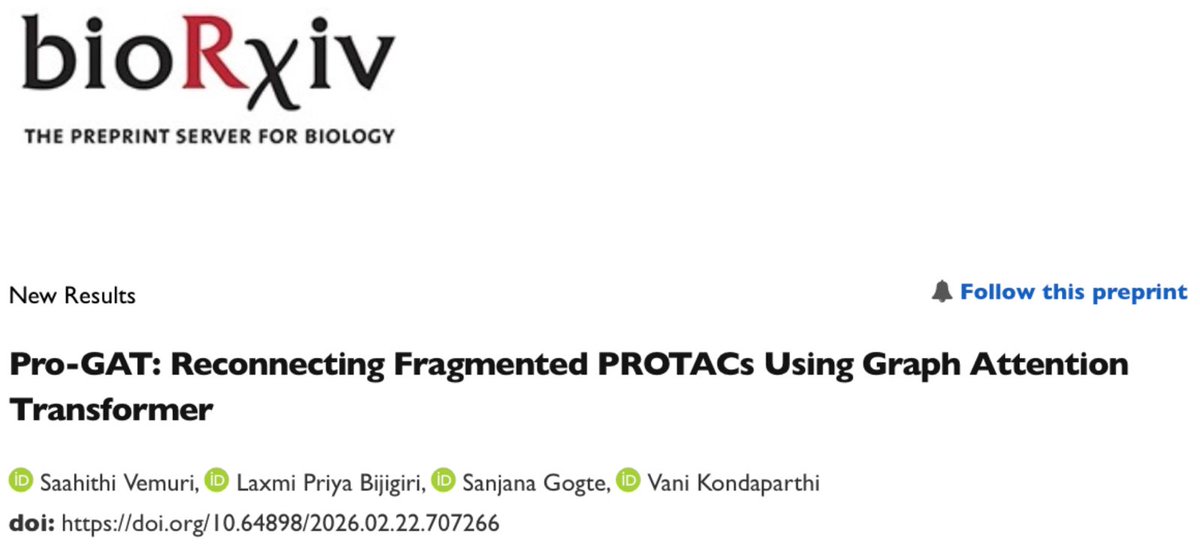
Our recent work on Reconnecting Fragmented PROTACs Using Graph Attention Transformer is featured in K-Hub's Paradigm Chronicles – Issue 08.
Check: https://t.co/VdQu2CwCh3
#DrugDiscovery#PROTAC#khub#Newsletter#DeepTech
Our preprint on ABFormer is now available on bioRxiv.
A transformer-based approach to ADC activity prediction that explicitly models antibody-antigen interaction context.
Read more: https://t.co/9PqID0Z4Jm
#AI#DrugDiscovery#ABFormer#Pharma#ADC#Drugparadigm
We’re setting up our in-house wet lab facility at Drugparadigm.
To experimentally validate generated molecules and model predictions, and systematically integrate the resulting feedback data into the modeling loop.
#AI#DrugDiscovery#ComputationalBiology#Pharma#WetLab
AI can guide early-stage decisions in drug discovery, but translating predictions into real-world outcomes often requires wet lab validation. Without experimental feedback, the models remain constrained to in-silico assumptions.
#AI#DrugDiscovery#Bioinformatics#Pharma
@NomosLogic The “intelligence” lies in how the chemical search space is explored, not just in ranking outcomes. So the question is: are we choosing the right objective for the models to optimize, as you pointed out?
Thanks for asking an interesting question!
@NomosLogic That’s a fair point, and we agree that AI can optimize for the wrong objective if poorly defined. But the role of AI here isn’t sorting molecules or being a search engine. It’s about generating candidates & iteratively modifying them under constraints defined by the researcher.