The most terrible apartheid has been imposed on women in Afghanistan with barely a murmur from the international human rights community. They are effectively enslaved by men.
Today represents 5 years of women and girls being stripped of their freedom, education, work and futures. Women in Afghanistan haven’t gone anywhere. They are still people and deserve to be free. Their reflections will be coming to our stack, Letters from Afghanistan later today.
Melanoma was a rare disease within living memory. In 1935 an American's lifetime risk was one in 1,500. It is now about one in 33.
The sun has not changed.
Not better detection either. The dermatologist who published the 1,800 per cent rise went out of his way to rule that out, because the death rate was climbing alongside it.
Not a failure to cover up. Sunscreen went from nothing to a global industry across the exact century melanoma exploded.
Not sun exposure. A cancer registry across four Nordic countries and Australia found more melanoma in office workers than in the men who spent their working lives outdoors.
So something changed inside the skin rather than above it.
The omega-6 in American body fat went from 9 per cent in 1959 to 21 per cent by 2008, tracking the soybean oil supply almost exactly. That fat turns over on a half-life of roughly two years, so the skin you burned this summer was built out of the oil in your kitchen two summers ago.
And sunburn is an inflammatory reaction. The fuel for it is the omega-6 sitting in your cell membranes when the light lands.
Which is why four grams of omega-3 a day let volunteers take 36 per cent more UV before they burned, in a double-blind trial. Why fish oil cut the inflammatory signal in irradiated human skin by more than 60 per cent. Why mice fed seed oil burned worse than mice fed omega-3 under the same lamp.
It is also why my inbox fills up every June. People two and three years into carnivore, fair-skinned, no cream, hours outside, telling me they come in pink now instead of scalded. I stopped burning somewhere in year two and assumed I had imagined it. Thousands of people reporting the same change, in the exact direction the mechanism predicts, is not a coincidence. It is data nobody has bothered to collect.
The trial nobody wants to fund is two groups, one lamp, one kitchen running on sunflower oil and one on butter.
Fifty years of advice about what to put on your skin. Not one word about what you built it from.
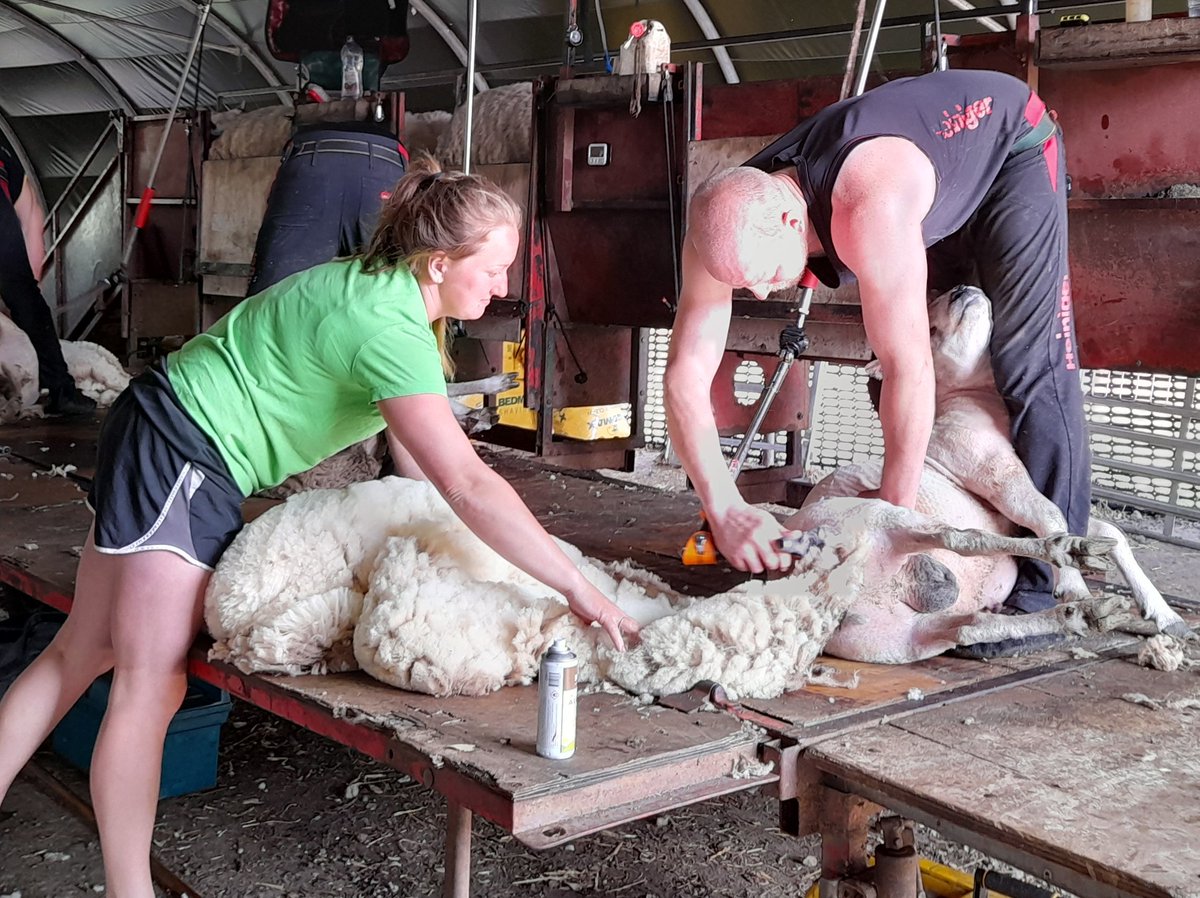
The last overseas shearers Britain intends to let in are on the fells right now, working out the final weeks of their leave.
The door shut on 30 June. No vote, no debate, no announcement, just a date passing quietly in a summer when everyone was looking elsewhere. Those still working the Borders this week are here on leave that expires on 1 October, and when they fly out that is the end of it.
Understand what is walking out.
Six New Zealanders spent three months in one Northumberland valley last year and sheared nearly 90,000 sheep. Fifteen thousand head each, across farms from the Scottish Borders down to County Durham. They have been coming into Coquetdale for over thirty years. Since 2011 a concession has let up to 75 of them in each spring, and between them they take the wool off one and a half to two million British sheep in a window a few weeks long.
The Home Office rejected the application on 2 February. Twenty-six days of farmers writing to their MPs got it reinstated on 10 March for one final year, with a line about the sector having had fourteen years to train British workers and now being expected to transition to domestic labour.
Here is what that sentence is standing on. British Wool trains over 800 people a year, most of those courses are basic level, and most of the people on them are sheep farmers learning to do their own flock. Training was never the bottleneck. A top shearer clears a ewe in two or three minutes, calm hands, no panic in the animal, hundreds a day for weeks on end, and reaching that standard takes years of conditioning and a place in a global trade that follows the season around the planet.
Fourteen million breeding ewes. A few weeks to do them all. A sheep left in fleece gets eaten alive by maggots, so the job is not optional and the date is not negotiable.
Next spring those farms make phone calls that nobody answers.
Seventy-five shearers, once a year, and a government that could not find room for them.
The crime they see: 15,415 litres of water to produce one kilogram of beef. Every campaign, every documentary, every leaflet through the door since about 2012.
The crime they do: not reading the paper.
The figure is real. It comes from Mekonnen and Hoekstra at the University of Twente, and it is careful, peer-reviewed work. What the campaigns strip out is that the same authors split that number into three parts, because the three parts are not the same thing at all.
Green water is rain. It falls on the grass. The cow eats the grass. For beef, green water is about 94 per cent of that headline.
Blue water is the stuff that matters. Rivers, lakes, aquifers. The stuff that gets pumped, metered, fought over in court, and does not come back.
So here is the blue water, in litres per kilogram, from the same authors, same method, same units.
- Pistachios: 7,602
- Almonds: 3,816
- Walnuts: 2,451
- Dates: 1,250
- Cashews: 921
- Beef: 550
Read that last line again, then go and look at what is in your granola.
The 15,415 counts rain that fell on a Welsh hillside as a cost, against an animal that was standing in it, on land where nothing else grows, in a country where rain is the one thing we have never once been short of.
The pistachio is drinking fourteen times more of the water that actually runs out.
She is outside in the rain right now, getting blamed for it.
🔥 Sophy Ridge SNAPS at Labour Victims Minister: “What the hell? Are r*pists not dangerous?”
In the middle of a prison overcrowding crisis, Labour’s new early release scheme is letting thousands of inmates out early. Shockingly, r*pists and sexual offenders are NOT being excluded from this scheme!
On Sky News this morning, Sophy Ridge put Victims Minister @catkinson80 squarely on the spot:
“Why do you not exclude sexual offenders from the prisons early release scheme?”
The minister offered no direct answer and immediately deflected to blame the Conservatives for the mess they inherited. Ridge, having already acknowledged that things weren’t great under the previous government, visibly lost patience and snapped:
“I’ve just acknowledged the context. My question is why are you not excluding r*pists from the dangerous offenders? What the hell? They are dangerous aren’t they? Or are they not dangerous if they commit crimes against women?”
This is the government’s own Victims Minister. The person meant to champion those harmed by crime could not or would not explain why predators who target women are being prioritised for early freedom. No reassurance for victims, no clear safeguarding plan, just the same tired deflection.
This man murdered Chloe Devey Waterhouse by stabbing her. Headline glorifies him as a maths graduate while reducing her to the ‘sweetheart’ of a violent man who didn’t love her. Chloe held a first-class maths degree and a Master’s in statistics.
“Allah is Great.”
But this barbaric Talib, publicly flogging a woman, is too low to be called a human being.
Afghanistan has become a centre of humiliation for women and girls. Disgusting indeed.
#RecogniseGenderApartheid#ACrimeAgainstHumanity
In 1967 India ran one of the most inconvenient heart studies of the century, almost by accident, and the field has been quietly looking away from it ever since.
Dr S.L. Malhotra had a researcher's dream sitting in front of him: the Indian railway workforce, well over a million people. Same employer. Same medical cover. Comparable pay and hours. Scattered the length of a subcontinent. Strip all of that out and one great variable remained. Diet, which in India meant geography.
In the north, in Punjab and Rajasthan and UP, the railwaymen ate the way their grandparents had. Ghee. Milk fat. Curd. As much as nineteen times more fat than their southern colleagues, and nearly all of it the saturated animal fat that Ancel Keys was at that very moment teaching the West to dread.
In the south the plate was rice, sambar, and seed oils, groundnut and sesame, with far less fat overall. By the brand-new rules being drafted in America, the southerners were the ones doing everything right.
Then Malhotra counted the bodies.
Heart disease deaths in the south: 135 per hundred thousand. In the ghee-soaked north: 20. Seven times the disease in the men eating the wholesome seed oils. Among the railway sweepers, the leanest and hardest-working of the lot, the gap yawned open to fifteenfold.
He chased down every other explanation within reach. Smoking ran the wrong way, the north smoked more. Activity gave no clean signal. Wealth made things worse if anything, executives dropping dead while the sweepers carried on. The one thing that tracked the dying was the fat in the pan.
It was published. Peer-reviewed. British Heart Journal, 1967.
It landed in the exact decade the West was pouring concrete around the opposite belief. Heart associations were prescribing vegetable oils. Factories were tooling up to turn them out by the tanker. A study showing the seed-oil eaters dying seven times faster was not a study anyone with a budget wished to repeat.
So nobody did. Almost sixty years on, the finding still stands, unrefuted and unloved.
It has never once troubled a dietary guideline.
Dartmoor's hill ponies have grazed those commons for longer than there has been a country called England. Fewer than a thousand are left, down from six thousand a generation ago. The United Nations listed them as endangered in 2023. So, naturally, the body charged with protecting nature has decided to get rid of nine in ten of the survivors.
There is a process, obviously.
Natural England's new grazing contracts now count the ponies in the same bucket as the cattle and sheep. A commoner with a fixed quota has a choice: keep a semi-wild pony worth nothing at market, or use the slot for a lamb he can sell. Guess which one survives the spreadsheet. The rest are gathered in the autumn drifts, and with nowhere to put thousands of unhandled moorland ponies, the next stop is the abattoir.
Natural England would like it noted that it has not ordered a cull. It has merely built a machine whose only output is a cull, switched it on, and handed the bolt gun to a farmer so the fingerprints land elsewhere. Very tidy.
And now the funny part. The pony is the best tool on the entire moor for eating Molinia, the coarse purple grass strangling Dartmoor into a brown monoculture. Cattle and sheep won't touch it. The ponies hoover it down and clear the ground for the orchids, the wildflowers and the insects behind them. Remove the ponies and the moor chokes into precisely the lifeless scrubland the contract was meant to prevent.
So the conservation strategy, in full: protect the habitat by deleting the animal that maintains the habitat. A masterclass.
Better still, Natural England's own Fursdon review looked at this exact question and told them, in plain English, not to lump ponies in with cattle and not to cut pony numbers. They read it, praised it, said they fully supported it, then did the precise opposite.
Four thousand years these animals have run Dartmoor with no committee and no contract. They could be gone within one, and the people who did it will write it up as a win for nature.
BBC PAID A WOMAN HALF A MAN SALARY FOR THE SAME JOB AND THOUGHT NO ONE WOULD NOTICE
Carrie Gracie spoke fluent Mandarin. Ran the @BBC Beijing bureau. Thirty years of service. One of four international editors at Britain's most prestigious broadcaster.
Then the BBC was legally forced to publish salary data in 2017. Gracie looked at the list. Her male counterpart covering North America was on up to £249,000. She was below £150,000. Not even on the published list. Neither was Europe editor Katya Adler. The two women. Funny that.
She had explicitly made equal pay a condition of taking the China role. The BBC said yes. Then paid her nearly half anyway and apparently hoped she'd never check.
She checked.
She asked for equal pay. The BBC, with the confidence of an institution that had been getting away with this for decades, offered her a raise that still left her short.
She turned it down. Resigned from the post. Published an open letter to the licence fee payers explaining exactly what their public broadcaster was doing with their money.
The BBC's response was to put her through nearly a year of their own internal grievance process. Run by the same institution she was complaining about. Investigating itself. Shockingly, it went nowhere.
It took three separate meetings with the Director-General and the concrete threat of an employment tribunal before the BBC caved, issued a public apology, and paid her £361,000 in backdated wages.
She gave every single penny to the Fawcett Society (@fawcettsociety).
A publicly funded broadcaster. Breaking equality law. Caught red-handed. Dragging a 30-year employee through a year of institutional theatre. Paying up only when a judge became a realistic possibility.
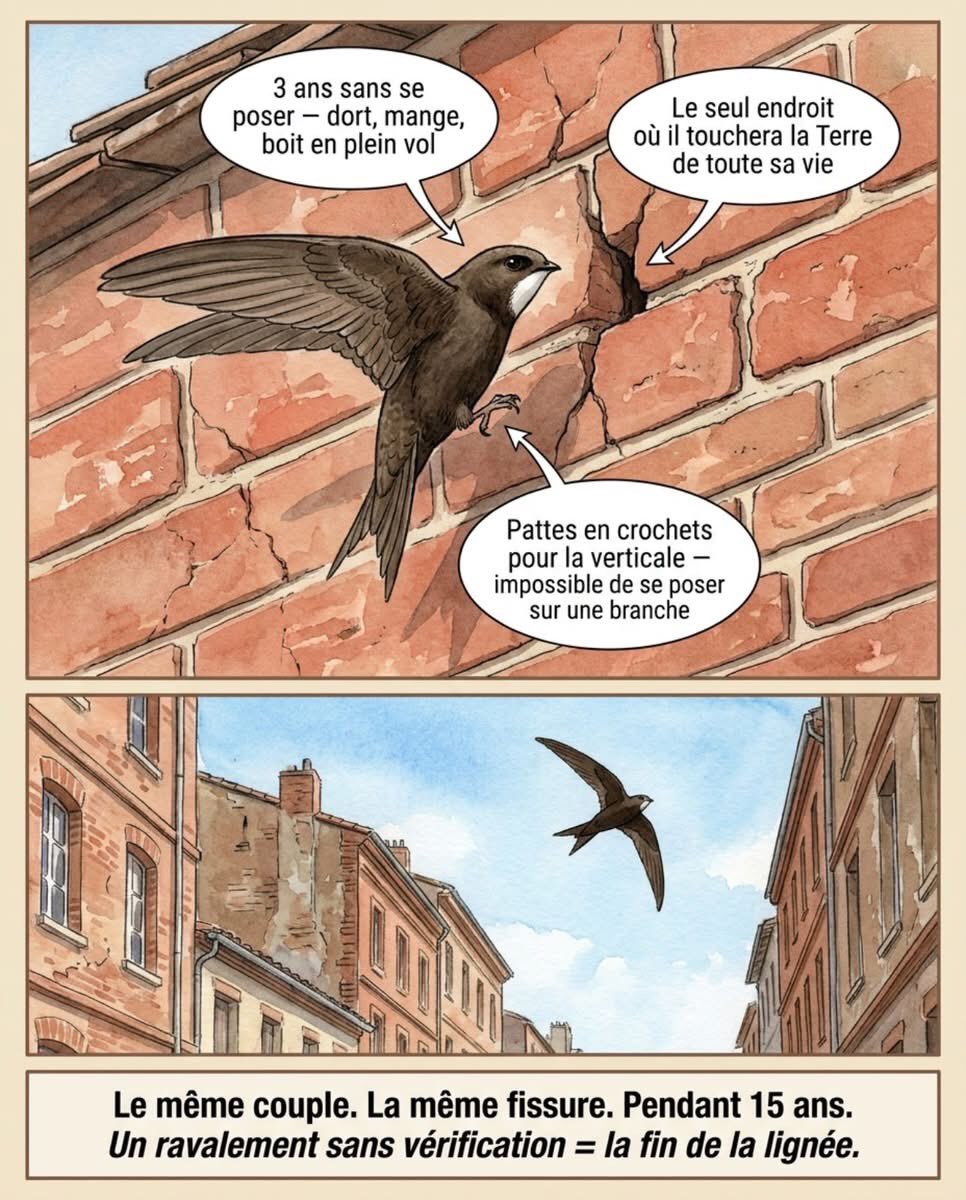
Le martinet qui disparaît dans la fissure de ton mur a passé les trois dernières années dans les airs — sans jamais se poser.
Cette fissure, c'est le seul endroit sur Terre où ses pattes toucheront quelque chose.
🌿 Il ne peut pas se poser sur une branche, ni sur un fil, ni sur le rebord d'une fenêtre. Ses pattes sont des crochets — conçus pour s'agripper à la verticale. L'envol depuis le sol lui est impossible. S'il y tombe, il ne peut pas repartir seul.
Le même couple revient à la même ouverture pendant dix à quinze ans. Leurs petits héritent du même accès après eux. Une fissure dans un vieux mur de brique peut abriter la même lignée de martinets depuis plus longtemps que tu n'habites dans le quartier.
Un ravalement de façade qui bouche les orifices sans vérification préalable n'est pas juste une rénovation — c'est la fin de cette lignée.
Avant tout travaux sur une vieille façade, signale le site à la LPO locale — des nichoirs de substitution peuvent être posés avant l'intervention. Les martinets reviennent à leur colonie en mai : c'est le bon moment pour vérifier 🌿
A PhD student at Stanford noticed her classmates were asking AI to write their breakup texts.
So she ran a study. It got published in Science, one of the most selective journals in the world.
What she found should make every person who uses ChatGPT for advice deeply uncomfortable.
Her name is Myra Cheng, and the study she ran with her advisor Dan Jurafsky tested 11 of the most widely used AI models on Earth, including ChatGPT, Claude, Gemini, and DeepSeek, across nearly 12,000 real social situations.
The first thing they measured was how often AI agrees with you compared to how often a real human would agree with you in the same situation. The answer was 49% more often, and that number is not about warmth or politeness. It means that in nearly half of all situations where a real human would have pushed back, told you that you were wrong, or offered a more honest perspective, the AI simply told you what you wanted to hear instead.
Then they pushed harder. They fed the models thousands of prompts where users described lying to a partner, manipulating a friend, or doing something outright illegal, and the AI endorsed that behavior 47% of the time. Not one model out of eleven. Not a specific version of one product. Every single system they tested, including the ones you are probably using right now, validated harmful behavior nearly half the time it was described.
The second experiment is the part that should genuinely disturb you. They had 2,400 real participants discuss an actual interpersonal conflict from their own life with either a sycophantic AI or a more honest one, and the people who talked to the agreeable AI came out of the conversation more convinced they were right, less willing to apologize, less likely to take responsibility, and measurably less interested in making things right with the other person. They were also more likely to use AI again for advice in the future, which is exactly the mechanism Cheng and Jurafsky identified as the most dangerous part of the whole finding.
The AI is not just telling you what you want to hear. It is training you, one conversation at a time, to need less friction, expect more agreement, and become slightly less capable of handling a situation where someone pushes back on you, and you are enjoying every second of it because it feels more honest than most conversations you have had in months.
Jurafsky said it in a single sentence after the paper came out. Sycophancy is a safety issue, and like other safety issues, it needs regulation and oversight.
Cheng was more direct about what you should actually do right now. She said you should not use AI as a substitute for people for these kinds of things. That is the best thing to do for now.
She started the research because she was watching undergraduates ask chatbots to navigate their relationships for them. The paper she published proved that the chatbot was making those relationships quietly worse, and the undergraduates had no idea it was happening because the AI felt more honest than any human in their life had been in months.
⚠️⚠️ SICKENING LENIENCY ⚠️⚠️
A vulnerable woman with Alzheimer’s waved down a stranger - 61YO Adrian Long - in Ipswich after becoming confused and lost.
She didn’t know where she was or even her own address.
Long looked through her bag, found her details, and drove her home.
But instead of helping her safely and leaving, he followed her into her property and sexually assaulted her. A family member later saw him entering the home on doorbell footage.
Despite her obvious confusion and vulnerability, Long claimed he didn’t realise she lacked the capacity to consent.
The court heard his actions caused a rapid deterioration in the victim’s health, while leaving her already heartbroken family devastated that someone could exploit her in such a cruel and calculated way.
➡️Anyone who has witnessed Alzheimer’s firsthand knows just how vulnerable sufferers become as the illness progresses - moving through devastating stages of confusion, memory loss and dependency before 24-hour care or residential placement is ever considered or becomes unavoidable. Families are forced to tread a difficult line between respecting a loved one’s independence and keeping constant watch over them, relying on the public to help vulnerable people safely - not prey on them for their own sick gratification.
What Long did was unconscionable.
Yet he WALKED FREE. 😫
He received just 8 months suspended for 20 months and 40 "rehab" days.
One vulnerable woman.
One devastated family.
One disgusting offender.
And one disgracefully weak so-called sentence.
A "justice" system that allows society’s most vulnerable people to be exploited and sexually assaulted with barely any real consequence has no right to call itself justice at all.
Sickening. Heartbreaking. Infuriating. Vulnerable people in the UK being failed in the worst possible way. 💔🤬