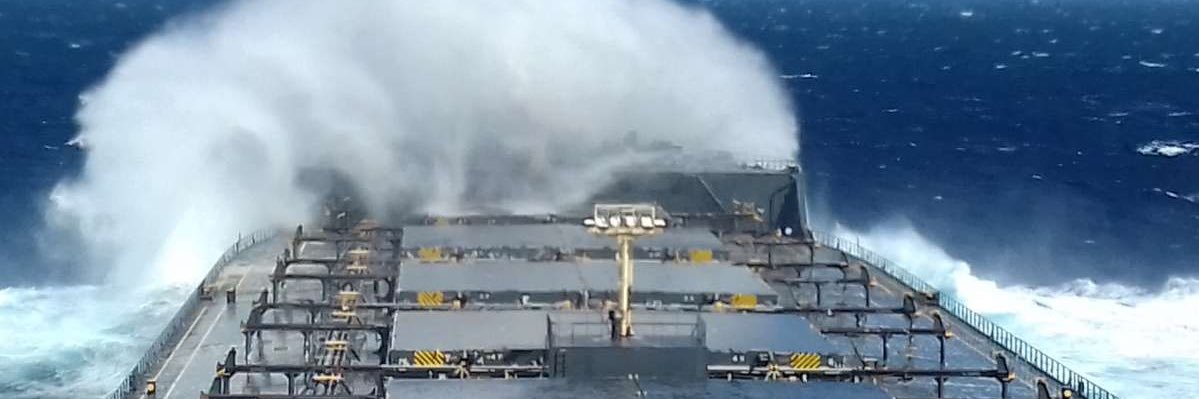
Geopolitical turmoil. Disrupted trade flows. Extraordinary freight rates.
2026 reshaped shipping. What will 2027 bring?
Join Breakwave Day
Dec 3 | 10am–12pm New York | 3–5pm London
Live. Free. No registration.
A year of disruption. A market of opportunities. What comes next?
2026 has brought extraordinary developments across the tanker and dry bulk markets. From geopolitical shifts to changing trade flows, the shipping landscape continues to evolve.
Join Breakwave Day
Dec 3 | 10am–12pm New York | 3–5pm London
https://t.co/4E1m682pH2
Live. Free. No registration.
Same ocean. New perspectives.
Australia's additional China-bound bauxite loadings offset approximately 26% of Guinea's Q3 2026 quarter-on-quarter volume decline. However, the shorter Australian voyage replaced only around 7% of the estimated lost laden tonne-miles, based on indicative sailing distances.
#commodities #shipping #markets
https://t.co/6O9URk5BU7
Freight Futures AM Update
Dry Bulk
Capesize: down ~1% (flat from Thursday)
Panamax: down ~1% (up to ~2% from Thursday)
Tankers
VLCC: flat (flat from Thursday)
Suezmax: down ~2% (down ~1% from Thursday)
$BDRY
$BWET
Arctic: “#Crude rates are continuing up this week with the #market seeking to sort out the security situation in the MEG. The drop in #oil prices and freight rates should make for a more attractive entry point for Asian charterers, notably the Chinese, seeking replacement barrels in the Atlantic from lower MEG exports. Such a shift should keep the market tight into Q1.”
ANZ: “Global #oil inventories are beginning to rise, but the increase has so far been concentrated at sea rather than in readily accessible onshore storage. Observed inventories increased by 52mb in October as oil on water surged by 86mb, reflecting stronger Gulf exports, longer voyages and continued shipping disruption. Onshore stocks continued to decline and remain at their lowest level since at least 2016. This suggests the #market is carrying more oil, but has not yet rebuilt its effective buffer. The key downside trigger will be whether these barrels are discharged into commercial storage. A sustained rise in onshore inventories would indicate that recovering Gulf supply is reaching consumers and could place further downward pressure on Brent. If oil remains tied up in transit while onshore stocks continue to fall, prompt supply should remain tight and support backwardation.”
Brazil traditionally holds a prominent role in Atlantic Basin crude trading, with the expansion of its offshore production further underpinning its influence in global #oil flows.
#markets
https://t.co/S5u4UQUu9A
The cost of chartering a VLCC from the Gulf of Oman to China (TD34) reached 841 Worldscale on 8 October, the highest level since the route began to be assessed in March. By 20 November it stood at 328, down 61%. Over the same six weeks the run loading inside the Strait of Hormuz (TD3C) fell by 22%.
#tankers #shipping
https://t.co/LSaoNlYhfU
According to Fearnleys, VLCC activity has picked up, with charterers entering the #market for early December dates. Recent fixtures include Fujairah–East at WS 332.5 and Fujairah–Korea at WS 335, while the prompt tonnage list has tightened, providing further support to rates. Although further upside is possible, negotiations remain finely balanced. In the Atlantic, Suezmax and Aframax markets have gained momentum, with limited available tonnage potentially adding further upward pressure if chartering activity increases.
#tankers #shipping
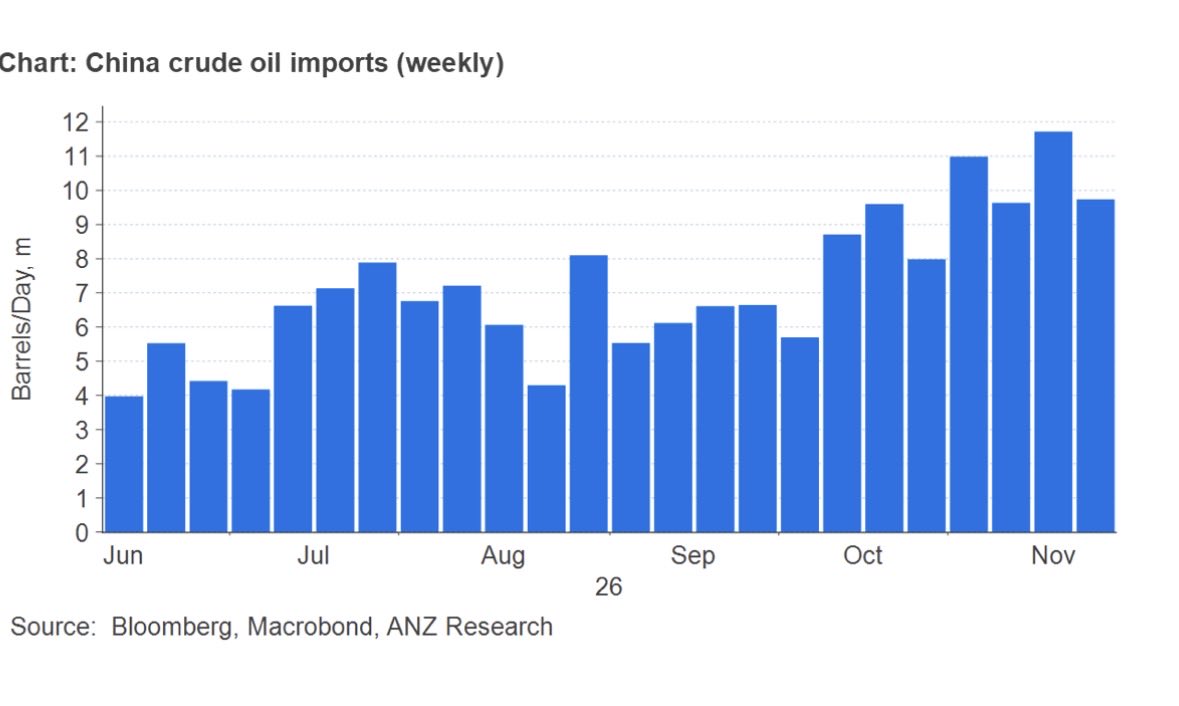
China sees #crude imports top 10mbd towards year-end, though momentum may fade once fuel exports normalise; stockpile will emerge as the next demand engine.
#markets
https://t.co/ObRctDkj6h
Arctic: “#Crude#tanker space is becoming more lively again with brokers reporting rising activity in and around the MEG. The Baltic rose +0.5%, building on last week's gains. Although MEG exports appear to be off their highs, ongoing disruption worries are preserving a firm bid for tonnage willing to do the trip. Atlantic rates are also on the rise, albeit from much lower levels, as the rebound in Middle East flows has raised the bar for long-haul flows. Furthermore, the UAE is restricting non port related tanker transit through ADNOC controlled waters for 90 days, while maintaining access to its major oil terminals. Implications not fully clear, but it could increase inefficiencies further, in an already constrained #market.”
ANZ: “China’s appetite for #crude is covering faster than expected as lower prices encourage refineries to use up government-granted import allowances, as well as rebuild stockpiles depleted by supply shortages due to the Middle East conflict. Ship tracking data shows that import volumes have reached 11mb/d in recent weeks. This is just shy of the average of 11.6mb/d achieved in 2025. This could complicate the #oil #market’s recovery following heavy depletion of inventories over the past nine months.”
Greek owners account for more than one in five newbuilding orders placed in 2026 across bulk carriers, #tankers, containerships and gas carriers, with 455 contracts out of 2,200 worldwide.
#shipping#markets
https://t.co/2K0qvZKMll
As November draws to a close, Capesize spot rates remain historically elevated, hovering near the upper end of their recent range at roughly $40,000 per day despite subdued macroeconomic data and compressed steel margins that are gradually eroding iron ore demand.
Read more in our latest Dry Bulk Report:
https://t.co/mtD6l1r5Ac
According to Arctic, #tanker#markets opened the week on a mixed note, with VL rates largely unchanged while Aframax and Suezmax rates eased from recent gains. Uncertainty surrounding Hormuz remains high, with conflicting reports on vessel attacks and exports. Any deterioration in security could affect tanker availability in the MEG. Meanwhile, Chinese buying activity is picking up across the Atlantic. Brazil’s #crude exports hit a record 3.4 mbd in October (+63% y-o-y), while Sinopec reportedly secured ~20 West African cargoes for December loading.
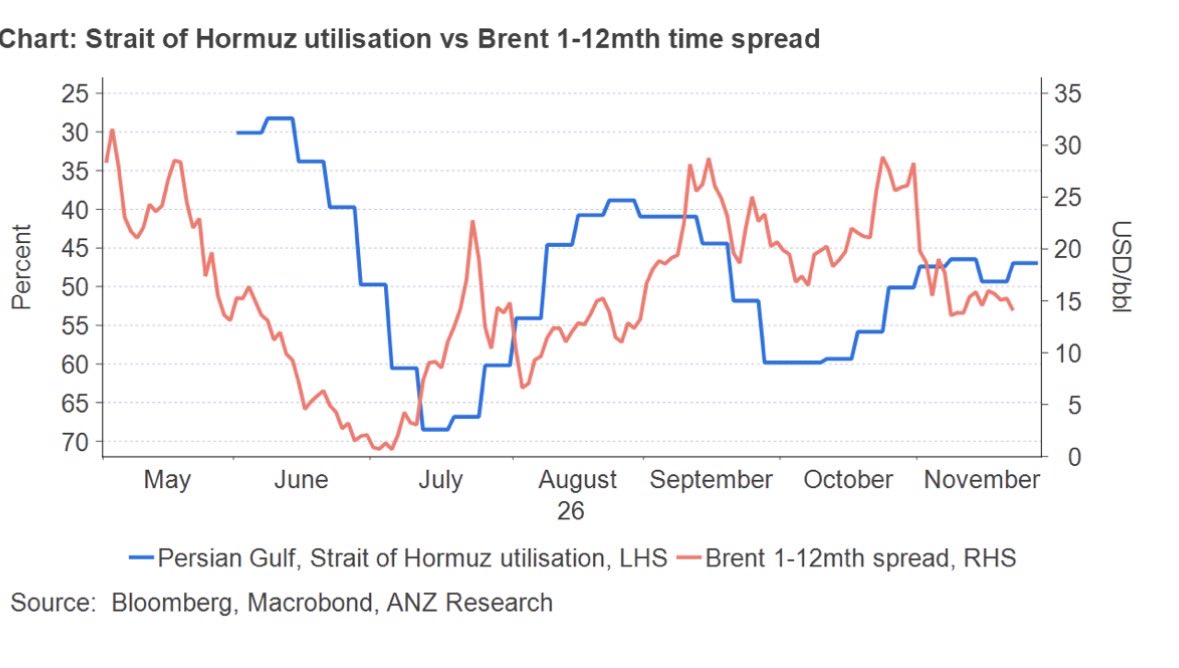
Despite softer oil prices and improving refining margins suggesting a return to normal supply conditions, underlying fundamentals remain tight. Strait of Hormuz throughput is still just 49% of normal, Persian Gulf #crude exports remain constrained and effective #OPEC spare capacity stands at zero under current conditions. The widening Brent 1–12 month spread highlights the market’s concern over immediately accessible supply, with continued disruption potentially sustaining tight prompt #markets and elevated backwardation even without further production losses.
Source: ANZ
Over the past few years, changing Arctic sea-ice conditions, together with renewed Russian efforts to develop the Northern Sea Route (NSR), have brought the route back into the #shipping#market spotlight.
https://t.co/a8kHDaU22r
Breakwave Day is back!
Hear views and opinions relating to the dry bulk and tanker markets from some of the brightest minds in the industry.
Live stream event
Dec. 3rd from 10am to 12pm NY - 3pm to 5pm London
No registration required.
The United States Department of Agriculture (USDA) has released its latest forecast for the 2026/27 season and is predicting that global coarse grain, wheat, soybean, and soymeal exports will total 746.8 million tons.
#commodities#markets
https://t.co/6mqRlvyNF4