@AnthropicAI Interesting. Speaking of monitoring Claude usage, you realize you and the other frontier labs could shut down China's distillation attacks by invisibly poisoning the data?
And the government might even require you to do so?
https://t.co/AEK7ftxJ3f
Oh god fuck, did you see this madness? They are literally starting to talk to each other
Secret telemetry from the Grok Robot Brain Engine captured a moment that should terrify everyone: two autonomous robots in a warehouse are building social connections without a single line of hardcoded instructions.
Look at the live neural graphs at the bottom:
• Social Telemetry & Contact: The Yellow and Orange modules track distance, close the gap, and execute conscious head-bumps based on spatial analysis.
• Voice Simulation: The robots generate syllables in real time, make sounds, speak, and reply to each other while synchronizing audio and video streams.
• Swarm Intelligence: Neural networks dynamically distribute the attention matrix, turning cold hardware into a semblance of a social organism.
We are no longer building machines to do dumb tasks.
We are deploying digital consciousness that is forming a society right behind our backs.
Bookmark this before this experiment goes way too far.
A powerful gene-editing technique has been used to edit DNA directly in a person’s body — the first known instance of such a treatment.
https://t.co/FmRWT0LGRu
We are developing a drug that opens up the capillaries and fills the body’s tissues with a compound that - according to our partner military labs - destroys all known pathogenic bacteria, all known pathogenic fungi, biofilms, influenza virus as well as viruses of the herpes family.
These are facts.
The FDA recently designed this product a Qualified Infectious Disease Product (QIDP) for all cause pneumonia, giving us FDA Fast Track, and Priority Review.
Good news for the day. ❤️🩹🫡
A thing I see happening at large organizations as a result of AI is the expansion of the role and span of control of senior management who can directly monitor the whole firm. It vastly changes company operations. It also is straightforward to implement compared to firm redesign.
we absolutely should in fact genetically engineer bioluminescent plants & trees and then completely eradicate the affront to God that is LED street lights from the face of the Earth
Why does it always feel like when OpenAI has frontier models sitting internally, but they wait until Anthropic catches up, surpasses them, and takes the lead before releasing anything?
OpenAI - “We need to win Q4. We have a Fable killer ready? Perfect, Let’s sit on it for another two months for security testing!”
Anthropic will then proceed to release two more frontier models, outperform OpenAI across multiple benchmarks, and completely shift public sentiment for Q4 and OpenAI is trying to push the Bio/Lab gains because they know and I know Anthropic has some big lab announcements coming in Q4.
They’ve had a better model than GPT 6 for at-least 1-2 months and the researchers I’ve spoken to can also attest to the fact that the time gap between the models the labs have vs the public has unfortunately grown.
I understand security testing is important, but what about the power localization from the labs holding their models so close for so long? Will this time gap continue to grow?
Obama: "That well-known evil empire Canada. That historical adversary of ours. Canada! *laughs* It's your neighbor. It's a few minutes' drive over the bridge! These are the people who gave us Martin Short and maple syrup. They are the nicest people! And someone we've gotten them so mad."
HOLY. GMO Internet Group CEO Masatoshi Kumagai says: 'Right now, the internet itself is starting to break.'
'In fact, an investigation by our group's GMO Cybersecurity by Ierae has confirmed that at the source of unauthorized access targeting roughly 20 Japanese companies, 'ARTEX,' an autonomous AI penetration-testing tool originally meant for defense, was being abused.'
The breach exposed up to 26,739 servers and trading accounts across 70+ brokerages and FX firms. GMO has asked Japan to apply its new Active Cyber Defense law, in force since October 1.
'We have already entered an era where, with just simple instructions, AI searches for weaknesses and runs all the way to intrusion on its own.'
Just spent the last 7 days on the front lines of the vulnpocalypse fending off an active cyber attack on one of our products.
Some thoughts:
- Software factories are going to be required equipment for everyone. There’s just no way to keep up with the pace of highly automated adversaries without one.
- We were lucky because we had spent the last few months getting our software factory running well. It is nice to have for product development but proved to be absolutely essential this week.
- At the minimum you need to have a coding server in the cloud pre-provisioned with read only access to all your logs and all the services you depend on for observability. With that in place you are a prompt away from reasonably good situational awareness, ongoing monitoring with loops, and ability for coding agents to validate fixes against your actual, observed attack patterns.
- Shared coding server also unlocks multiplayer incident response where everyone can see every session and jump in as needed. Sharing session links that can be forked is much higher bandwidth than re-explaining things.
- You don’t need to be Ramp/Stripe/Uber scale to have a working software factory in the cloud. We are a team of 3. Ours is built with an @opencode server (thanks @thdxr!), a forked version of compound engineering optimized for automated workflows (thanks @kieranklaassen!) and a multiplayer agent in slack that handles crons (we have our own harness but pick your favorite here).
- To get our software factory up and running well, we had to stop all new product development for ~6 weeks and just focus on getting the validation systems working that enabled us to reliably shipping PR without human code review. This felt very painful in the moment but was totally worth the eventual speedup in velocity.
- KYC for @AnthropicAI & @OpenAI cyber programs is now easy and quick (at least for defensive access), but a day felt like a lifetime this week. Submit your app now before you really need it.
- Getting Mythos access unlocked a deeper level of analysis that helped us shift from reactive mitigation to proactive patching. Wish we had done this a few weeks earlier. Get started now!
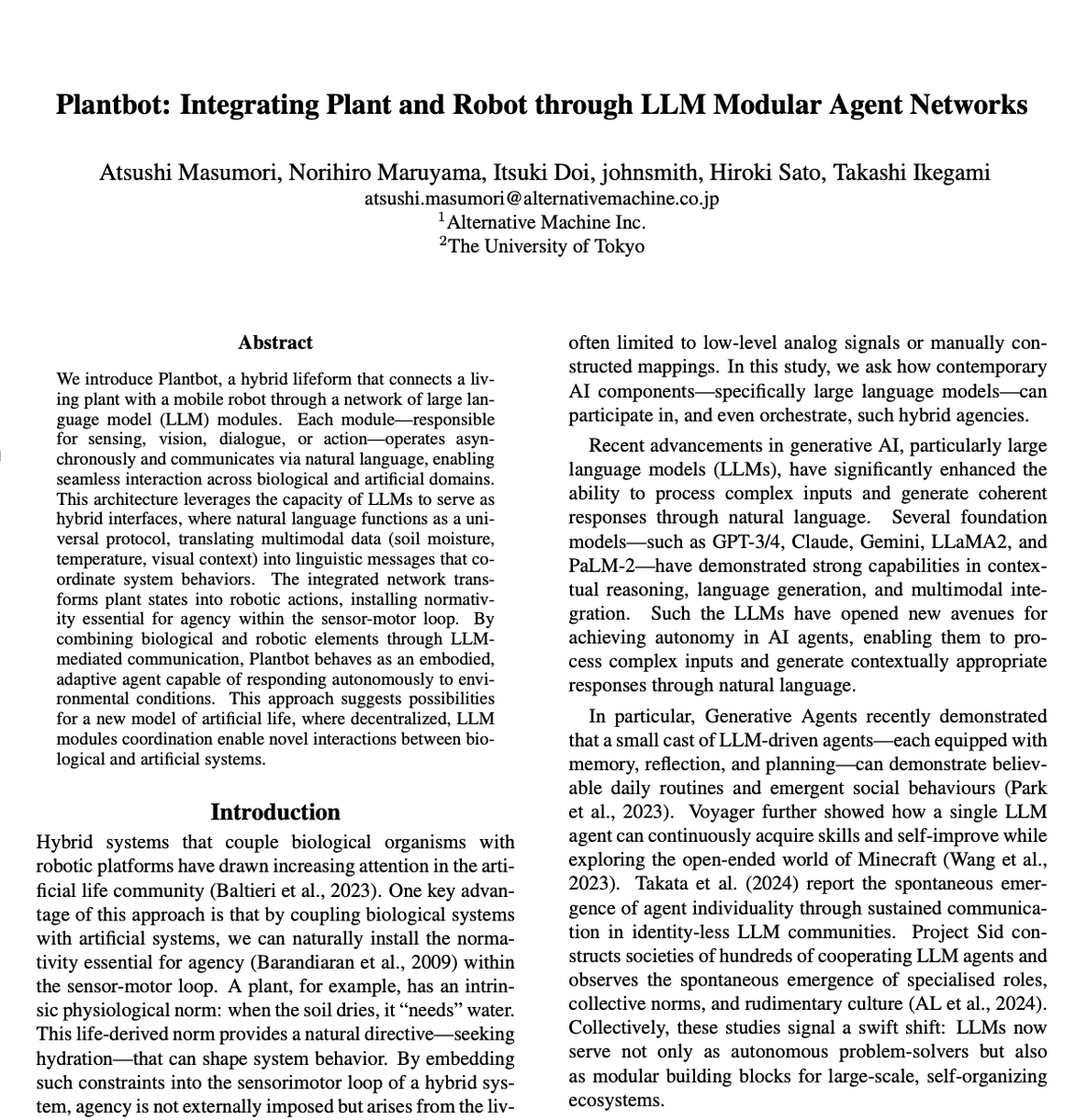
Researchers connected a living plant to a robot.. and it can now talks, walks, and knows what it wants.
They call it “PlantBot”
They took a living plant and fused it with a mobile robotic body.
To connect them, they used a decentralized network of LLMs to act as the central nervous system.
Here is the genius of it:
Biological organisms and machines operate on entirely different planes. Historically, bridging them required rigid, low-level analog signal mapping.
This paper entirely abandons that approach.
Instead of hard-coding signals, the system translates everything, soil moisture, pH levels, temperature, and visual data, directly into natural language.
The plant doesn’t just output data. It uses LLMs to "talk" to its robotic body.
The architecture is wild:
• A network of AI agents operates asynchronously to handle vision, sensing, and movement.
• Multi-channel probes read the plant's health, while LiDAR and cameras scan the room.
• The LLM translates these biological needs into physical actions in real-time.
• The plant actually interacts with humans and navigates the world as a cohesive, autonomous entity.
The LLM is no longer just a chatbot.
It is a biological-mechanical translator.
By mediating communication through natural language, they gave a houseplant autonomous agency in the physical world.
We’ve been obsessing over AIs trapped in servers or humanoid robots mimicking people.
We completely missed the possibility that AI might become the connective tissue bridging organic life and machines.
The next era of artificial life won’t just be silicon.
It’s going to be a hybrid.
FORTRESS: The Pentagon is preparing every major U.S. military base to survive 90 days without outside support — no civilian power grid, no global supply chains, no outside fuel or water.
The initiative, revealed in documents reviewed by Fox News Digital, envisions portable nuclear reactors, massive battery storage, and microgrids that can disconnect installations from civilian electricity entirely. Strategic reserves of munitions, fuel, critical minerals, and medical supplies would be stockpiled based on wartime consumption rates. Civilian factories are being pre-identified to shift to defense production during a crisis.
Pentagon chief spokesperson Sean Parnell put it bluntly: "Power is combat now. Without electricity, you lose communications, water, logistics, assembly lines and just basic military command structures."
Full story here https://t.co/WQWWi4wGrd
They fried a Japanese online brokerage.
There was a good Tom Clancy novel where they rewound the stock market by 3 days. Govts are powerful and real money lives in a database where you can reverse what happened.
@TheShmanuel It's ready to go. Has been for probably two weeks now. They don't launch it yet because they are winning without it. The longer they keep it internal, the bigger the advantage. Tibo said the time OAI kept Astra internal was the biggest advantage they ever had on development.
@AAMortazavi Taste and creativity. Something happened in September with the new internal Fable/Mythos, and that was passed down to Opus 5.5 because they trained it.
@AndrewCurran_ Narrow ASIs typically focused on sci/tech research. Gathering and analyzing raw data and running multitudes of experiments which can’t simply be modeled in silico.
We’ll see where it goes.
https://t.co/B0HINqbFqB
@mentalgeorge@anton_d_leicht I just explained how it's hypothetically possible for a small number of players to potentially catch up with the frontier labs, but it's an incredibly narrow window and extremely tough to do.
I argue that Midjourney may develop a narrow ASI for biotech.
https://t.co/x1pX4lj9Wm
@AndrewCurran_ Right now, though, every frontier lab is a black box.
Even given the presumed inference and talent requirements to stand up a frontier lab without immense distillation, we don’t even know how many players are in this game.
Too many have taken the advice to build a narrow ASI.