This week, we hosted Dr. @claudiagentile_ and colleagues from @DanaFarber Cancer Institute and @harvardmed for an online seminar.
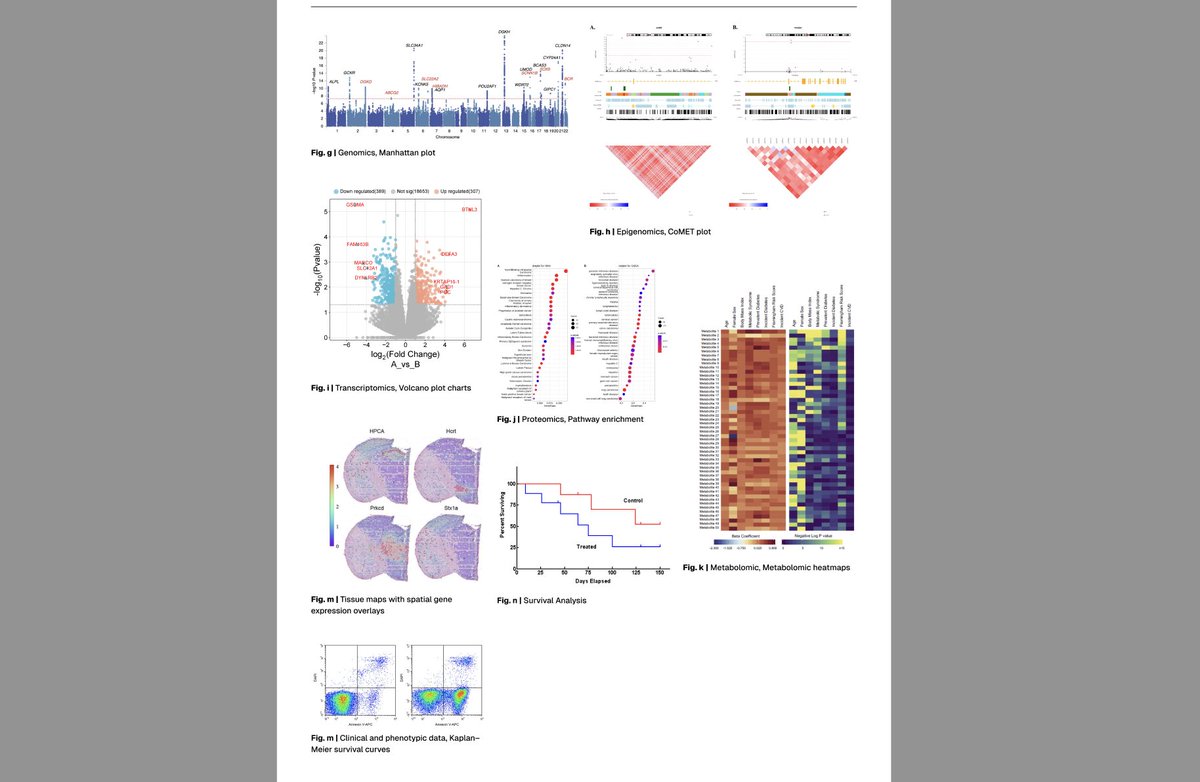
We reanalyzed data from Desanlis et al., 2020 (@Nature Communications) to demonstrate how Drylab supports epigenomics workflows.
Thanks Dr. Gentile for making this happen!
Use case → https://t.co/e2LbmKzow3
Try Drylab→ https://t.co/eOHcmexuFQ
Is your insight truly novel? Our Literature Double-Check compares your results with published studies in real time.
Example Chat here: https://t.co/4lP94dWFy4
➤Try on Drylab: https://t.co/Bk3Nam7x3m
#Drylab#LiteratureDoubleCheck#ResearchValidation#Bioinformatics
#AIforScience
#ComputationalBiology
The official CellRank protocol has just been published in @Nature Protocols!(https://t.co/j6ITF2L1vd)
CellRank has set a strong standard for modeling cell fate trajectories in single-cell data. But reproducing these workflows often requires hours of environment setup and troubleshooting.
We tested how quick and accurate we could replicate a pancreatic endocrinogenesis analysis.
After calling '@' Cellrank in Drylab, key outputs: mRNA trends, RNA velocity streams, and latent time were generated in 20 minutes.
Full chat workflow: https://t.co/Xg929yDUEB
#SingleCell #scRNAseq #CellRank #ComputationalBiology #Bioinformatics
We added a small, but genuinely useful feature in Drylab Updates 3.0: You can now design figures by dropping a style reference from any paper or journal directly into the chatbox.
Drylab applies that visual style to your own results. That means less time formatting, more time sharing the science.
More updates coming this week!
➤Try on Drylab: https://t.co/eOHcmexuFQ
➤Try on Drylab Desktop App: https://t.co/xci273eyRt
AI-enabled Molecular Stratification in Metastatic Breast Cancer 🧬
By integrating gene expression, clinical metadata, and Drylab AI Analysis, researchers identify prognostic signals 14× faster, with full reproducibility and transparent code.
https://t.co/0IQmIdmUdt
➤View Full Chat Conversation Here: https://t.co/uERLs9nEfi
➤Try Spatial Transcriptomics on Drylab Desktop App to preserve data locality Here: https://t.co/DCn72I9viV
Drylab AI in Spatial Transcriptomics
NTU researchers used Drylab to
- Run spatial clustering
- Compare HC vs SOR-trained mouse brains
- Finish end-to-end analysis in 20 minutes
What stood out wasn’t dramatic brain rewiring, but subtle, training-associated compositional shifts.
Scientific data belongs where it was generated.
Drylab Desktop App makes it real, for the first time in life-sciences AI.
Zero upload. Zero exposure. Built for terabytes.
Now Available on macOS. Windows. Linux. https://t.co/DCn72I9viV
We asked Drylab to help design protocols.
It said: “Sure, I’ve read 10,000 papers.” Now it’s suggesting steps, optimizing workflows, checking what’s in your lab fridge, and politely pretending your spreadsheets make sense.
🧪 https://t.co/hwdKoE7nDW
Yes! Each workflow includes a built-in code environment (so you can start without downloading R/RStudio), with transparent code and version control. We're also adding a shareable environment feature to ensure reproducibility.
Drylab creates custom analysis plans based on your prompts and raw data. Unlike generic AI, it's trained on biological datasets and workflows, making it better at understanding real research. You’ll always review and co-edit the plan before it runs.