1/ With NASA's Roman Space Telescope launch 🚀 in T-20 days and our official team jerseys in hand, this is the perfect timing to congratulate my PhD student, @rujutapurohit, on her first-first author paper 🎉
Paper: https://t.co/VLz1BgVFyH
Roman Hype: https://t.co/vXBTAP44sW
So the dramatic gain in precision comes from assuming the reconstructed peculiar velocities are known with very little uncertainty. Would be good to propagate the full M25 ensemble, not just its mean corrections, including covariance, residual small-scale velocity dispersion, and selection.
The original MCP analysis, using the 2M++ peculiar-velocity model, gave H0 = 71.8 ± 2.7. Switching to M25 lowers the central value to ~69.7 +/- 2.6, not such a dramatic change. But allowing σv to vanish drives H0 lower and crucially the uncertainty down to ±0.9 km/s/Mpc, roughly 3× more precise than the original megamaser determination.
The paper then concludes that this suggests the Hubble tension may arise from an unidentified systematic in the distance ladder rather than new physics. Conclusion is roughly: six spatially correlated masers + a velocity model whose uncertainty has been dramatically compressed → a ~2σ difference with H0DN → evidence that the cross-checked distance ladder has an unidentified systematic?
.
Leaving out those posteriors and external information leaves little leverage on σv, and its driven toward ~0 km/s, which just can't be. The weights of the masers change dramatically, so that even nearby NGC 4258 itself, just outside the Local Group at ~7.6 Mpc away where peculiar velocity is usually considered a large fraction of the Hubble flow, is claimed to measure H0 very precisely.
M25 doesn’t just give one peculiar velocity per galaxy. It uses constrained realizations to provide uncertainty and covariance in the reconstructed velocity field, which should be propagated into maser analysis. Instead, the paper uses only the central values and replaces all the rest of the information with a single independent velocity dispersion, σv, inferred from just these 6 masers.
New H0 paper https://t.co/kMoUbmrSnV which applies sophisticated Manticore (M25) peculiar-velocity reconstruction to the 6 megamaser galaxies from the MCP (P20). Important idea, but leaves out what makes M25 powerful.
@WKCosmo Ok, I may not be following, but just for record, the three supernova analyses use a ton of the same data (particularly at low redshift), so they absolutely should not be combined. That would be super bad.
Understood. "This implicitly assumes that the systematic offsets between the different measurements are zero, which is an absurd assumption" - I agree with this sentence. Its so absurd, I don't even know who would say this, cause it's definitely not the supernova people whose data this assumption is about.
Who is assuming that? The SN datasets absolutely have systematics and also have a lot of covariance (not independent). I was pleased with the level of small differences of SN datasets when DESI first looked, and even more pleased after latest rounds of SN re-analyses (e.g. Dovekie). This signal with CMB+BAO is 2.5-3.5sigma. Hubble Tension is at 7sigma and still people are like "Lets wait and see." I don't see SNe people shouting from rooftops about evolving dark energy. There is clearly more work to be done.
Had a group goodbye dinner for @space_veggie before they go off and become fancy NASA Goddard scientist. Lauren is leading our supernova photometry pipeline for @NASARoman and will continue this work at Goddard.
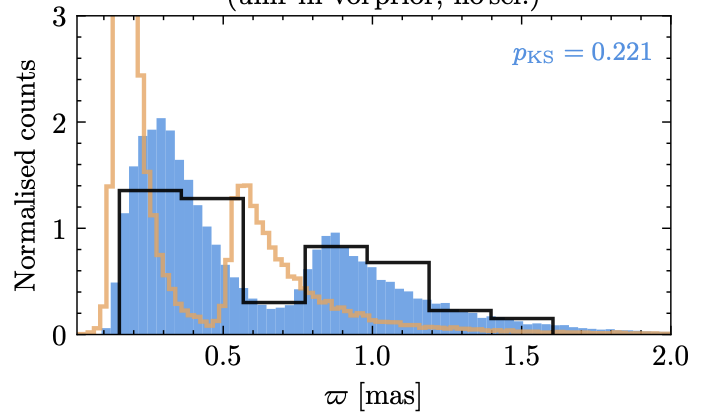
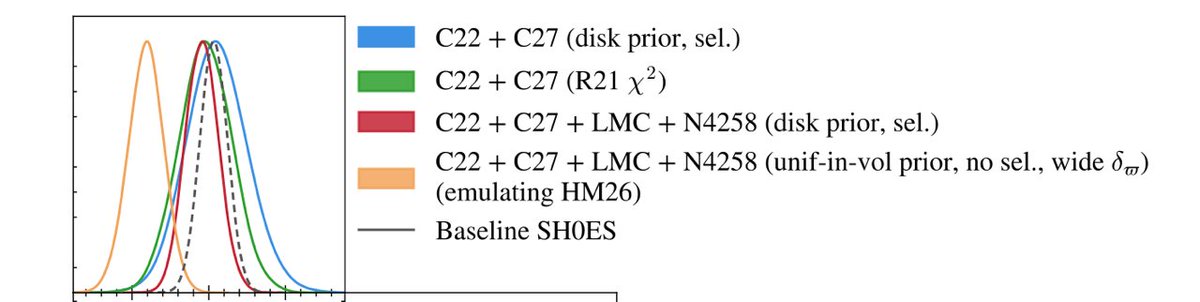
When the model includes the actual selection functions and a realistic MW disk prior, the forward model reproduces the observed distributions (heavy black) and yields the same calibration as SH0ES. Bonus insight shown in the paper: because the Cepheid PL relation is very tight, Bayesian and frequentist approaches agree as long as the prior isn’t in strong conflict with the data.
Really impressive H0-related paper by Richard Stiskalek et al. https://t.co/xMyCLL2VHA to make full Bayesian forward model of the Milky Way Gaia+HST Cepheid sample—periods, parallaxes, magnitudes, MW disk geometry, and survey selection all modeled together.
Key: Bayesian model must reproduce the data. A recent reanalysis (HM26) that lowered H₀ modeled the MW disk as a sphere and ignored selection, pushing Cepheids farther away. With a realistic disk + selection, the Cepheid calibration and the Hubble tension remain. Thread.
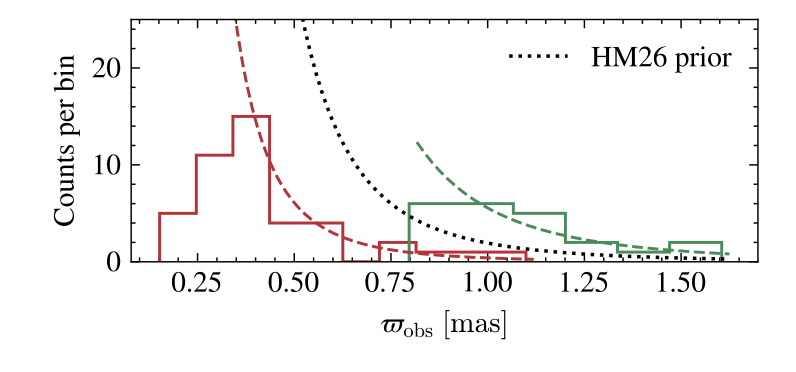
The issue is visible in Fig. 1.
The dashed curves show the parallax distribution expected if MW Cepheids followed a single uniform-in-volume (spherical) prior without selection.
But the observed Cepheids (two samples, red and green, with different selection functions) clearly don’t look like that, they live in the Galactic disk and are shaped by survey selection (closer, less extinction).
If the prior + selection don’t reproduce the observed distributions, the inference gets biased.
It was great to join @DukeU's SPACE Initiative to discuss the importance of bolstering STEM education and innovation.
As the Ranking Member of the Space & Aeronautics Subcommittee, I am grateful to see our local universities taking steps to support these educational initiatives in the face of Trump's funding cuts.
Duke’s @michaeltroxel received NASA’s Exceptional Public Achievement Medal for leading the OpenUniverse 2024 simulations--one of the most detailed synthetic views of the cosmos ever made. Congratulations!🔭✨
Read more: https://t.co/HQD1XQZy2B