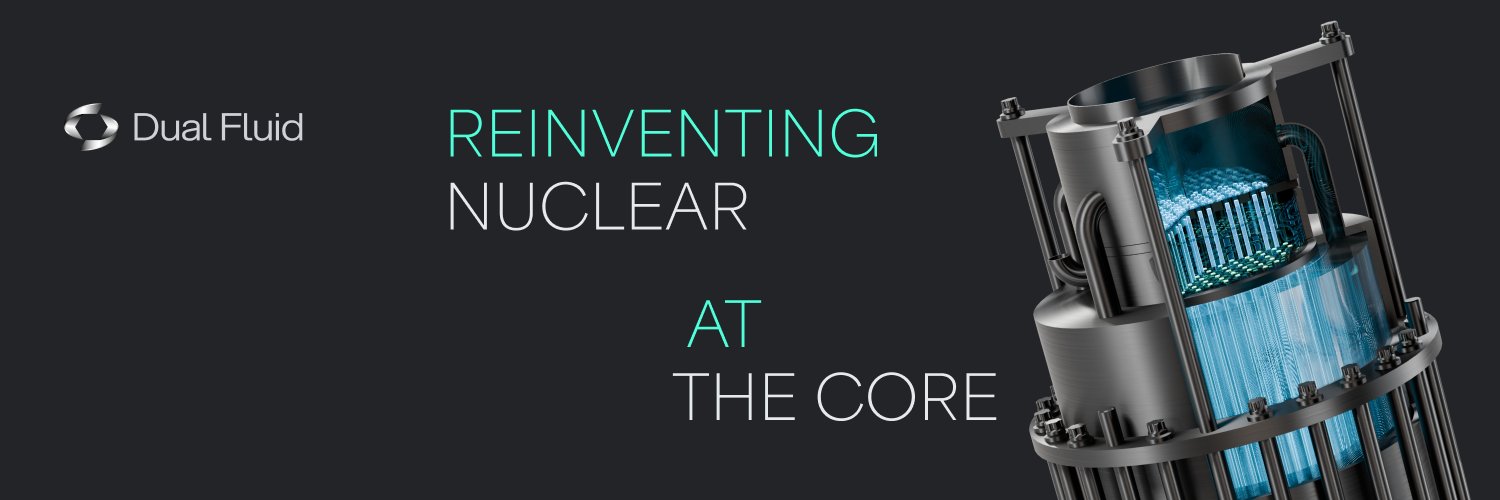
The world’s most efficient nuclear reactor.
The only true Generation V design.
German engineered for unmatched power — and a fuel cycle that ends nuclear waste.
@Bjoern_Peters@handelsblatt Die 200 Millionen Euro sind wohl die Garantie vor Kapitalverlust. Von Fördermittel hat sie in diesem Zusammenhang jedoch nicht gesprochen.
€200 million won't win the nuclear technology race
“Purely symbolic policy.”
That is how Dual Fluid CEO Dr. Götz Ruprecht described the EU’s newly announced €200 million support for small modular reactors (SMRs), as quoted in @handelsblatt (link below).
The reason is scale. Developing SMR nuclear technologies does not cost hundreds of millions – it costs tens of billions. And globally, the race is already well underway: the United States is investing heavily in advanced reactor programs and commercialization. The UK alone has committed multi-billion funding to build a domestic SMR industry. China is already deploying new reactor technologies at industrial pace. And France alone has launched a €1 billion program for next-generation reactors, including significant funding for SMR development.
In this global competition, Europe has world-class engineering, but it must match that with strategic investment and industrial ambition instead of symbolic policy.
At Dual Fluid, we are working on the world’s only Generation V reactor concept currently in development: the Dual Fluid Reactor. Our technology separates liquid fuel from liquid metal coolant, enabling:
⚡ higher fuel efficiency than any other nuclear reactor technology approaching 100%
♻️ the ability to consume existing nuclear waste as fuel
🛡️ inherent safety characteristics due to its simple design
📈 unmatched competitive baseload energy for a decarbonized economy (<2 ct/kWh)
At the same time, the project is progressing toward real-world deployment. In Rwanda, the first design approval was granted for the Critical Demonstration Reactor, the site license is on its way and Australia’s Nuclear Science and Technology Organisation (@ANSTO) successfully finished the first step of Dual Fluid’s patented novel liquid metal fuel production.
The global momentum behind nuclear energy is accelerating. Europe has the scientific foundations, but it requires full commitment from politics and investors. The next step is turning that potential into industrial leadership.
The full article (in German) is available in Handelsblatt behind the paywall: https://t.co/X0QiCGMvMv
Laut der Zusammenfassung auf @golem erzeugen SMR 3× so teuren Strom pro kWh wie große AKWs und bräuchten zigtausende Einheiten für echte Skaleneffekte. Gut, dass #DualFluid kein klassisches SMR ist, sondern ein schneller Flüssigmetall-Reaktor mit völlig anderen Wirtschaftstreibern. Unsere kWh kostet <2,7 ct.
Zum Vergleich: Die Energiewende kostet Deutschland >80 Mrd €/Jahr, treibt Strompreise hoch, schafft Abhängigkeiten und erzeugt Sondermüll. Dual Fluid recycelt Atommüll als Brennstoff und löst damit praktisch die Endlagerproblematik.
According to @golem, conventional SMRs produce electricity three times more expensive per kWh than large nuclear plants and would require tens of thousands of units to achieve meaningful economies of scale — a limitation of current modular reactor designs.
#DualFluid is fundamentally different. It’s not an ordinary SMR but a fast liquid-metal reactor, starting at 300 MW and scaling up to 1.5–30 GW, designed for maximum power density and industrial scalability. Its dual-fluid core separates fuel and coolant, enabling operation at ~1000 °C, fully utilizing nuclear fuel and producing ultra-low-cost electricity — as low as 2.7 cents per kWh for the first reactors, with further reductions as larger units are deployed.
What makes Dual Fluid transformative is its ability to provide continuous, abundant, and flexible energy for industrial-scale applications.
The reactors can produce high-temperature heat suitable for hydrogen production, synthetic fuels, and energy-intensive industrial processes. They can power gigafactories, large data centers, or entire cities continuously, while remaining walk-away safe and emission-free. A single DF‑300 unit can supply a gigafactory or data centers 24/7 for decades, a DF‑1500 can cover the electricity needs of Manhattan, and a DF‑30G can generate enough synthetic fuel to power all transportation in a region like New York City — completely emission-free.
A key innovation is the recycling of nuclear waste via a pyroprocessing method, allowing the use of virtually any fissionable material and drastically reducing the volume and lifetime of radioactive waste. This system makes geological waste storage unnecessary and establishes a circular nuclear fuel economy.
With these capabilities, Dual Fluid is more than cheap power — it’s a platform for industrial transformation. It enables the large-scale production of hydrogen and synthetic fuels, ultra-high-temperature heat for chemical, cement, and material industries, reliable energy for data-intensive operations, and sustainable synthetic fuel for transport. Its compact, scalable, and safe design makes it adaptable to multiple industrial needs, creating the foundation for a 21st-century Industrial Revolution powered by abundant, low-cost, emission-free energy.
In comparison, Germany’s current "green energy transition" costs over €80 billion per year, drives up electricity prices, and creates dependencies. Dual Fluid offers scalable, reliable, and fully decarbonized energy infrastructure, unlocking new industries, unmatched efficiency gains, and opportunities for true technological innovation.
https://t.co/6TSFinkg5E
@nnzp1730@gbponz@vtchakarova@grok We offer the world’s first and only Generation V nuclear reactor. 1 kWh costs less than 2.7 cents. It is walk-away safe and recycles nuclear waste as fuel. The secret? A very simple design with a liquid metal core. Learn more on our website.
@kokoloresklausi@elonmusk Yes. We are the first and only Generation V nuclear reactor. < 2,7 cts/kWh is unique. Plus we are walk-away safe. Plus we can use nuclear waste as fuel.
@toddcheck@BurgerleinWatch Wir laden Sie gerne ein, sich mit dem Dual Fluid Reaktor auseinanderzusetzen. Der CDR wird in Ruanda gebaut. Der Preis liegt bei unter 2,7 ct/kWh. Die nuklearen Reststoffe können wir als Brennstoff wiederverwerten und damit die Endlagerproblematik faktisch lösen.
In 2013, our #DualFluid had been chosen by the public as a finalist for the German GreenTec environmental award for its potential to produce clean energy and reduce long-lived nuclear waste was quietly removed - simply because it did not fit the anti-nuclear ideology of the jury. Instead of debating our potential to provide clean energy and reduce nuclear waste, the organizers changed the rules and quietly made the reactor “disappear” to avoid legitimizing advanced nuclear technology.
The clear signal from Davos 2026: Nuclear energy is the future
The @wef in Davos 2026 sends an unmistakable message: Affordable, reliable energy is the foundation of prosperity, industry, and global technological leadership.
At Davos, the President @POTUS Donald J. Trump made it clear that he was once skeptical of nuclear energy but today recognizes it as safe and economically viable. Affordable and reliable energy is the decisive competitive advantage of the digital age. Those who fail to deliver it will lose markets, competitiveness, and technological sovereignty.
Dual Fluid delivers exactly what Davos 2026 calls for—as the world’s first and only Generation V reactor:
📷 Inherently safe technology – physically stable, with no risk of core meltdown
📷 Electricity costs below 2 ct/kWh – a decisive advantage for industry, AI, and digitalization
📷 Use of nuclear waste as fuel – turning waste into a resource
While other countries are actively securing future markets, Germany remains stuck in stagnation and outdated thinking. This was also evident in the speech by German Federal Chancellor @bundeskanzler Friedrich Merz in Davos: to reduce energy costs, he continues to rely on renewables, energy storage systems that do not yet exist, and expensive gas-fired power plants that are unlikely to come online for at least another decade. The phase-out of nuclear energy, he stated, is final.
With this fundamental policy stance, Germany will not regain competitiveness. Dual Fluid offers the opportunity to transform what has been called the world’s “most expensive and dumbest energy policy” (Wall Street Journal, January 29, 2019) into the smartest and most affordable energy transition in the world.
This is where the future locations of AI and hydrogen production will be decided. Dual Fluid is ready!
1. https://t.co/5DwCyiycH4
2. https://t.co/t5vFDny2IC
@GovNuclear Generation V - Dual Fluid. It's designed to use ~99% of nuclear fuel instead of the ~1% used in conventional reactors and delivers clean, safe energy for under 2¢/kWh.
Der Bundeskanzler hat die Diagnose gestellt. Dual Fluid ist bereit. (English version below 🇬🇧)
„Es war eben ein schwerer strategischer Fehler, aus der Kernenergie auszusteigen.“
Diese Aussage des Bundeskanzlers beim Neujahrsempfang der IHK Halle-Dessau und der Handwerkskammer Halle – vor Unternehmern, Mittelstand und Industrie – wurde mit starkem Applaus aufgenommen. Sie bringt das energiepolitische Kernproblem des Industriestandorts Deutschland auf den Punkt.
Die Konsequenz aus einem „schweren strategischen Fehler“ kann nicht sein, alte Technologien zu verlängern oder neue fossile Kraftwerke zu planen, die erst in zehn Jahren verfügbar sind - insbesondere vor dem Hintergrund, dass Dual Fluid für die vollständige Entwicklung zur Marktreife selbst deutlich weniger als zehn Jahren braucht. Notwendig ist eine technologische Neuausrichtung, die Energiesouveränität, Wettbewerbsfähigkeit und Zukunftsfähigkeit gleichzeitig sichert, insbesondere angesichts des stark wachsenden Energiebedarfs durch KI und der geopolitischen Entwicklungen. Auch synthetische Kraftstoffe lassen sich mit Dual Fluid besonders kostengünstig herstellen. Ihre Produktion ist selbst unter dem geltenden Atomausstieg im Rahmen des bestehenden Atomgesetzes rechtlich zulässig.
Mit dem Dual-Fluid-Reaktor steht heute eine solche Neuentwicklung real zur Verfügung: ein inhärent sicherer Reaktor, Stromkosten unter 2 ct/kWh, die Verwertung nuklearer Reststoffe als Brennstoff – und damit eine technologische Lösung der Endlagerproblematik. Der Reaktor ist ready to build; die Site License für den Demonstrationsreaktor in Ruanda wird in wenigen Wochen erwartet.
Rechtlich ist der Weg klar. Das gegenwärtig gültige Atomgesetz verbietet zwar die kommerzielle Stromerzeugung aus Kernspaltung im Inland, nicht jedoch Entwicklung, Bau und Export moderner Kerntechnologie. Deutschland kann damit vollständig legal industrielle Kernkompetenz aufbauen, Wertschöpfung sichern und bei einer Korrektur dieses schweren strategischen Fehlers selbst von günstigster Energie profitieren.
Aus der richtigen Diagnose des Bundeskanzlers folgt ein politischer Auftrag: moderne Kerntechnologie der V. Generation ermöglichen, statt sie auszublenden. Dual Fluid ist bereit.
https://t.co/ncNzpHEiXa
——————————————
The German Chancellor has made the diagnosis. Dual Fluid is ready.
“It was, quite simply, a serious strategic mistake to phase out nuclear energy.”
This statement by the German Chancellor at the New Year’s reception of the Halle-Dessau Chamber of Industry and Commerce and the Halle Chamber of Crafts — addressed to entrepreneurs, small and medium-sized businesses, and industry — was met with strong applause. It succinctly captures the core energy-policy problem facing Germany as an industrial location.
The consequence of a “serious strategic mistake” cannot be to extend legacy technologies or to plan new fossil-fuel power plants that will not become available for another ten years — especially given that Dual Fluid requires significantly less than ten years to complete full development to market readiness. What is required instead is a technological realignment that simultaneously secures energy sovereignty, competitiveness, and long-term viability, particularly in light of rapidly growing energy demand driven by AI and ongoing geopolitical developments. Synthetic fuels can also be produced particularly cost-effectively using Dual Fluid technology. Their production is legally permissible under the existing Atomic Energy Act, even within the framework of the current nuclear phase-out.
With the Dual-Fluid Reactor, such a new development is already realistically available today: an inherently safe reactor, electricity costs below 3 cents per kWh, the use of nuclear waste as fuel — and thus a technological solution to the nuclear waste disposal problem. The reactor is ready to build; the site license for the demonstration reactor in Rwanda is expected within a few weeks.
From a legal perspective, the path forward is clear. While the currently applicable Atomic Energy Act prohibits the commercial generation of electricity from nuclear fission within Germany, it does not prohibit the development, construction, or export of modern nuclear technology. Germany can therefore, fully legally, build industrial nuclear expertise, secure value creation, and — once this serious strategic mistake is corrected — benefit itself from the lowest-cost energy.
From the German Chancellor’s correct diagnosis follows a political mandate: enable modern fifth-generation nuclear technology instead of ignoring it. Dual Fluid is ready.
https://t.co/QZMp8GMgEc
@NoahRettberg@RareNotion@CSU@Markus_Soeder Wir laden Sie herzlich dazu ein, sich mit dem Dual Fluid Reaktor auseinanderzusetzen, sich auf den aktuellen Stand bringen zu lassen und Fakten statt persönlicher Angriffe Raum zu geben.
@NoahRettberg@CSU@Markus_Soeder Da wir jegliche substanzielle Kritik jenseits von persönlichen Angriffen in Ihrem Post vermissen, laden wir Sie gerne zu einem Austausch fundierter Argumente ein - gerne auch öffentlich. Wir freuen uns!
@Glitchymagic@GovNuclear Energy density is exactly the point. The Dual Fluid reactor (the only Gen V reactor worldwide) is designed to utilize around 99% of nuclear fuel, compared to roughly 1% in today’s reactors, enabling massive clean power with minimal material footprint.