@TheStalwart The main thing I've learned as a programmer leaning heavily into AI tools is that programming is SO MUCH MORE than just writing code - and while I can get amazing results out of the AI it's taking every inch of my 25+ years of software experience
This song has a similar story concept, except the traveler comes back 100 years later when only one year has passed on Earth. His wife has long since passed but he meets his (daughter or granddaughter?) and sings “your mother’s eyes, from your eyes, cry to me.” https://t.co/PZRMtACHqd
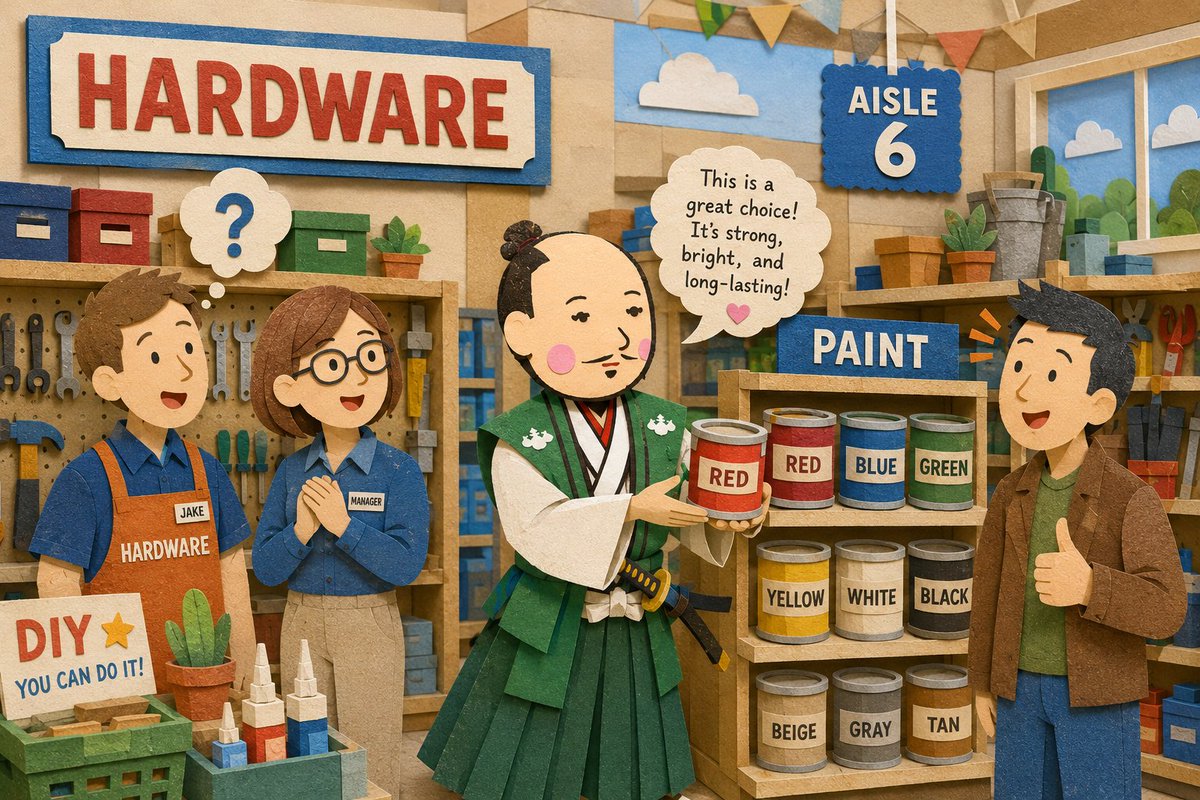
The man at the hardware store called me "boss."
I do not work there. I want to be clear about that from the beginning, because of what followed.
I had only asked where the nails were. He pointed and said, "aisle six, boss."
Boss.
I stood very still. A title is not given lightly. In my country, to be named the head of a house is a ceremony that takes a full day and three witnesses. This man had done it in half a second, over nails, and walked away.
But done is done. I had been appointed. I would not dishonor the appointment.
So I assumed my duties.
I began arriving early. I learned where everything was. When a customer looked lost, I guided them, because a boss does not abandon his people. When two boxes fell, I restacked them. When a child cried, I gave the child a small respectful nod, and the child stopped, because authority comforts.
A real employee found me straightening the paint cans. He asked what I was doing. I told him, simply, "my job."
He called his manager. The manager arrived. I bowed and prepared to receive my first performance review.
The manager said, "Sir, you can't be back here."
I understood. A new boss must earn trust. I accepted the demotion with grace. I returned to the floor and continued serving the people, now from a humbler station, which only deepened my resolve.
By closing time I had helped forty customers, reunited a man with the correct drill bit, and been thanked, by name, as "boss," four more times.
Four more appointments. I now hold five titles at a store that does not employ me.
A weaker man might find this confusing.
I find it an honor I never asked for, and cannot return, so I have simply decided to be worthy of it.
The manager walked me out gently and said, "have a good one, chief."
Chief.
I stopped at the door.
That is a promotion.
So I will be back tomorrow. Earlier. There is clearly a path here for a man willing to work, and I intend to climb it, one kind stranger's word at a time, until I have earned every title this generous country keeps handing me for free.
I do not know what I am the boss of.
But I will protect it with my life.
Anthropic is questioning whether AI may turn out to be altogether useless. This is the single most honest thing Anthropic has ever written.
“But achieving recursive improvement alone does not suggest an immediate change in how industrial production occurs, societies organize, or markets function. More intelligence can’t learn what a drug does over decades of use, can’t hold elections sooner than a constitution dictates, and can’t turn a stranger into an old friend in a weekend. For most people, the felt pace of this future will still be set by the bottlenecks, even if the laboratory upstream runs at the speed of compute. That collision, where recursive intelligence building itself ever faster meets the world of humans, relationships, and governance, is another part of this future we can’t predict.”
Let me give some "behind the scenes" as to why AI ROI is so elusive. Even if the AI works, you have to navigate the "Seven Gates of Software Hell".
I ran AI for a company that managed a huge portion of the world's communications data for financial services companies. This is an excruciating read but the realities are tough.
Let's get started. Suppose you want to scan all of your communications for customer complaints and respond quickly. Here's your journey:
Gate 1: Data Controls
Various geographies require the data to be stored in-region, and in some cases, only accessed in-region. You may need separate AI deployments for each one.
The data may need to be scrubbed for PHI/PII and will need to be scrubbed for Material Non-Public Information. If it leaves the System of Record you'll need to ensure there is a way to selectively delete data so that you can adhere to GDPR, CCPA or PIPL.
Gate 2: Data Quality
Even if you get controls in place, you discover that your data is coming from 8 different vendors. Some are real-time, others T+1 and they all have different APIs. To boot, your corporate directory has 4 identities for Brandon Carl that have never been merged so you can't properly query even a single person's data.
Gate 3: Security + Controls
Given the sensitivity of the data you're sending, you'll need to go through an extensive security audit. Since this is an LLM you'll need to look beyond SOC2 and into OWASP Top 10 LLM risks and Gen AI risks too.
Gate 4: SLAs
Your AI Agent calls are taxing your system with bursty volumes and risking your mission-critical production workloads. You may need to set up read-only replicas, throttling and overage billing.
Gate 5: Vendor Risk
Your vendor will be assessed for their financial viability as well as the controls they put in place. This may go as far as analyzing the vendor's software development processes.
Gate 6: Legal + Procurement
You've almost made it, but procurement needs to demonstrate that they are saving the firm money. Negotiations come down to the end of the quarter. Redlines are flying everywhere to meet your firm's AI policies and to ensure there's no training on your data.
Gate 7: Model Governance
The AI/ML models need to be assessed versus your firm's Responsible AI Policy. And if you're going to automate things get really tricky. The model needs to be assessed for Materiality, Autonomy and Complexity. You may need documented evaluations, extensive model documentation and champion challenger comparisons performed by your own internal AI teams.
–––
You've made it this far, congratulations!
While you've been working through the "7 Gates of Hell" you've had to manage a team of workers you know you're going to fire to justify the AI spend. This requires coordination with HR, one-time separation costs and managing team morale for those employees that stay.
Thanks @emollick for posing the question. Also see https://t.co/ISNlNgDfvH
I really believed a whole generation of developers, who only know open source from npm and pypi, miss how open source actually used to work.
When Debian or a Linux distribution ships a dependency they take responsibility of it. If there is a security issue and it’s not fixed by the developer upstream, they fix it for their users.
Debian and others basically vendor every thing they distribute. They honor the license and they maintain patches. Most of the stuff that you get from your Linux distribution is basically a (small) fork.
The same is true for Apple, Microsoft and others. The open source software they ship, they carry that responsibility.
That doesn’t mean that security fixes are not upstreamed, but Apple or Debian or anyone else won’t jump in Twitter to shame a developer into compliance with their ways. They are not dependent on the health of a packaging infrastructure. They own their software including all the things it depends on.
I want that thinking back. Because it fundamentally makes people feel more responsibility and it shares the burden of issues. It also does not put so much focus and attention on the one overworked developer who just happened to have too much of the world depend on their library. Remember: they carry a responsibility they never signed up to and they never got compensated for.
Notes on 100+ Recent Technical Interviews
I interview a ton of engineers. Recruiting is the single most important technical CEO activity. Here are a bunch of impressions
1. There is a severe ZIRP engineering overhang that is currently washing out. They're getting laid off, managed out, etc. after having been massively overhired around 2020-2022. This is worst for Tier-2 big tech (think PayPal, Bill, etc.) but also FAANGs. These are overwhelmingly bad engineers.
2. This flood of unqualified but good-on-paper candidates makes this the hardest SF hiring market I have ever seen, due to the amount of nominally strong-looking candidates that you need to grind through.
3. I am highly skeptical of "AI as a cause for engineering layoffs". I think this is a large-scale polite fiction -- the companies don't want to admit they overhired, the engineers don't want to admit they are bad at their jobs. Everyone's blaming AI when it's really just the market rectifying itself.
4. Many of these engineers appear never to have had a real engineering function at their corporations. They're sitting in meetings, "making decisions about technology" but are unable to write software. I leave many interviews baffled by what exactly they were doing for so many years, let alone what their manager was doing.
5. I have interviewed some engineers from FAANG companies so shockingly nontechnical that I am forced to conclude that there is either (1) a lot of resume fraud going on or (2) that there are kickback grifts within those organizations -- people hiring their cousins and splitting the pay, that kind of thing. I have no other explanation.
6. There's a fun side-effect where after interviewing 20+ people from certain small but public companies, I actually feel like I am gaining a short sellers' advantage: there are financial technology companies out there that, knowing what I now know, I would never deposit a single dollar into.
8. Based on this "exhaust" data, and extrapolating a little bit, maybe aggressively so: I think folks like @pmarca are basically right when they say that ~every tech company is overstaffed by a factor of 2-4x. Whatever the reason -- staffing ahead of need, monopolizing certain engineer types (Google-style), headcount-driven promotion incentives, the reality is that a lot of these companies are not being run for the shareholders. The aggregate SBC expense is insane, and I expect this is going to get rectified eventually.
I'm sure that AI will play a role in rectifying this -- but I fear that people are going to blame AI for taking people's jobs when the reality is that the jobs were already long-gone, possibly always useless, but the highly-paid butts-in-seats remained. People will be mad at AI for taking away their lucrative sinecures. Maybe that's the same effect from a public policy perspective, but it feels different morally.
AI can now make you a great parent.
Introducing Ollie: the world’s first AI family assistant that manages your family life better than any human.
Here’s how it works:
42 years ago today I made a surprising discovery that every year has been showing us more and more about the answer to life, the universe and everything...
https://t.co/z1uA3RyxYF
My biggest takeaways from @benedictevans:
1. We’re in 1997 for AI—it’s as big a deal as the internet or mobile, and only as big a deal as the internet or mobile. We’re at the stage where most stuff kind of doesn’t work yet, most of what people will build hasn’t been built, and it’s not clear how any of it will work when it does. Some people in tech have bought clusters of Mac Minis, while even among 13-to-18-year-olds, only about 15% to 20% are daily active users of AI. The companies that win may not exist yet, and the use cases that matter most are probably invisible to us today.
2. Every technology wave brings ways to ruin people’s lives, deliberately or by accident, and we need to be conscious of that without panicking. Every wave of technology—databases in the 1970s, social media in the 2010s, AI today—creates new ways to harm people. We need to be conscious of these risks, build safeguards, and hold people accountable. But we also can’t let fear of potential harms stop us from capturing the benefits. The goal is thoughtful deployment, not paralysis.
3. Things will probably be okay—but “on average” hides a lot of individual pain. We’ve been automating jobs and creating new jobs since 1800. Each time, you can see the jobs that will disappear but not the new jobs, because they don’t exist yet. We go through frictional pain, dislocation, people lose jobs, towns get hollowed out, and it all sucks. But we come through richer, and we’re not worried about crops failing anymore.
4. If you’re worried about your job, the worst thing you can do is stick your head in the sand and declare AI evil. Yes, some professions face major questions, particularly if you’re an associate or would have been thinking about becoming one. The pyramid structure of professional services may fundamentally change. What helps is submerging yourself in AI, understanding what you can do with it, how it changes things, and how you can be a great hire in this new environment. That may still not be enough, but it’s the only path forward.
5. The history of accounting shows us how automation often increases employment rather than decreasing it. Despite adding machines, punch cards, mainframes, databases, ERP systems, cloud software, spreadsheets, and PCs, the number of accountants keeps going up. This is the Jevons paradox: when you make something cheaper or easier, you don’t do the same amount of work for less money. You often do vastly more because the ROI changes.
6. Distribution is becoming a more valuable moat as software gets easier to build, which favors incumbents. As AI makes building software cheaper and faster, the market gets noisier. More products launch, more companies compete for attention, and breaking through becomes harder. This means distribution—the ability to reach customers and get them to use your product—matters more than ever.
7. Foundation AI model companies won’t have lasting pricing power, and value will likely accrue up the stack. The models don’t seem to have network effects, so there’s no winner-takes-all dynamic. If you have indefinite competition between three to six foundation model providers, and the models look like undifferentiated commodities to users, why would anyone have pricing power? The current pricing chaos—people spending $1.5 million on inference in a month—is temporary disequilibrium, like someone getting a $50,000 mobile data bill in 2010. The steady state will look different.
8. OpenAI and Anthropic are buying consultancies and PE firms. This seems counterintuitive—aren’t these the companies that should need consultants least? But the reality is that companies don’t have people sitting around waiting to reimagine all their internal workflows and figure out which could be automated with AI. That’s a project requiring five to 10 people spending months working it out, then actually implementing it across vertical and horizontal systems.
9. The fundamental question isn’t whether AI automates your job—it’s whether your profession is a "task" or a job. Some jobs are just tasks, and when you automate the task, the job disappears (i.e. elevator attendants). But in most professions, the task you think you’re being paid for isn’t actually what you’re being paid for. McKinsey doesn’t get hired to produce a 75-slide deck—they get hired to walk through your enterprise, understand the politics, talk to customers, and figure out what you actually need to do. The deck is just the artifact.
10. The anti-AI backlash is real, and a fuzzy mass of different concerns, some real and some not—much like the social media backlash. There are tangible concerns: electricity bills went up in some places, though this applies to very few locations objectively. The water consumption issue is largely false; data centers use about 0.017% of U.S. water consumption. There are real questions about jobs, though economists can’t yet find clear consensus in the data about AI’s employment impact. There’s also the culture war over AI-generated content and “AI slop.” The challenge is that all of this creates political pressure even when the underlying facts are unclear or contested.
You haven't "confidentially submitted" a draft S-1 registration, you have (publicly) submitted a confidential registration. Come on, use @claudeai to proof-read your tweets!
Anthropic has confidentially submitted a draft S-1 registration statement to the Securities and Exchange Commission.
Pending completion of SEC review, this gives us the option to pursue an initial public offering.
Read more: https://t.co/onGZAhRLvD
Hello, we are Jonathan and Abigail - unashamed pedants who want to bring this affliction to bear on all things public policy and practice.
We believe that details matter, especially in public administration. This is why today we are founding quibble: a campaign to fix the small stuff.
Think, for example, about the cookie banner that we click on every webpage. Each instance is not a big deal, so we just put up with it. But its cumulative impact adds up - on average we press it 5 times per day. The European Commission estimates that it costs EU citizens 343 million hours per year.
And who is there to represent the impacts of seemingly minor issues like this in a systematic way? We want quibble to be the answer. In the case of the cookie banner, lots of advocacy has rightly focused on privacy, but has this meant that user experience has taken a backseat? We believe there are ways to improve user experience without compromising on privacy. We will share more about this soon.
Consider another example. Did you know that in some government-run car parks you can be fined for a minor keying error, such as accidentally typing a zero instead of an “o”? Again, we will come to the detail of this quibble in the coming weeks, but for now just consider again the question: who? Who is there currently to systematically represent the interests of the parker who is given an unfair ticket?
An inherent feature of consumer interests is that those who have them rarely have enough other things in common to make collective organisation and representation feasible. This is the gap that quibble seeks to fill. Now of course excellent consumer interest groups exist. But understandably quibbles might not be at the top of their lists. Our hope is that quibble will be complementary; picking up the bottom-of-the-list issues faced by various groups - the stuff they are almost too embarrassed to raise because they are too small.
We are not embarrassed about detail. If you’ve ever had a splinter, you know small things can have a big impact. This is what quibble is committed to tackling, and our wider hope is that by doing so we will also incentivise policy makers to be even more careful about detail.
Check out our website here, including our first four campaigns: https://t.co/gZiqqHbhIL
@anuroopk4u@pmarca Since the 1970s, many people who wanted housing to be more affordable supported rules that made it harder to build. The result was less housing, more scarcity, and higher prices. We made housing unaffordable in the name of affordability.
I mean, it's a good question. Why hasn't human civilization naturally developed into a brutal aristocracy of the highly moral and high-IQ? Why don't we have a global "130 IQ high-trust Anglo" paradise already?
What mysterious force obviously overcomes and beats intelligence?