Proud Nationalist.....Either Assimilate or FO ! Allergic to : Terrorism, Wokiesm, Psuedo-liberalism, Secularism, Multiculturalism, Lack of Common sense etc.
@IndiGo6E@IndiGo6E I have done as you suggested : cancelled the previous flight from riyadh and rebooked the next from Bahrain.
By when can we expect the FULL Refund including Cancellation and Convenience Fees as you promised ?
@IndiGo6E have emailed you multiple times to either rebook my flight (riyadh to del) from a different airport (bahrain-del) or give me a full refund. Also the app is showing refund of only 81k against 1.26L booking amount. Didnt u say FULL refund ? Why the partial amount?
Interesting. Hindu festivals are designed around the very things that psychologists have identified as essential for our happiness. https://t.co/aXeTJNFyKu
As an interiors architect, I have always disagreed with architects who dismiss verandahs in individual homes and apartments as ‘not cost-effective’.
That is one piece of feedback I have received repeatedly from clients over the years: the verandah may not show up as a line item that makes financial sense on a spreadsheet, but once they live with it, they understand its value. It becomes the space they sit in, read in, have their morning tea in and, importantly, the buffer between the outdoors and the conditioned interiors.
In office high-rises, I understand the widespread use of glass. It gives us light, views and a sense of openness. But in our climate, particularly across much of India, we can and should use architecture to work with the weather rather than simply seal ourselves away from it.
Deep overhangs, recessed windows, and intelligently designed sun-breakers can reduce heat gain while giving buildings something increasingly rare: spaces that allow people to experience the outdoors without being completely at its mercy.
Perhaps the real question is not whether these spaces are ‘cost-effective’, but whether we have become too accustomed to measuring architecture only by what it costs to build and not by what it gives back to the people who inhabit it.
Two groups of politicians are harming the country: those who back the protests on reservations and education, and those who stay silent due to their political compulsions..
Twenty or thirty years from now, long after Rahul Gandhi, Narendra Modi, and the rest who are busy taking sides are gone, this country will produce its first full batch of poorly educated graduates, if we let things slide the way they are.
People who talk easily about brain drain should first ask why it happens. Is it a weak education system, a lack of real opportunities, or an unfair examination process?
As a parent, I know the cost. I am still paying heavily for sending my son through some of the best institutions abroad. After Class 12 he sat for CET and other exams and saw despairingly what he was up against.
As a general-category student he had almost no chance of a medical college seat unless he scored in the 99.99 percentile. And often. not even then. He and his mother looked at private institutions in India and abroad. It meant handing our home and our future to the bank because otherwise on our meagre salaries and savings he didn’t stand a chance.
With help from his mother, he chose another subject that let him think and explore, and he loved it.
Once, on a short holiday at home, he said something that was both revealing and frustrating. In India, when he asked a professor during graduation why they were studying a topic, the answer was: “Because it is in the syllabus.”
In Europe, in the first year of his Master’s, he asked the same question. The professor told him to wait till the lecture ended. Then he sat him down and spent an hour explaining the reasons, the strengths, and the limits of what they were learning.
“I knew I had to unlearn most of what I did in college,” my son said. “The days of rote learning were over. And I never felt better.”
Circa 2026, I’m still working, a decade past my retirement age, to pay off the education loan. But it’s been worth it.
The IITs and IIMs produce the best brains in the country and the world. Don’t destroy them for your petty political gains.
The IIT B case of the SC student reminds me of the saying - चोरी ऊपर से सीना जोरी.
If cheating is going to be allowed for the fear of false cases being filed, then god save our country.
People must understand basic psychology that poor parents sending their children to rich childrens school (under ews) do a massive injustice because for the rest of their lives that child is going to feel inferior and may turn into a cheat to level up.
Similarly children with reservation who get into institutes where high IQ and top marks are the norm, these children will feel dumb all their life. One cannot increase brain capacity at the age of 18/19. Again cheating will be resorted to try and level up.
Jumping class or jumping merit is not everyone’s cup of tea. It takes multiple generations to level up in class and intelligence is defined by genetics. One cannot beat genes and anyone who jumps class unnaturally is usually mocked.
Class and intelligence are different social hierarchies. These are unequal to jati divisions and trying to fix jati by forcing into established social hierarchies is a failed experiment in India. These hierarchies exist across the world both in humans and animals.
This is something all Indians must understand leaving behind politics and ideologies:
The massive boom in India's infrastructure in the last 10 years is undeniable. Be it highways, border roads, airports, trains, metros, or ports - there's a 100-300% increase compared to before. No joke.
I have not seen this level of development and building for decades before. Projects are not just announced but are actually being completed and inaugurated.
When you have this much infrastructure being built by thousands of contractors and companies, there will always be some issues come up. From bad quality here and there to delays in some.
It happens in every country. Even in the most developed and advanced ones like the very large US or very small Singapore. They too have leaking metro stations, roads that cave in, bridges that break, and trains that breakdown.
But only for India, there's a coordinated communist campaign being run online to blackpill Indians by lifting every issue around the large country, amplifying it as the worst that only happens in India, to destroy the credibility of India's development and government.
If you suddenly start building 100,000 kms of highways, using thousands of contractors and hundreds of companies, yes there will be a few kms of bad patch somewhere or a bad contractor doing a shoddy job.
Yet, that is being taken and amplified online to disillusion Indians about their own democracy, destroy their confidence, and derail India's development using their disillusionment. They are made to believe and say "Everything is bad, everything is corrupt."
This is being done in a coordinated way targeting India's youth primarily. Because the adversaries know India's youth have no past experience to judge. And they are the ones who will take India to the future.
They can be easily programmed showing only the glitzy images of Shangai & Shenzen to make them feel sad about their cities. They know by disillusioning them, and destroying their confidence, India's development can be arrested for a long time.
If you as an older adult understand this and the significance of the current infrastructure boom for the future, it is your responsibility to inform at least a few of the people you know offline about what's going on.
It's OK you get challenged, ridiculed, or even abused. Because we know the mental programming and blackpilling is that much these days. Yet, it is important to try make them understand for India's sake.
As someone who grew up as an NRI in the Middle East, I’ve always found the debate around India’s history curriculum deeply personal rather than merely political.
I studied Islamic Social Studies and Arabic throughout my early schooling. I then spent a year in a convent where mornings began by reading from a hymn book. I eventually completed my education through the Cambridge GCSE and A-Level system. Looking back, what strikes me isn’t that I learnt about other cultures and faiths. That was never the problem. The problem was how little I learnt about my own.
If you had asked me to explain India’s historical chronology back then, my understanding was embarrassingly simplistic. In my mind, the British had simply taken India from the Mughals. Thousands of years of civilisation before that barely existed in the education I received.
It was only much later that I learnt the British did not establish dominion over India by merely replacing a powerful Mughal Empire. By the late eighteenth century, Mughal authority had largely collapsed beyond Delhi. Before the East India Company could become the dominant power on the subcontinent, it had to fight and ultimately prevail in three hard-fought Anglo-Maratha Wars between 1775 and 1818 against the Maratha Confederacy, which had become the foremost indigenous power across much of India. Yet, in the curriculum I grew up with, this immense struggle for the subcontinent often felt like little more than a footnote compared to the space devoted to the Mughals and the Raj.
Everything I knew about the Mahabharata, the Ramayana, the Mauryas, the Guptas, Shivaji Maharaj, Chanakya and countless other chapters of our civilisation came not from school, but from the stacks of Amar Chitra Katha comics my mother would buy for me every time we returned to India during our vacations.
No child should have to discover the story of their own civilisation by accident.
Teaching Indian history with greater depth and continuity doesn’t require diminishing anyone else’s history. It simply means ensuring that Indian children, wherever they grow up, leave school knowing that our story did not begin with the Delhi Sultanate, the Mughals or the British. Those were important chapters, but they were chapters in a civilisation whose history stretches back millennia.
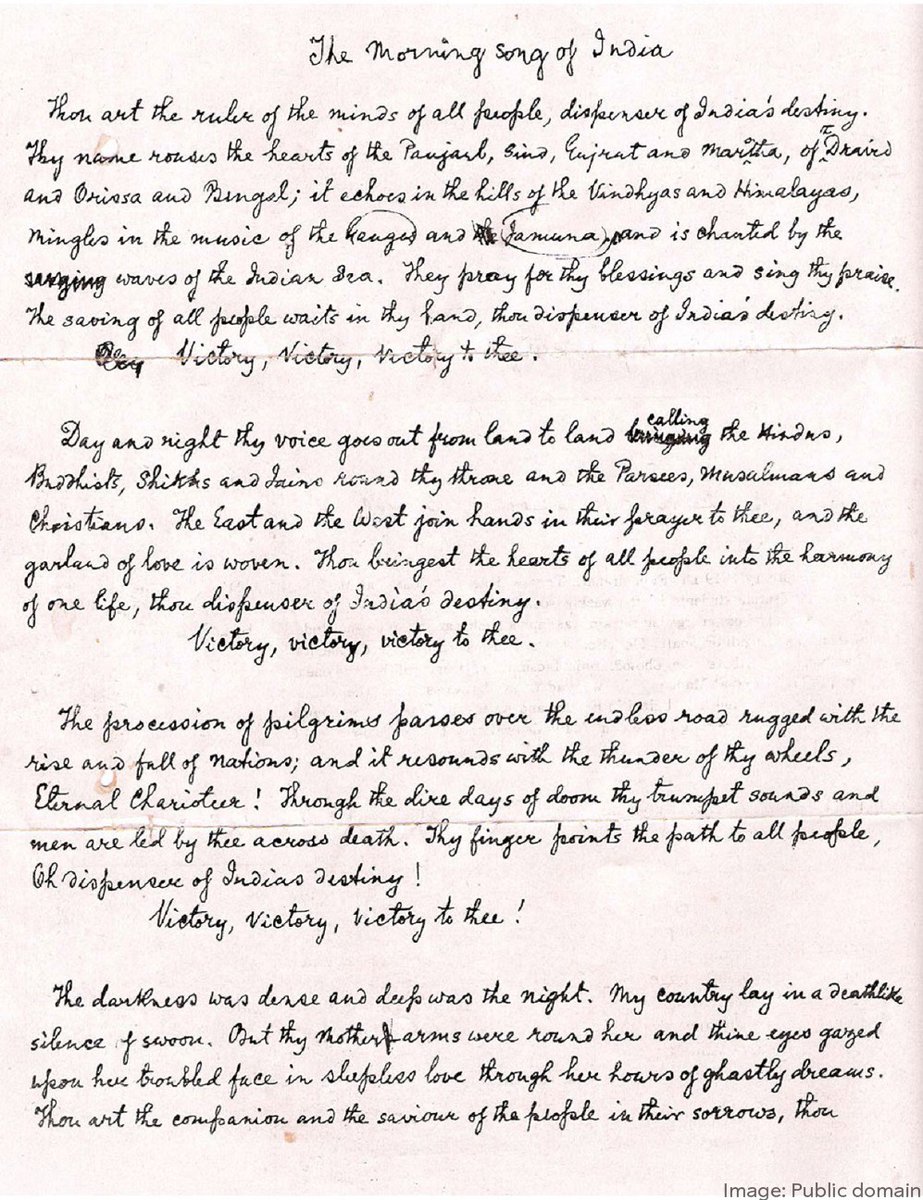
"Jana Gana Mana" (Bengali: [ɟənə gəɳə mənə]) is the national anthem of India, originally composed in Bengali by poet Rabindranath Tagore, who was awarded the #NobelPrize in Literature in 1913.
Pictured: An English translation of Jana Gana Mana by Tagore
United Airlines updated its contract of carriage — the rules a passenger agrees to in order to fly — to specify that “passengers who fail to use headphones while listening to audio or video content” could be removed from a plane or not allowed to board. https://t.co/kxy1TYzytL