Trump says his Iran deal avoided a “worldwide depression.”
That is not a boast. It is an indictment.
It means the war ended not because Iran was defeated, not because the regime capitulated, not because its nuclear and missile programs were dismantled — but because Iran succeeded in turning the Strait of Hormuz into a hostage.
That was the decisive issue from the beginning.
And it was completely foreseeable.
The Strait is not a symbol. It is one of the central arteries of the world economy. Roughly 20% of global petroleum liquids and a major share of LNG normally move through it. Iran sits on the northern shore with mines, missiles, drones, coastal batteries, and fast boats. Everyone knew this. The Pentagon knew it. The Navy knew it. Tehran knew it.
The United States has spent decades planning, exercising, and operating in precisely this battlespace.
This is not some mysterious, unforeseeable problem. The Navy has escorted tankers through the Persian Gulf before. It has fought Iran’s navy before. It has practiced mine-countermeasures, maritime security, convoy protection, unmanned surveillance, and freedom-of-navigation operations in and around the Strait for years.
The issue was never whether America had the capability to keep the straits open.
It did.
The issue was whether the president would make preventing Iran from closing the Straits of Hormuz a strategic objective of the war.
Trump CHOSE not to.
That decision doomed the war from the start.
Control of the Strait did not mean occupying Iran. It did not mean guaranteeing zero risk. It meant declaring, from the first hour, that the Strait is an international waterway; that no Iranian mine, missile battery, drone site, fast boat, “permit authority,” or IRGC toll booth would be allowed to determine whether world trade moves; and that every asset threatening commercial shipping would be destroyed.
Control meant executing on the Navy’s existing plans.
That should have been the opening strategic objective.
Instead, Trump failed to act and instead treated Hormuz as a bargaining chip.
I identified this on my show a week into the war and said it on my show: if the United States does not break Iran’s control over Hormuz immediately, every later battlefield success will be strategically compromised.
That is exactly what happened.
The U.S. and Israel hit Iran hard. The White House says more than 10,000 sorties were flown and more than 13,000 targets were struck. Iranian air defenses, command nodes, missile sites, naval targets, and parts of the regime’s military infrastructure were devastated.
But tactical destruction is not victory.
Victory requires identifying the enemy’s decisive leverage and breaking it.
Iran’s leverage was Hormuz.
If America controls the Strait, Iran is isolated. Its exports are constrained. Its revenue dries up. Its regime faces the consequences of aggression. The pressure falls on Tehran.
If Iran controls the Strait, the pressure falls on Washington. Oil prices rise. LNG markets tighten. Allies panic. Markets wobble. Governments demand de-escalation. Suddenly the aggressor is negotiating from leverage.
That is exactly what happened.
Iran did not need to defeat the U.S. Navy. It only needed to convince American politicians that reopening the Strait by force was too risky, too costly, too frightening.
And Trump accepted that premise.
Once he did, the war was lost politically, no matter how many targets were destroyed.
The tragedy is that America did not lack the means. It lacked the will and the strategic clarity.
A serious administration would have flooded the theater early, established overwhelming control of the air and sea approaches, protected commercial transit, cleared mines, destroyed minelayers, and made clear that any Iranian attempt to close the Strait would bring immediate military consequences.
Hard? Yes.
Risky? Of course.
But wars are hard and risky. That is why they must be fought only when the objective is clear and the will exists to achieve it.
The unforgivable error was going to war while leaving Iran’s strongest weapon intact.
And now we have a deal that reportedly reopens the Strait temporarily, lifts parts of the blockade, offers sanctions relief, unfreezes billions, contemplates a massive reconstruction fund, and postpones the hardest questions: missiles, proxies, enrichment, and the survival of the regime itself.
This is not how a serious country wins a war.
This is how it buys time from the enemy after failing to neutralize the enemy’s strongest weapon.
The worst part is not this agreement. The worst part is the precedent.
Iran now knows that if it can close Hormuz long enough, America will bargain. China is watching. Every hostile regime sitting near a chokepoint is watching. The lesson they will draw is obvious: do not defeat the U.S. military; threaten the arteries of trade until American politicians fear the economic consequences of victory.
That is the catastrophe.
Not merely that Trump blinked. Not merely that Iran survived. But that the United States taught its enemies that control over trade routes can substitute for military power.
Wars are not won by counting targets destroyed. They are won by achieving the political objective.
The objective should have been the defeat of the Iranian regime and the restoration of absolute freedom of navigation in the Persian Gulf.
Instead, America settled for a pause — and Iran kept the weapon.
The bill for that failure will not come due all at once.
But it will come due.
@japan_nobunaga Japan is a high-trust society, the US low. There is a cultural element. America is about individual autonomy, almost sovereignty. Japan, as I understand it, is more about the whole, a collective (the kokutai?) Hence, Americans want guns, Japanese have more mutual trust.
Here is what someone should tell the President, because it bears on his own political survival.
A well-armed tyranny ruling an unarmed population is remarkably durable under economic pain. The Iranian regime can starve its people and shoot the ones who object. It has done so for decades. It will absorb two-hundred-dollar oil and call it resistance.
A republic founded not on theocratic rule, but on rule of the people, by the people, and for the people is different. It answers to voters — and these voters elected a President on a promise to crush the inflation Joe Biden left behind. Instead, they have watched costs climb under tariffs, trade wars, and now an actual war that has sent energy prices soaring with no end in sight. The mullahs can outlast their economic misery. The coalition that put this President in office cannot. Mr. Trump is betting the American voter has the patience of a captive Iranian. That is a bet he will lose.
The honorable path is also the sound one: finish what we started, or get out of the way of the ally willing to. Reopen Hormuz by force if Iran will not do it by agreement. Stop calling a war a ceasefire and stop dignifying a rout as diplomacy.
Otherwise, the verdict will be brief and brutal. We had Iran beaten. We talked ourselves out of the win. And we let a regime that shoots its own citizens lecture us on what a ceasefire means — while we nodded along, shooting, as the President put it, “in a more moderate manner.”
https://t.co/5KOv5Nftwl
In 1979, the mullahs tortured the Shah's favourite horse to death.
The horse, Azar, was paraded in the streets. They broke his legs, cut his tongue out, and then shot him in the head in front of a large crowd.
Iran is occupied by demons from hell.
A lot of people ask why Generation Jones insists on being its own thing.
After all, we’re usually lumped in with the Boomers.
The answer is simple.
We may have been born during the Baby Boom, but we did not have the same formative experiences as the older Boomers, and we did not have the same upbringing as Gen X.
We were the bridge generation.
The oldest Boomers remember where they were when President Kennedy was assassinated. Many of us do not. Kennedy was buried on my first birthday.
They were old enough to remember the optimism of the early 1960s, the moon landing as teenagers, and the cultural revolutions as participants.
Most of us arrived too late for that.
Likewise, Gen X grew up with personal computers, video games, cable television, and a world that was already becoming digital.
We didn’t.
Generation Jones grew up in a world that was almost entirely analog.
We used rotary phones.
We looked things up in encyclopedias.
We learned the Dewey Decimal System.
We used card catalogs.
We balanced checkbooks by hand.
If you wanted directions, you unfolded a map.
If you wanted to know something, you went to the library.
If you missed your favorite television show, you missed it.
There was no streaming service waiting for you.
But unlike previous generations, we didn’t stay there.
We had to adapt.
We watched computers move from climate controlled rooms into offices and homes.
We learned on mainframes and Wang systems.
We used Lotus 1-2-3 and WordPerfect.
We fed giant floppy disks into computers that had less computing power than today’s coffee maker.
We learned email.
Then the internet.
Then cell phones.
Then smartphones.
Then social media.
And now artificial intelligence.
Most generations learn one world.
Generation Jones learned several.
That’s what makes us different.
We are one of the last generations that remembers life before digital technology became part of every waking moment, but we were young enough to adapt and thrive as it arrived.
We didn’t just witness the technological revolution.
We had to reinvent ourselves to keep up with it.
Every decade brought another transformation.
Every decade required new skills.
Every decade demanded adaptation.
Perhaps that’s why so many Generation Jones people are independent, resilient, and skeptical of anyone claiming the world has always been the way it is now.
We know better.
We’ve lived through too many versions of it.
Generation Jones isn’t defined by what we were born into.
We’re defined by everything we had to learn along the way.
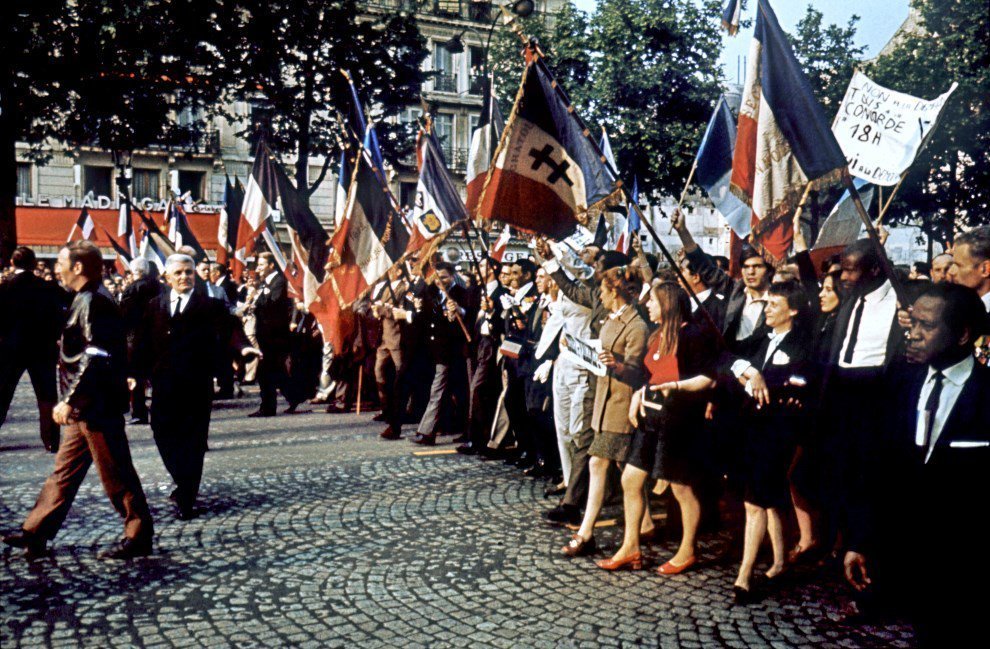
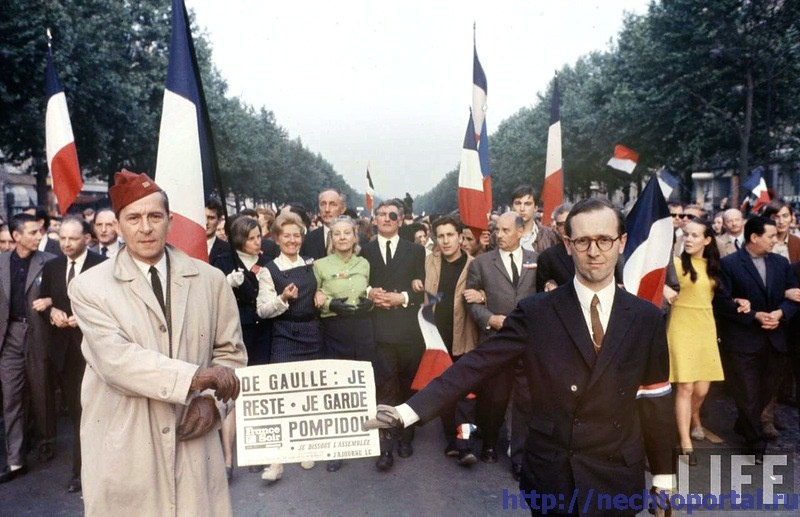
Good morning all & OTD in 1968, French President Charles de Gaulle, amid the May riots, dissolved the National Assembly, ordered new elections & threatened to institute a State of Emergency if protesters did not return to work. Gaullists rallied in Paris in support of the General
An old, but apt fable:
A scorpion wants to cross a river but cannot swim, so it asks a frog to carry it across. The frog hesitates, afraid that the scorpion might sting it, but the scorpion promises not to, pointing out that it would drown if it killed the frog in the middle of the river. The frog considers this argument sensible and agrees to transport the scorpion. Midway across the river, the scorpion stings the frog anyway, dooming them both. The dying frog asks the scorpion why it stung despite knowing the consequence, to which the scorpion replies: "I am sorry, but I couldn't help myself. It's my character." @Wikipedia
Oh goody. It is Europe whining about America having air conditioning while they drop like flies season again. This is my favorite time of year. (the other continents call it "summer")
This year they seem fixated on American houses being made of wood and how we have tornados?
Because you know, Europeans all live in two thousand year old mud huts and windowless castles that can't accept a window unit, and that somehow makes them morally superior to us, so they can die miserably by the thousands when it hits 78 degrees, while lecturing us smugly about "climate change" the whole time.
I live in a place that's Norway in the winter, Algeria in the summer, five thousand feet higher than the average elevation in the UK, in a house that's so large the average UK home would fit in my office/game room, but please, do go on about how amazing your 800 square foot mud brick shack built after the Blitz is.
Listen, you absolute pussies, if you're that scared of living where there's tornados that's okay. Tornados are like a warning sign God put up saying you're not tall enough to ride this ride. That's why our ancestors came here and yours stayed to decay there.
A couple generations ago the UK used to be our peer. Now they've got the per capita GDP of Mississippi, there's only 5 UK companies in the global top 100, it took them a month to get their one functioning destroyer out of dock (and it promptly broke a week later), and they're menaced by the rape gangs their government imported and protected. You'd think there would be some self-awareness exercised in there somewhere, but nope. It's all hubris. America sucks because our average house (which is about 3x bigger than the UK's, only its insulated and has air conditioning) is made of wood. Oooh sick burn. We also put ice in our water. GASP.
I just saw some Brit bragging about how he had a pub in his neighborhood older than America. Cool. The guys who built that pub would be ashamed of what's become of you, while their descendents who weren't scared of tornados moved here. Then he bragged his house was two hundred years old and would be standing in two hundred more! Sure, but living in it will be five dudes named Achmed and their twenty wives.
For the record I don't hate the British. I like most Brits. I just despise your bossy weenie socialists who want you to live like fucking peasants to sacrifice on behalf of global warming, and those are the ones who mouth off on X all day. I'm actually rooting for you normal sane Brits to continue overthrowing your shitty labor government in the hopes you can move into the modern air conditioned world with the rest of us.
So anyways, happy summer. Try not to die.