In America, a stranger will rename you in public, and you are simply expected to become that man.
I entered a busy café.
The line was long.
The machines screamed.
The people moved with confidence, like everyone had been trained since birth to order milk in secret codes.
A woman at the counter smiled.
“Name?”
I stood tall.
Eight hundred years of family history rested on my tongue.
“NyanChuu.”
She nodded with great confidence and wrote something on the cup.
No hesitation.
No fear.
A professional.
Then she read it back.
“Nacho?”
The café continued.
Nobody stopped.
Nobody gasped.
Nobody drew a sword.
Just me.
Standing there.
Watching my soul become a snack.
In Japan, a name is a house you inherit.
In America, a name is wet clay in the hands of a barista.
I wanted to correct her.
But she had said it with such bright certainty.
There was no mockery.
Only service.
Only speed.
Only a cup waiting to be born.
So I bowed.
“Yes. Today, I am Nacho.”
The man behind me said, “That’s kind of a cool name.”
He had no idea what he had witnessed.
A funeral.
A baptism.
A menu item.
I stepped aside and waited.
Every time the staff shouted another name, people moved instantly.
“Emily!”
“Jason!”
“Mike!”
Then it came.
“Nacho!”
The sound hit the room.
Not as a mistake.
As destiny.
I walked forward.
Not fast.
A man should never rush toward a new identity.
The barista handed me the cup.
“Have a good one, Nacho.”
I received it with both hands.
Because when America gives you a new name, it also gives you the courage to answer to it.
I drank the coffee.
Too hot.
Too sweet.
Too large.
Perfect.
For twenty minutes, I was not NyanChuu.
I was Nacho.
I sat by the window and wondered what kind of man Nacho should become.
A lighter man.
A crispy man.
A man who does not fear melted cheese.
Before leaving, I looked at the cup again.
The handwriting was terrible.
The meaning was holy.
You call it a misspelled name.
I call it a temporary American rebirth.
Tomorrow, I will return to another counter.
If they call me NyanChuu, I will bow.
If they call me Nacho, I will bow deeper.
And if one day they call me Taco, I will not resist the ceremony.
@PerceptualPeak@polygrafix@steipete@venky4a Super streamlined. As I read you I can confirm that the best use cases depend on the smartness of the person behind the keyboard. I want to implement. Something like this to distill new ideas
@NoahEpstein_ For a person trying to build a business based on AI automation with a human front end, this is the most insightful article I’ve ever read. Thanks a lot
🚨 HERE’S WHY BITCOIN IS NONSTOP DUMPING RIGHT NOW
If you still think $BTC trades like a supply-and-demand asset, you MUST read this carefully.
Because that market no longer exists.
What you’re watching right now is not normal price action.
It’s not “weak hands.”
It’s not sentiment.
And it’s definitely not retail selling.
Most people are completely unaware what’s happening.
And by the time it becomes obvious, the damage is already done.
This move didn’t start today.
It’s been building quietly under the surface for months.
And now it’s accelerating.
Here’s the truth:
The moment supply can be synthetically created, scarcity is gone.
And when scarcity is gone, price stops being discovered on-chain and starts being set in derivatives.
That is exactly what happened to Bitcoin.
And it’s the same structural break that already happened to:
→ Gold
→ Silver
→ Oil
→ Equities
Once derivatives took over.
The original Bitcoin thesis is broken.
Bitcoin’s valuation was built on two ideas:
→ A hard cap of 21 million
→ No rehypothecation
That framework died the moment Wall Street layered this on top of the chain:
→ Cash-settled futures
→ Perpetual swaps
→ Options
→ ETFs
→ Prime broker lending
→ Wrapped BTC
→ Total return swaps
From that point forward Bitcoin supply became theoretically INFINITE.
Not on-chain.
But in price discovery, which is what actually matters.
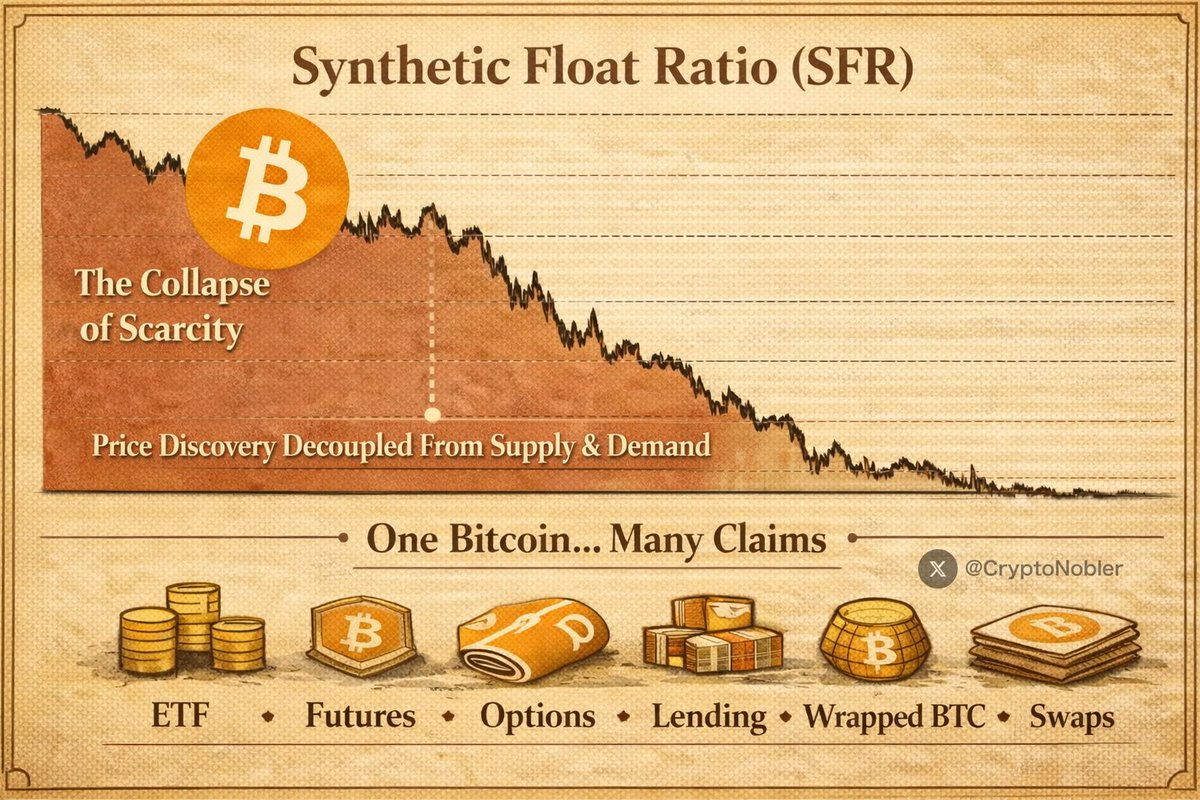
Synthetic Float Ratio (SFR).
The metric that explains everything.
Once synthetic supply overwhelms real supply, price no longer responds to demand.
It responds to positioning, hedging, and liquidation flows.
Wall Street can now trade against Bitcoin.
They’re not guessing direction.
They’re doing what they do in every derivatives-dominated market:
1⃣ Create unlimited paper BTC
2⃣ Short into rallies
3⃣ Force liquidations
4⃣ Cover lower
5⃣ Repeat
This isn’t “betting.”
It’s inventory manufacturing.
One real BTC can now simultaneously back:
→ An ETF share
→ A futures contract
→ A perpetual swap
→ An options delta
→ A broker loan
→ A structured note
All at THE SAME TIME.
That’s six claims on one coin.
That is not a free market.
That is a fractional-reserve price system wearing a Bitcoin mask.
Ignore it if you want, but don’t pretend you weren’t warned.
I’ve been calling Bitcoin tops and bottoms for over a decade now, and I’ll do it again in 2026.
Follow and turn on notifications before it's too late.
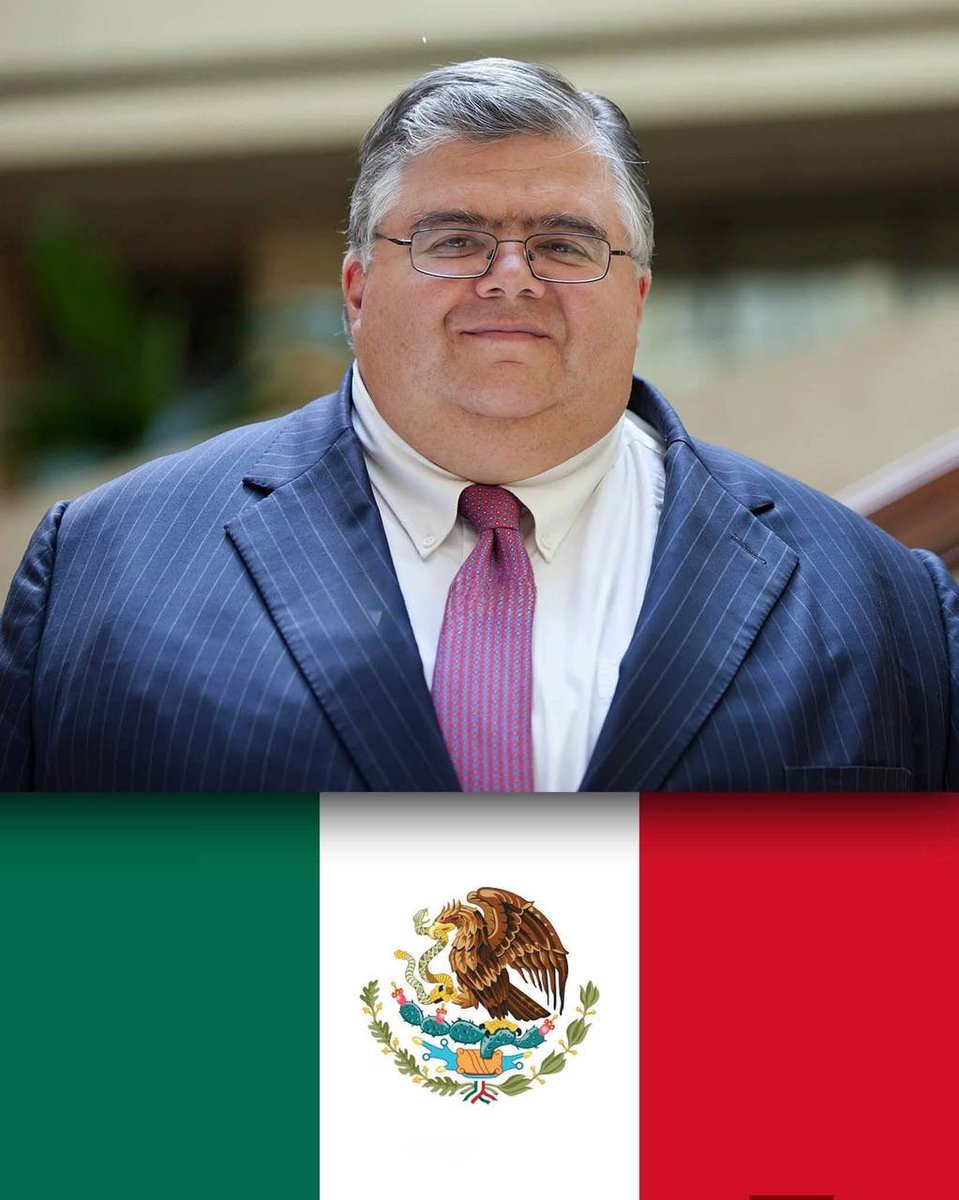
🇲🇽 Agustín Carstens acaba de retirarse como Director General del Banco de Pagos Internacionales (BIS) - literalmente el "banco de los bancos centrales" - después de transformar las finanzas mundiales durante 8 años. En Estados Unidos, Europa y Asia estudian sus estrategias sobre política monetaria y lo consideran uno de los economistas más influyentes del siglo XXI.
Este mexicano de 67 años fue el primer líder de una economía emergente en dirigir el BIS. Universidad de Chicago, doctorado en economía, asesor del FMI, salvador de México durante la crisis financiera de 2008 (le llamaban "San Agustín" por salvar $5 mil millones al país), gobernador del Banco de México, y candidato a dirigir el FMI compitiendo contra Christine Lagarde.
Los premios internacionales no paran:
- Premio Rey de España en Economía 2022
- Lifetime Achievement Award 2025
- Mejor Gobernador de Banco Central del Mundo 2012
- Reconocido por crear el Innovation Hub del BIS que revolucionó las monedas digitales
Pero aquí está lo irónico: cuando estuvo en México como Secretario de Hacienda y Gobernador del Banxico (2006-2017), muchos mexicanos ni sabían quién era. Mientras tanto, en universidades de Harvard, Chicago, Oxford y el MIT analizan sus papers. Banqueros centrales de 60 países lo consultan. La Reserva Federal de Estados Unidos estudia sus modelos económicos.
Mientras el mexicano promedio lee hilos conspiranoicos sobre cómo los Rockefeller controlan el mundo, el estadounidense promedio lee hilos académicos sobre cómo Agustín Carstens transformó el sistema financiero global. Estudiantes de economía en Europa hacen tesis sobre sus políticas monetarias.
Mexicano con trayectoria y prestigio bien ganado‼️
Vía… Dinero&Negocios
Jensen Huang just BROKE the most important rule in the industry.
And it explains why Nvidia controls 95% of the AI chip market.
Last night at CES, he unveiled Vera Rubin - the new AI supercomputer that's shipping right now.
Full production started weeks ago.
But here's the part that made every semiconductor engineer in the room go crazy:
Reuben GPU is 5x faster than Blackwell.
But only has 1.6x the transistors.
That should be physically impossible.
Moore's Law says you get maybe 25% more performance per transistor generation.
Jensen just delivered 300%.
How?
He BROKE the most sacred rule in chip design.
The rule every company follows: "Never redesign more than 1-2 chips per generation."
Nvidia redesigned all six chips simultaneously.
Vera CPU. Reuben GPU. Connect X9 networking. Bluefield 4 DPU. MVLink switches. Spectrum X Ethernet.
Every. Single. Component.
From scratch.
He calls it "extreme co-design."
The industry calls it insane.
One rack now moves 240 terabytes per second.
That's TWICE the entire global internet bandwidth.
In a single rack.
And it runs on 45°C water - no chillers needed.
Which saves 6% of global data center power.
But the real story isn't the hardware...
It's what they're doing with it.
Nvidia just open-sourced Alpha Mayo.
The world's first reasoning autonomous vehicle AI.
Mercedes-Benz CLA launches with it in Q1. Europe Q2. Asia by year-end.
Not a concept car. Not a limited release.
Full production vehicles.
And the AI will even explain its reasoning out loud.
"I'm slowing down because the truck ahead is braking and there's a cyclist merging."
It thinks. Then tells you what it's thinking. Then executes.
Jensen drove it through San Francisco for an hour yesterday.
No hands. No interventions.
Through heavy Sunday traffic.
The whole thing is open source now.
Every line of training code. Every data source. The entire stack.
But why would Nvidia give this away?
Because they learned something from the last year:
Open models activated the entire world.
DeepSeek R1 proved open source can hit the frontier.
Downloads exploded. Every country, every startup, every researcher can now build AI.
And they all need Nvidia hardware to train it.
That's the strategy.
Give away the recipes. Sell the kitchen.
The partnerships tell you where this is going:
Siemens is integrating Nvidia into every industrial design tool.
Cadence and Synopsys are rebuilding chip design around Nvidia.
Palantir, ServiceNow, Snowflake - their entire platforms now run on Nvidia's agentic AI stack.
This isn't just selling chips anymore.
Nvidia is rebuilding the entire computing stack.
From design to manufacturing to deployment.
Every layer of the trillion-dollar AI infrastructure buildout runs through them.
And now they're 18 months ahead of everyone else.
Again.
The competition is still trying to match Blackwell.
Nvidia's already shipping the thing that makes Blackwell look slow.
What do you think - is anyone catching them?
The only company capable of this might be Google.