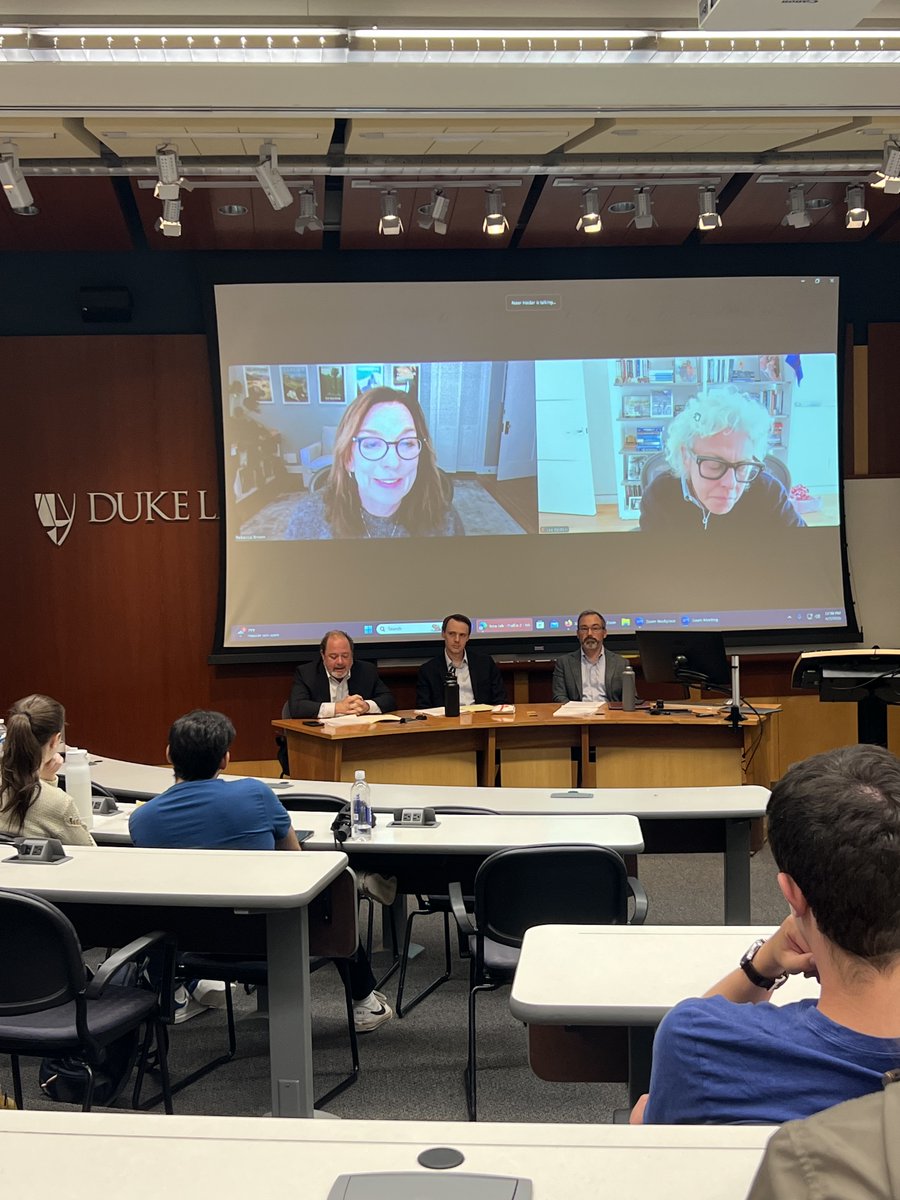
Today, DLJO, Duke Center for Firearms Law, & other partners presented a discussion of “Guns, Judges, and Trump.” Professors Blocher & Denning discussed the essay’s data and their own observations. Read their thoughts in two response pieces, now live: https://t.co/fpg3IelqQ0
In "Reforming H-2A: Protecting Migrant Workers Before Arrival on U.S. Farms," Editorial Board Member Isabella Cheng examines the recruitment debt that H-2A workers shoulder & argues that current regulations enable this debt. Her note proposes two solutions https://t.co/6AoM1LwdLL
MEMBER SPOTLIGHT: Special Projects Editor Melana Dayanim led DLJ's 55th Administrative Law Symposium last week. Her hard work resulted in thoughtful lectures & meaningful conversation. Stay tuned for our authors' published articles later this spring!
Notes Editor Katherine French's Justice on the Home Front: Domestic Prosecution of Foreign Combatants During Wartime, examines Ukrainian war-crimes prosecutions. It concludes that their procedural shortcomings undermine substantive & symbolic benefits. https://t.co/3JhFKMgtJ9
Articles Editor Brandon Bishop mentors fellow students in DLJ and beyond. He has also helped publish four articles in Volume 74. Thank you, Brandon for your great work!
Issue 6 kicks off with "The Road to Slow Deportation" by Duke Law Clinical Professors Fogel & Evans. Their Article describes how the use of traffic stops to police noncitizens creates a system of racialized social control for immigrant communities. https://t.co/pbDQ6VDvin
Issue 6 kicks off with "The Road to Slow Deportation" by Duke Law Clinical Professors Fogel & Evans. Their Article describes how the use of traffic stops to police noncitizens creates a system of racialized social control for immigrant communities. https://t.co/2cuTqXi6Ce
Volume 75 is now accepting articles for the 56th Administrative Law Symposium. Submit via our Scholastica portal and visit our website for more information: https://t.co/a1WXfzb69G
Gillian, one of our many incredible Staff Editors, has worked on pieces for DLJ and DLJO including "Discretionary Immigration Detention" and "Predatory Decarceration." Thank you for your hard work, Gillian!
In "Fair Notice is a Sociopolitical Choice," Alexander Zhang reframes a debate in statutory interpretation by developing a historical account of legislatures' and laypeople's value judgments about notice. Read more: https://t.co/v4AMkst4Tn
"Reparations for Project One Hundred Thousand" draws on DOD archives to present the discriminatory origins and lasting harms of a Vietnam War–era program. Professor Morales proposes a remedy to restore dignity & access to veteran’s benefits. Read more: https://t.co/ij6u0j3tpi
The Second Amendment has been widely changed by Heller and Bruen. Professors Brown, Epstein, & Gulati report on preliminary data regarding the impacts of the Court's new historical test. Read more now & follow DLJO for forthcoming response pieces: https://t.co/I98eYCfGje
Issue 5 features two cutting-edge notes about the Supreme Court’s Bruen holding by two DLJ executive board members, Timothy J. Southam & Thomas Moy. Read more in Volume 74's Issue 5, published now: https://t.co/ij6u0j3tpi
Join Duke Law Journal Online for (Executive) Order in the Court—an ongoing series explaining the Trump Administration's executive orders and how the courts have responded: https://t.co/6UQi0Sr6Ej
Submissions for Duke Law Journal and Duke Law Journal Online are now open on Scholastica: https://t.co/KKYAEscYFT. Volume 75 looks forward to reviewing your work!
For more information: https://t.co/VkUID90NVB
In "Hell Comes with High Water," DLJ Notes Editor Robert Cerise conducts a case study of the state he calls home, Louisiana, to identify legislative and judicial solutions to the erosion of speedy trial protections. https://t.co/I7Jeu4EIiO
In "Discretionary Immigration Detention," Mary Holper argues against the justifications frequently offered for unreviewable discretion and jurisdiction stripping of federal courts over immigration decisions. Read on: https://t.co/qONRfsmvsp
DLJ's Senior Research Editor Katie Grace Frisbee is featured in Volume 74 Issue 4 for her note, "Caught in the Content Tornado." Read her solution for providing a fair trial in the modern digital age here: https://t.co/fnX0oG1jlR
Our first spotlight of 2025 is Articles Editor Rebecca Magid. She brings her careful attention and radiant kindness to the articles department. Thank you for your hard work, Rebecca!