🧵 The Forgotten 'Punjabi Bulbul.'
Firoz Din Sharaf, dubbed 'Punjabi Bulbul' (The Nightingale of Punjab) due to his sweet voice, and an honorary Sikh, Sharaf ruled the popular poetry scene for a generation, and was one of the most beloved 'awami' poets of Amritsar and Lahore.
Something deeply disturbing about the enthusiasm with which people are defending the Afghan medical students being forced out of Pakistan. It has the unmistakable logic of collective punishment- take a political conflict, collapse an entire nationality into it, and then decide that individual people can bear the consequences.
I understand that we, as a people, are remarkably selective about where we extend empathy- but what I find particularly depressing is seeing that selectivity from people who supposedly belong to educated and professional circles.
Empathy is not supposed to mean merely feeling sorry for people you like. It is the ability to recognize another person’s humanity *especially* when their circumstances, identity, or politics are unlike your own.
Now imagine this.
You spend years studying medicine. You reach your final year. You are months away from becoming a doctor, after years of exams, clinical training, exhaustion and sacrifice. You are looking forward to entering one of the few professions that can directly improve other people’s lives.
And then, just before you finish, you are told to leave the country *solely* because you are Afghan.
Not because you failed your exams. Not because you committed professional misconduct. Not because you were found guilty of some crime. Your nationality is the *only* thing that has suddenly made your education expendable.
How would you feel?
Put yourself in their shoes for a second. Take a breath before writing that long reply about how terrible, abusive, or otherwise deserving of punishment Afghans supposedly are, and ask yourself- I repeat- how would you feel if the same logic were applied to you?)
Which it very much can be, in the case of Pakistanis.
And even if you believe that some Afghan individuals have done reprehensible things, what exactly does that have to do with these particular students? At what point did the actions of governments, militants, criminals, or strangers become sufficient grounds for treating an entire nationality as collectively responsible?
Is this really the kind of society we want to be? One that can watch young people who have spent years training to become doctors have their education interrupted and respond with celebration simply because they possess the wrong passport?
Then we act surprised when stray cats and dogs are slaughtered en masse, native trees and greenery are erased in the name of “beautification,” children are murdered and sexually abused, and women are raped or killed in the name of “honor.”
These things are not morally equivalent, obviously. But there is something deeply dangerous about becoming habituated to cruelty- about repeatedly finding reasons why someone else’s suffering is acceptable, tolerable, or simply not our concern.
It starts with the little things.
Every time you teach yourself that another human being’s suffering does not matter because they belong to the wrong group, you make the next act of cruelty easier to rationalize.
Eventually you end up with a society in which cruelty is no longer shocking. It is merely something people learn to justify when the victim happens to be someone they have been taught not to see as fully human.
Tired of these imbeciles rehashing western terms with zero local context and history knowledge.
The only "demographic engineering" that has happened in Balochistan till date has been the forced expulsion of 300,000 Punjabis - mostly educationists and bankers - from Balochistan in the 70s on the orders of the-then CM of Balochistan Ataullah Mengal (Akhtar Mengal's dad), who wanted a Baloch ethno-fascist province where Balochs were only 35%. The next "demographic engineering" began again in 2004 with the forced expulsion of over 200,000 Punjabi and Sindhi residents of Balochistan, which continues till date. Between 2008 and 2011 alone, 1200 Punjabis were massacred by BLA. Just this morning in Washuk, 5 poor Punjabi labourers have been massacred by BLA.
This is "demographic engineering". This is ethnic-cleansing. This is textbook apartheid. Not whatever bullshit you're claiming based on an anonymous account's rants.
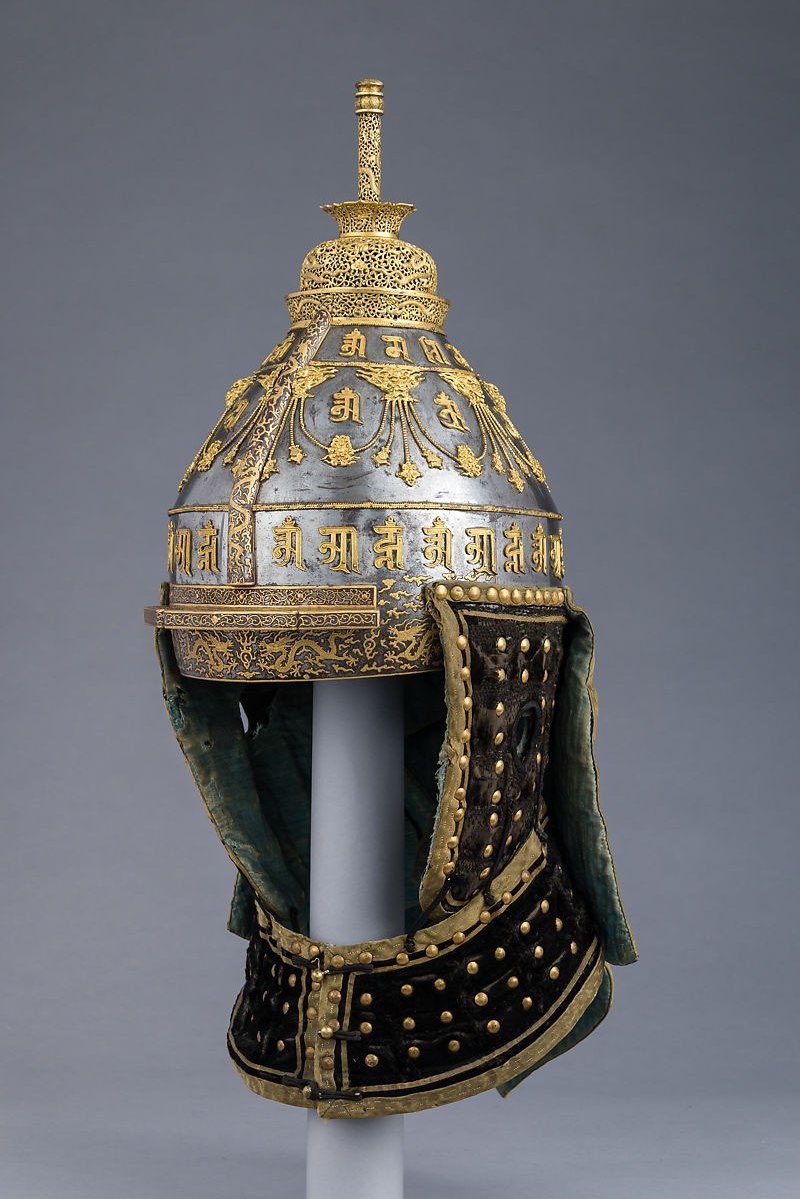
The Manchus who invaded and ruled China had imperial crowns bearing inscriptions in Sanskrit and Indic scripts, indicating their reverence for these writing systems as sacred and divinely sanctioned.
Manchu Qing Dynasty Helmet embossed with the Sanskrit Mantra "Om mani padme hum" in Ranjana/Lantsa Script.
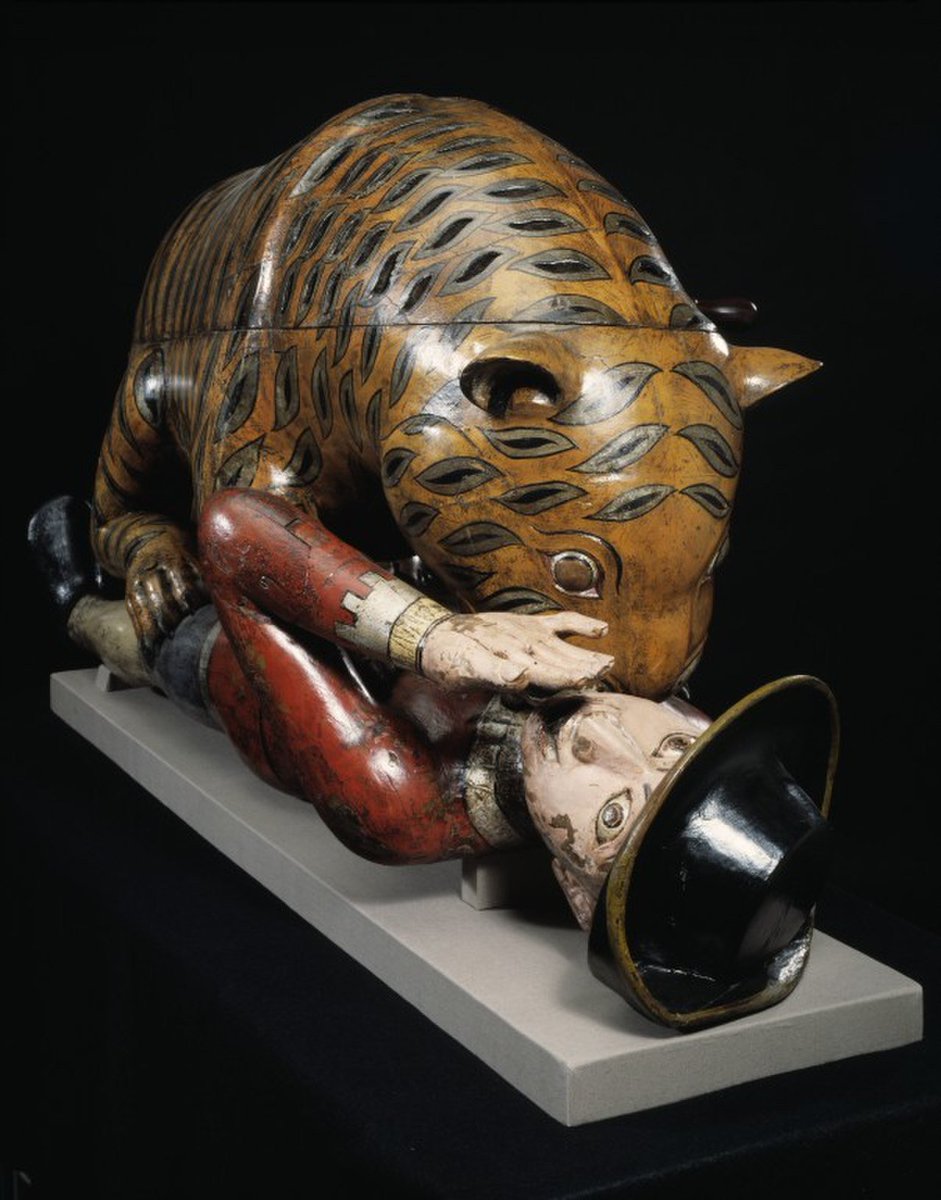
Built in 1790, Tipoo's Tiger is a life sized Indian toy showing a Bengal tiger eating a British soldier. The machination features mechanism that causes the English soldier to flail his arms and an automated 18-note keyboard pipe organ that plays the sound of a scream.
Battle flag of the Sikh Empire during the reign of Maharaja Ranjit Singh.
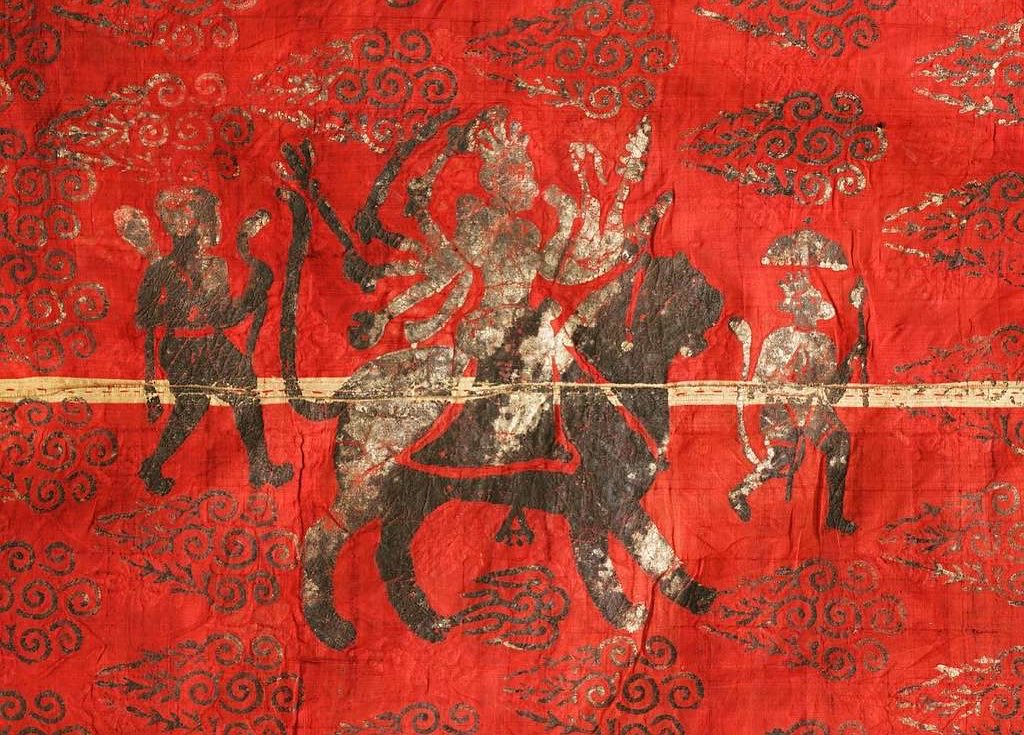
Goddess Chandi is in the centre, flanked by Hanuman to her right and Bhairava to her left.
A rare moment of linguistic literacy on this platform. As someone proficient in both scripts, I have maintained the exact same position for years; the conclusion is unavoidable. Gurmukhi is structurally and phonetically vastly superior for Panjabi. It was engineered specifically around the language itself, rather than being haphazardly retrofitted from an orthographic system built for Persian and Urdu.
This is not to say that Western Panjab will adopt it tomorrow (or perhaps ever). The political insecurity surrounding the suggestion is glaringly obvious - an exercise in state-sponsored self-mutilation. Rather, this is a claim regarding linguistic suitability: Panjabi already possesses a mature script built around its own sound system, and it is difficult to pretend that a borrowed orthography is structurally preferable merely because it has become familiar.
What people continually fail to grasp is that Panjabi is not Urdu spoken with a rural inflection. Its vowel system, aspiration, consonantal distinctions, tonal architecture, and spoken rhythm all demand a script that reflects how the language is actually heard and spoken. Gurmukhi gives Panjabi’s tonal and phonetic structure a far more systematic written representation; Shahmukhi, by contrast, requires the reader to supply distinctions the script leaves implicit. Gurmukhi is cleaner, more intuitive, and far better suited to mass literacy, schooling, publishing, and eventually, the technical demands of digitization. Shahmukhi can be read by those already trained in Urdu, certainly, but that is not the same thing as saying it is the optimal script for teaching Panjabi to millions. For anyone claiming to care about Panjabi nationalism, the priority should be the language’s survival as a living, literate, institutional medium - not a dialect confined to folklore, but a language legible to the masses and intellectually respectable enough to sustain scholarship, administration, and modern literature.
To anticipate the predictable historical romanticism: none of this is a denial of Shahmukhi’s place in The Panjab’s literary inheritance. Waris Shah, Bulleh Shah, the qissas, the kalams, the folk archive - all of that matters, and no serious scholar would pretend otherwise. Nor is anyone proposing that those texts be discarded. But invoking Heer Ranjha whenever this question arises does not settle an argument about modern orthography; inheritance cannot become a veto on improvement.
A script can carry a great literature and still remain mathematically unsuited to the full phonetic demands of the language it carries. Persian was once the language of court and administration across much of The Panjab; that did not make Panjabi a dialect of Persian. Urdu has been the language of state schooling for generations; that does not make it the natural intellectual horizon of Panjabis. History records what power, patronage, and religion made possible; it does not automatically tell us what is best suited to a people’s linguistic future. ‘Older’ is not synonymous with ‘better suited.’ The past deserves preservation, obviously. But it need not become a prison.
To slightly amend her point on Sindhi: the extensive adaptation of the Perso-Arabic base in Sindh actually illustrates the limitation. It required a long series of dots and diacritical surgery to force an inherited script to carry a language it was not built for. We do not need to replicate that exhausting, unnecessary labour for Panjabi. We already possess a script designed around the language’s own structure, with centuries of literary continuity behind it. Why indefinitely perform orthographic surgery on Shahmukhi when Gurmukhi already exists?
As for the inevitable ‘just reform Shahmukhi’ response, it can certainly be reformed. But every proposed reform concedes the central point: the inherited orthography is insufficiently adapted to Panjabi as it is actually spoken. The question is whether one should indefinitely keep repairing a borrowed framework when a mature native script is already available.
And it is worth noting that, after nearly eight decades of Pakistani rule - leaving aside how systematically Panjabi has been marginalized, divided, and treated as culturally subordinate - no serious, sustained reform project has ever been undertaken. The sudden confidence that such reform is imminent tends to appear only when Gurmukhi is mentioned. I find that reflex quite telling.
None of this is really about linguistics, though. The deeper resistance is entirely political and psychological. As she notes, Gurmukhi dismantles the fantasy that Western and Eastern Panjab are two unrelated civilizational worlds, separated not merely by a British-drawn border but by some invented cultural abyss. It reminds the insecure that a state boundary can divide sovereignty without erasing language, memory, literature, or a people’s deeper continuity.
Which is why the loudest replies will not seriously answer the structural question. They will instead default to insult, suspicion, and the usual nationalist panic whenever Panjabis are asked to imagine themselves as something more than a provincial appendage of the state.
And this is where the supposed (Pakistani) Panjabi nationalists will reveal themselves, too. Many are Pakistani nationalists first, with a thin layer of Panjabi vocabulary placed over the same old ideological insecurity - occasionally supplemented by a little provincial chauvinism, misogyny, or vulgar petulance, all of which they mistake for nationalism. They will defend Panjab only so long as it remains culturally harmless, politically subordinate, and psychologically detached from itself. But a real Panjabi politics cannot be built on fearing one’s own continuity.
Le drame de l'ignorance...
If Punjabi nationalists are actually interested in Punjabi becoming a meaningful language in Pakistan the first thing to do is to abandon the Perso-Arabic script (Shahmukhi) that just cannot capture the nuances of the language (I don’t know how the Sindhis managed to do it but quite clearly Pakistani Punjabis have failed).
As a Punjabi speaker and fluent Urdu reader shahmukhi gives me a headache and I always drop it within minutes. I have discussed it with many other Punjabi speakers and they feel the same way.
The best way out is to adopt the Gurmukhi script that is already well-adapted to Punjabi and has centuries of literary history in-built. The half-baked shahmukhi script is also the biggest hurdle in implementing Punjabi at the school level in Pakistan.
But obviously Pakistan’s small d syndrome won’t accept such a route because it would literally erase the psychological distinctions between lehnda and charhda Punjab.
Tell me you do not know Gurmukhi without telling me you do not know Gurmukhi. Gurmukhi was developed specifically for Panjabi, not for preserving every phonemic distinction of Arabic or Persian that Panjabi speakers themselves do not make in ordinary speech.
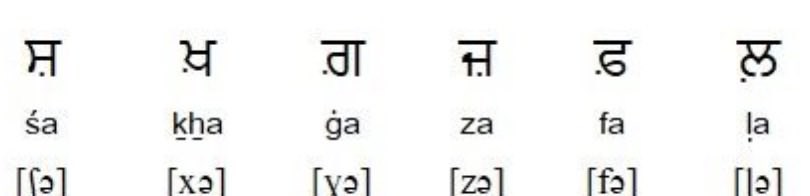
It has pairī̃ bindī letters for loanword sounds such as ਸ਼, ਖ਼, ਗ਼, ਜ਼, ਫ਼, and ਲ਼. More importantly, loanwords enter a language through its own phonology. Panjabi does not cease to be Panjabi merely because a word once arrived through Persian or Arabic. The task of a Panjabi script is to represent Panjabi as Panjabis speak it, not to preserve a foreign word in museum-condition.
Thank you. You are entirely correct regarding the communal lens; it has been used to retroactively fracture a shared intellectual history. The tragedy is that Partition did not merely bifurcate a territory; it gradually trained both sides to treat the other’s script as evidence of religious or civilizational foreignness.
I have heard the same thing from others in East Panjab too. Grandparents who could read Shahmukhi, families who encountered Persianate Panjabi literature without experiencing it as somehow alien, people for whom the linguistic world of the other side was still at least partially legible.
That older literacy did not mean there were no religious differences, of course. But it did mean that the border had not yet fully colonized the imagination. A Panjabi Sikh could encounter Shahmukhi without feeling that he was entering an alien world; a Panjabi Muslim could recognize Gurmukhi as part of the wider literary inheritance of the land, even if it was not the script his own family used.
Now both scripts are increasingly read through communal suspicion. That is one of the quieter losses of the twentieth century. Not simply that The Panjab was divided, but that Panjabis were taught to become illiterate in... each other.
A profound loss.
Historically, yes, Panjabi Muslims did not use Gurmukhi in any widespread capacity; Shahmukhi and related Perso-Arabic forms were indeed the administrative and literary norm in Muslim Panjab.
But scripts do not possess religions, and historical usage is not synonymous with linguistic suitability. I acquired Gurmukhi simply because restricting oneself to a single, politically convenient archive means accepting a fragmented view of the language's civilizational (and literary) landscape. It is quite straightforward to acquire once you commit to the language itself.
A small historical correction for the nationalists in the mentions currently weaponizing poetry they cannot actually read: Gurmukhi was standardized in the sixteenth century, while Bulleh Shah lived later, from the late seventeenth into the eighteenth. His work belongs fully to Western Panjab’s Perso-Arabic literary archive; that still does not establish that Shahmukhi is structurally superior for Panjabi, or that a script’s historical use settles its suitability for modern literacy and standardization. Read a book.
Hard truth to accept for many: if you’re from Pakistan and are genuinely interested in preserving and nurturing the Panjabi language at a higher level and well into the future, Gurmukhi is the way to go.
Anyone fluent in both Shahmukhi and Gurmukhi will tell always tell you that Gurmukhi is by far the superior script for Panjabi, as it was literally developed and adapted for the Panjabi language.
“it would literally erase the psychological distinctions between lehnda and charhda Punjab.”
If you genuinely care about Panjabiyat, this should be seen as a goal, not a problem. Reducing the linguistic divisions between the eastern and western parts of Panjab should be a central aim.
I would even go as far as to argue that we need a unified regulatory body for the Panjabi language. At the very least, if Pakistan establishes a proper one in Lahore, it should work closely with the one in Patiala. The Patiala-based institution has managed to do a great deal for Panjabi, but not without its costs: it has often artificially saturated Panjabi with tatsamas and Hindustani vocabulary, while sidelining much of the Theth vocabulary, and it has also failed in coinining new terms for modern concepts. Having our regulatory bodies working closer together on both sides of Panjab will help in elevating the language further.
Bringing both the script and the standardised forms of Panjabi closer together would strengthen the Panjabi language across both India and Pakistan while simultaneously helping Panjabi diaspora communities maintain a shared linguistic and cultural identity. Preventing the continued drift of the Lehnda and Charda varieties of Panjabi will be crucial if Panjabi is to remain a significant and enduring global language. A shared standard, a shared script, and greater mutual intelligibility will become ever so essential to the language’s long-term endurance and adaptability.
If Punjabi nationalists are actually interested in Punjabi becoming a meaningful language in Pakistan the first thing to do is to abandon the Perso-Arabic script (Shahmukhi) that just cannot capture the nuances of the language (I don’t know how the Sindhis managed to do it but quite clearly Pakistani Punjabis have failed).
As a Punjabi speaker and fluent Urdu reader shahmukhi gives me a headache and I always drop it within minutes. I have discussed it with many other Punjabi speakers and they feel the same way.
The best way out is to adopt the Gurmukhi script that is already well-adapted to Punjabi and has centuries of literary history in-built. The half-baked shahmukhi script is also the biggest hurdle in implementing Punjabi at the school level in Pakistan.
But obviously Pakistan’s small d syndrome won’t accept such a route because it would literally erase the psychological distinctions between lehnda and charhda Punjab.
Today is the 227th anniversary of Maharaja Ranjit Singh liberating Lahore from the Bhangi misl and declaring it the capital of the Sukerchakia misl at just age 19.
Two years later, on April 12th, on the occasion of Vaisakhi, he was proclaimed the Maharaja of Panjab and would officially establish the Sarkar-e-Khalsa.
Medusa is actually correct here, changing the name of the Islamic Republic of Pakistan to just ‘Republic of Indus’ for some larp does alienate the non-Indic populations of Pakistan. Firstly the Indus valley civilisation is ancient and long dead with no existing continuity, it is a piece of history rather than a living identity to be used.
The second thing is the only thing tying a Pashtun to a Punjabi or a Kashmiri to a Baloch is Islam, not an Indic civilisation from 5000 years ago or Gandhara and whatnot. The Indus valley civilisation is more Indic in nature than it is Iranic, same applies to Gandhara, which was most definitely Indic in everything from language to culture and even faith. Only thing these have to do with Pashtuns or Balochs is the land they reside over and some ancestry (even then it’s usually Pashtunised or Balochified local Indic people with the highest).
In reality we are separate nations, a Pashtun from Khyber Pakhtunkhwa will always feel more affinity to a Pashtun from Afghanistan than to a Sindhi from Larkana, same applies to the Punjabi, Baloch, Kashmiri and Sindhi nations. Pakistan was made in the name of Muslim nationalism, thats the only thing that ties one group to the other, applying any ethos to the Pakistan other than Islam, will always result in the excludsion of one ethnic group or the other, since we have little in common other than that.
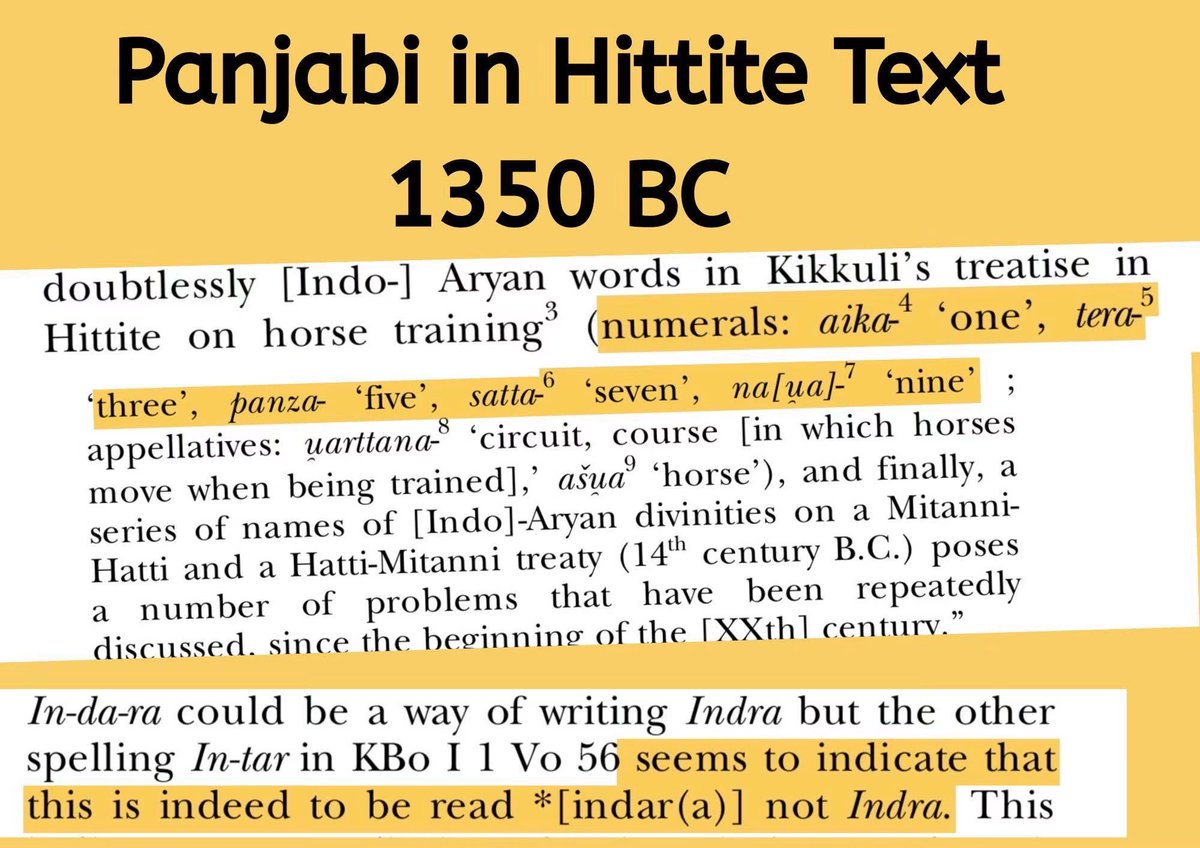
Words found in a famous Hittite horse manual are more similar to modern Punjabi than Sanskrit.
Aika, Dua, Teea, Panja, Satta/Satti, Nau are still used in Panjabi. It’s Ekam, Tri, Panch, Sapat, Nav in Sanskrit.
Hittite text predates any form of Sanskrit, and Panjabi is quite close to a pre-Sanskrit language.
Hittite text contains Indar, Mittar like Panjabi not Sanskrit Indira, Mitra
It doesn’t mean Hittite originated from Panjabi. Panjab was a melting pot of civilizations for centuries, where many languages mingled. Its scripts and language have preserved many archaic elements
Reference paper: https://t.co/SAQ9uE0yfG