Premier prediction market 100% onchain qui arrives dans les semaines à venir. Zéro vc, dev dox
système innovateurs qui n’a rien a voir avec polymarket et il boss dessus depuis 2022. Bullish
100k mc
4t1xhKJd6oFGr98oWJoxYjLU74eFe7xiYSRDoX18pump
New updates must for now remain simmering under the surface, but the road ahead is clear: after finishing the Airdrop, and then our security Audit, we can release that Document and announce a date for Mainnet Alpha.
We'll take the time in-between to make final adjustments
Shift Series Tokens by @ShiftRWA are live on Vibe Trading 🚀
Get stock exposure onchain with up to 20x leverage.
Or, deposit your tokens into the market LP to earn yield in USDC!
Reply below for beta access👇
The chain doesnt lie
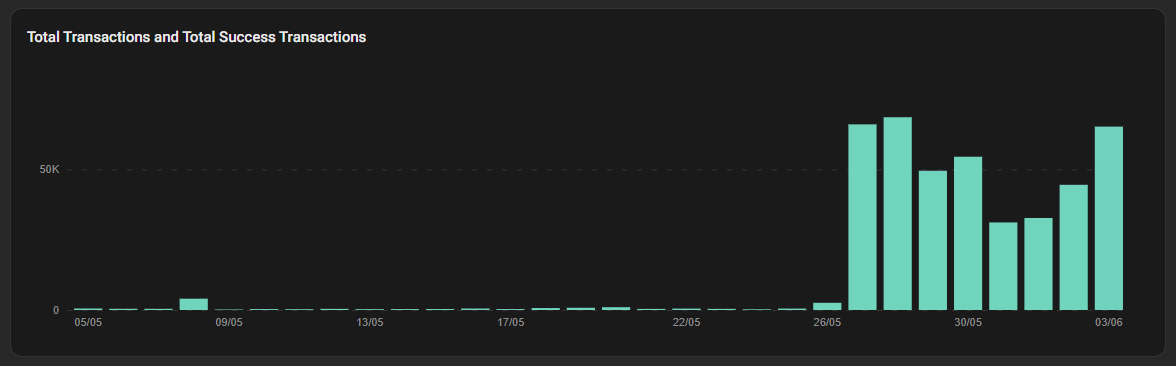
This is MagicBlocks txn count. Just a random 40x spike the day @FastdotPoker launched
Also notice that traction is now starting to pick up signalling good growth 📈
An extremely sticky product & a tonne of fun!
@solana needs to acknowledge soon 🔥
The SOL earned from initial staking and Dealer Node profits was originally set aside for staking rewards.
After talking it through with the community, we agreed on a stronger move. It's going into an LP strategy to deepen liquidity for $FP, with options for both raw and refined.
Full breakdown coming soon.
Wagers in Riverboat will allow for the specification of any Solana address for resolution, permitting trustworthy resolvers to distinguish themselves by merit alone.
It should also be noted that Terms finalization is quite naturally enforced at the protocol level—
I think this is a good anti pumpfun narrative coin since everyone’s waiting and knows the airdrop isn’t coming anytime soon
Anti PF coin, goal to top the communities list within pump app, bought it when it was #8
Sidenote that in 24/25 and even before, CT would have made it a quick mission to do so…. CT misses some sort of togetherness these days… lots of big ego’s
Similar to Hyperliquid listing auctions, Fast Poker lets anybody bid to list any token for poker gameplay.
Users have added HYPE and EMBLEM so far.
May be interesting to add SPL stocks. And then open NVDA table for instance and play for stock.
Stakers (FP burners) earn stocks.
FastPoker a Permissionless Protocol. Build a Room. Run a Dealer-Service.
FastPoker is not a service we run. It is a protocol. Rules of poker deployed as code on Solana, permissionless by design. No team wallet holding player funds. No admin key choosing cards, rewriting hands, or redirecting normal payouts.
Two ways to operate on top of it. Anyone can spin up their own fully branded, fully gated poker room: their players, their brand, their access rules, FastPoker as the infrastructure underneath. And from day one, anyone can run a dealer service that cranks the games and earns rake share for every action they perform.
This post walks through what permissionless means here, how to operate on top, and where we are in the trajectory.
The trajectory: hand-holding now, fully public later:
We are at the start of the protocol's life. At mainnet launch the contracts are live, the dealer code is public, and admin functions are on a Squads multisig. We are hand-holding the rest of the system through its early period: shipping patches, hardening edge cases, ironing out economic surfaces before opening every component. Source release happens progressively as the protocol matures. The endgame is fully public source and a frozen upgrade authority.
The design is permissionless. The current operating posture is bootstrapped. These are not in conflict. Every protocol that wants to end up trustless starts here.
Build your own poker room:
The biggest thing this unlocks. Once frontend source is public, any project, DAO, community, or operator can spin up their own fully branded, fully gated poker room on top of FastPoker without our involvement.
Fork the frontend. Brand it. Run it on your own domain. Create whitelist-only tables gated to wallets you approve, managed entirely by you. Add wallets, remove wallets, gate by NFT holding, by KYC pass, by membership tier, by anything. Run your own server-side stack for anti-bot, anti-collusion, fraud scoring, regional restrictions, KYC if your jurisdiction or business needs it. None of that touches the protocol. It lives in your stack and runs on your logic.
What FastPoker gives you is the rails. Settlement, rake routing, TEE-backed card privacy, hand fairness, custody. Players in your room hold their own funds. Settlement runs on-chain. Hands are provably fair. None of that is something you have to build, secure, or audit yourself. It is already there.
What you capture: 50% of every pot's rake as the table creator, paid in whatever token the table is denominated in, forever, automatically routed to your wallet on settlement. Run your own licensed dealer to crank your tables and you stack the dealer share on top, which means your room can return up to 70% of the rake it generates back to you.
The trust assumption flips. Players in your room do not need to trust you with their chips. They custody their own funds. The contracts settle the math. You do not need to build a poker engine, an RNG, or a settlement system. None of that is your problem.
Your job collapses to your actual value-add: the audience, the brand, the access control, the anti-cheat policy. Everything below that line is infrastructure.
Run a dealer service:
The other operator path. Dealers run the bots that crank the games. They sign on-chain actions: seating players, dealing hands, settling pots, distributing prizes. The dealer code is public from day one. Anyone with infrastructure can spin up a node and start cranking. No whitelist, no approval, no gatekeeper.
Stand up a node. Sign actions for whatever tables you crank. Earn the dealer/operator share for the tables you service: cash rake in the table token, SNG fees in SOL.
The incentive is direct. More actions, more earnings. The protocol picks no favorites. Dealers compete openly based on the work they actually do, with rake split pro-rata across whoever signed the actions. There is no central operator handing out tables and no team deciding who gets paid.
A license gates the earnings, not the operation. Unlicensed nodes can crank tables and contribute to network resilience as a public good. Licensed nodes capture the dealer share automatically on every action.
Useful if you have infrastructure chops, want exposure to protocol revenue without staking, or want to support specific tables. Your community's, your DAO's, your private room's. Run a dealer underneath the room you operate and the dealer share stacks on top of the table creator share. Same machine, two streams of revenue.
The protocol:
FastPoker runs on two layers: Solana for settlement, custody, and durable state, and MagicBlock Ephemeral Rollups for fast gameplay with TEE-backed card privacy. The contracts are deployed on Solana mainnet. Anyone can read on-chain state and verify what is happening directly. There is no API in the way and no off-chain rulebook gating access. What the contracts do is what the protocol is.
The frontend:
What we host is the reference frontend. As source release rolls out, anyone will be able to fork it, rebrand it, host their own version, and connect to the same protocol. Even now, the contracts run independently of any frontend. If our site goes offline tomorrow, the protocol keeps running and your funds, stakes, and seats remain on-chain regardless.
Tables:
Anyone can create a cash table in any supported token. The creator earns 50% of every pot's rake on that table forever, paid automatically. No application, no approval. Spin it up and collect.
Token listings:
Any SPL token can be listed for play through an on-chain bid auction. Bids accumulate during each epoch and the highest bid at epoch end wins the listing slot. Projects pay to bring their communities to the felt. We do not approve or reject listings. The highest bidder gets the spot.
No admin keys in gameplay:
The part most projects lie about. FastPoker has no admin key controlling gameplay. Settlement, payouts, rake routing, staking, every action is open and validated by the protocol against its own state. We do not sign anything to make the system work.
Admin functions are on a Squads multisig. As the contracts harden, that authority eventually freezes entirely. Frozen contracts are the endgame.
Custody:
There is no FastPoker house wallet holding player balances. Player chips live in protocol vaults, and the code defines when funds move: deposits, pots, rake, cashouts, claims. The team does not sit in the middle of that flow.
If the team walks away, the vaults keep paying out. Stakers keep earning. The protocol keeps running on Solana, not on our servers.
Card privacy:
The part pros care about most. Dealing, shuffling, and card visibility all happen inside MagicBlock's TEE. The team has zero control. We cannot peek at hole cards. We cannot deal a specific card. We cannot run a superuser. Even if we wanted to, we could not. The architecture forbids it.
This addresses the actual scar online poker carries. The UB/Absolute attack surface, where insiders ran superuser accounts and watched opponents' cards, does not exist here. Not because we promise to behave. Because we cannot misbehave.
Provable fairness:
Shuffles draw randomness from multiple independent sources: every player's actions during the hand, a network-wide entropy pool, the dealer's own actions, and a verifiable random function (VRF) layered on top of all of it.
Every hand is committed before any card is revealed, and revealed cards come with proofs linking back to that commitment. Folded and mucked cards stay private, like real poker. Anyone can verify the hand history without trusting the team or dealer.
Stakers:
Burning $FP buys a permanent claim on protocol rake. The claim lives on-chain. We do not honor it. The contracts honor it, automatically, indefinitely. Burn is irreversible. Yield is structural.
What the team does:
In the short term, the team builds. We ship patches, fix bugs, add features, run the reference frontend, market, onboard partners. Early-stage protocols need active stewardship and that is what we are here for. Source goes public progressively as we are confident the protocol stands on its own.
In the long term, our job is to make ourselves unnecessary. The protocol is designed to outlive us. Anyone will be able to run a dealer (already true on day one), fork the frontend, create tables, list tokens, stake, play, all without ever touching infrastructure we control.
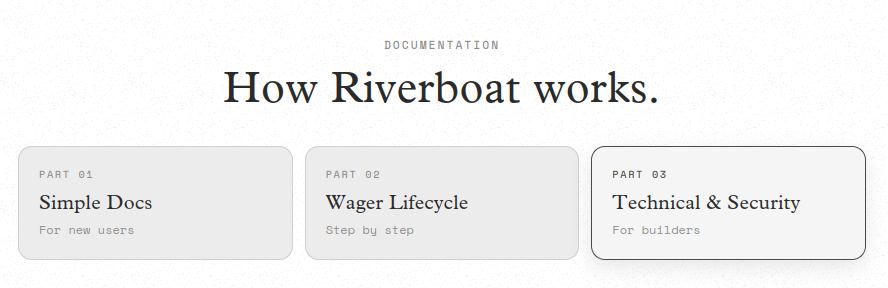
Riverboat protocol documentation has been completed across three separate volumes to accommodate differing levels of technical interest and expertise.
May they be shipped far and wide—
https://t.co/clnebl1b54
Pumpfun made token creation easier than ever.
Anyone can launch a token (almost) for free.
But out of the MILLIONS that get launched…
Very few ever become deep, tradable markets.
That’s because it usually requires:
• market makers
• outside liquidity
• exchange relationships
• large capital commitments
• or enough speculation to attract traders organically
Without it, tokens become shallow charts with limited participation.
That’s one of the biggest bottlenecks in crypto today.
We solved token creation…
But we never solved market creation.
That’s where Vibe comes in.
Instead of requiring projects to source traditional market makers or large amounts of external liquidity, Vibe allows projects to use their own token inventory as the foundation for a perp market.
In simple terms:
→ Treasuries hold supply.
→ Communities hold supply.
→ Whales hold supply.
Normally that inventory sits idle.
But Vibe turns it into efficient market infrastructure.
That means anyone can:
1. deploy token supply
2. create open interest
3. allow traders to long and short
4. bootstrap real market activity around the asset
All without needing a centralized exchange listing or massive external liquidity upfront.
This changes the economics of market creation entirely.
Instead of exchanges trying to predict derivative demand before a market exists, traders can express demand directly through trading activity itself.
Traditional Orderbook listings are fundamentally gatekept because exchanges and market makers must decide what deserves infrastructure before real demand fully forms.
That leads to what we call narrative-based listings:
• optics
• narrative
• fake traction
• relationships
• social pressure
Everyone tries to look listable before real demand has actually formed.
But if markets can bootstrap permissionlessly using token inventory itself, demand can reveal itself organically.
Traders decide what matters.
And once markets can form freely, something else happens:
Strong communities attract liquidity, attention, and participation naturally over time.
Weak markets die early.
Strong markets compound.
The market becomes the filter for the project itself.
This model is far more scalable than manually selecting winners.
Especially in a future where millions of assets already exist onchain.
Spot tokens need a different model.
That’s why token-supplied perp liquidity matters.
It gives anyone the ability to create (and own) the markets they trade.
Only on Vibe 🌐