Enterprise Architecture Practitioner Methodology, Solutions, Training & Certifications | Enterprise Architecture Center Of Excellence (EACOE). Est. 1972
Is what you deliver to stakeholders truly human-consumable - or just human-frightening?
For over five decades, we have witnessed a pervasive problem: professionals produce lengthy strategy documents, complex maps, flows, and diagrams that business decision-makers simply skim or ignore.
Having developed, implemented, managed, and perfected more successful Enterprise and Business Architectures worldwide than any other firm, we firmly believe your architecture deliverables must prioritize human consumption and stakeholder comprehension above all else.
Through expert training and coaching from the Enterprise Architecture Center Of Excellence (EACOE) and the Business Architecture Center Of Excellence (BACOE), you will master how to create stakeholder-focused, easily digestible representations that generate clear understanding, actionable outcomes, and measurable success.
Link to the full video is in the replies
The key to getting professionally recognized and making more money as an Enterprise Architect does not come from a "logo" next to a name or having read a bunch of books. Enterprise Architect proficiency and success come from practice with a proven, high-return, cost-effective approach to Enterprise Architecture and stakeholder-focused deliverables that enable business strategy, reduce complexity, drive innovation, increase efficiency, and manage change.
We get you ready to develop Enterprise Architectures "next Monday morning!" More than theory alone, EACOE Certification has you participating in all the phases of Enterprise Architecture and certifying your ability to transfer that knowledge to your organization.
There are four distinct member badges to recognize the professional accomplishments of EACOE Certified Enterprise Architect Practitioners:
https://t.co/pAuMMw61H3
#EnterpriseArchitecture #EnterpriseArchitect #EACOE
Enterprise Architecture has a problem.
For decades, architects have churned out complex diagrams and binders of documentation that only a handful of technical specialists can interpret - while the business quietly moves on without them. Stakeholders do not care about your meta models, capability maps, cryptic diagrams, or colorful maps; they care about growth, risk, and ROI.
That is exactly what Enterprise Architecture 5.0 is designed to fix. Instead of starting with frameworks or reference models, EA 5.0 starts with measurable business goals and uses two simple but powerful ideas HACs ™ (architecture of intent) and HICs TM (architecture of delivery) - to create living architecture that connects vision directly to execution. Stakeholders see why something matters, delivery teams see what to build, and both are tied back to the same intent.
The outcome is a different kind of architecture conversation:
•From documentation to direction.
•From governance for its own sake to guidance that drives decisions.
•From paralyzing complexity to clarity that leaders can act on with confidence.
This is not hypothetical. EACOE has been training professionals in this approach for decades, and with agentic AI accelerating everything from decisions to delivery, an EA 5.0 model that is business led, explicit, and traceable is rapidly shifting from “nice to have” to unavoidable.
If you are tired of architecture no one reads, and ready to practice architecture that actually changes outcomes, this is where to start:
👉 https://t.co/GYQbovooX6
#EnterpriseArchitecture #EnterpriseArchitect #EACOE
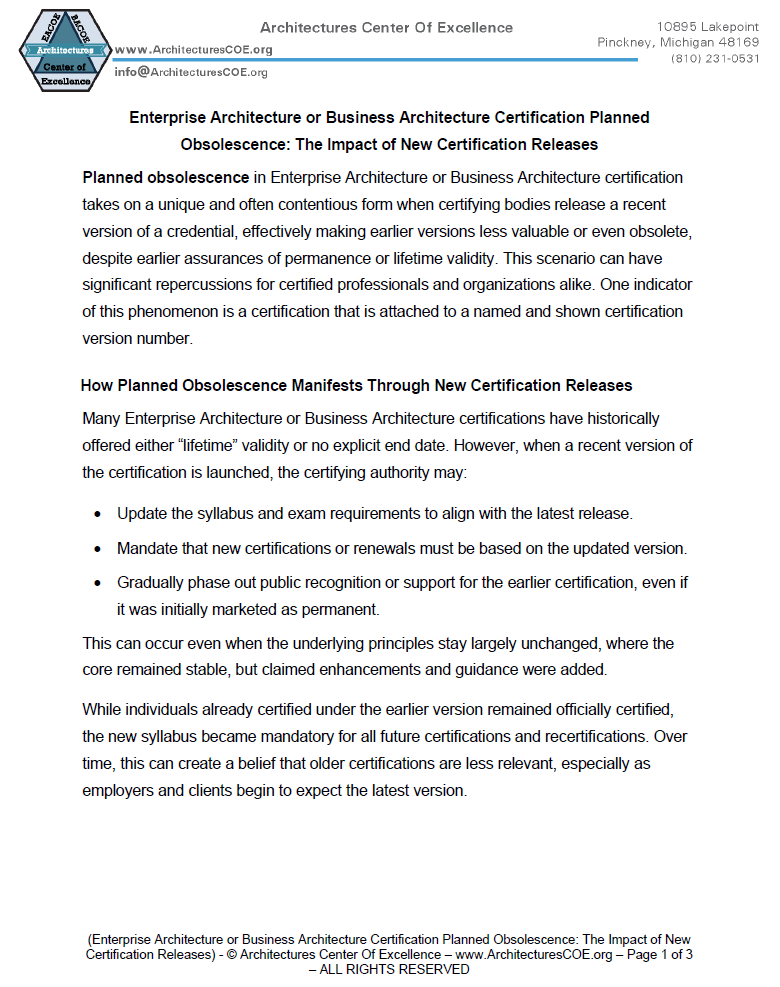
Planned obsolescence in Enterprise Architecture or Business Architecture certification takes on a unique and often contentious form when certifying bodies release a recent version of a credential, effectively making earlier versions less valuable or even obsolete, despite earlier assurances of permanence or lifetime validity. This scenario can have significant repercussions for certified professionals and organizations alike. One indicator of this phenomenon is a certification that is attached to a named and shown certification version number.
Enterprise Architecture or Business Architecture Certification Planned Obsolescence: The Impact of New Certification Releases. Read the full article on this link: https://t.co/d2fFq3Ibo4
--
#RealTalkWithSamHolcman #TipsFromSam #datamodeling #SmallLangaugeModels #EAI #AI #AugmentedInformation #ArtificialIntelligence #EnterpriseArchitecture #EnterpriseArchitect #EACOE #BACOE #BusinessArchitecture #BusinessArchitect
If your executives cannot actually use your enterprise architecture to make strategic decisions, you do not have Enterprise Architecture. You have expensive technical documentation.
REAL enterprise architecture - Realistic, Enabling, Actionable, Logical - has one non negotiable rule: it must speak the language of business, not the language of frameworks, not the language of technology. If the C suite needs a translator to understand it, it is already failing its job.
EA 5.0 is built on that premise. It uses H.A.Cs™ (Holcman Architecture Containers) to capture what the organization is trying to achieve and which initiatives matter, and H.I.Cs™ (Holcman Implementation Composites) to turn that intent into delivery - funding logic, transformation pathways, and measurable strategic impact. No thousand arrow diagrams. No jargon driven complexity. Just clear, traceable connections from business vision to execution reality.
This is exactly the connective tissue most AI initiatives are missing. Boards want AI to restore growth and productivity, but too many programs jump straight into tools and models without mapping them to strategy, operating model, or the processes that actually create value. The result: lots of AI, not a lot of ROI.
EACOE enabling Enterprise Architecture fills that gap by making architecture consumable in the boardroom and executable in delivery - something it has been doing for decades while the rest of the field argues about frameworks. With agentic AI increasing both complexity and urgency, EA 5.0 stops being a “nice upgrade” and starts looking like the only sane way to run an enterprise.
If you want architecture that your executives can read, trust, and act on, it is time to move past documentation and into EA 5.0. Start that transformation here: https://t.co/GYQbovooX6
#EnterpriseArchitecture #EACOE #EnterpriseArchitect
Successfully capturing the value of a Holistic Enterprise Architecture is very achievable if you approach the task in a thoughtful, guided fashion. This article shares the four significant components or four “Pillars” of any successful Holistic Enterprise Architectural effort.
The Four Pillars Of Holistic Enterprise Architecture. Driving Efficiency and Innovation by Consistently Managing Complexity and Change. Read the full article on this link: https://t.co/MDZFYGIgNd
Designing an Enterprise Architecture is a people-oriented analysis and solution, not one only of technology. Peoples’ business knowledge forms your enterprise’s foundation.
We recognized in many actual Holistic Enterprise Architecture engagements, a consistent set of required components for success; these four “pillars” are.
•Architectural Models,
•A Framework,
•A Methodology, and
•Solution Models.
#EnterpriseArchitecture #EnterpriseArchitect #EACOE
What is the right question to ask about AI in your enterprise?
It is not "Which model do we use?"
It is: "What architecture will that model be reading from?"
Last week on our live broadcast, we unpacked exactly this. AI without an ontology-based Enterprise Architecture is just guessing in an exceptionally large room. AI with architecture is operating inside a designed, navigable, and auditable enterprise library.
Dewey turned a room full of books into a navigable system of knowledge. An EACOE ontology-first Enterprise Architecture does the same for AI.
Watch the full session here: https://t.co/QxDw1ZVWuJ
#EnterpriseArchitecture #EACOE #EnterpriseArchitect #AI
Unpopular opinion: Your certification logo isn’t what makes you a great Enterprise Architect or Business Architect.
There, it’s said.
We just hit publish on a no-BS deep dive into what actually separates "paper architects" from the people executives fight to get into the room.
Spoiler: Passing a multiple-choice exam isn’t it.
After more than five decades in this field, we’ve lost count of how many “certified” architects we’ve seen crank out gorgeous reference models, colorful maps, and eye-watering diagrams… that nobody uses.
The business moves on. The slides stay in PowerPoint.
The architects who matter?
- They’re in the room before the decision is made.
- Leaders treat them like trusted advisors, not documentation machines.
- Their work shows up in outcomes, not just in binders and modeling tools.
Here’s the uncomfortable truth about what really matters:
- Turning complexity into clear, simple choices executives can act on.
- Earning trust by delivering quick wins and showing your work, not hiding behind jargon.
- Thinking strategically across business goals, data, process, organization, location and events – and connecting the dots.
- Influencing without authority, aligning stakeholders who want different things, and navigating politics without drama.
- Operating with stakeholders, for stakeholders — not worshiping a framework as if it’s a religion.
And the problem with most certification exams?
- They test recall, not judgment. Memory, not mindset.
- They reward people who can recite terminology, not those who can broker trade-offs in a tense steering committee.
- They quietly encourage “model freaks” who love governance theater more than business value.
In the new article, we lay out the full picture: the behaviors that build real stakeholder trust, the red flags that scream “paper architect,” and the soft skills that separate theory from tangible enterprise impact.
👉 Read: “What Makes a Great Enterprise Architect or Business Architect.”
https://t.co/XB0cmtj4ZA
Your turn:
► What do you think makes a great Enterprise or Business Architect?
► Have you ever seen a “highly certified” architect completely miss the point?
Drop your experience in the comments — the next generation of architects is reading.
#EnterpriseArchitecture #BusinessArchitecture #EnterpriseArchitect #BusinessArchitect #RealTalkWithSamHolcman
This is a clip from our recent broadcast, "Federated Architecture: Currently the Most Practical Approach to Business Architecture and Enterprise Architecture."
From our five decades of field practice with thousands of organizations around the world, it was in the late 90s when we ran into our first version of this approach to "Federated Architecture."
Access to the full broadcast can be found here - https://t.co/6snalUHRTw
#EnterpriseArchitect #EnterpriseArchitecture #BusinessArchitecture #BusinessArchitect #RealTalkWithSamHolcman
A rapidly decreasing number of enterprise architecture teams still keep a “principles” catalog.
“Reuse before build.” “One source of truth.” “Align with business objectives.”
It sounds serious. It looks professional on a slide.
But here is the uncomfortable question:
Has a single project in your organization ever been stopped, redesigned, or reprioritized because it violated one of those principles?
If the honest answer is no, then those principles are not governing anything. They are decorations around decisions made for other reasons.
That is not architecture. That is a legitimacy costume.
In the late 1980s through the 2000s, principle catalogs had their moment. Frameworks put 10–20 “architecture principles” front and center as required deliverables.
Then the mid 2010s arrived. Product-centric ways of working forced EA to prove value in speed, customer impact, and cost.
Static, unmeasured principle lists did not survive that scrutiny.
The problem was never the idea of principles. The problem is how they are practiced.
Vague, unmeasured slogans do not constrain decisions. They never show up in incentives, funding, or governance.
And the organizations with pages of EA principles often still measure architects on document production and standards compliance - not on cost, speed, risk, or customer outcomes.
What actually works is a small number of explicit goals with concrete measures.
Instead of “Standardization and interoperability,” try:
“Reduce the application portfolio by 25% in 3 years while improving time to market for new products by 20%.”
Now you have a real target. Standards, patterns, and decisions either move those numbers or they do not.
The difference is accountability:
“We believe in good architecture” versus
“We are accountable for these movements in the enterprise - and here is how architecture is moving those needles.”
Take the classic: “Reuse before Buy, Buy before Build.” On its own, it cannot be measured and will not change behavior.
Run it through an EACOE™ SMART lens and it becomes:
“By Q4 2027, increase the percentage of new solution needs satisfied by reuse of approved platforms from 25% to 60%, cutting application run cost by 15% and reducing time to market by 20%.”
The center of gravity in EA shifts from:
❌ “What do we believe?”
to
✅ “What are we trying to achieve, how will we know, and how does architecture get us there?”
Principles can still exist in that world - but they are distilled from goals and metrics, not invented as free-floating statements.
🎧 Listen to the podcast: https://t.co/i2AF1IfjmW
📘 Read the full article: https://t.co/nfxNC6iIbg
If you’re ready to move from platitudes to real EA performance, reach out at: https://t.co/gzXNiKiwMx
#EnterpriseArchitecture #BusinessArchitecture #EnterpriseArchitect #BusinessArchitect #RealTalkWithSamHolcman #EACOE #BACOE
CIOs are under intense pressure to harness AI to drive efficiency, innovation, and competitive advantage - but as the CIO article on "reimagining business processes" makes clear, the first step is not to “automate faster,” but to rethink how work actually happens before a single model is deployed.
In this context, the EACOE Process Visualization approach emerges as a best practice methodology for reworking processes in preparation for AI, ensuring that organizations automate optimized workflows, not legacy inefficiencies.
"Process Visualization: A Best Practice Blueprint for Reworking Processes Before AI"
Watch on YouTube: https://t.co/PUpAYDibaO
Watch or listen on the ArchitecturesCOE website: https://t.co/D6UfPi6Npa
Watch or listen on Spotify: https://t.co/ttzFTHxXHP
Listen on Apple Podcasts: https://t.co/nxirLyIONi
#RealTalkWithSamHolcman #ProcessVisulization #EACOE #BACOE #EnterpriseArchitecture #BusinessArchitecture #AI #EAI #SmallLangaugeModels
Most AI initiatives don’t deliver real ROI.
And it’s not because the models aren’t good enough. It’s because the enterprise isn’t.
Boardrooms are betting on AI to restart growth and productivity, yet almost no one is wiring AI into the connective tissue between strategy, operating model, and the real data and processes agents will act on. That gap is exactly where Enterprise Architecture should live - and too often doesn’t.
For years, traditional architects have been trapped in framework wars, technology-first focus, meta-model purity, and static diagrams that look great in slide decks while the business quietly moves on without them. The result? Beautiful models. Minimal impact.
EA 5.0 flips that script.
No more “models for models’ sake.” It starts with hard, measurable business goals and uses architecture as a decision tool for strategy, investment, and risk - not as a documentation exercise.
Why does this matter for Agentic AI?
Because agents will blindly amplify whatever business logic, constraints, and assumptions architects have - or haven’t - made explicit.
As agents begin planning, deciding, and acting across customer journeys, supply chains, and support operations, the complexity doesn’t just increase - it explodes. Non-deterministic models suddenly sit in the middle of real workflows, changing real data, affecting real customers. At that point, hand-waving about “governance” isn’t enough.
You need deterministic guardrails:
- Clear data boundaries and ownership.
- Strong segregation of duties between humans, systems, and agents.
- End-to-end traceability from every autonomous decision back to goals, capabilities, initiatives, and rules.
That’s not academic. That’s what it takes to keep AI powerful and safe in production.
EACOE’s EA 5.0 methodology gives CIOs and architects technology-neutral views, explicit governance rows, and full traceability from business intent down to execution - so agents operate inside a clearly modeled business context, not a chaotic pile of disconnected systems and APIs. Agents don’t need to be feared, but they do need a well-architected arena to play in.
If your architecture is business-led, explicit, and traceable, agents become force multipliers.
If it isn’t, they become very fast, very confident amplifiers of your existing chaos.
For a deeper breakdown of how Agentic AI and EA 5.0 fit together, including the concrete patterns and guardrails, read the full article:
👉 “Agentic AI, EA 5.0, and EACOE”
https://t.co/VIgZQESSrw
#AI #ArtificialIntelligence #EnterpriseArchitect #EnterpriseArchitecture
This topic is one that should sound familiar to anyone who has been around enterprise architecture, transformation, or banking, as one example, for more than a few years: everything old is new again. The latest version of the old story is being told through “purchased models,” “off-the-shelf ontologies,” and what some are now calling the semantic operating system for banking, as one example.
Buying somebody else’s model of your industry is not a new idea. It is a very old idea in very new packaging. Twenty-five years ago, it was sold as reference architectures, industry models, enterprise blueprints, and packaged best practices. Accenture sold it. IBM sold it.
But if you take that message into the C‑suite or the boardroom, and you lead with “data debt” and “process standardization,” you will lose the audience that matters most.
The Big Four sold it. Entire consulting practices were built around the claim that if you adopted a prebuilt model of your enterprise, you could move faster, reduce risk, and leapfrog the painful work of figuring out your own organization. But here is the Real Talk.
"Purchased Models, Off-the-Shelf Ontologies, and Why Everything Old Is New Again"
Watch on YouTube: https://t.co/aPJZRLwP0s
Watch or listen on the ArchitecturesCOE website: https://t.co/UsFQi3YBUt
Watch or listen on Spotify: https://t.co/j9GEyI2VGR
Listen on Apple Podcasts: https://t.co/xKqbcxnoTN
#RealTalkWithSamHolcman
TOGAF presents years of IT implementation experience dressed up as “enterprise architecture.”
But it does not present an architecture, nor a true architecture development approach.
That’s Bernard Baillargeon’s conclusion after a 17-page, point-by-point comparison of TOGAF® and EACOE™.
His bottom line is blunt: TOGAF is IT-focused. EACOE is business-focused.
TOGAF buries Business Architecture as a peer to IT-centric domains - applications, information, and technology - when it should be the driver.
That framing quietly erodes the real power of business intent and turns “business” into just another checkbox in an IT method.
Worse, TOGAF says Business Architecture is a prerequisite, then runs phases that barely depend on it.
You get weak traceability, composite documents instead of crisp, traceable artifacts, and “architecture” that looks more like prescriptive IT solutioning than true enterprise design.
EACOE flips this script.
It starts with business language and human-consumable artifacts that leaders can actually read, challenge, and use to make decisions.
No initial IT bias.
No baked-in technology assumptions.
Just a platform of knowledge built through comparison, discovery, investigation, and refinement - until there’s a clear, shared picture of how the enterprise works and where it needs to go.
Only then does technology enter the conversation as “make to order” implementations that align to that evolving business vision - not as handcrafted apps chasing the latest tool or vendor trend.
That’s where enterprise agility really comes from:
•A living, changing representation of the business.
•Explicit, traceable decisions from intent → design → implementation.
•Technology following the business, not the other way around.
EACOE also calls out a hard truth the industry often dodges: Enterprise Architecture is a practice, not a multiple-choice exam.
Skills are forged in real engagements, with stakeholders, constraints, and consequences - not in a proctored test center.
TOGAF’s strength is clear: over 300 IT vendors and IT clients behind it.
But that strength comes with a cost: heavy IT emphasis, committee-driven evolution, and a pace of change that lags what modern enterprises actually need.
If you’re leading IT projects, TOGAF offers useful guidance.
If you want true Enterprise Architecture - business-led, human-consumable, deeply traceable, and outcome-focused - EACOE delivers what TOGAF structurally cannot.
Curious what that looks like in detail?
Bernard Baillargeon’s full 17-page comparison pulls no punches:
👉 “TOGAF® and EACOE™: A Comparative Review.”
https://t.co/G3HGN68phw
#EnterpriseArchitecture #EnterpriseArchitect
“I wanted something I could start tomorrow. Not spend six months building a practice the business sees as more red tape.”
That was the reality for Mohammed Khalil - and it is painfully familiar for a lot of Enterprise Architects. They are stuck with:
- No common ground for enterprise architecture or business architecture.
- EA seen purely through a technology lens.
- A complex, federated environment with many departments and agendas.
- Methodologies that demand endless customization before delivering any value.
Mohammed went a different route with the EACOE Enterprise Architecture approach, built around three blunt principles:
1. Traceability and transparency: Harvest everything, trace it back to real sources, and surface what is outdated so people can see the truth instead of debating opinions.
2. Human consumable representation: No thousand arrow diagrams that make stakeholders shut down - just clear visuals and language leaders can understand in minutes.
3. Immediate implementation: Tools, methodologies, and frameworks you can use Monday morning, not theory you study for months while the business loses patience.
The impact? Initiatives that are prioritized, ranked, and ingested straight into their intake process – a living ecosystem of strategy instead of static diagrams rotting in a repository.
The phrase Mohammed kept hearing from stakeholders was simple and powerful: “That makes sense.”
Because enterprise architecture shouldn’t mystify. It should clarify.
🎥 Watch Mohammed’s full story: https://t.co/g7OnYpuGtM
🔍 Curious about the training and methodology behind it? Start here: https://t.co/gzXNiKiwMx
#EnterpriseArchitect #EnterpriseArchitecture
Coming out of the EACOE practitioner-based Workshops are Certified Enterprise Architecture Practitioners with the skills, knowledge, and tools to effectively manage change and complexity and enable enterprise mission strategies and goals.
You and your team gain and practice the most cost-effective, vendor-neutral, fully integrated environment Enterprise Architecture Methodology focused on successful Enterprise outcome-driven results and frictionless development / implementation / management efforts.
We help you eliminate as many burdens as possible during Enterprise Architecture development, implementation, and management through EACOE Enterprise Architecture Training and Certification Workshops. Review the full Workshop Outline and Brochure: https://t.co/GdgnfVTlEE
You can maximize the value and minimize the time and costs it takes to “do” Enterprise Architecture by attending the Distance Learning, October 19 - 22, 2026, Enterprise Architecture Practitioner Training and Certification Workshop. Confirm your seat by registering on this link - https://t.co/Q3hdh3ELOS
Once your registration is confirmed, we will ship all the workshop materials directly to you.
#EnterpriseArchitecture #EnterpriseArchitect #EACOE
What is an Enterprise Architect?
In our "EACOE Enterprise Architecture Position Description," we describe in full detail the experience, skills, roles, responsibilities, and competencies a desired Enterprise Architect professional should have.
Download and read the complete "EACOE Enterprise Architecture Position Description" using this link - https://t.co/YaIROhsLdY
Hiring agents should use this outline when developing job descriptions for Enterprise Architect talent. Furthermore, those looking for work in Enterprise Architecture can use this document as a basis for understanding what skills are imperative in helping them stand out as an ideal candidate.
Enterprise Architects are integral members of an organization, helping organizations achieve their desired state Goals and Objectives. Enterprise Architects are change agents who need to work with both businesspeople and technology people to be effective. Therefore, Enterprise Architects should have the necessary soft skills in addition to technology acumen to work successfully in this profession.
#EACOE #EnterpriseArchitecture #EnterpriseArchitect
In both EACOE enterprise architecture and BACOE business architecture, ontology is the backbone: it tells us what kinds of things exist in the enterprise, how they relate, and how those meanings stay consistent as we automate, integrate, and apply AI.
Today, that makes ontology not just a theoretical idea, but one of the most valuable, underused skills in the AI job market – and a critical success factor for serious Enterprise Architecture and Business Architecture work.
What an Ontology Really Is: Kinds of Things Together and Their Relationships In information and computer science, an ontology is a formal description of knowledge in a domain – the kinds of things (concepts/classes) and the relationships between them. It is more than a glossary; it is a structured model of meaning that both humans and machines can use.
"Ontology in AI: The Hidden Skill That Makes Architecture and Your Career Work"
Watch on YouTube: https://t.co/JsnDmgY20Z
Watch or listen on the ArchitecturesCOE website: https://t.co/hdMnxgolCV
Watch or listen on Spotify: https://t.co/qgjPqKnjMd
Listen on Apple Podcasts: https://t.co/cu41YOpucz
#RealTalkWithSamHolcman #EACOE #BACOE #EnterpriseArchitecture #BusinessArchitecture #AI #EAI #SmallLangaugeModels #Data #DataModeling
Do you have the skills and tools to effectively address, manage, and lead successful change?
As complexity and change continue to accelerate within hyper-competitive business markets and advancements in technology and science, make sure you have the skills and tools to effectively address, manage, and lead successful change among business units, projects, and organizations.
You can review the EACOE Enterprise Architecture Workshop and its content as the best practice base for these required skills, and map them into your present skill set. Review the Workshop brochure - https://t.co/GdgnfVTlEE
Coming out of the EACOE practitioner-based Workshops are Certified Enterprise Architecture Practitioners with the skills, knowledge, and tools to effectively manage change and complexity and enable enterprise mission strategies and goals.
Advance your Enterprise Architecture Skills and deliverables by attending the upcoming distance learning, August 10 - 13, 2026, EACOE Enterprise Architecture Practitioner Training and Certification Workshop. Once registered, we ship all the physical materials directly to you. Register today using this link: https://t.co/Q3hdh3ELOS
With an EACOE Workshop, you can ensure that an investment in Enterprise Architecture Training provides the most benefit to your career and organization. You and your team gain and practice the most cost-effective, vendor-neutral, fully integrated Enterprise Architecture methodology focused on successful enterprise outcome-driven results and human-consumable development/implementation/management efforts.
#EnterpriseArchitecture #EnterpriseArchitect #EACOE
Most organizations are chasing “enterprise agility” by doing one thing: trying to make programmers go faster.
They rename it every few years - agile, iterative, sprints, low code, COTS tweaks - but the bet is always the same: if IT ships faster, the enterprise becomes agile. It does not. It just burns out engineers while the real constraint stays untouched.
The problem is simple and brutal: this is one dimensional change.
No matter how clever the technique - agile, incremental development, COTS customization, use cases - if the answer is always “hand craft another solution,” IT will never keep up with the volume and pace of business change.
If you want a better model for enterprise agility, look at the physical world: the Manufacturing Maturity Model.
Manufacturing has three maturity levels:
1. Make to Order – Everything custom, built from scratch.
2. Provide from Stock – Standard products, off the shelf.
3. Assemble to Order – Pre built components assembled into solutions.
Most enterprises and vendors are stuck at Level 1 or, at best, Level 2.
Level 3 - Assemble to Order - is where real agility lives.
Think about ordering a PC from Dell.
If you accept 250 GB, you get your machine in days. If you insist on 187 GB exactly, you wait longer and pay more, because now someone is effectively building from scratch. At Assemble to Order, the trade off between speed and cost is explicit and sits in the customer’s hands.
To bring that kind of agility into the enterprise, you need three things:
1. A classification system so everyone knows what components exist.
2. Stable components that do not randomly change out from under you.
3. A “librarian” function to govern, curate, and protect the integrity of those components.
The payoff: massive reuse, shorter time-to-market, and decisions framed around choice, not chaos.
Right now, most organizations do not have true Assemble to Order options because IT thinking is still stuck in “code faster” mode. But the principles can be applied today - starting with how you design processes, capabilities, services, and data - so that future change is mostly assembly, not reinvention.
Enterprise agility will not come from pushing developers harder.
It will come from changing the architecture of how you build: from Make to Order to Assemble to Order, with business and technology designed for reuse from the start.
For a deeper breakdown of how to move toward Assemble to Order and real enterprise agility, including practical steps and examples, see the full guide to “Achieving Enterprise Agility” https://t.co/1rUusqkLjo
#EnterpriseArchitect #EnterpriseArchitecture
If you are a CIO, CTO, or Architecture Manager, you are already paying an “architecture tax” you never approved.
It shows up as overlapping platforms, programs that cannot finish, and “strategic” projects that quietly die after burning millions. The surprising culprit: ten everyday EA/BA words that your organization thinks it understands - but does not.
When these words are fuzzy, your architecture is fuzzy. And fuzzy architecture is expensive.
"The Ten Most Misunderstood Words in EA/BA"
Watch on YouTube: https://t.co/jtXeV4xM5L
Watch or listen on the ArchitecturesCOE website: https://t.co/efocR0l7tN
Watch or listen on Spotify: https://t.co/FukLuNwaJt
Listen on Apple Podcasts: https://t.co/BZPCx3v7Xd
#RealTalkWithSamHolcman #EACOE #BACOE #EnterpriseArchitecture #BusinessArchitecture