Howard Marks: “You should never buy into momentum, you should never buy something because it’s been going up...
You should only buy it if you think it’s good value.”
13yr NBA vet, CJ McCollum effortlessly breaks down how to STAY in the league, get your 2nd Contract & set your family up for generational wealth. He lays it all out on the table!
“This is money you’re going to NEED when you’re 50yrs old”
“I maximized my blessings, I’ll be able to stop playing when I want to stop playing, I won’t be FORCED OUT” —CJ on not blowing his money & making smart investments such as real estate & 30+ alternative investments🍷
CJ: “I don’t have the all the answers to everything but I know how to make money”
“I know how to stay in the league, I know how to show up on time, I know how to take coaching, I don’t get in trouble off the court, I know how to invest, I know how to do a lot of things right, and I know what NOT to do ‘cause I’ve seen it”
“For young player, If you want to stay in the league, just look around, see whose still hanging around, see who continues to get contract after contract, see whose making $5,000,000 that shouldn’t be making $5,000,000”
“You gotta maximize your earning potential”
CJ highlights the importance of NOT having an Ego & reaching out to your peers:
“I reach out to Steph Curry when it comes to shooting”
McCollum has earned more than $300,000,000 in the NBA and still is playing at a high level.
The league & more importantly PLAYERS need more CJ McCollum’s in the league.
DOPE.
@otautune Quoi ? Quoi ? Quoi ?!! On parle du meme South Central Cartel qui a sorti l’album « All Day Every Day » ?
(En vrai mon preferé c’est « Kickin Game » d’Havoc & Prodeje 😎 )
All EYEZ ON ME 👀
Sorti le 13 février 1996, le quatrième album de Tupac est son premier chez Death Row,le dernier de son vivant.
Considéré comme l’un des albums les plus importants et influents de l’histoire du rap
L’APOGÉE DE LA WEST COAST 🌴
Warren Buffett: "I would still hold stocks even if I knew that World War III would happen."
Timeless lesson.
A few weeks ago, everybody was selling because of Iran War. Doomsday scenarios were everywhere.
They missed a great rally.
Optimists have won, again.
Stay bullish.
L'industrie pétrolière ne l'utilise plus depuis 100 ans: c'est quoi un baril de pétrole et pourquoi ça reste la référence aujourd'hui encore (et pas la tonne ou le litre)
https://t.co/TH1kuioYfu
“We train our analysts to learn about businesses; the essence of them, what's potentially positive or negative. It's to learn how businesses really function and to judge the character of their CEO founders.”
- Ron Baron
Here’s 250+ business biographies to get started…
https://t.co/mmtCxlzBEX
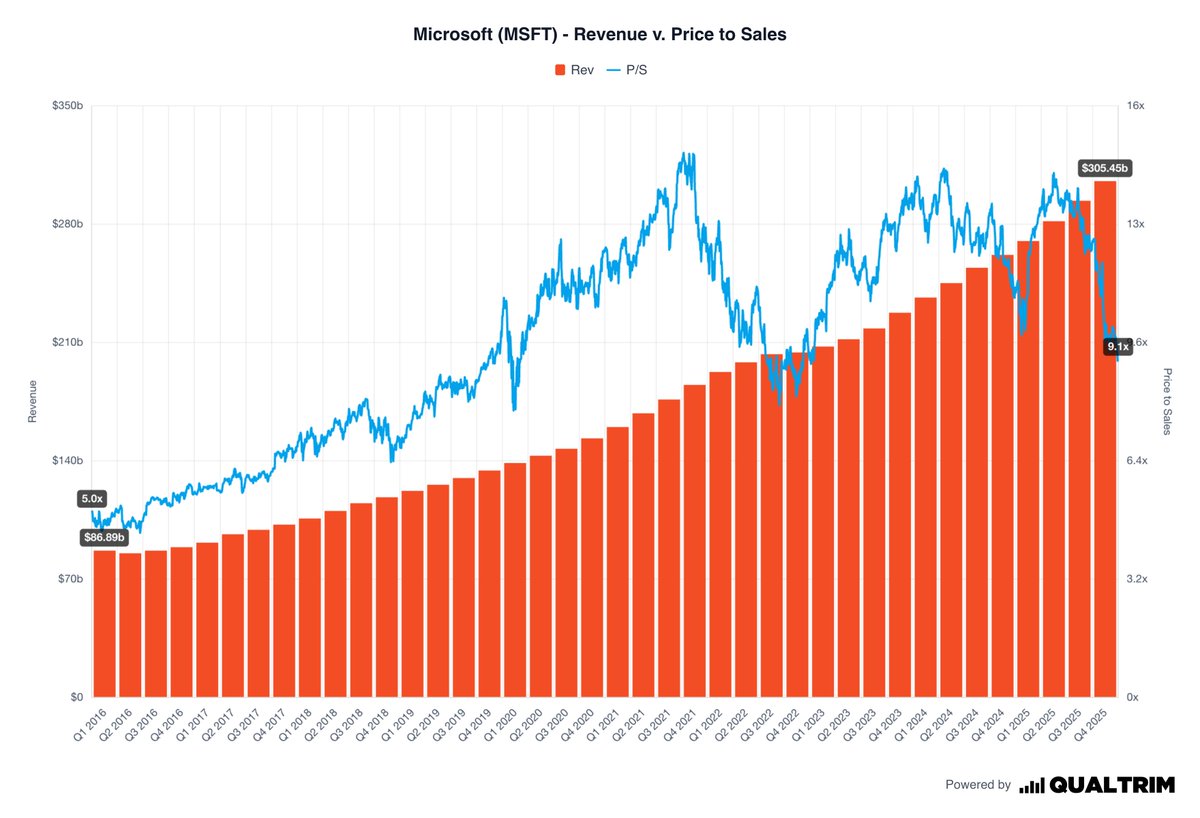
Microsoft is now down -33%.
PEG: 1.50x
Here are 5 Microsoft charts you need to see if you're thinking about buying this stock:
1. $MSFT: Revenue v. P/S ratio
@IguanoDeLaBolsa@RomainFCU Ils ont annoncé le mois dernier une émission obligataire échangeable en actions ADP pouvant potentiellement faire tomber leur participation dans ADP vers les 4.9% du capital 😕
@IguanoDeLaBolsa@RomainFCU ADP détient 47.5% de GMR airport qui a (entre autre) 3 airports en Inde dont celui de Delhi.
Vinci est en train de liquider une partie de sa participation de 8% dans … ADP.
One more thing on Google.
Warren Buffett has been clear about two types of great businesses.
The first is See's Candies. The dream. A business that grows earnings year after year with virtually no reinvestment. Returns on invested capital are almost infinite because the invested capital is so small. You take the cash out and deploy it elsewhere. Beautiful.
The second is what Buffett calls a great business that can absorb large amounts of capital at attractive returns. BNSF. Berkshire Hathaway Energy. Not as elegant as See's. You have to keep putting money in. But if the returns are good and the runway is long, the total wealth created can actually exceed See's — because you can keep compounding at scale.
Buffett has said the second type can be the better business. Most people miss this because they're anchored on the beauty of the asset-light model.
Google was See's Candies for twenty years. A toll booth on the world's information. Near-zero marginal costs. Every additional search query was almost pure profit. Returns on capital were incalculable.
Now Google is becoming BNSF. $75 billion in capex last year. $175-185 billion guided for 2026. The market sees this and worries. The beautiful asset-light model is getting heavy.
But here's what I think the market is missing.
Google isn't just transitioning from See's to BNSF. It's transitioning to a BNSF with a longer runway and potentially higher returns — because the demand driving the capital deployment is the Intelligence Invariance. Every person, business, institution, and government will want cheaper, more accessible, better intelligence. That demand doesn't saturate. It deepens.
And unlike a railroad, where the capital buys track that serves one route, Google's capital buys vertically integrated AI infrastructure — custom TPUs, frontier models, inference optimization — that deploys across the largest distribution surfaces on earth and monetizes through the highest-margin advertising engine in history.
See's couldn't absorb more capital. That was its limitation.
Google can absorb $185 billion a year. And every dollar goes into a system where Google captures value at every layer — from silicon to consumer surface to ad revenue.
The question isn't whether the capex is scary. The question is whether the returns are attractive and the runway is long. The Intelligence Invariance says the runway may be the longest in the history of technology investing.
#google $googl